


Overview
New York, NY – Aug 17, 2026 – The Global Clinical Trial Biorepository & Archiving Solution Market size is expected to be worth around US$ 9.7 Billion by 2034 from US$ 4.4 Billion in 2024, growing at a CAGR of 8.2% during the forecast period 2025 to 2034. North America held a dominant market position, capturing more than a 48.2% share and holding a US$ 2.1 Billion market value for the year.
The Clinical Trial Biorepository and Archiving Solution Market is witnessing significant growth as pharmaceutical companies, biotechnology firms, and research organizations increasingly adopt secure biospecimen management systems.
The rising focus on precision medicine, biomarker discovery, and personalized therapies is driving demand for advanced storage solutions that ensure sample integrity throughout clinical research programs.
The increasing number of clinical studies worldwide is creating substantial opportunities for biorepository providers. According to ClinicalTrials.gov, more than 554,798 clinical studies were registered globally by December 2024, generating millions of biological specimens requiring controlled storage and efficient retrieval systems.
Oncology trials represent a major growth area, with over 45,000 cancer-related studies registered globally, increasing demand for preserved tumor tissues, blood samples, and genomic materials for biomarker validation and long-term analysis.
Technological advancements are further accelerating adoption, including AI-powered sample tracking, automated retrieval platforms, and cloud-based inventory management systems. Modern cryopreservation technologies maintain sensitive specimens at ultra-low temperatures, including −80°C freezers and liquid nitrogen storage near −196°C, supporting applications in cell therapy, immunotherapy, and regenerative medicine.
Market development is also supported by infrastructure expansion. In June 2023, Azenta launched a 40,000-square-foot biorepository facility in Massachusetts, strengthening global sample storage capacity. Additionally, Cryoport introduced IntegriCell cryopreservation services in October 2024 to support standardized cell therapy sample preservation.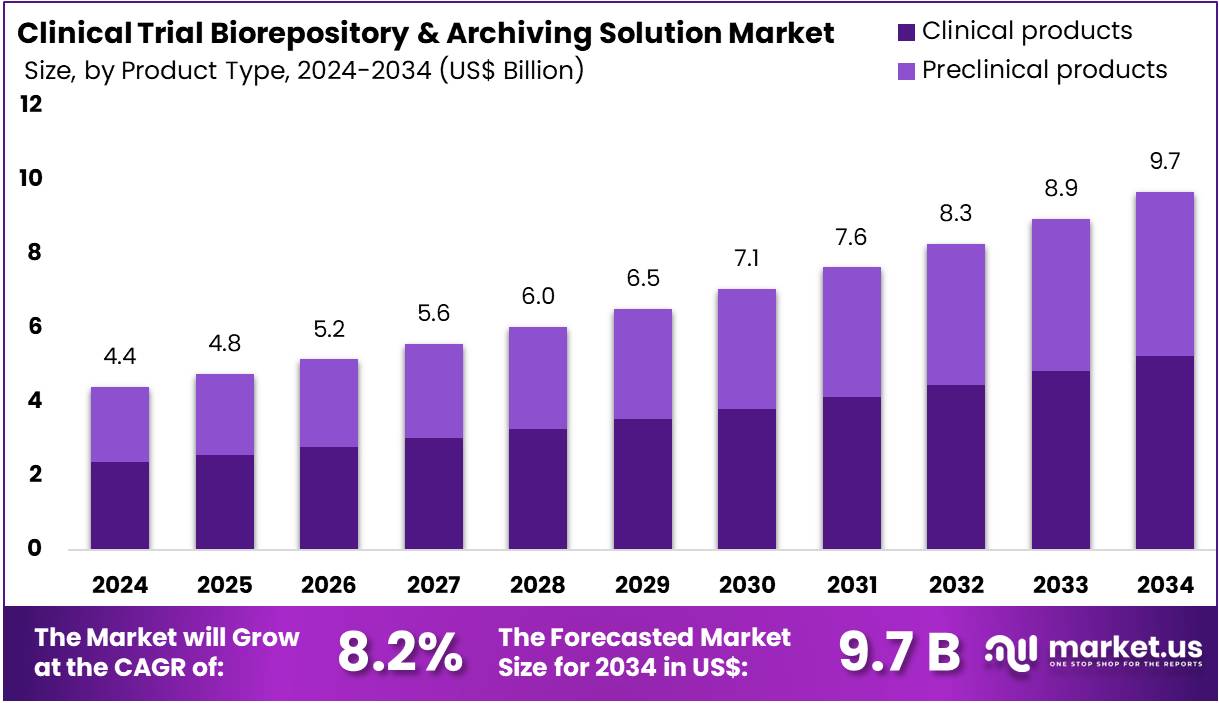
Key Takeaways
- In 2024, the Clinical Trial Biorepository and Archiving Solution Market generated revenue of US$ 4.4 billion and is projected to reach US$ 9.7 billion by 2034, expanding at a CAGR of 8.2% during the forecast period.
- Based on product type, the market is segmented into clinical products and preclinical products. The clinical products segment dominated the market in 2023, accounting for a 54.1% market share.
- Based on services, the market is categorized into biorepository services and archiving solution services. The biorepository services segment held the leading position in 2023, capturing a 58.3% market share.
- Based on phase, the market is segmented into preclinical, Phase I, Phase II, Phase III, and Phase IV. The preclinical segment emerged as the largest segment in 2023, contributing 32.2% of the total market revenue.
- Based on end users, the market is divided into pharmaceutical companies, contract research organizations (CROs), biotechnology companies, and academic and research institutions. The pharmaceutical companies segment dominated the market in 2023, holding a 42.7% revenue share.
- Regionally, North America accounted for the largest market share in 2023, capturing 48.2% of the global clinical trial biorepository and archiving solution market.
Statistical Information
- Clinical Trial Registration Growth is Increasing Demand for Large-Scale Biospecimen Management: The increasing number of clinical studies worldwide is creating higher demand for reliable biospecimen collection, storage, and archiving infrastructure. ClinicalTrials.gov recorded 520,862 registered studies at the end of 2024, compared with 477,191 studies at the end of 2023, representing an increase of 43,671 new registered studies during 2024. This growth increases the requirement for secure sample preservation systems supporting clinical research workflows.
- Global Clinical Research Expansion Supports Demand for Centralized Biorepositories: ClinicalTrials.gov has tracked clinical research activity since 2000, when the registry contained only 1,255 studies. By the end of 2024, registrations exceeded 520,000 studies, showing more than a 400-fold increase in registered clinical research activity over two decades. This expansion creates increasing demand for sample lifecycle management, storage monitoring, and data-linked archiving solutions.
- Automated and Ultra-Low Temperature Storage Infrastructure is Expanding: Modern biorepositories increasingly rely on automated storage systems and ultra-low temperature technologies to preserve sensitive biological materials. Cryogenic storage systems maintain samples at temperatures around −196°C using liquid nitrogen, while ultra-low freezers commonly operate near −80°C for long-term biological sample preservation.
- NIH All of Us Research Program Demonstrates Large-Scale Biobank Demand: The NIH All of Us Research Program represents one of the largest health research databases in the United States. The program aims to collect health information and biological samples from at least 1 million participants to support precision medicine research. The program has enrolled more than 500,000 participants, with collected data including electronic health records, surveys, physical measurements, and biospecimens. This large-scale initiative highlights the increasing importance of integrated biorepository platforms combining samples with clinical data.
- Rare Disease Research Requires Long-Term Biospecimen Availability: The NIH estimates that approximately 7,000 rare diseases affect more than 30 million Americans. Due to small patient populations, stored biospecimens are important for future genetic analysis, disease characterization, and therapeutic research.
- NIH Data Infrastructure Supports Thousands of Research Projects: The NIH All of Us Research Program reported that its dataset has supported more than 300 NIH research project grants and training activities totaling over US$694 million through FY 2025. More than 400 NIH Intramural Research Program investigators across 23 NIH Institutes and Centers have used the resource.
- ClinicalTrials.gov Database Growth Indicates Rising Biospecimen Generation: ClinicalTrials.gov currently lists 593,857 registered clinical studies conducted across 226 countries and territories, showing the massive scale of global clinical research activities generating biological samples requiring collection, storage, tracking, and archiving. Among these, 453,135 studies (76%) are interventional studies, including drug and biologic investigations.
Regional Analysis
North America led the market by securing a market share of 48.2% in 2023.
North America remains a leading region in the Clinical Trial Biorepository & Archiving Solution Market, supported by advanced healthcare infrastructure, strong regulatory frameworks, and increasing clinical research activities. The region’s growth is driven by rising demand for secure biospecimen storage, automated sample management systems, and digital platforms that ensure sample traceability and regulatory compliance. The expansion of oncology, rare disease, and precision medicine studies has increased the need for long-term preservation of tissue, plasma, and genomic specimens.
The U.S. FDA’s emphasis on Good Clinical Practice (GCP) standards encourages pharmaceutical companies and research organizations to adopt compliant archiving solutions for clinical trial materials. Public and academic biobanks are also expanding capabilities to support large-scale research programs. According to the World Health Organization (WHO), the United States accounted for more than 186,000 registered clinical trials as of June 2024, reflecting the region’s significant clinical research volume and increasing requirement for advanced biorepository infrastructure.
Emerging Trends
- Expansion of Precision Medicine Biobanks: Precision medicine programs are increasing demand for integrated biorepositories that connect biological samples with genomic and clinical information. NIH’s All of Us Research Program has enrolled more than 884,000 participants, with over 598,000 completing initial steps including biospecimen donation, supporting large-scale genomic research.
- Growth of Automated Sample Tracking and Digital Archiving: Clinical research networks are adopting digital platforms for sample tracking, chain-of-custody monitoring, and faster retrieval. ClinicalTrials.gov currently lists 593,857 registered clinical studies across 226 countries and territories, increasing the need for scalable biospecimen management infrastructure.
- Increasing Use of Biospecimens in Oncology Research: Oncology studies are driving demand for long-term storage of tumor tissues, blood, and molecular samples used for biomarker discovery. The NCI Cancer Moonshot Biobank collects longitudinal biospecimens from cancer patients to support research on treatment response and disease progression over multiple years.
- Integration of Genomic Data with Biorepository Systems: Genomic-linked biobanks are becoming important for drug discovery and personalized therapies. NIH reported that the All of Us Research Program released data from more than 747,000 participants, including over 535,000 whole genome sequences linked with nearly 482,000 electronic health records.
- Rising Demand for Cryopreservation in Cell and Gene Therapy Trials: Expansion of cellular and gene therapies is increasing the requirement for advanced cryogenic storage solutions. FDA regulates cellular and gene therapy products that require controlled handling and preservation systems to maintain biological material quality during clinical development.
Use Cases
- Oncology Biomarker Discovery and Precision Cancer Research: Clinical trial biorepositories store tumor tissues, blood, plasma, and genomic samples collected from cancer patients to support biomarker identification and treatment response analysis. The NCI Cancer Moonshot Biobank collects longitudinal biospecimens over 5 years to study cancer progression and therapy outcomes.
- Cell and Gene Therapy Sample Preservation: Biorepository solutions are used for preserving patient-derived cells, immune cells, and gene therapy materials under controlled cryogenic conditions. FDA-approved cellular and gene therapies require validated handling and storage processes to maintain product quality during clinical development and commercialization.
- Pharmacogenomics and Genomic Research Applications: Archived biospecimens are increasingly used with genomic sequencing data to identify genetic variations influencing treatment response. NIH’s All of Us Research Program combines biospecimens with genomic information and health records, including data from more than 747,000 participants to support precision medicine research.
- Rare Disease Research and Therapeutic Development: Biorepositories enable researchers to access limited patient samples for rare disease diagnosis, genetic analysis, and drug discovery. NIH estimates that approximately 7,000 rare diseases affect more than 30 million Americans, creating demand for long-term sample preservation and collaborative research resources.
- Vaccine Development and Infectious Disease Research: Archived biological samples support vaccine studies by enabling researchers to analyze immune responses, pathogen characteristics, and antibody development. Biorepository systems help maintain controlled storage of blood samples, serum, and viral materials used in infectious disease research programs.
Frequently Asked Questions on Clinical Trial Biorepository & Archiving Solution
- Why is the Clinical Trial Biorepository & Archiving Solution Market growing?
The market is expanding due to increasing clinical trials, precision medicine adoption, biomarker research, and rising demand for secure biospecimen storage. Growing volumes of tissue, blood, genomic, and cellular samples require advanced platforms for efficient management and long-term preservation. - What types of samples are stored in clinical trial biorepositories?
Clinical trial biorepositories store samples including blood, plasma, serum, tissue, DNA, RNA, cells, and cerebrospinal fluid. These specimens support oncology studies, genomic research, biomarker validation, immunotherapy trials, and development of personalized treatment approaches. - How does precision medicine influence the Clinical Trial Biorepository Market?
Precision medicine increases demand for biospecimens connected with genomic and clinical data. Researchers use stored samples to identify molecular markers, study disease pathways, and develop targeted therapies, making advanced biorepository solutions important for personalized healthcare research. - What technologies are used in clinical trial biorepository systems?
Modern biorepositories use automated storage systems, artificial intelligence-based inventory tracking, cloud-based data platforms, barcode identification, and temperature monitoring technologies. These solutions improve sample security, reduce retrieval time, and enable accurate management of large specimen collections. - Why is cryopreservation important in clinical trial biorepositories?
Cryopreservation maintains the stability and biological characteristics of sensitive specimens such as cells, tissues, and genetic materials. Ultra-low temperature storage systems, including −80°C freezers and liquid nitrogen storage near −196°C, support long-term preservation of valuable research samples. - How do regulatory requirements impact the biorepository market?
Regulatory requirements from organizations such as the FDA promote proper sample documentation, quality control, and traceability. Clinical research organizations increasingly adopt compliant digital archiving solutions to support audits, monitoring activities, and secure management of trial-related biospecimens. - What are the major applications of clinical trial biorepository solutions?
Major applications include oncology research, vaccine development, cell and gene therapy studies, rare disease investigations, genomic analysis, and biomarker discovery. These solutions help researchers preserve biological materials needed for developing advanced diagnostics and therapeutic products. - How do contract research organizations (CROs) use biorepository solutions?
CROs use biorepository platforms to manage samples collected from multi-center clinical trials. These systems enable efficient sample tracking, controlled storage, documentation management, and coordination between research sites, sponsors, and laboratories involved in clinical development programs.
Conclusion
The Clinical Trial Biorepository & Archiving Solution Market is evolving rapidly due to increasing clinical research activities, precision medicine adoption, and growing demand for secure biospecimen management. Advancements in automation, AI-based tracking, cryopreservation, and digital data integration are improving sample quality, accessibility, and regulatory compliance.
Oncology, cell and gene therapy, rare disease research, and biomarker discovery are major application areas driving adoption. Pharmaceutical companies, CROs, and academic institutions are increasingly investing in advanced biorepository infrastructure to support complex clinical trials. As research becomes more data-driven, scalable and compliant archiving solutions will remain essential for accelerating therapeutic discoveries and improving healthcare outcomes.
Discuss your needs with our analyst
Please share your requirements with more details so our analyst can check if they can solve your problem(s)




