


Overview
New York, NY – Aug 19, 2026 – The Global Clinical Risk Grouping Solution Market size is expected to be worth around US$ 3.4 billion by 2034 from US$ 0.9 billion in 2024, growing at a CAGR of 14.1% during the forecast period 2025 to 2034. In 2024, North America led the market, achieving over a 38.7% share with a revenue of US$ 0.3 billion.
The Clinical Risk Grouping (CRG) Solution is experiencing steady growth as healthcare providers and payers increasingly adopt predictive analytics and population health management tools to improve patient outcomes while controlling costs.
Clinical risk grouping solutions categorize patients based on disease burden, health status, and expected healthcare utilization, helping organizations allocate resources more efficiently. The market is projected to expand at a double-digit CAGR of around 12–15% during the forecast period, driven by the rapid digital transformation of healthcare systems.
Healthcare data generation continues to rise worldwide. According to the World Health Organization (WHO), noncommunicable diseases (NCDs) account for 74% of all global deaths, or approximately 41 million deaths annually, emphasizing the need for effective risk stratification. Meanwhile, the U.S. Centers for Disease Control and Prevention (CDC) reports that 6 in 10 U.S. adults have at least one chronic disease, while 4 in 10 live with two or more chronic conditions, significantly increasing healthcare spending and demand for clinical risk assessment technologies.
The widespread adoption of electronic health records (EHRs), cloud computing, artificial intelligence (AI), and machine learning is improving the speed and accuracy of clinical risk grouping solutions. According to the Office of the National Coordinator for Health Information Technology (ONC), nearly 96% of U.S. non-federal acute care hospitals have adopted certified EHR technology, creating a strong foundation for advanced analytics and patient risk modeling.
Supported by rising healthcare expenditures, an aging global population expected to reach 1.6 billion people aged 65 years and above by 2050 (WHO), and increasing investments in value-based care, the Clinical Risk Grouping Solution Market is expected to create substantial growth opportunities for healthcare technology providers, insurers, hospitals, and public health organizations over the coming decade.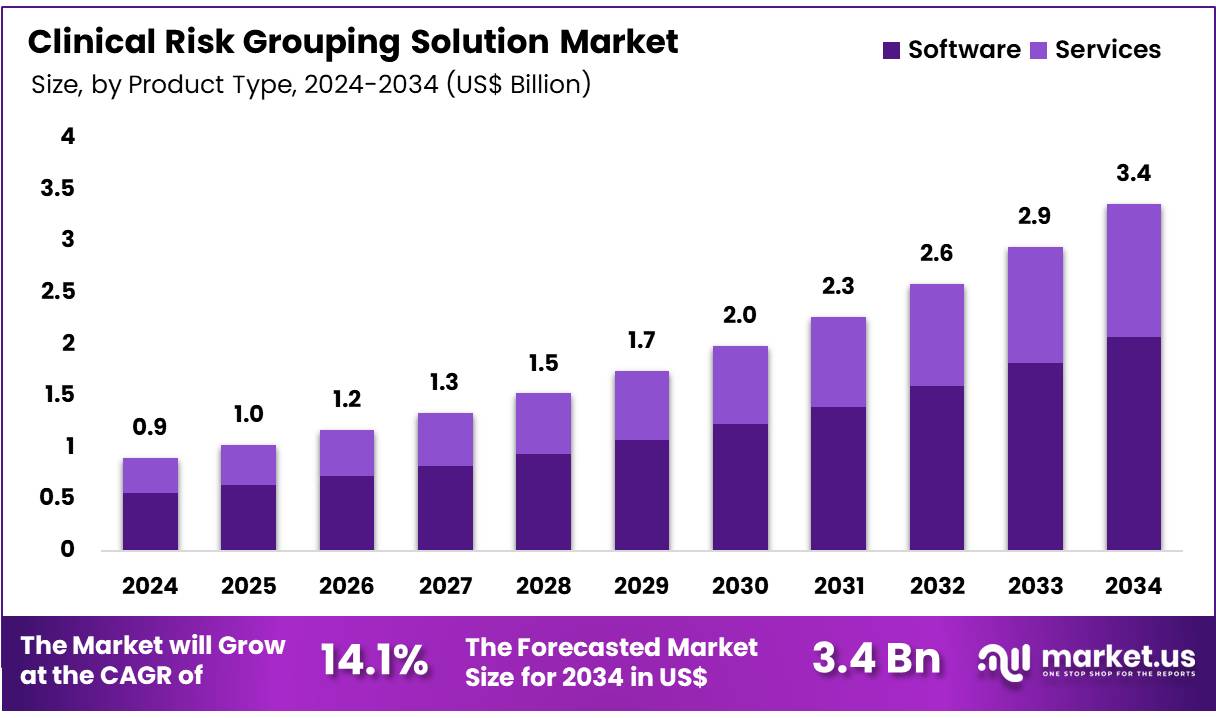
Key Takeaways
- In 2024, the Clinical Risk Grouping Solution Market generated US$ 0.9 billion in revenue and is projected to reach US$ 3.4 billion by 2034, expanding at a CAGR of 14.1% during the forecast period.
- By product type, the market is segmented into software and services. The software segment dominated the market in 2023, accounting for 61.7% of the total market share.
- Based on application, the market is categorized into population health management, fraud detection and prevention, clinical decision support, chronic disease management, and others. Among these, population health management held the largest share at 44.5% in 2023.
- By end user, the market is segmented into hospitals & clinics, long-term care centers, ambulatory surgical centers, and others. Hospitals & clinics emerged as the leading segment, capturing 52.9% of the market revenue in 2023.
- North America dominated the global Clinical Risk Grouping Solution Market in 2023, accounting for the largest regional market share of 38.7%.
Statistical Information
- Chronic Diseases Are Driving Demand for Clinical Risk Grouping Solutions: Chronic diseases remain the leading cause of death globally, increasing the need for clinical risk grouping tools that identify high-risk patients and support early intervention. According to the World Health Organization (WHO), 41 million people die each year from noncommunicable diseases (NCDs), representing 74% of all global deaths. These figures highlight the growing demand for advanced patient risk stratification and population health management systems.
- High Burden of Chronic Conditions Increases Need for Risk Stratification: The U.S. Centers for Disease Control and Prevention (CDC) reports that 6 in 10 U.S. adults have at least one chronic disease, while 4 in 10 have two or more chronic diseases. Managing these complex patient populations requires clinical risk grouping platforms that help providers identify high-risk individuals and optimize healthcare resources
- Electronic Health Record Adoption Among Physicians Continues to Grow: According to ONC, 95% of office-based physicians use an Electronic Health Record (EHR), and 91% use a certified EHR system (2024). The widespread availability of structured patient data supports the implementation of clinical decision support, predictive analytics, and risk grouping technologies.
- Accountable Care Organizations Expand Population Health Management: The Centers for Medicare & Medicaid Services (CMS) estimates that 14.3 million Medicare beneficiaries receive coordinated care through Accountable Care Organizations (ACOs) in 2026, representing a 4.4% increase from 2025. This growth supports increasing adoption of clinical risk grouping solutions for value-based healthcare delivery.
- EHR Data Supports Large-Scale Population Health Analytics: According to the CDC, the PCORnet research network includes data from more than 300 hospitals, over 3,500 primary care practices, around 1,000 community clinics, and approximately 80 million patients. These large-scale clinical datasets enable advanced risk prediction, chronic disease surveillance, and population health analytics.
- EHR Implementation Improves Preventive Care Performance: A CDC study involving 151 primary care practices found that after implementing Electronic Health Records, blood pressure control improved from 55.3% to 64.1%, HbA1c testing increased from 46.4% to 57.7%, and smoking cessation interventions rose from 29.3% to 46.2% over two years. These findings demonstrate the value of digital health systems that support clinical risk grouping and care management.
- Healthcare Spending Continues to Rise Due to Chronic Disease Burden: According to the U.S. Centers for Medicare & Medicaid Services (CMS), U.S. national health expenditures reached US$ 4.9 trillion in 2023, representing 17.6% of the nation’s Gross Domestic Product (GDP). Rising healthcare spending is increasing the demand for clinical risk grouping solutions that help healthcare organizations identify high-risk patients and optimize resource utilization.
- Older Population Is Growing Rapidly Worldwide: According to the World Health Organization (WHO), the global population aged 60 years and older will increase from 1 billion in 2020 to 1.4 billion by 2030, while the number of people aged 80 years and above is expected to reach 426 million by 2050. The aging population increases demand for clinical risk grouping solutions to manage multiple chronic conditions.
- Hospital Readmissions Create Significant Financial Pressure: The Agency for Healthcare Research and Quality (AHRQ) reports that approximately 14% of hospitalized patients are readmitted within 30 days for many medical conditions. Clinical risk grouping solutions help providers identify patients at high risk of readmission and improve discharge planning.
- Value-Based Care Participation Is Expanding: According to CMS, the Medicare Shared Savings Program (MSSP) includes more than 470 Accountable Care Organizations (ACOs) serving over 11 million Medicare beneficiaries. These organizations depend on patient risk stratification and predictive analytics to improve outcomes and reduce avoidable healthcare costs.
Regional Analysis
North America led the market by securing a market share of 38.7% in 2023.
North America accounted for the largest share of the Clinical Risk Grouping Solution Market in 2024, supported by widespread adoption of value-based care, advanced healthcare IT infrastructure, and high electronic health record (EHR) usage. Healthcare providers and insurers increasingly use clinical risk grouping solutions to identify high-risk patients, improve chronic disease management, and optimize care coordination.
According to the Centers for Medicare & Medicaid Services (CMS), more than 14 million Medicare beneficiaries were enrolled in Accountable Care Organizations (ACOs) in 2026, demonstrating the growing emphasis on population health management and risk-based reimbursement.
Additionally, the Office of the National Coordinator for Health Information Technology (ONC) reports that over 99% of U.S. non-federal acute care hospitals have adopted certified EHRs, creating a strong foundation for predictive analytics and clinical risk stratification. Continuous investments in artificial intelligence, interoperability, and digital health technologies further strengthen the region’s leadership in advanced clinical risk management.
Emerging Trends
- AI-powered clinical risk prediction is expanding across healthcare systems: Clinical Risk Grouping (CRG) platforms are increasingly integrating artificial intelligence and machine learning to identify high-risk patients earlier. The FDA has authorized more than 1,000 AI-enabled medical devices, supporting broader adoption of predictive analytics for clinical decision-making and population health management.
- Electronic Health Records are becoming the backbone of risk grouping: Clinical risk solutions increasingly rely on digital patient records to improve patient stratification and care planning. More than 99% of U.S. non-federal acute care hospitals have adopted certified EHRs, creating a strong data foundation for advanced risk assessment and clinical analytics.
- Value-based healthcare is increasing demand for patient risk stratification: Healthcare providers are adopting clinical risk grouping to support fair reimbursement and improve outcomes. More than 14 million Medicare beneficiaries participate in Accountable Care Organizations (ACOs), where risk adjustment is essential for coordinated and value-based care.
- Interoperability standards are improving healthcare data sharing: Healthcare organizations are adopting standardized clinical classifications such as ICD-11 to improve interoperability and support AI-driven patient risk models. WHO states that ICD-11 has been in effect globally since 2022, enabling better digital health integration and clinical decision support.
- Growing chronic disease burden is accelerating predictive healthcare: According to the CDC, analysis of more than 30 million adult electronic health records demonstrates the growing value of EHR-based surveillance for detecting chronic diseases and improving preventive care through clinical risk grouping technologies.
Use Cases
- Population health management for chronic disease patients: Healthcare organizations use clinical risk grouping to classify patients with diabetes, cardiovascular disease, and other chronic illnesses for targeted care. The CDC reports that over 30 million patient records are being used through EHR networks to improve preventive health monitoring.
- Risk adjustment for value-based reimbursement: Health insurers and Medicare programs use clinical risk grouping to calculate patient risk scores and allocate payments fairly. According to CMS, risk adjustment helps estimate expected healthcare costs based on patient health conditions and predicted service utilization.
- Clinical decision support for physicians: Hospitals integrate clinical risk grouping with decision support software to identify patients requiring early intervention. The FDA’s 2026 Clinical Decision Support guidance encourages the safe use of software that assists clinicians in making evidence-based treatment decisions.
- Remote patient monitoring through digital health platforms: Clinical risk grouping solutions combine telehealth, wearable devices, and EHR data to continuously monitor high-risk patients. The WHO identifies digital health, telemedicine, and AI as major tools supporting more connected and proactive healthcare delivery worldwide.
- Reducing hospital readmissions through predictive analytics: Hospitals use clinical risk grouping to identify patients at high risk of complications before discharge and prioritize follow-up care. CMS highlights that EHRs support evidence-based decision support, quality management, and better patient outcomes by improving access to comprehensive clinical information.
Frequently Asked Questions on Clinical Risk Grouping Solution
- How does a Clinical Risk Grouping Solution benefit healthcare providers?
It enables providers to identify high-risk patients, improve care coordination, reduce avoidable hospitalizations, support clinical decision-making, and enhance chronic disease management through predictive analytics and patient risk stratification using clinical and administrative healthcare data. - Who uses Clinical Risk Grouping Solutions?
These solutions are primarily used by hospitals, clinics, insurance companies, accountable care organizations (ACOs), government healthcare agencies, and healthcare analytics firms to improve patient outcomes, reimbursement accuracy, and population health management. - Which technologies are integrated with Clinical Risk Grouping Solutions?
Modern platforms integrate artificial intelligence, machine learning, electronic health records (EHRs), cloud computing, predictive analytics, and interoperability standards to deliver accurate patient risk assessment and real-time clinical insights. - Why are Clinical Risk Grouping Solutions becoming increasingly important?
The growing burden of chronic diseases, aging populations, increasing healthcare costs, and the shift toward value-based healthcare are driving healthcare organizations to adopt clinical risk grouping technologies for efficient and personalized patient care. - What factors are driving the Clinical Risk Grouping Solution Market?
The market is driven by increasing adoption of value-based healthcare, rising chronic disease prevalence, expanding healthcare digitalization, widespread EHR implementation, growing investments in AI-powered healthcare analytics, and increasing demand for population health management solutions. - Which product segment dominates the Clinical Risk Grouping Solution Market?
The software segment holds the largest market share because healthcare organizations increasingly require scalable analytics platforms, automated patient classification, cloud-based deployment, and integrated clinical decision support capabilities to improve operational efficiency. - Which application leads the Clinical Risk Grouping Solution Market?
Population health management represents the leading application segment as healthcare providers focus on identifying high-risk patient groups, improving preventive care, reducing healthcare costs, and optimizing long-term disease management strategies. - Why does North America lead the Clinical Risk Grouping Solution Market?
North America maintains market leadership due to advanced healthcare infrastructure, widespread electronic health record adoption, strong government support for value-based care, high healthcare spending, and continuous investment in healthcare analytics and artificial intelligence. - What are the future growth opportunities in the Clinical Risk Grouping Solution Market?
Future opportunities include AI-driven predictive analytics, cloud-based clinical platforms, precision medicine, remote patient monitoring, interoperability improvements, and expanding adoption of digital health technologies to enhance patient care and healthcare efficiency.
Conclusion
The Clinical Risk Grouping Solution Market is witnessing strong growth as healthcare organizations increasingly adopt data-driven technologies to improve patient outcomes, manage chronic diseases, and support value-based care. Rising implementation of electronic health records, artificial intelligence, predictive analytics, and interoperable healthcare systems is strengthening the adoption of clinical risk grouping platforms worldwide.
North America continues to lead the market due to its advanced healthcare infrastructure, while Asia Pacific is expected to register the fastest growth through expanding digital health investments. As healthcare providers focus on personalized care, resource optimization, and preventive interventions, clinical risk grouping solutions will remain essential for improving healthcare quality and operational efficiency.
Discuss your needs with our analyst
Please share your requirements with more details so our analyst can check if they can solve your problem(s)




