


Overview
New York, NY – Aug 06, 2026 – The Global Cell Sorting Market Size is expected to be worth around US$ 604.1 million by 2034 from US$ 262.3 million in 2024, growing at a CAGR of 8.7% during the forecast period 2025 to 2034. North America held a dominant market position, capturing more than a 40.5% share and holding a US$ 106.2 million market value for the year.
The global cell sorting market is expanding rapidly due to increasing research and development activities in immunology, oncology, stem cell biology, and precision medicine. Cell sorting technologies allow researchers to separate and analyze specific cell populations from complex biological samples with high accuracy, supporting applications in cancer research, immune profiling, regenerative medicine, and cell-based therapies.
According to the Centers for Disease Control and Prevention (CDC), cancer impacts millions of people globally each year, with approximately 20 million new cancer cases and 9.7 million cancer-related deaths reported worldwide in 2022, highlighting the need for advanced cellular analysis technologies for better diagnosis and targeted treatments.
Technological innovation is accelerating market growth as manufacturers focus on high-parameter, automated, and high-throughput cell sorting platforms. Next-generation instruments are enabling researchers to analyze hundreds of cellular characteristics simultaneously. For example, in October 2023, Sony launched the FP7000 Spectral Cell Sorter, equipped with 6 lasers and 182 detectors, allowing detailed analysis of complex cellular populations for applications including single-cell sequencing, immunotherapy research, and molecular biology.
Increasing investments in cell and gene therapy research are creating significant growth opportunities. According to the National Center for Biotechnology Information (NCBI), more than 3,700 cell and gene therapy candidates were in clinical and preclinical development by early 2023, reflecting strong demand for advanced cell processing technologies.
The National Institutes of Health (NIH) invests billions of dollars annually in biomedical research, supporting innovations in single-cell analysis and therapeutic development. With rising adoption of personalized medicine and more than 7,000 rare diseases affecting over 300 million people worldwide, advanced cell sorting solutions are becoming essential tools for future healthcare breakthroughs.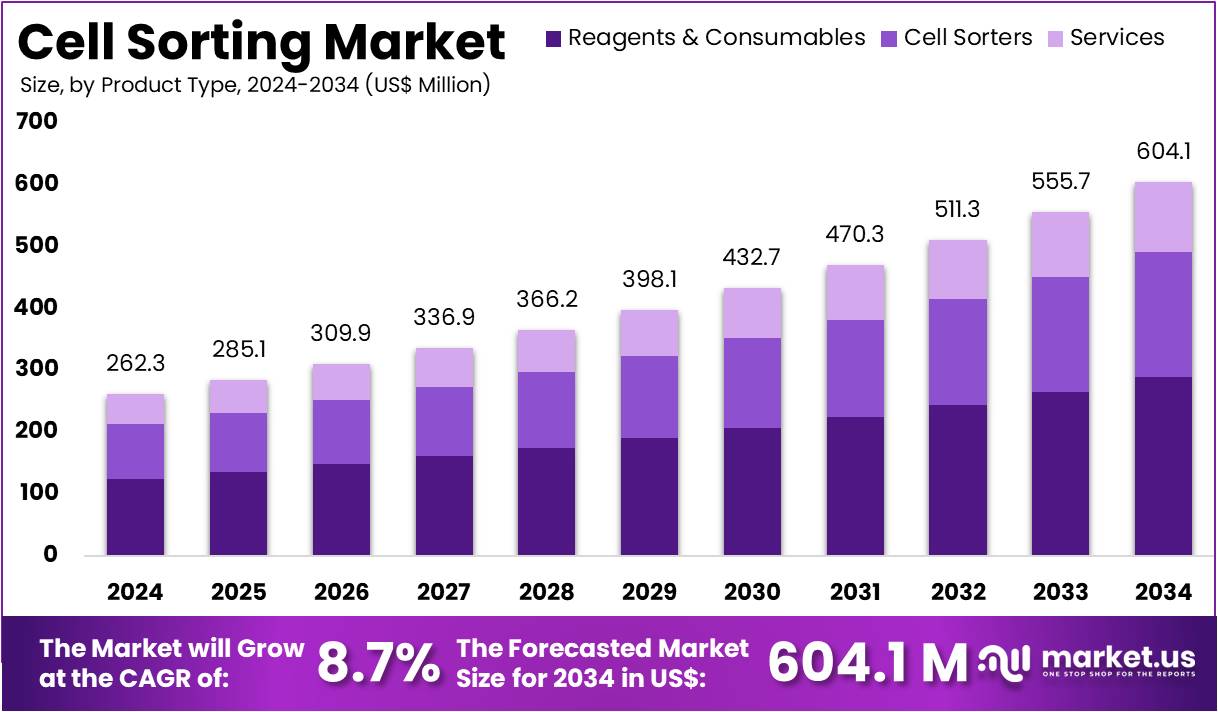
Key Takeaways
- In 2024, the cell sorting market generated revenue of US$ 262.3 million and is projected to grow at a CAGR of 8.7%, reaching approximately US$ 604.1 million by 2034.
- Based on product type, the market is segmented into reagents & consumables, cell sorters, and services. The reagents & consumables segment dominated in 2023, accounting for a market share of 47.8%.
- By technology, the cell sorting market is categorized into fluorescence-based droplet cell sorting, MEMS–microfluidics, and magnetic-activated cell sorting. Among these, fluorescence-based droplet cell sorting held the leading position in 2023, with a market share of 52.4%.
- Based on application, the market is divided into research applications and clinical applications. The research applications segment emerged as the dominant segment, capturing the largest revenue share of 58.2%.
- By end user, the market is segmented into research institutions, medical schools & academic institutions, pharmaceutical & biotechnology companies, and hospitals & clinical testing laboratories. The research institutions segment led the market in 2023, holding a revenue share of 49.6%.
- Regionally, North America dominated the global cell sorting market in 2023, accounting for a market share of 40.5%.
Statistical Information
- NIH funding supports cell sorting infrastructure: NIH-related core facilities actively purchase and operate cell sorters for research use. For example, George Washington University reported a $600,000 NIH S10 grant to buy a BD FACSDiscover S8 CellView spectral flow cytometer and live cell sorter.
- BD is a major company player in flow cytometry and cell sorting: BD says its Life Sciences segment generated $1.330 billion in revenue in FY2023, and the company specifically highlighted strong demand for its BD FACSDiscover S8 Cell Sorter.
- Government Biomedical Research Funding Supports Single-Cell Analysis and Cell Sorting Development: Government investment in biomedical research is accelerating the adoption of advanced cellular analysis platforms. The National Institutes of Health (NIH) operates with an annual budget of nearly US$48 billion, with approximately 82% of funding directed toward extramural research programs. NIH supports thousands of research projects focused on molecular biology, immunology, cancer biology, and single-cell technologies where cell sorting is frequently used.
- Academic and Research Institutions Represent Major Users of Cell Sorting Systems: Research institutions and universities are among the largest users of cell sorting technologies due to extensive applications in biomedical research, genomics, and disease studies. NIH funding supports research activities across more than 2,500 universities, medical schools, and research institutions, involving over 300,000 researchers through competitive grant programs.
- Rare Disease Research Requires Advanced Cell Separation and Analysis Technologies: Rare disease studies often require identification of small and specific cell populations that may represent important disease markers. According to the National Institutes of Health (NIH), approximately 7,000 rare diseases affect more than 25 million to 30 million Americans. Cell sorting helps researchers study disease mechanisms by isolating rare cellular subsets for molecular analysis.
- Company-side demand signals: BD says its Life Sciences segment delivered $1.330 billion in revenue in fiscal 2023, and its investor release highlighted the BD FACSDiscover S8 Cell Sorter, showing that cell sorting remains a meaningful product area within a major global medtech company.
- Academic Research Funding Drives Adoption of Cell Sorting Instruments: Universities and medical research centers use cell sorting systems for studies related to cancer, immunology, infectious diseases, and developmental biology. The NIH supports more than 50,000 research grants annually, many of which involve advanced laboratory technologies including flow cytometry and cellular analysis platforms.
- Pharmaceutical R&D Spending Supports Advanced Cellular Research: Pharmaceutical companies continue investing heavily in research and development activities, including biologics, gene therapies, and personalized medicine. According to the Pharmaceutical Research and Manufacturers of America (PhRMA), biopharmaceutical companies invested approximately $100 billion annually in U.S. research and development activities in recent years, supporting technologies such as advanced cell analysis platforms.
Regional Analysis
North America led the market by securing a market share of 40.5% in 2023.
North America holds a strong position in the cell sorting market due to its advanced biomedical research infrastructure, significant healthcare investment, and growing adoption of cell-based therapies. The United States continues to drive regional growth through extensive government-supported research programs. The National Institutes of Health (NIH) received a budget of approximately US$47.7 billion in 2023, supporting research areas such as oncology, immunology, genomics, and cellular analysis.
Additionally, the region faces a high cancer burden, with the International Agency for Research on Cancer (IARC) estimating approximately 2.67 million new cancer cases in Northern America in 2022, increasing demand for advanced diagnostic and therapeutic research tools. Asia Pacific is witnessing rapid expansion due to increasing biotechnology investments, rising clinical research activities, and government initiatives supporting life sciences.
China’s growing biotechnology sector, Japan’s regenerative medicine research, and increasing investments in advanced healthcare technologies are driving adoption of cell sorting solutions. The region’s focus on precision medicine, stem cell research, and immunotherapy development is expected to create significant opportunities for cell sorting technologies.
Emerging Trends
- Growing Adoption of Single-Cell Analysis Technologies: Single-cell analysis is becoming a major trend in biomedical research as scientists study variations between individual cells. Cell sorting helps isolate specific cell populations before sequencing and molecular analysis. NIH-supported single-cell initiatives highlight the role of these technologies in cancer research, immunology, and precision medicine applications.
- Increasing Use of Cell Sorting in Cell and Gene Therapy Manufacturing: The growth of advanced therapies is increasing the need for accurate cell isolation, purification, and quality control. More than 3,700 cell, gene, and RNA therapy programs were reported to be in clinical and preclinical development by 2023, creating demand for advanced cell processing technologies.
- Rising Demand for CAR-T Cell Therapy and Immunotherapy Research: Cell sorting is becoming essential in cancer immunotherapy development, particularly for CAR-T therapies that require precise isolation and characterization of immune cells. The FDA has approved multiple CAR-T therapies for blood cancers, increasing the use of advanced cellular analysis tools in oncology research.
- Shift Toward High-Parameter and Spectral Cell Sorting Platforms: Researchers are adopting advanced spectral cell sorting systems capable of analyzing multiple cellular markers simultaneously. For example, Sony’s FP7000 Spectral Cell Sorter features 6 lasers and 182 detectors, supporting complex immune profiling, oncology studies, and multi-parameter cellular analysis.
- Integration of Automation and Artificial Intelligence in Cell Sorting: Automation and AI-based analysis are improving sorting speed, accuracy, and reproducibility in laboratories. Machine learning-based cell classification approaches are being developed to support faster identification of complex cell populations, with some research models achieving approximately 98% classification accuracy.
Use Cases
- Oncology Research and Tumor Cell Analysis: Cell sorting is widely used to separate tumor cells, immune cells, and rare cancer populations for cancer research. According to WHO, approximately 20 million new cancer cases and 9.7 million cancer deaths occurred globally in 2022, increasing demand for advanced cellular research technologies.
- Stem Cell Research and Regenerative Medicine: Cell sorting supports stem cell research by enabling scientists to isolate specific cell populations for disease modeling, tissue regeneration, and therapeutic development. NIH-funded stem cell programs focus on understanding human development and improving regenerative medicine approaches.
- Pharmaceutical Drug Discovery and Biotechnology Research: Biotechnology and pharmaceutical companies use cell sorting for biomarker identification, immune profiling, and drug response studies. The increasing development of thousands of cell and gene therapy candidates is creating demand for accurate cellular analysis during research and manufacturing.
- Clinical Diagnostics and Immune Monitoring: Cell sorting is used in clinical research for immune monitoring, blood disorder analysis, and infectious disease studies. Flow cytometry-based sorting allows researchers to examine immune cells using multiple markers, helping identify cellular changes linked to diseases and treatment responses.
- Personalized Medicine and Precision Healthcare: Cell sorting supports precision medicine by isolating patient-specific cell populations for genomic and molecular studies. The NIH All of Us Research Program aims to collect health information from more than 1 million participants to improve personalized healthcare research and disease understanding.
Frequently Asked Questions On Cell Sorting
- What are the major applications of the cell sorting market?
The major applications of the cell sorting market include oncology research, immunotherapy development, stem cell research, single-cell analysis, drug discovery, clinical diagnostics, and cell-based therapy manufacturing. These applications help researchers understand diseases and develop targeted treatment approaches. - Which technology is commonly used in cell sorting systems?
Fluorescence-activated cell sorting (FACS) is one of the most widely used technologies due to its high accuracy and ability to analyze multiple cellular markers. Other technologies include magnetic-activated cell sorting and microfluidics-based cell sorting systems. - How does cell sorting support cancer research?
Cell sorting helps cancer researchers isolate tumor cells, immune cells, and rare cell populations for detailed analysis. This technology supports biomarker discovery, tumor profiling, and development of targeted therapies such as immune checkpoint treatments and CAR-T cell therapies. - Why are cell sorting technologies important for cell and gene therapies?
Cell sorting is essential in cell and gene therapy development because it enables researchers to select, purify, and characterize therapeutic cells. These processes improve treatment quality, safety, and consistency during manufacturing of advanced cellular products. - How are technological advancements influencing the cell sorting market?
Technological advancements are improving cell sorting speed, accuracy, automation, and multi-parameter analysis capabilities. New-generation systems with advanced detectors, artificial intelligence integration, and automated workflows are helping researchers perform complex cellular analysis more efficiently. - What role does single-cell analysis play in the cell sorting market?
Single-cell analysis is a growing application area where cell sorting helps isolate individual cell populations for genomic and molecular studies. This approach supports research in cancer biology, immune responses, disease mechanisms, and precision medicine development. - Which region dominates the global cell sorting market?
North America holds a leading position in the global cell sorting market due to strong biomedical research infrastructure, government funding, advanced healthcare systems, and high adoption of cell-based therapies. The region benefits from extensive oncology and biotechnology research activities.
Conclusion
The cell sorting market is experiencing significant growth due to rising demand for advanced cellular analysis in oncology, immunology, stem cell research, and cell-based therapies. Increasing investments in biotechnology, precision medicine, and regenerative medicine are accelerating the adoption of high-parameter and automated sorting platforms.
Growing cell and gene therapy pipelines, along with advancements in single-cell analysis, are creating new opportunities for market expansion. North America continues to lead due to strong research infrastructure and funding, while Asia Pacific is emerging with increasing biotechnology development. Overall, cell sorting technologies remain essential for future medical research and therapeutic innovation.
Discuss your needs with our analyst
Please share your requirements with more details so our analyst can check if they can solve your problem(s)




