


Overview
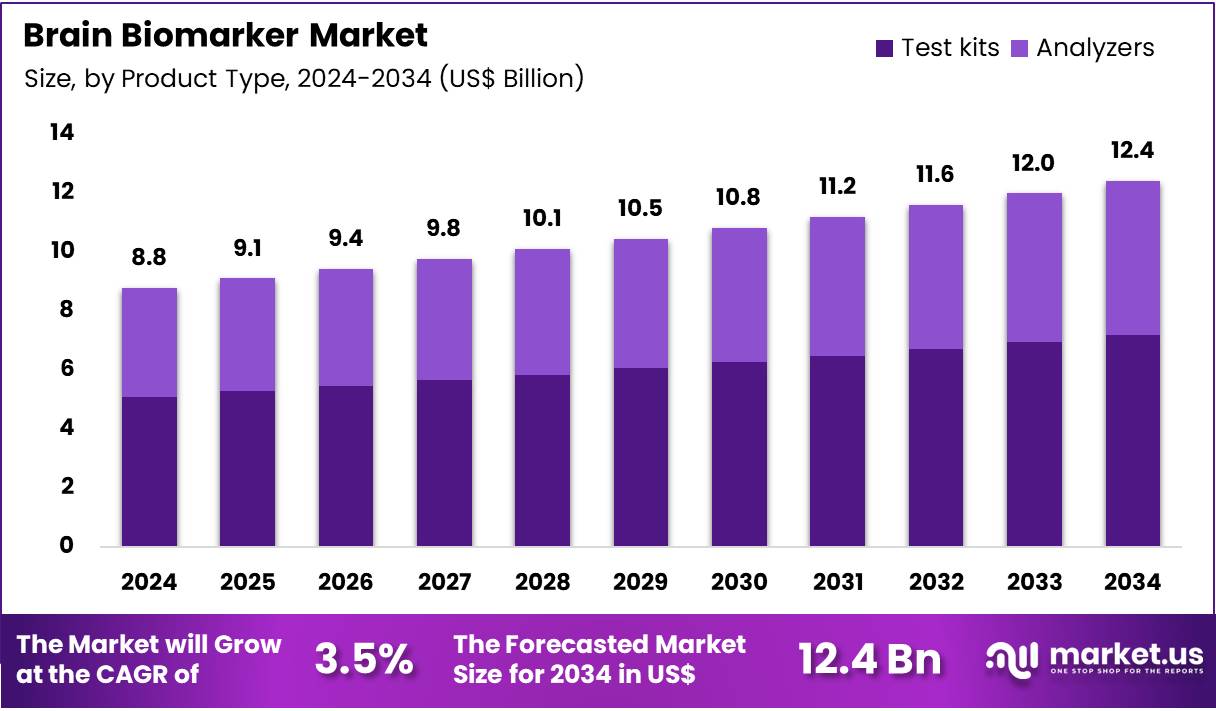
Global Brain Biomarker Market size is expected to be worth around US$ 12.4 Billion by 2034 from US$ 8.8 Billion in 2024, growing at a CAGR of 3.5% during the forecast period 2025 to 2034. In 2024, North America led the market, achieving over 41.6% share with a revenue of US$ 3.7 Billion.
The global Brain Biomarker field is gaining significant attention as neurological disorders become more common and healthcare systems prioritize early diagnosis. Brain biomarkers are measurable biological indicators found in blood, cerebrospinal fluid (CSF), or imaging scans that help detect, monitor, and predict diseases such as Alzheimer’s disease, Parkinson’s disease, multiple sclerosis, traumatic brain injury, and stroke. These biomarkers support clinicians in making faster and more accurate treatment decisions while improving patient outcomes.
According to the World Health Organization (WHO), neurological conditions affect more than 3 billion people worldwide, making them one of the leading causes of illness and disability. Alzheimer’s disease accounts for 60–70% of dementia cases globally, highlighting the growing demand for reliable biomarker-based diagnostics.
The U.S. Food and Drug Administration (FDA) has also expanded approvals for blood-based diagnostic tools and companion diagnostics, encouraging wider clinical adoption. Meanwhile, the National Institutes of Health (NIH) continues to invest billions of dollars annually in neuroscience and brain research, accelerating biomarker discovery and validation.
Technological advances in genomics, proteomics, artificial intelligence, and high-sensitivity immunoassays are improving the accuracy and accessibility of brain biomarker testing. Blood-based biomarkers are reducing the need for invasive lumbar punctures, while digital biomarkers collected through wearable devices are expanding opportunities for continuous neurological monitoring.
With aging populations, increasing prevalence of neurodegenerative diseases, and ongoing research investments, brain biomarkers are expected to play a critical role in precision medicine, personalized treatment strategies, and the future of neurological healthcare.
Key Takeaways
- In 2024, the Brain Biomarker Market was valued at US$ 8.8 billion and is projected to reach US$ 12.4 billion by 2034, expanding at a CAGR of 3.5% during the forecast period.
- By product type, the market is segmented into test kits and analyzers. Test kits dominated the segment in 2024, accounting for 57.9% of the total market share.
- Based on indication, the market is categorized into Alzheimer’s disease & other dementias, stroke, Parkinson’s disease, MND & ALS, and Huntington’s disease. Among these, Alzheimer’s disease & other dementias held the largest share at 44.6% in 2024.
- In terms of application, the market is divided into drug discovery & development, diagnosis, and others. The drug discovery & development segment led the market with a 52.7% revenue share in 2024.
- By end user, the market is segmented into pharma & biotech companies, hospitals, and research & diagnostic laboratories. Pharma & biotech companies emerged as the leading end-user segment, capturing 48.5% of the market revenue.
- North America dominated the global Brain Biomarker Market in 2024, holding the largest regional market share of 41.6%.
Statistical Information
- In May 2025, the FDA reported that 91.7% of patients with a positive Lumipulse G pTau217/β-Amyloid 1-42 Plasma Ratio blood test were confirmed to have amyloid plaques by PET imaging or cerebrospinal fluid (CSF) testing.
- Among patients with negative test results, 97.3% were confirmed negative for amyloid pathology using PET or CSF reference methods, demonstrating high reliability for ruling out Alzheimer’s pathology.
- The FDA clinical validation study involving 499 cognitively impaired adults found that fewer than 20% of samples required additional confirmatory testing because the blood biomarker result was indeterminate.
- A meta-analysis of 27 studies involving 19,652 participants found plasma p-tau217 detected Alzheimer’s pathology with a pooled 85.4% sensitivity, indicating a strong ability to correctly identify affected patients.
- The 2026 meta-analysis found that plasma p-tau217 achieved 88.0% specificity, showing high accuracy in correctly identifying individuals without Alzheimer’s pathology.
- The pooled diagnostic evaluation reported a positive likelihood ratio (PLR) of 7.13, indicating that a positive biomarker result substantially increases the probability of Alzheimer’s pathology.
- The same meta-analysis calculated a diagnostic odds ratio (DOR) of 42.7, reflecting excellent overall diagnostic discrimination between Alzheimer’s disease and non-disease cases.
- A 2025 multicenter Nature Medicine study involving 1,767 participants found that fully automated plasma p-tau217 assays delivered 89–91% overall diagnostic accuracy in secondary-care memory clinics.
- Using predefined biomarker thresholds, plasma p-tau217 demonstrated a positive predictive value ranging from 89% to 95%, depending on the participating clinical cohort.
- The automated biomarker platform achieved negative predictive values between 77% and 90%, supporting its effectiveness for excluding Alzheimer’s pathology in symptomatic patients.
- A 2025 analytical validation study found Spearman correlation coefficients (ρ) greater than 0.80 between serum and plasma p-tau217 measurements across four different assay platforms, supporting consistent laboratory performance.
Regional Analysis
North America dominated the Brain Biomarker Market with a 41.6% global market share in 2024, supported by strong investments in precision medicine, neuroscience research, and advanced diagnostic technologies.
The U.S. benefits from extensive funding by the National Institutes of Health (NIH) and the National Institute on Aging (NIA), which continue to support biomarker discovery, validation, and clinical translation for Alzheimer’s disease and related dementias. As of the end of fiscal year 2024, NIH funded 495 clinical trials focused on Alzheimer’s and related dementias, highlighting the region’s leadership in biomarker-driven innovation.
Academic medical centers, biotechnology companies, and healthcare providers are expanding the use of blood-based biomarkers, neuroimaging, and digital diagnostic tools to enable earlier disease detection and treatment monitoring.
Meanwhile, the Asia Pacific region is expected to register the fastest growth during the forecast period, driven by rising dementia awareness, government-backed neuroscience programs, expanding healthcare infrastructure, increasing clinical research, and growing adoption of AI-enabled diagnostic technologies across China, Japan, India, South Korea, and Australia.
Emerging Trends
- Blood-based brain biomarker tests are replacing invasive methods: In 2025, the U.S. FDA cleared the first blood test for Alzheimer’s disease diagnosis using the pTau217/β-Amyloid 1-42 plasma ratio for adults aged 55 years and older. This reduces dependence on spinal fluid tests and expensive PET scans, supporting faster and easier clinical assessment.
- Precision biomarkers are improving early Alzheimer’s detection: NIH reported in 2025 that blood biomarkers such as p-tau217, amyloid-beta, and neurofilament light chain (NfL) are showing accuracy comparable to cerebrospinal fluid testing. These markers help identify disease before symptoms appear, supporting precision medicine and earlier treatment decisions.
- AI and multi-omics research are expanding biomarker discovery: Government-supported research increasingly combines genomics, proteomics, metabolomics, and single-cell analysis to discover new brain biomarkers. NIH programs such as AMP-AD and SUNBIRD are validating multiple blood biomarkers for diagnosis, prognosis, and treatment monitoring across diverse populations.
- Brain biomarkers are becoming key tools for clinical trials: FDA’s biomarker qualification program encourages validated biomarkers to improve drug development. Biomarkers reduce uncertainty in clinical studies by identifying suitable participants and measuring treatment response more accurately, helping accelerate neurological drug development and regulatory review.
- Research is expanding beyond Alzheimer’s disease: NIH is developing biomarkers for Parkinson’s disease, Lewy body dementia, frontotemporal dementia, and neuroinflammation. New biomarkers, including alpha-synuclein, TDP-43, and NfL, are broadening the market by supporting diagnosis and disease monitoring across multiple neurological disorders.
Use Cases
- Early diagnosis of Alzheimer’s disease: Blood biomarkers such as pTau217 and amyloid-beta help physicians identify Alzheimer’s pathology before memory symptoms develop. NIH estimates that more than 7 million Americans are living with Alzheimer’s disease, increasing demand for early and accessible diagnostic testing.
- Monitoring disease progression: Blood biomarkers, including NfL and tau proteins, are used to monitor ongoing neurodegeneration and treatment effectiveness. NIH studies found that elevated Alzheimer’s-related proteins in blood were associated with cognitive decline among adults in their 50s and 60s, supporting long-term patient monitoring.
- Selecting patients for clinical trials: Brain biomarkers help researchers identify participants with confirmed disease pathology before enrollment. NIH reported that improved blood biomarker testing enables better screening for anti-amyloid therapies, increasing trial efficiency while reducing unnecessary imaging procedures.
- Supporting personalized treatment decisions: Clinicians use biomarker results to determine whether patients may benefit from targeted therapies. FDA-approved blood biomarker tests provide objective biological evidence alongside clinical assessment, improving confidence in treatment planning for adults with suspected Alzheimer’s disease.
- Population screening and risk assessment research: NIH research involving 1,350 participants found that 4% to 15% had blood biomarker levels suggesting Alzheimer’s-related brain changes despite no dementia diagnosis. These findings support future community-based screening and preventive healthcare strategies for high-risk individuals.
Frequently Asked Questions on Brain Biomarker
- What factors are driving the Brain Biomarker Market?
The market is growing because neurological disorders are becoming more common, healthcare systems are emphasizing early diagnosis, and governments are funding neuroscience research. Advances in blood-based biomarkers, artificial intelligence, and precision medicine are also improving diagnostic accuracy and clinical adoption. - Which diseases are commonly diagnosed using brain biomarkers?
Brain biomarkers are widely used to support the diagnosis and monitoring of Alzheimer’s disease, Parkinson’s disease, multiple sclerosis, traumatic brain injury, stroke, Huntington’s disease, and certain brain tumors. They help clinicians evaluate disease progression and personalize treatment strategies. - Which technologies are used in brain biomarker testing?
Common technologies include immunoassays, polymerase chain reaction (PCR), next-generation sequencing (NGS), mass spectrometry, magnetic resonance imaging (MRI), positron emission tomography (PET), and advanced digital biomarker platforms. These technologies improve sensitivity, specificity, and clinical decision-making. - Why are blood-based brain biomarkers gaining popularity?
Blood-based brain biomarkers offer a less invasive and more convenient alternative to cerebrospinal fluid testing. They simplify sample collection, reduce patient discomfort, support large-scale screening programs, and enable faster disease monitoring in hospitals, diagnostic laboratories, and research institutions. - Which end users contribute most to the Brain Biomarker Market?
Hospitals, diagnostic laboratories, academic research institutes, pharmaceutical companies, and biotechnology firms are the primary end users. These organizations use brain biomarkers for clinical diagnosis, drug development, patient stratification, clinical trials, and monitoring treatment effectiveness. - Which region leads the Brain Biomarker Market?
North America currently leads the Brain Biomarker Market because of strong healthcare infrastructure, significant neuroscience research funding, widespread adoption of advanced diagnostic technologies, favorable regulatory support, and increasing investments from biotechnology and pharmaceutical companies. - What is the future outlook for the Brain Biomarker Market?
The Brain Biomarker Market is expected to expand steadily as early diagnosis becomes a healthcare priority. Continued investment in biomarker discovery, AI-enabled diagnostics, precision medicine, and companion diagnostics is likely to improve patient outcomes and accelerate clinical adoption worldwide.
Conclusion
The global Brain Biomarker Market is steadily expanding as healthcare systems increasingly prioritize the early detection and monitoring of neurological disorders such as Alzheimer’s disease, Parkinson’s disease, stroke, and traumatic brain injury. Rising adoption of blood-based biomarker testing, advances in molecular diagnostics, and growing investments in neuroscience research are supporting market growth.
Test kits continue to dominate due to their convenience and diagnostic accuracy, while pharmaceutical and biotechnology companies remain the leading end users. North America maintains the largest regional share, supported by advanced healthcare infrastructure and strong research funding. Overall, continued technological innovation and increasing demand for precision neurology are expected to sustain the market’s long-term growth.
Discuss your needs with our analyst
Please share your requirements with more details so our analyst can check if they can solve your problem(s)




