


Overview
New York, NY – Sep 15, 2026 – The Global Blood Volume Analyzer Market size is expected to be worth around US$ 12.6 Billion by 2034 from US$ 5.1 Billion in 2024, growing at a CAGR of 9.5% during the forecast period 2025 to 2034. In 2024, North America led the market, achieving over 37.3% market share with revenue of US$1.9 billion.
Blood Volume Analyzer is witnessing significant development due to rising demand for accurate blood volume measurement solutions across hospitals, diagnostic laboratories, and research institutions. These analyzers help measure total blood volume, plasma volume, and red blood cell mass, supporting clinical decisions in cardiovascular care, critical care, oncology, and surgical procedures. Increasing cases of cardiovascular diseases, blood disorders, and trauma-related emergencies are driving the need for advanced monitoring technologies.
According to the World Health Organization (WHO), cardiovascular diseases cause approximately 17.9 million deaths annually, representing nearly 32% of all global deaths. The increasing prevalence of heart failure, which affects more than 64 million people worldwide, is creating strong demand for precise hemodynamic assessment tools, including blood volume analysis systems. Additionally, anemia affects around 1.9 billion people globally, increasing the requirement for accurate blood volume and red blood cell evaluation.
The adoption of blood volume analyzers is rising in intensive care units (ICUs), where more than 50 million patients globally require critical care services each year. These systems enable faster assessment of fluid status and support treatment decisions for patients undergoing complex surgeries, organ transplantation, and blood transfusion procedures. Advanced analyzer technologies can provide blood volume measurements within approximately 30–60 minutes, improving workflow efficiency compared with conventional estimation methods.
The growing number of surgical procedures worldwide, exceeding 300 million major surgeries annually, is further supporting market expansion. Hospitals are increasingly investing in automated diagnostic equipment, digital healthcare integration, and minimally invasive testing solutions to enhance patient monitoring. Furthermore, rising healthcare expenditure, which exceeds US$ 9 trillion globally, is encouraging adoption of precision diagnostic technologies.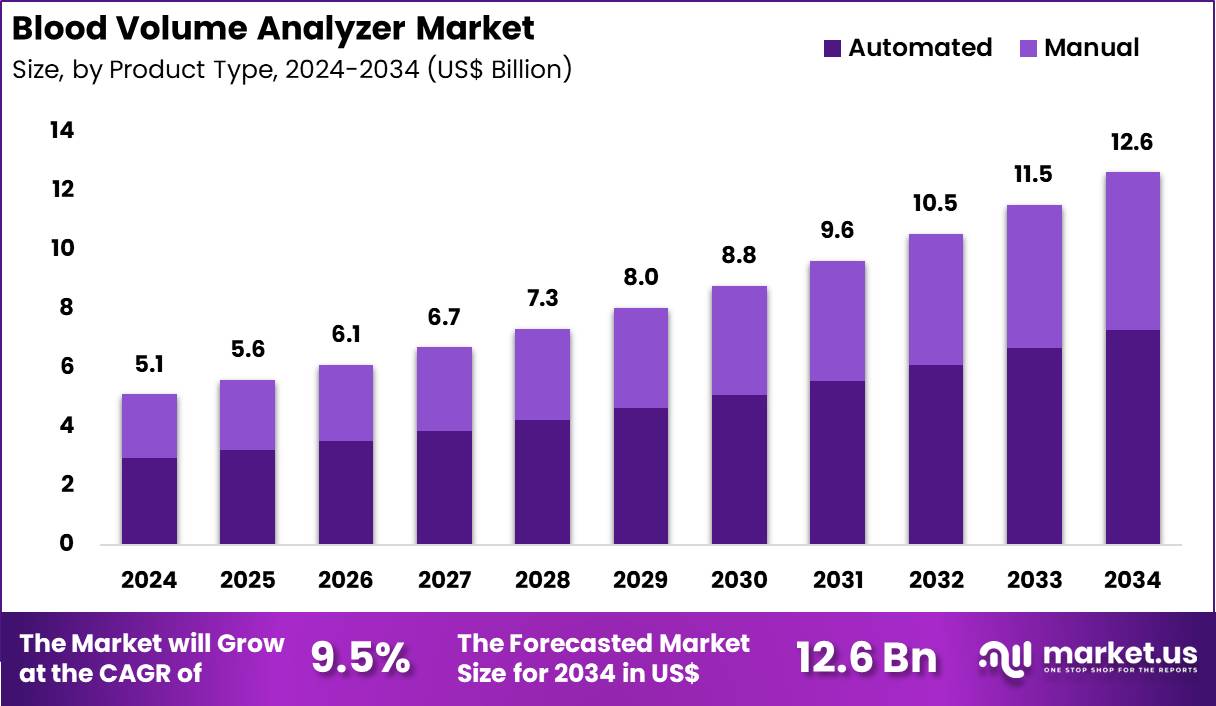
Key Takeaways
- In 2024, the Blood Volume Analyzer Market generated revenue of US$ 5.1 billion and is projected to grow at a CAGR of 9.5%, reaching approximately US$ 12.6 billion by 2034.
- Based on product type, the market is segmented into automated and manual analyzers. The automated segment dominated in 2024, accounting for a market share of 57.8%, driven by higher accuracy, efficiency, and adoption in healthcare facilities.
- By test type, the market is categorized into blood clotting test, blood enzyme test, and blood chemistry test. Among these, the blood clotting test segment held a leading position in 2024, capturing a significant market share of 46.9%.
- Based on end-user, the market is divided into diagnostic centers, hospitals, specialty clinics, and others. The diagnostic centers segment emerged as the dominant category in 2024, accounting for the largest revenue share of 44.7%.
- North America dominated the Blood Volume Analyzer Market in 2024, holding a market share of 37.3%, supported by advanced healthcare infrastructure, increasing diagnostic procedures, and higher adoption of automated blood analysis technologies.
Market Segmentation Overview
- Product Type Analysis: Automated systems dominated the market with a 57.8% share in 2024 and are expected to maintain leadership due to faster processing, improved accuracy, and reduced manual errors. These analyzers support high-volume testing in laboratories and hospitals. Increasing demand for standardized blood analysis, advanced sensors, and integrated software solutions is driving adoption of automated blood volume analyzer systems.
- Test Type Analysis: Blood clotting tests accounted for a 46.9% market share in 2024 and are expected to remain the leading test type due to their importance in detecting coagulation disorders and monitoring anticoagulant therapies. Rising cases of cardiovascular diseases, hemophilia, liver disorders, and surgical procedures are increasing demand for accurate clotting assessments across diagnostic laboratories and healthcare facilities.
- End-User Analysis: Diagnostic centers held the largest share of 44.7% in 2024 and are projected to dominate due to high testing volumes and growing demand for specialized blood analysis services. These centers increasingly adopt automated analyzers to improve efficiency, reduce turnaround time, and provide accurate results. Expansion of diagnostic networks and rising preventive testing trends further support segment growth.
Statistical Information
- Cardiovascular Disease Burden Driving Blood Volume Monitoring Requirements: The increasing prevalence of cardiovascular conditions is creating demand for accurate blood volume measurement and hemodynamic monitoring technologies. WHO reported that cardiovascular diseases accounted for 19.8 million deaths in 2022, with 85% of cardiovascular deaths linked to heart attacks and strokes. Early detection and monitoring are considered essential for improving patient outcomes.
- Automation Adoption in Blood Volume Analyzer Systems: The demand for automated blood analysis is supported by the increasing burden of cardiovascular diseases. According to WHO, cardiovascular diseases caused 19.8 million deaths globally in 2022, accounting for approximately 32% of all deaths worldwide. Among these deaths, 85% were caused by heart attacks and strokes, increasing the requirement for advanced monitoring and diagnostic technologies.
- Anemia Prevalence Increasing Need for Blood Volume Measurement: Anemia remains a major health concern worldwide and increases demand for blood-related diagnostic assessments. According to WHO, anemia affects approximately 1.92 billion people globally, with women and children representing the most affected groups. Around 30% of women aged 15–49 years worldwide are affected by anemia.
- Increasing Blood Transfusion Procedures Supporting Blood Volume Assessment: The growing requirement for blood transfusion management is increasing demand for technologies that provide accurate blood volume information. According to the American Red Cross, approximately 29,000 units of red blood cells, 5,000 units of platelets, and 6,500 units of plasma are needed daily in the United States for patients requiring transfusion support.
- Increasing Prevalence of Anemia Driving Demand for Blood Volume Measurement: The rising global burden of anemia is increasing the requirement for advanced blood analysis and volume measurement technologies. According to WHO, anemia affects approximately 1.92 billion people worldwide, creating significant demand for diagnostic solutions that evaluate hemoglobin levels, red blood cell status, and overall blood health. Around 40% of children aged 6–59 months, 37% of pregnant women, and 30% of women aged 15–49 years are affected by anemia globally.
- Anticoagulant Therapy Growth Increasing Coagulation Test Requirements: The increasing use of anticoagulant medications is driving demand for regular blood clotting monitoring. CDC estimates that atrial fibrillation affects approximately 5.6 million people in the United States, and the number is projected to rise to 12.1 million by 2030.
- Increasing Blood Disorder Burden Supporting Blood Volume Analyzer Adoption: The increasing prevalence of blood-related disorders is creating demand for advanced blood volume measurement and diagnostic technologies. According to the World Health Organization (WHO), anemia affects approximately 1.92 billion people globally, representing nearly 24.3% of the world’s population. Anemia is particularly common among vulnerable groups, affecting around 40% of children aged 6–59 months, 37% of pregnant women, and 30% of women aged 15–49 years.
- Increasing Blood Transfusion Requirements Supporting Analyzer Utilization: The rising demand for blood transfusion services is supporting adoption of technologies that improve blood volume assessment and transfusion management. According to the American Red Cross, approximately 29,000 units of red blood cells, 5,000 platelet units, and 6,500 plasma units are required every day in the United States.
Regional Analysis
North America led the market by securing a market share of 37.3% in 2024.
North America led the Blood Volume Analyzer Market in 2024, accounting for 37.3% market share, supported by advanced healthcare infrastructure, high adoption of diagnostic technologies, and increasing demand for precise cardiovascular monitoring. The rising burden of heart failure and critical care cases is driving the use of blood volume assessment solutions. According to the American Heart Association, approximately 6.7 million adults in the United States were living with heart failure in 2022, increasing the need for improved fluid management.
Asia Pacific is projected to experience strong growth during the forecast period due to rising cardiovascular disease cases, healthcare infrastructure expansion, and increasing adoption of advanced diagnostic systems. According to WHO, cardiovascular diseases remain a leading cause of mortality across the region, encouraging early diagnosis and monitoring. Growing investments in hospitals, research centers, and diagnostic networks are expected to support regional expansion.
Business Opportunities
The Blood Volume Analyzer Market offers significant growth opportunities through automation, digital healthcare integration, and expanding clinical applications. Companies can develop advanced automated systems with improved accuracy, faster processing, and artificial intelligence capabilities to support hospitals and diagnostic laboratories. Rising cardiovascular disease and heart failure cases are creating demand for precise blood volume monitoring solutions, especially in critical care and cardiology departments.
According to the American Heart Association, approximately 6.7 million adults in the U.S. were living with heart failure in 2022, increasing the need for better fluid-management technologies. Emerging markets in Asia Pacific and Latin America provide opportunities through healthcare infrastructure expansion and increasing diagnostic access. Additionally, portable and point-of-care blood volume analyzers can improve testing availability in emergency and outpatient settings. Partnerships with hospitals, research institutions, and diagnostic networks can further accelerate adoption and market penetration.
Emerging Trends
- Increasing Use in Heart Failure Management: Blood volume analyzers are becoming important tools for monitoring fluid status in heart failure patients. The American Heart Association reported approximately 6.7 million adults in the U.S. had heart failure in 2022, increasing demand for accurate volume assessment technologies.
- Growing Adoption in Critical Care Monitoring: Intensive care units are increasingly using advanced blood volume assessment solutions for patients with sepsis, shock, and hemodynamic instability. The Society of Critical Care Medicine reports more than 5.7 million ICU admissions annually in the U.S., supporting demand for rapid monitoring systems.
- Integration of Automation and Digital Healthcare Platforms: Laboratories are adopting automated diagnostic systems with digital connectivity to improve accuracy, workflow, and reporting efficiency. The U.S. CMS reports more than 260,000 laboratories participating in the CLIA program, reflecting the expanding diagnostic infrastructure.
- Expansion in Surgical and Perioperative Applications: Blood volume analysis is increasingly used for evaluating blood loss, fluid replacement, and transfusion planning during surgeries. WHO estimates approximately 313 million surgical procedures are performed each year globally, creating demand for advanced monitoring technologies.
- Shift Toward Personalized Fluid Management: Healthcare providers are adopting quantitative blood volume measurements to improve individualized treatment decisions in cardiovascular, renal, and critical care settings. WHO reports cardiovascular diseases cause approximately 19.8 million deaths annually, increasing the need for precise monitoring approaches.
Use Cases
- Heart Failure Patient Monitoring: Blood volume analyzers are used to measure fluid status in heart failure patients, helping clinicians identify fluid overload and optimize treatment strategies. The American Heart Association reported approximately 6.7 million adults in the U.S. had heart failure in 2022, increasing demand for precise volume assessment tools.
- Critical Care and ICU Management: These analyzers support intensive care teams in monitoring blood volume changes in patients with shock, sepsis, and hemodynamic instability. The Society of Critical Care Medicine reports over 5.7 million ICU admissions annually in the U.S., creating demand for advanced monitoring technologies.
- Surgical Blood Loss Assessment: Blood volume analysis is used before and after major surgeries to estimate blood loss, guide transfusion decisions, and improve patient safety. WHO estimates approximately 313 million surgical procedures are performed worldwide each year, increasing the need for accurate perioperative monitoring.
- Renal Disease and Fluid Balance Management: Blood volume analyzers assist healthcare providers in evaluating fluid changes among patients with kidney disorders requiring careful volume management. The National Kidney Foundation reports that chronic kidney disease affects approximately 850 million people globally, increasing the need for improved monitoring solutions.
- Blood Transfusion Planning and Management: These systems help assess patient blood volume to support appropriate transfusion decisions in trauma, anemia, and surgical cases. The American Red Cross states that approximately 29,000 red blood cell units are required daily in the U.S., highlighting the need for effective blood management technologies.
Recent Development
- In 2026, Sysmex Corporation continued strengthening its diagnostics business by advancing medical digital transformation and expanding its global diagnostic technology portfolio. The company introduced the HISCL™ p-Tau217 Assay Kit for Research Use in Europe in April 2026, supporting blood-based biomarker testing and future in-vitro diagnostic development. Sysmex also announced a new mid-term plan focused on reinforcing diagnostics and healthcare innovation through 2029.
- In 2026, Beckman Coulter Diagnostics expanded its automated diagnostics portfolio with new laboratory testing solutions. The company launched the DxU 1800 Fully Automated Urinalysis System in July 2026 to support increasing laboratory testing volumes. It also introduced new blood-based diagnostic capabilities, including a CE-marked p-Tau217 blood test, strengthening its precision diagnostics portfolio.
- In 2026, Abbott Laboratories continued expanding its diagnostics and medical technology business. The company reported strong growth momentum, supported by diagnostics and medical device segments. Abbott also completed the acquisition of Exact Sciences, strengthening its cancer diagnostics capabilities and expanding its advanced testing portfolio.
- In 2026, Roche Diagnostics continued focusing on laboratory automation, digital diagnostics, and advanced testing platforms. The company expanded integrated diagnostic solutions designed to improve laboratory efficiency, increase testing capacity, and support faster clinical decision-making across hospitals and diagnostic centers.
- In 2026, Thermo Fisher Scientific, Inc. continued investing in laboratory technologies, analytical instruments, and precision diagnostics. The company focused on improving workflow automation, advanced analytical capabilities, and solutions supporting clinical research and healthcare laboratories.
- In 2026, Siemens Healthineers AG advanced its diagnostic technology strategy through automation, digital healthcare solutions, and connected laboratory systems. The company continued developing solutions aimed at improving diagnostic accuracy, reducing turnaround time, and supporting data-driven healthcare decisions.
Frequently Asked Questions on Blood Volume Analyzer
- What is driving the growth of the Blood Volume Analyzer Market?
The market is growing due to increasing cardiovascular diseases, rising critical care admissions, growing surgical procedures, and demand for accurate fluid management. Advanced automated analyzers, improved diagnostic accuracy, and increasing adoption of precision healthcare solutions are further supporting market expansion. - Which product type dominates the Blood Volume Analyzer Market?
The automated blood volume analyzer segment dominated the market in 2024, accounting for 57.8% share. Automated systems are preferred due to faster processing, improved accuracy, reduced manual errors, and better suitability for high-volume laboratory testing environments. - Which region dominates the Blood Volume Analyzer Market?
North America dominated the Blood Volume Analyzer Market in 2024 with a 37.3% market share. The region benefits from advanced healthcare infrastructure, increasing cardiovascular disease burden, strong diagnostic networks, and higher adoption of automated laboratory technologies. - What are the major applications of Blood Volume Analyzers?
Blood volume analyzers are mainly used in cardiovascular monitoring, heart failure management, critical care, surgical blood loss assessment, transfusion planning, and fluid balance evaluation. These applications help healthcare providers improve diagnosis, treatment planning, and patient monitoring outcomes. - How does automation impact the Blood Volume Analyzer Market?
Automation improves laboratory efficiency by reducing manual intervention, increasing testing accuracy, and enabling faster processing. Automated blood volume analyzers help hospitals and diagnostic centers manage large sample volumes while maintaining consistent and reliable clinical results. - What role does cardiovascular disease play in market growth?
Cardiovascular disease significantly influences market growth because accurate blood volume assessment supports heart failure and fluid management. According to WHO, cardiovascular diseases cause approximately 19.8 million deaths annually, increasing demand for advanced monitoring technologies. - What are the key trends in the Blood Volume Analyzer Market?
Major trends include integration of digital healthcare platforms, automation, point-of-care testing development, artificial intelligence-based analysis, and personalized fluid management. These advancements improve diagnostic accuracy, support faster decision-making, and expand applications across hospitals and specialized healthcare settings.
Conclusion
The Blood Volume Analyzer Market is experiencing steady growth due to increasing demand for accurate blood measurement technologies in cardiovascular care, critical care, surgery, and diagnostic applications. Automation, digital integration, and advanced testing solutions are improving diagnostic efficiency and patient management.
The market is supported by rising cardiovascular disease prevalence, growing surgical procedures, and increasing adoption of precision healthcare approaches. North America currently leads the market due to strong healthcare infrastructure, while Asia Pacific offers significant growth opportunities. Key players are focusing on innovation, product development, and strategic expansion to enhance diagnostic capabilities and address the growing need for reliable blood volume assessment solutions.
Discuss your needs with our analyst
Please share your requirements with more details so our analyst can check if they can solve your problem(s)




