


Overview
New York, NY – August 19, 2026 – The Global Beta Thalassemia Testing Market Size is expected to be worth around US$ 1245.7 Million by 2034 from US$ 561.2 Million in 2024, growing at a CAGR of 8.3% during the forecast period 2025 to 2034. North America held a dominant market position, capturing more than a 38.8% share and holding a US$ 271.8 Million market value for the year.
Beta thalassemia testing is an essential diagnostic approach for identifying inherited blood disorders caused by mutations in the HBB gene, which reduce the production of beta-globin in hemoglobin. Early testing enables timely diagnosis, carrier detection, genetic counseling, and prenatal screening, helping reduce the burden of severe disease. According to the World Health Organization (WHO), nearly 5% of the global population carries a gene associated with a hemoglobin disorder, while approximately 300,000–500,000 infants are born each year with severe inherited hemoglobin disorders.
In addition, around 1.1% of couples worldwide are at risk of having children with clinically significant hemoglobin disorders. Beta thalassemia testing includes complete blood count (CBC), hemoglobin electrophoresis, high-performance liquid chromatography (HPLC), and DNA-based molecular testing. HbA2 levels above 3.5% are a common indicator of beta thalassemia trait, while advanced next-generation sequencing (NGS) can detect more than 350 HBB gene mutations, improving diagnostic accuracy.
According to the National Heart, Lung, and Blood Institute (NHLBI), patients with beta thalassemia major often require blood transfusions every 2–5 weeks, making early diagnosis critical for effective disease management. Growing newborn screening programs, expanding carrier screening initiatives, and increasing government investment in genetic testing are driving broader adoption of beta thalassemia testing worldwide.
Advances in molecular diagnostics, automation, and precision medicine continue to improve testing accuracy, support personalized treatment decisions, enhance patient outcomes, and reduce the long-term healthcare burden associated with inherited blood disorders.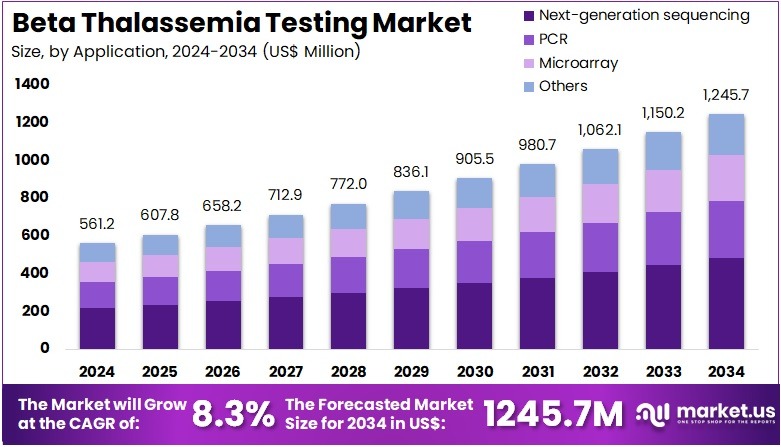
Key Takeaways
- In 2024, the beta thalassemia testing market generated US$ 561.2 million in revenue and is projected to reach US$ 1,245.7 million by 2034, expanding at a CAGR of 8.3% during the forecast period.
- By product type, the market is segmented into prenatal testing, perinatal testing, preimplantation testing, DNA testing, complete blood count (CBC), and chorionic villus sampling (CVS). Among these, prenatal testing dominated the market with a 41.2% share in 2024.
- Based on application, the market is categorized into next-generation sequencing (NGS), PCR, microarray, and others. Next-generation sequencing (NGS) emerged as the leading application segment, accounting for 38.7% of the market share.
- By end user, the market is classified into diagnostic laboratories, hospitals, pharmaceutical industries, and others. Diagnostic laboratories held the largest share, contributing 49.6% of the total market revenue in 2024.
- North America dominated the global beta thalassemia testing market, capturing a 38.8% market share in 2024.
Statistical Information
- Global Burden of Hemoglobin Disorders Supports Demand for Beta Thalassemia Testing: According to the World Health Organization (WHO), approximately 5% of the world’s population carries genes for hemoglobin disorders, and about 300,000–500,000 infants are born each year with severe inherited hemoglobin disorders, including beta thalassemia. These figures highlight the growing need for carrier screening, prenatal diagnosis, and early genetic testing.
- Carrier Screening Identifies High-Risk Couples Before Pregnancy: The U.S. Centers for Disease Control and Prevention (CDC) states that when both parents are carriers of a beta-thalassemia gene mutation, each pregnancy has a 25% chance of producing an affected child, a 50% chance of producing a carrier, and a 25% chance of producing an unaffected child. This supports increased adoption of premarital and preconception genetic testing.
- Newborn Screening Programs Continue to Expand: A CDC-supported nationwide survey found that 44 of 53 (83%) U.S. newborn screening programs participated in the survey, and 41 of 44 responding programs (93%) reported screening newborns for thalassemia-related conditions. This demonstrates the growing integration of hemoglobin disorder testing into public health screening programs.
- Two Carrier Parents Face a 25% Risk in Every Pregnancy: According to ACOG, if both parents are carriers of beta thalassemia or another autosomal recessive hemoglobin disorder, each pregnancy carries a 25% (1 in 4) chance of an affected child, a 50% chance of a carrier child, and a 25% chance of an unaffected child. This is a major driver for genetic testing.
- HbA₂ Levels Above 3.5% Are a Key Diagnostic Marker: According to GeneReviews (NCBI Bookshelf), individuals with beta-thalassemia trait typically have HbA₂ levels greater than 3.5%. Normal HbA₂ levels are 2–3%, making this laboratory threshold one of the most important indicators used during diagnostic testing
- Normal Hemoglobin A Represents 96–98% of Adult Hemoglobin: GeneReviews reports that healthy adults generally have 96–98% Hemoglobin A (HbA), whereas beta-thalassemia carriers usually have 92–95% HbA, together with elevated HbA₂. These measurable differences support accurate laboratory diagnosis.
- More Than 300 Million People Carry a Hemoglobin Disorder Gene Worldwide: The World Health Organization (WHO) estimates that about 5% of the global population carries genes for hemoglobin disorders. Based on the current global population of more than 8 billion, this represents over 400 million people, underscoring the importance of population-wide carrier screening and genetic testing.
- More Than 1,000 Clinical Laboratories Hold CAP Accreditation: The College of American Pathologists (CAP) accredits more than 8,000 laboratories worldwide, including many molecular and genetic testing laboratories that perform beta thalassemia testing. CAP accreditation supports high-quality diagnostic laboratory services.
Regional Analysis
North America led the market by securing a market share of 38.8% in 2024.
In 2024, North America accounted for 38.8% of the global beta thalassemia testing market, supported by advanced healthcare infrastructure, widespread genetic screening, and strong public health initiatives. The American College of Obstetricians and Gynecologists (ACOG) recommends universal hemoglobinopathy testing for individuals planning pregnancy or during the first prenatal visit, increasing demand for carrier screening and prenatal diagnosis.
According to the U.S. Centers for Disease Control and Prevention (CDC), about 98% of newborns in the United States receive newborn screening, while the Health Resources and Services Administration (HRSA) includes hemoglobin disorders in the Recommended Uniform Screening Panel (RUSP). A study published in the International Journal of Neonatal Screening reported that 26 U.S. states include beta thalassemia in their newborn screening programs.
The region also benefits from the growing adoption of next-generation sequencing (NGS), automated HPLC systems, molecular diagnostics, and genetic counseling services, enabling earlier diagnosis, improved clinical management, and better long-term patient outcomes.
Emerging Trends
- Growing adoption of genetic and DNA-based testing: Healthcare providers are increasingly using next-generation sequencing (NGS) and molecular genetic testing to identify HBB gene mutations with greater accuracy. According to NIH GeneReviews, molecular testing confirms disease subtype and supports carrier detection, prenatal diagnosis, and personalized clinical management.
- Expansion of universal prenatal carrier screening: The American College of Obstetricians and Gynecologists (ACOG) recommends hemoglobinopathy testing for people planning pregnancy or at the first prenatal visit. ACOG estimates that about 1 in 66 people in the United States carries a hemoglobinopathy trait, increasing demand for routine screening.
- Increasing use of newborn screening programs: Newborn screening continues to expand across the United States. The CDC reports that about 98% of U.S. newborns receive newborn screening, enabling earlier diagnosis of inherited blood disorders and faster confirmatory beta thalassemia testing through specialized laboratories.
- Advanced laboratory technologies improve testing efficiency: Automated HPLC, hemoglobin electrophoresis, and molecular diagnostics are improving laboratory accuracy and reducing diagnostic delays. The NIH recommends combining CBC, hemoglobin analysis, and genetic testing to differentiate beta thalassemia from other causes of anemia and confirm inherited mutations.
- Greater focus on early diagnosis through public health programs: Government agencies continue to strengthen education and screening initiatives. The CDC updated its healthcare provider toolkit in 2025, promoting standardized diagnosis, genetic counseling, and long-term disease management to improve patient outcomes and reduce complications.
Use Cases
- Carrier screening before pregnancy: Beta thalassemia testing is widely used to identify healthy carriers before conception. According to ACOG, if both partners are carriers, each pregnancy has a 25% chance of producing an affected child, making early screening valuable for reproductive planning.
- Prenatal diagnosis in high-risk pregnancies: Physicians use chorionic villus sampling (10–13 weeks), amniocentesis, and DNA testing to detect beta thalassemia during pregnancy. Early diagnosis supports informed clinical decisions and helps families prepare for specialized medical care after birth.
- Confirming diagnosis in patients with unexplained anemia: Patients with persistent microcytic anemia often undergo CBC, hemoglobin electrophoresis, and genetic testing. According to ACOG, an MCV below 80 fL and HbA₂ levels above 3.5% strongly indicate beta thalassemia trait and require confirmatory testing.
- Newborn confirmation and early disease management: Infants with abnormal newborn screening results receive confirmatory beta thalassemia testing shortly after birth. Early identification enables prompt clinical monitoring, transfusion planning, and genetic counseling, helping reduce disease-related complications during childhood.
- Monitoring patients receiving lifelong treatment: Individuals with severe beta thalassemia require continuous laboratory testing during treatment. The CDC notes that many patients receive regular blood transfusions every few weeks, making repeated hematology testing essential for monitoring hemoglobin levels, iron overload, and treatment effectiveness.
Frequently Asked Questions on Beta Thalassemia Testing
- Which tests are commonly used to diagnose beta thalassemia?
Diagnosis generally starts with CBC and hemoglobin electrophoresis or HPLC to evaluate hemoglobin abnormalities. DNA testing and next-generation sequencing (NGS) are then used to confirm HBB gene mutations and provide an accurate genetic diagnosis. - Why is prenatal beta thalassemia testing important?
Prenatal testing identifies whether a fetus has inherited beta thalassemia when both parents are carriers. Early diagnosis through chorionic villus sampling or amniocentesis supports informed reproductive decisions and timely medical planning for affected pregnancies. - How does genetic testing improve beta thalassemia diagnosis?
Genetic testing identifies specific mutations in the HBB gene, improving diagnostic accuracy compared with blood tests alone. It enables carrier detection, prenatal diagnosis, family screening, and personalized treatment planning for individuals with inherited blood disorders. - What factors are driving the beta thalassemia testing market?
The market is driven by growing newborn screening programs, increasing carrier screening, greater awareness of inherited blood disorders, expanding use of molecular diagnostics, and advances in next-generation sequencing technologies that improve diagnostic accuracy and clinical decision-making. - Which end-user segment dominates the beta thalassemia testing market?
Diagnostic laboratories account for the largest market share because they perform carrier screening, confirmatory molecular testing, prenatal diagnosis, and routine hematology analysis. Increasing investments in laboratory automation further strengthen their role in disease diagnosis. - Why does North America lead the beta thalassemia testing market?
North America leads due to advanced healthcare infrastructure, widespread newborn screening, strong clinical guidelines, and growing adoption of molecular diagnostic technologies. Continued investment in genetic testing, public health programs, and laboratory services supports regional market growth. - Is DNA testing more accurate than routine blood tests?
DNA testing directly identifies mutations in the HBB gene, providing greater diagnostic certainty than routine blood tests alone. It is especially useful for confirming uncertain cases, detecting rare variants, and supporting prenatal and preimplantation genetic testing. - How long does beta thalassemia testing usually take?
Routine laboratory tests such as CBC and hemoglobin electrophoresis are generally completed within a few days, while molecular genetic testing may require additional time depending on laboratory workflow and the complexity of the genetic analysis performed.
Conclusion
Beta thalassemia testing has become an essential component of modern healthcare, supporting early diagnosis, carrier identification, prenatal screening, and long-term disease management. Advances in molecular diagnostics, next-generation sequencing (NGS), and automated laboratory technologies are improving testing accuracy and accessibility worldwide. Expanding newborn screening programs, growing awareness of inherited blood disorders, and increasing government support for genetic screening continue to strengthen adoption across hospitals and diagnostic laboratories.
North America remains the leading regional market, while Asia Pacific is expected to witness strong growth due to rising screening initiatives. As precision medicine advances, beta thalassemia testing will play a critical role in improving patient outcomes, enabling informed reproductive decisions, and reducing the global burden of inherited hemoglobin disorders.
Discuss your needs with our analyst
Please share your requirements with more details so our analyst can check if they can solve your problem(s)




