


Overview
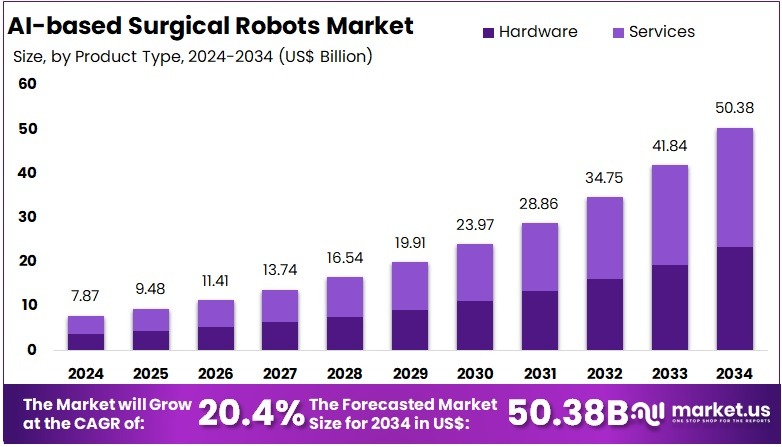
The Global AI-based Surgical Robots Market size is expected to be worth around US$ 50.38 Billion by 2034, from US$ 7.87 Billion in 2024, growing at a CAGR of 20.4% during the forecast period from 2025 to 2034. North America held a dominant market position, capturing more than a 42.2% share and holds US$ 3.32 Billion market value for the year.
AI-based surgical robots are advanced medical systems that combine robotic-assisted surgery with artificial intelligence (AI) to support surgeons in performing complex procedures with greater precision, consistency, and efficiency. These systems use technologies such as computer vision, machine learning, real-time imaging, and data analytics to assist with surgical planning, instrument guidance, and intraoperative decision-making. Rather than replacing surgeons, AI-powered robots enhance human expertise by improving accuracy and reducing variability during minimally invasive procedures.
The adoption of AI-based surgical robots is increasing across specialties such as urology, gynecology, orthopedics, cardiothoracic surgery, neurosurgery, and general surgery. Hospitals and healthcare providers are investing in these technologies to improve patient outcomes, shorten hospital stays, reduce complications, and enhance surgical workflow. The growing use of digital healthcare platforms, high-definition imaging, and cloud-based data analysis is further strengthening the role of AI in robotic surgery.
Technological advancements continue to expand the capabilities of AI-enabled surgical systems. Features such as real-time tissue recognition, predictive analytics, robotic motion assistance, and AI-driven workflow optimization are helping surgeons perform procedures with greater confidence. Integration with electronic health records (EHRs), advanced imaging platforms, and remote collaboration tools is also improving surgical planning and post-operative evaluation.
The market is supported by increasing demand for minimally invasive surgery, rising investments in healthcare automation, expanding surgical procedure volumes, and continuous innovation by medical technology companies. As regulatory approvals increase and healthcare infrastructure improves worldwide, AI-based surgical robots are expected to play a significant role in transforming modern surgical care, improving operational efficiency, and supporting better clinical outcomes across a wide range of medical specialties.
Key Takeaways
- The global AI-based surgical robots market is expected to grow from US$ 7.87 billion in 2024 to US$ 50.38 billion by 2034, expanding at a 20.4% CAGR during the forecast period.
- The services segment held more than 53.7% of the market in 2024, supported by increasing demand for system maintenance, software upgrades, technical support, and clinician training.
- Semi-autonomous robotic systems accounted for over 44.1% of the market in 2024, driven by their ability to combine AI-assisted automation with surgeon control for improved procedural accuracy.
- General surgery represented more than 29.7% of the application segment in 2024, reflecting the widespread use of robotic-assisted technologies across minimally invasive surgical procedures.
- Hospitals captured over 73.9% of the end-user market in 2024, owing to higher adoption of robotic surgical platforms in tertiary care hospitals and advanced healthcare institutions.
- North America held more than 42.2% of the global market in 2024, reaching approximately US$ 3.32 billion, supported by advanced healthcare infrastructure, early technology adoption, and strong investment in robotic-assisted surgery.
Statistical Information
- A 2025 peer-reviewed study of the ROSA Knee System found that the average total operative time decreased from 62.6 ± 7.9 minutes during the learning phase to 49.9 ± 8.1 minutes after the first 10 cases, representing a reduction of about 20.3%.
- The same 2025 study reported that the robotic portion of surgery accounted for 48% of total operative time during the learning phase, decreasing to 42% after surgeons reached proficiency.
- A 2025 multicenter study of robot-assisted total knee arthroplasty found tourniquet time decreased from 61.4 minutes to 56.7 minutes as surgeons gained experience (P = 0.0417).
- The same 2025 study showed robotic planning time was reduced from 13.49 minutes to 6.68 minutes, representing approximately a 50.5% reduction over the first 75 robotic procedures.
- The AI-assisted robotic group also reduced total postoperative blood loss within 72 hours from 1118.71 ± 193.30 mL to 1022.96 ± 226.14 mL (P = 0.036).
- A 2025 systematic review covering 25 peer-reviewed studies (2024–2025) found AI-assisted robotic surgery achieved an average 25% reduction in operative time compared with conventional surgery.
- The same 2025 review reported a 30% reduction in intraoperative complications with AI-assisted robotic surgery compared with manual techniques.
- The review also found AI-assisted robotic surgery improved surgical precision by approximately 40%, particularly in tumor resections and implant placement.
- According to the same 2025 review, patient recovery time was shortened by an average of 15% following AI-assisted robotic procedures.
Regional Analysis
North America dominated the AI-based surgical robots market in 2024, accounting for more than 42.2% of global revenue, valued at US$ 3.32 billion. The region’s leadership is driven by widespread adoption of robotic-assisted surgery, advanced hospital infrastructure, and strong investments in artificial intelligence. The U.S. Food and Drug Administration (FDA) has established clear regulatory pathways for AI-enabled medical devices through the 510(k), De Novo, and PMA programs, encouraging hospitals to deploy advanced surgical technologies. The Agency for Healthcare Research and Quality (AHRQ) has reported continued growth in robotic-assisted procedures across inpatient and outpatient settings, reflecting expanding clinical acceptance.
The Veterans Health Administration (VHA) has also increased robotic surgery utilization across its healthcare network, supporting broader institutional adoption. In Canada, standardized reporting by the Canadian Institute for Health Information (CIHI) has improved monitoring of robotic-assisted procedures. Combined with strong academic research, high electronic health record adoption, and supportive reimbursement policies, these factors continue to strengthen North America’s leadership in the AI-based surgical robots market.
Emerging Trends
- AI-assisted decision support is becoming a standard feature. AI is increasingly used to identify anatomical structures, provide real-time surgical guidance, and reduce human error during minimally invasive procedures. In January 2025, the U.S. FDA issued comprehensive draft guidance for AI-enabled medical devices, encouraging safer lifecycle management. The FDA has also authorized more than 1,000 AI-enabled medical devices, supporting broader clinical adoption.
- Human-controlled robotic surgery remains the dominant approach. Modern AI surgical robots continue to assist rather than replace surgeons. According to the FDA, robot-assisted systems are approved for procedures including urology, gynecology, thoracic, cardiac, colorectal, and general surgery. A systematic review identified 49 FDA-cleared surgical robots, with 86% classified as Level 1 (robot assistance), showing that surgeon oversight remains essential.
- AI is improving surgeon training and surgical quality. Healthcare providers are adopting AI to evaluate surgical skills, detect workflow errors, and shorten learning curves. A 2026 review published in Nature Reviews Urology highlighted AI applications in automated skill assessment, anatomy recognition, and intraoperative guidance, helping improve consistency across surgical teams.
- Compact robotic platforms are expanding hospital adoption. Manufacturers are introducing smaller robotic systems that fit standard operating rooms. In 2026, Johnson & Johnson received U.S. FDA authorization for its Ottava robotic system, designed with an integrated operating table that reduces its operating-room footprint by up to 50%, enabling installation in hospitals with limited surgical space.
- Greater focus on AI safety, transparency, and post-market monitoring. Regulatory agencies are strengthening oversight as AI capabilities expand. The FDA continues to monitor adverse event reports, encourages real-world evidence collection, and promotes surgeon training programs. New AI regulations emphasize bias reduction, documentation, and continuous software updates throughout a device’s lifecycle.
Use Cases
- Minimally invasive abdominal surgery: AI-assisted robotic systems are widely used for laparoscopic procedures such as gallbladder removal, gastric bypass, gastrectomy, and appendectomy. These systems provide three-dimensional visualization, enhanced instrument control, and greater precision through small incisions, supporting faster patient recovery and improved surgical accuracy.
- Urology and prostate surgery: Robotic platforms are extensively used for prostatectomy and other urological procedures. AI supports accurate tissue identification, motion stabilization, and workflow guidance, helping surgeons perform delicate operations with improved precision while reducing unnecessary tissue damage during complex procedures.
- Gynecological and colorectal procedures: Hospitals increasingly use AI-assisted robots for hysterectomy and colorectal surgery because robotic instruments improve dexterity in confined anatomical spaces. FDA-cleared robotic systems are approved across multiple specialties, allowing surgeons to perform complex minimally invasive procedures with greater consistency.
- Real-time surgical guidance and anatomy recognition: AI analyzes live surgical video to identify organs, blood vessels, and anatomical landmarks while alerting surgeons to potential risks. Research published in 2026 shows AI-assisted perception and intraoperative guidance can reduce variability in surgical performance and improve clinical decision-making.
- Remote collaboration and surgical education: AI-enabled robotic systems support telesurgery research, simulation-based learning, and automated performance assessment. International surveys covering 671 surgeons from 98 countries found 96.6% were willing to integrate AI into clinical practice, highlighting strong interest in AI-supported education and collaborative surgical workflows.
Frequently Asked Questions on AI-based Surgical Robots
- What are the major applications of AI-based Surgical Robots?
AI-based surgical robots are used in various procedures, including general surgery, orthopedic surgery, neurosurgery, gynecology, urology, and cardiac surgery. These systems help perform minimally invasive operations by improving movement control, precision, visualization, and overall surgical workflow efficiency. - What are the benefits of AI-based Surgical Robots?
AI-based surgical robots offer several benefits, including improved surgical accuracy, smaller incisions, reduced blood loss, faster recovery times, and enhanced surgeon capabilities. AI technologies also support real-time analysis, automation, and improved planning for complex surgical procedures. - How is artificial intelligence improving robotic surgery?
Artificial intelligence improves robotic surgery by enabling advanced image recognition, automated assistance, motion analysis, and predictive decision support. AI algorithms help surgeons identify anatomical structures, optimize surgical approaches, and improve consistency during procedures while maintaining human control. - Are AI-based Surgical Robots replacing surgeons?
AI-based surgical robots are not replacing surgeons but assisting them with advanced technology. Surgeons remain responsible for decision-making and control, while robotic systems enhance their skills by providing improved precision, visualization, and data-driven support during operations. - What factors are driving the AI-based Surgical Robots Market growth?
The AI-based surgical robots market is growing due to increasing demand for minimally invasive surgeries, rising healthcare technology adoption, aging populations, higher surgical volumes, and advancements in artificial intelligence, robotics, imaging systems, and healthcare automation. - Which surgical areas are adopting AI-based robotic systems the most?
AI-based robotic systems are increasingly adopted in urology, gynecology, general surgery, orthopedics, and cardiac procedures. These fields benefit from robotic precision, enhanced visualization, smaller surgical movements, and improved control during minimally invasive and complex surgical interventions. - What technologies are used in AI-based Surgical Robots?
AI-based surgical robots integrate technologies such as machine learning, computer vision, advanced sensors, 3D imaging, robotic arms, data analytics, and real-time navigation systems. These technologies help improve surgical accuracy, automation capabilities, and clinical decision support. - How will AI-based Surgical Robots impact healthcare in the future?
AI-based surgical robots are expected to transform healthcare by enabling more precise procedures, personalized surgical planning, remote surgical assistance, and advanced automation. Future developments may increase accessibility, improve outcomes, and support surgeons in increasingly complex operations.
Conclusion
The AI-based surgical robots market is poised for strong long-term growth as healthcare providers increasingly adopt intelligent robotic systems to improve surgical precision, patient safety, and clinical efficiency. Advances in artificial intelligence, machine learning, computer vision, and real-time analytics are enabling more accurate and minimally invasive procedures across multiple surgical specialties. Rising demand for better patient outcomes, shorter hospital stays, and workflow optimization continues to support market expansion. Ongoing investments in research, regulatory approvals, and product innovation are expected to accelerate adoption worldwide. As technology continues to evolve, AI-based surgical robots will become an essential component of modern surgical care and healthcare transformation.
Discuss your needs with our analyst
Please share your requirements with more details so our analyst can check if they can solve your problem(s)




