


Overview
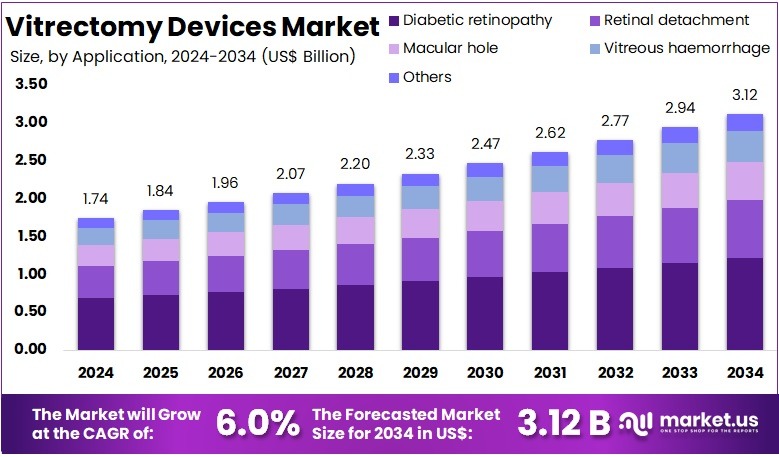
New York, NY – Aug 03, 2026 – The Global Vitrectomy Devices Market size is expected to be worth around US$ 3.12 Billion by 2034, from US$ 1.74 Billion in 2024, growing at a CAGR of 6% during the forecast period from 2025 to 2034. North America held a dominant market position in the global vitrectomy devices market, capturing more than a 37.2% share and achieving a market value of approximately USD 647.3 million.
Vitrectomy devices are advanced ophthalmic surgical instruments used to treat disorders affecting the vitreous humor and retina inside the eye. These devices play a vital role in modern vitreoretinal surgery by enabling surgeons to remove the vitreous gel safely and precisely while minimizing trauma to delicate eye tissues.
Vitrectomy procedures are commonly performed to manage retinal detachment, diabetic retinopathy, macular holes, epiretinal membranes, vitreous hemorrhage, and complications resulting from eye injuries. The growing prevalence of diabetes-related eye diseases and age-related retinal disorders continues to increase the demand for these specialized surgical systems.
Modern vitrectomy systems include high-speed vitreous cutters, illumination systems, fluidics management units, laser probes, and visualization technologies that improve surgical accuracy and patient outcomes. Continuous technological advancements, including smaller gauge instruments such as 23G, 25G, and 27G systems, have enabled minimally invasive procedures, leading to reduced surgical time, faster recovery, and improved patient comfort. Integration of digital imaging and advanced microscope visualization further enhances precision during complex retinal surgeries.
Hospitals, ophthalmology clinics, and ambulatory surgical centers are the primary end users of vitrectomy devices. Rising healthcare investments, expanding access to specialized eye care services, and increasing awareness of early diagnosis and treatment of retinal diseases are supporting broader adoption worldwide. In addition, the growing elderly population, which is more susceptible to retinal disorders, is contributing to sustained market demand.
As innovation continues in surgical instrumentation, imaging technologies, and minimally invasive ophthalmic procedures, vitrectomy devices are expected to remain an essential component of retinal disease management, supporting improved clinical outcomes and enhancing the quality of vision care across global healthcare systems.
Key Takeaways
- The Global Vitrectomy Devices Market is anticipated to reach US$ 3.12 billion by 2034, expanding at a 6.0% CAGR during the forecast period from 2025 to 2034.
- In 2024, vitrectomy surgical platforms emerged as the leading product type, accounting for over 31.4% of the global market, driven by their widespread use in advanced retinal surgeries.
- Diabetic retinopathy represented the largest application segment in 2024, contributing more than 39.2% of the market due to the increasing prevalence of diabetes-related retinal disorders.
- Hospitals remained the dominant end-user in 2024, capturing over 48.7% of the global market, supported by the availability of specialized ophthalmic surgeons and advanced surgical infrastructure.
- North America held the leading regional position in 2024, accounting for more than 37.2% of the global market, with a market value of approximately US$ 647.3 million, driven by strong healthcare infrastructure and high adoption of advanced ophthalmic technologies.
Statistical Information
- A 27-gauge 20,000 cuts-per-minute (CPM) vitrectomy probe reduced average core vitrectomy time to 161.6 ± 10.4 seconds, compared with 206.8 ± 10.1 seconds using a 10,000 CPM probe (approximately 22% faster) in a 2025 randomized clinical trial.
- The same 2025 study showed peripheral vitreous shaving time decreased from 544.2 ± 22.2 seconds to 446.3 ± 20.3 seconds when using a 20,000 CPM cutter instead of a 10,000 CPM cutter (about 18% reduction).
- A 2025 randomized study involving 71 completed surgeries reported mean core vitrectomy times of 269.28 seconds with a 20,000 CPM cutter versus 289.44 seconds with a 10,000 CPM cutter.
- In epiretinal membrane cases within the same 2025 trial, the 20,000 CPM system achieved a statistically significant reduction in core vitrectomy time compared with the 10,000 CPM system (P = 0.03).
- A 2025 randomized controlled trial enrolled 72 patients, with 71 completing follow-up, and found no statistically significant difference in overall surgical safety between 20,000 CPM and 10,000 CPM vitrectomy systems (P = 0.347).
- In the 2025 retinal detachment trial, there were no statistically significant differences in iatrogenic retinal breaks between the 20,000 CPM and 10,000 CPM groups (P = 0.523).
- At the 3-month postoperative assessment in the 2025 trial, anatomical success and visual acuity outcomes remained statistically similar between 20,000 CPM and 10,000 CPM vitrectomy systems (P > 0.9 for primary success).
- A 2026 randomized clinical trial evaluated 66 eyes, assigning 33 eyes to a 20,000 CPM vitrectomy system and 33 eyes to a 10,000 CPM system for epiretinal membrane surgery.
- A 2025 retrospective study evaluated 60 eyes treated using 25-gauge vitrectomy systems; 58 eyes completed the full 6-month follow-up assessment.
Regional Analysis
In 2024, North America accounted for the largest share of the global vitrectomy devices market, representing over 37.2% of total revenue and reaching approximately USD 647.3 million. The region’s strong position is supported by the growing burden of retinal diseases such as diabetic retinopathy, retinal detachment, epiretinal membranes, and macular holes, which continue to increase the demand for vitreoretinal surgeries. A well-established healthcare system, widespread access to specialized ophthalmology centers, and high adoption of advanced surgical technologies further strengthen market growth
Continuous investments in research and innovation have led to the introduction of high-speed vitrectomy systems, improved visualization platforms, and minimally invasive surgical instruments. The presence of leading medical device manufacturers and favorable reimbursement policies also encourage rapid adoption of advanced ophthalmic procedures. Moreover, stringent regulatory oversight by the U.S. Food and Drug Administration (FDA) ensures high standards for device safety and performance, supporting physician confidence and sustained market expansion across the region.
Emerging Trends
- Shift toward minimally invasive vitrectomy systems: Hospitals are increasingly using 23-, 25-, and 27-gauge microincision vitrectomy systems because they require smaller incisions, reduce tissue damage, and shorten recovery time. Modern platforms also operate at more than 10,000 cuts per minute, improving surgical precision and reducing retinal traction.
- Adoption of ultra-high-speed vitreous cutters: Manufacturers are developing high-speed vitrectomy cutters with dual-blade technology to improve safety during retinal surgery. Advanced systems now achieve cut rates exceeding 16,000 cuts per minute, helping surgeons remove vitreous tissue more smoothly while lowering the risk of retinal tears.
- Integration of advanced digital visualization: Vitrectomy platforms increasingly combine 3D digital visualization, wide-angle viewing, and improved endoillumination. These technologies provide better depth perception, clearer retinal images, and greater surgical accuracy, especially during complex retinal detachment and membrane peeling procedures.
- Growing focus on AI-assisted surgical workflows: Artificial intelligence is being incorporated into ophthalmic surgery for image analysis, surgical planning, and real-time guidance. AI-assisted systems improve decision-making by analyzing retinal images and supporting surgeons during delicate vitreoretinal procedures, enhancing precision and workflow efficiency.
- Stronger emphasis on device quality and regulatory compliance: Manufacturers are designing vitrectomy systems to comply with updated international safety requirements. The U.S. FDA classifies vitrectomy cutters as Class II medical devices, and the latest IEC 80601-2-58:2024 standard strengthens electrical safety and performance requirements for ophthalmic surgical equipment.
Use Cases
- Treatment of diabetic retinopathy complications: Vitrectomy devices are widely used to remove vitreous hemorrhage and scar tissue caused by advanced diabetic retinopathy. The procedure restores retinal visibility, supports laser treatment, and helps preserve vision in patients with severe retinal complications.
- Repair of retinal detachment: Vitrectomy systems are commonly used for retinal detachment surgery by removing vitreous traction and allowing retinal reattachment. Modern microincision instruments and high-speed cutters improve surgical stability while reducing postoperative inflammation and recovery time.
- Management of macular holes and epiretinal membranes: Retinal specialists use vitrectomy devices to treat macular holes and epiretinal membranes through delicate membrane peeling procedures. Enhanced visualization systems and precise cutters increase surgical success while minimizing trauma to surrounding retinal tissue.
- Removal of persistent vitreous floaters: Selected patients with severe symptomatic vitreous floaters undergo pars plana vitrectomy to remove cloudy vitreous gel. Advanced small-gauge instruments reduce incision size and improve patient comfort compared with traditional larger-gauge surgical techniques.
- Management of complex ocular trauma and infections: Vitrectomy devices are used in cases of ocular trauma and infectious endophthalmitis to remove blood, foreign material, inflammatory debris, and infected vitreous. Improved fluidics and precision cutting support safer surgery in these challenging ophthalmic conditions
Frequently Asked Questions on Vitrectomy Devices
- What conditions are treated using vitrectomy devices?
Vitrectomy devices are mainly used to treat retinal detachment, diabetic retinopathy, macular holes, epiretinal membranes, vitreous hemorrhage, and eye injuries. They allow ophthalmic surgeons to access the retina, remove damaged tissue, and improve the chances of restoring or preserving a patient’s vision. - How do modern vitrectomy devices improve surgical outcomes?
Modern vitrectomy devices feature high-speed cutters, small-gauge instruments, improved fluid control, and advanced illumination systems. These technologies reduce tissue damage, shorten surgery time, improve surgical precision, and support faster patient recovery while lowering the risk of complications during retinal procedures. - Who uses vitrectomy devices?
Vitrectomy devices are primarily used by vitreoretinal surgeons in hospitals, ophthalmology clinics, and specialized eye surgery centers. These professionals perform delicate retinal surgeries using advanced surgical platforms designed to ensure accurate tissue removal and effective management of complex retinal disorders. - What are the key components of a vitrectomy system?
A complete vitrectomy system generally includes a vitrectomy cutter, illumination probe, infusion system, aspiration unit, laser module, visualization equipment, and surgical console. Together, these components provide controlled tissue removal, stable intraocular pressure, and enhanced visibility throughout retinal surgical procedures. - Which region leads the vitrectomy devices market?
North America currently holds a leading position in the vitrectomy devices market because of its advanced healthcare infrastructure, high adoption of innovative ophthalmic technologies, skilled retinal specialists, and increasing demand for minimally invasive retinal surgeries across hospitals and specialized eye care centers. - Which product segment dominates the vitrectomy devices market?
Vitrectomy surgical platforms represent the leading product segment because they integrate cutting, fluid management, illumination, and laser capabilities into a single system. Their efficiency, precision, and compatibility with advanced retinal procedures make them the preferred choice for ophthalmic surgeons worldwide. - What trends are shaping the vitrectomy devices market?
Major market trends include the adoption of smaller-gauge surgical instruments, higher cutting speeds, digital visualization systems, AI-assisted surgical planning, ergonomic device designs, and portable ophthalmic equipment. These innovations improve surgical efficiency, patient comfort, and overall treatment outcomes while supporting healthcare modernization.
Conclusion
The global vitrectomy devices market is expected to witness steady growth, driven by the increasing prevalence of retinal disorders, rising diabetes-related eye complications, and growing demand for minimally invasive ophthalmic surgeries. Continuous advancements in vitrectomy platforms, illumination systems, and high-speed cutters are improving surgical precision, safety, and patient recovery.
Strong healthcare infrastructure and higher adoption of advanced eye care technologies continue to support market expansion, particularly in developed regions. Emerging economies are also creating new opportunities through improving access to specialized ophthalmic care. Overall, ongoing innovation, expanding surgical volumes, and increasing awareness of vision preservation will sustain long-term market growth.
Discuss your needs with our analyst
Please share your requirements with more details so our analyst can check if they can solve your problem(s)




