Overview
New York, NY – Sep 21, 2026 –The Global Veterinary Pregnancy Test Kit Market size is expected to be worth around US$ 78.8 Million by 2034 from US$ 49.8 Million in 2024, growing at a CAGR of 4.7% during the forecast period 2025 to 2034. In 2024, North America led the market, achieving over 35.9% share with a revenue of US$ 17.9 Million.
Veterinary Pregnancy Test Kit is expanding as livestock producers and veterinarians increasingly use rapid diagnostic tools to improve reproductive management. The market is estimated to be valued at approximately US$ 180 million in 2024 and is projected to reach around US$ 320 million by 2034, registering a 5.9% CAGR during 2025–2034.
Veterinary pregnancy test kits are used for early pregnancy detection in cattle, buffalo, sheep, goats, horses, and pigs. Depending on the testing technology and sample type, rapid kits can deliver results within approximately 10–20 minutes, compared with traditional diagnostic procedures that may require longer processing or laboratory support.
Cattle and dairy applications account for an estimated 45%–50% of overall demand, driven by the need to improve breeding efficiency and reduce the economic losses associated with extended non-pregnancy periods. Artificial insemination programs and commercial dairy operations are also increasing demand for convenient pregnancy confirmation.
North America represents approximately 35% of global market revenue, while Europe contributes nearly 28%. Asia-Pacific is emerging as a high-growth region due to expanding livestock production and increasing veterinary healthcare investment.
Point-of-care testing represents an estimated 40%–45% of product demand, reflecting the growing preference for portable and easy-to-use diagnostic solutions. Increasing adoption of precision livestock management, rising animal-health expenditure, and expansion of commercial farms are expected to support market growth through 2034.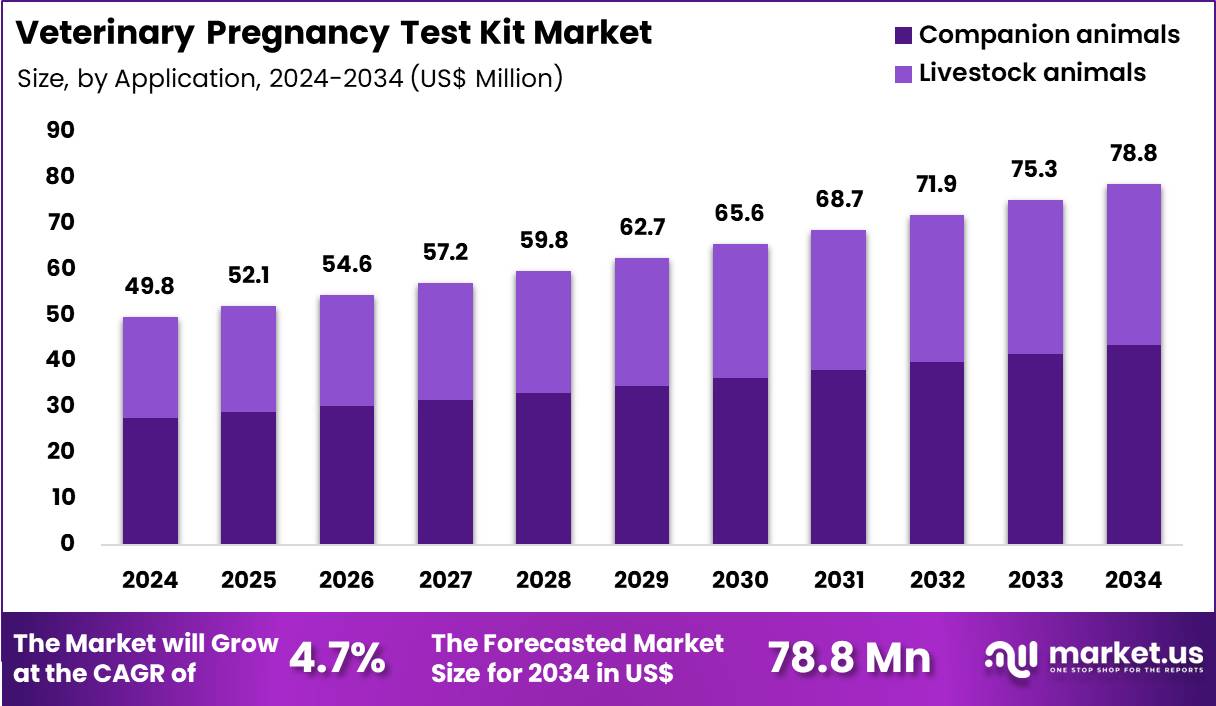
Key Takeaways
- In 2024, the Veterinary Pregnancy Test Kit Market generated revenue of US$ 49.8 million and is projected to reach US$ 78.8 million by 2034, expanding at a CAGR of 4.7% during the forecast period.
- By product type, the market is segmented into pregnancy test kit cassettes, pregnancy test kit strips, and ELISA test kits. Pregnancy test kit cassettes dominated in 2024, accounting for a 46.7% market share.
- Based on sample type, the market is categorized into urine, whole blood, serum, plasma, and others. Among these, the urine segment held the leading position in 2024, representing 51.3% of the market.
- By application, the market is divided into companion animals and livestock animals. The companion animals segment dominated the market in 2024, capturing the largest revenue share of 55.4%.
- Based on distribution channel, the market is segmented into veterinary hospitals and clinics, e-commerce, and retail stores. Veterinary hospitals and clinics led the market in 2024, accounting for a 52.6% revenue share.
- Regionally, North America dominated the Veterinary Pregnancy Test Kit Market in 2024, securing the largest regional market share of 35.9%.
Market Segmentation Overview
- Product Type Analysis: Pregnancy test kit cassettes, accounting for 46.7% of the market, are expected to maintain dominance due to their easy handling, clear result interpretation, and lower contamination risk. Their suitability across veterinary clinics, farms, and breeding facilities supports adoption. Improved assay sensitivity enables faster pregnancy confirmation, while disposable formats simplify workflows and reduce testing errors, strengthening demand through 2034.
- Sample Type Analysis: Urine, representing 51.3% of the market, is projected to remain the leading sample type because collection is non-invasive, convenient, and requires minimal animal handling. Urine-based testing is increasingly suitable for companion animals and livestock. Growing demand for rapid and home-based veterinary diagnostics, alongside improvements in assay accuracy and stability, is expected to support continued adoption.
- Application Analysis: Companion animals, holding a 55.4% market share, are expected to remain the dominant application segment. Rising pet ownership, selective breeding programs, and increasing spending on veterinary reproductive care are driving demand. Faster pregnancy confirmation helps veterinarians and pet owners initiate appropriate prenatal monitoring. Growing availability of convenient diagnostic kits is further supporting adoption among dog and cat owners.
- Distribution Channel Analysis: Veterinary hospitals and clinics, accounting for 52.6% of revenue, are projected to remain the leading distribution channel. These facilities provide professional testing, trained personnel, diagnostic support, and pregnancy-related follow-up care. Increasing veterinary service availability and demand for clinically validated pregnancy confirmation are supporting adoption. Growing reproductive health monitoring among companion animals and livestock further strengthens this channel.
Statistical Information
- United States Dairy Farms Widely Use Pregnancy Detection Methods: USDA’s Dairy 2014 study found that 98.8% of U.S. dairy operations used at least one pregnancy-detection method. Traditional rectal palpation remained widely used, but ultrasound, blood testing, and milk testing were gaining adoption. Blood testing was used by 3.0% of small operations, 6.4% of medium operations, and 8.1% of large operations, showing greater kit uptake in larger herds.
- More Than Nine In Ten Farms Conduct Pregnancy Exams: USDA reported that 93.0% of U.S. dairy operations performed pregnancy examinations during the previous 12 months. Among farms with 500 or more cows, pregnancy examinations were performed on 100% of operations. Overall, 67.0% of dairy farms used at least one pregnancy-detection method other than observing return to oestrus, supporting demand for blood, milk, ultrasound, and rapid veterinary pregnancy-testing solutions.
- Independent Study Reported Ninety-One Point Nine Test Accuracy: A 2025 study evaluating two commercial bovine pregnancy tests found overall accuracy of 87.9% for one assay and 91.9% for another. The higher-performing test recorded 97.5% sensitivity, 82.2% specificity, 90.6% positive predictive value, and 94.9% negative predictive value. Among multiparous cows tested between Days 28–34, sensitivity reached 98.5% and specificity reached 89.5%.
- Point-of-Care Test Reached Ninety-Three Per cent Accuracy: A 2024 dairy-cattle study evaluated a point-of-care lateral-flow pregnancy test between Days 28–34 after breeding. Overall accuracy was 93.1%, sensitivity was 98.9%, specificity was 88.7%, positive predictive value was 86.8%, and negative predictive value was 99.1%. The very high negative predictive value makes the test particularly useful for identifying open cattle for prompt rebreeding.
- Heifer Testing Achieved One Hundred Per cent Pregnancy Sensitivity: In the point-of-care pregnancy-test study, heifers recorded 100% sensitivity and 81.6% specificity. This means all confirmed pregnant heifers in the tested population were identified, while approximately 18.4% of non-pregnant heifers could be incorrectly classified as pregnant. In multiparous cows, sensitivity was 98.5%, and specificity was 89.5%, demonstrating that performance varies by animal category.
- Commercial Tests Show Nine Point Nine Percentage Accuracy Gap: A 2025 study compared two commercial bovine pregnancy tests. Test A recorded 92.4% sensitivity, 80.0% specificity, and 87.9% overall accuracy. Test B recorded 97.5% sensitivity, 82.2% specificity, and 91.9% overall accuracy. The difference in overall accuracy was 4.0 % points, while the difference in sensitivity was 5.1 % points, showing the importance of kit selection.
- Negative Predictive Value Reached Ninety-Four Point Nine Per cent: The higher-performing commercial bovine test had a negative predictive value of 94.9%, compared with 85.7% for the lower-performing test, a difference of 9.2 % points. Positive predictive values were 90.6% and 89.0%, respectively. For livestock producers, high negative predictive value helps reduce missed open animals, enabling earlier rebreeding, reproductive examination, nutrition adjustment, or culling decisions.
Regional Analysis
North America led the market by securing a market share of 35.9% in 2024.
North America remains a strong region for veterinary reproductive diagnostics, supported by its large livestock base and established veterinary infrastructure. In January 2026, the USDA reported 86.2 million cattle and calves in the U.S., including 27.6 million beef cows and 9.57 million milk cows. The scale of the breeding population supports demand for timely pregnancy diagnosis and reproductive management. USDA research also highlights the value of earlier pregnancy detection for improving breeding efficiency.
Asia Pacific offers significant potential for veterinary reproductive diagnostics because of its extensive livestock sector and increasing emphasis on animal productivity and health management. The region’s opportunity is particularly relevant for cattle, buffalo, pigs, sheep, and goats, where timely pregnancy confirmation can support breeding decisions. USDA-supported research demonstrates that earlier pregnancy identification can help producers rebreed non-pregnant animals sooner, improving reproductive efficiency.
Business Opportunities
The Veterinary Pregnancy Test Kit Market presents several business opportunities across companion-animal and livestock diagnostics. Rapid point-of-care testing offers strong potential as veterinarians and breeders seek faster pregnancy confirmation with minimal sample handling. Portable kits designed for field use can address the needs of cattle, buffalo, sheep, goats, and equine producers, particularly where laboratory access is limited.
Companion-animal diagnostics also provide opportunities through veterinary clinics and direct-to-consumer channels, supported by continued pet ownership and spending on veterinary services. The AVMA’s 2024 sourcebook surveyed more than 7,500 respondents, highlighting the scale of the U.S. pet-care market. Product developers can further focus on multiplex assays, improved sensitivity, digital readers, and species-specific testing formats.
Partnerships with veterinary hospitals, livestock cooperatives, breeding centers, and diagnostic distributors can expand market access. Companies may also develop affordable testing solutions for emerging livestock markets while emphasizing accuracy, ease of use, shelf stability, and regulatory compliance.
Emerging Trends
- Earlier Pregnancy Detection: Tests enabling pregnancy confirmation around day 18–25 are gaining importance by helping producers identify non-pregnant animals earlier and improve breeding schedules.
- Point-of-Care Testing: Portable veterinary kits offering rapid results are becoming more useful for farms and clinics where immediate diagnostic decisions are required.
- Digital Diagnostic Integration: Pregnancy-testing devices are increasingly being connected with digital readers and electronic animal-health records, supporting better reproductive tracking and data management.
- Improved Test Accuracy: Manufacturers are focusing on better biomarker detection, sample stability, and test validation to improve reliability across different animal species.
- Large-Herd Reproductive Management: The U.S. had 86.2 million cattle and calves in January 2026, creating substantial demand for efficient pregnancy monitoring and herd reproductive-management solutions.
Use Cases
- Cattle Pregnancy Confirmation: Rapid kits help farmers identify pregnant and non-pregnant cattle earlier, supporting timely rebreeding and improved herd reproductive management.
- Dairy Farm Management: Pregnancy testing helps dairy producers monitor breeding outcomes, reduce extended non-productive periods, and improve overall reproductive efficiency.
- Companion Animal Breeding: Veterinary clinics can use pregnancy tests for dogs and cats to confirm pregnancy and support appropriate prenatal monitoring.
- Livestock Breeding Programs: Sheep, goats, buffalo, and other breeding animals can benefit from convenient pregnancy diagnostics for scheduling breeding, nutrition, and veterinary interventions.
- Veterinary Clinic Screening: Clinics can use rapid pregnancy tests as an initial diagnostic tool before conducting additional examinations such as ultrasound or laboratory-based testing.
Recent Development
- In 2026, IDEXX Laboratories, Inc. continued expanding its veterinary reproductive diagnostics portfolio through the Alertys OnFarm Pregnancy Test, which enables pregnancy detection in cattle from approximately 28 days after breeding and provides results within 5–20 minutes, supporting faster reproductive management.
- In 2026, Zoetis Services LLC continued strengthening its animal-health portfolio with diagnostic and reproductive-health solutions designed to support veterinary professionals and livestock producers. Its broader livestock portfolio addresses disease management, preventive care, and productivity across commercial animal operations.
- In 2026, BioNote, Inc. continued developing rapid veterinary point-of-care diagnostics through its Vcheck platform. The company’s diagnostic systems support quantitative testing within veterinary settings, helping clinicians obtain faster laboratory information for animal-health management.
- In 2026, BioTracking, Inc. continued supporting livestock reproductive management through its BioPRYN pregnancy testing platform, which detects pregnancy-associated proteins in blood. The technology supports pregnancy diagnosis across cattle, sheep, goats, bison, and other livestock species.
- In 2026, Fassisi GmbH continued developing rapid veterinary diagnostic solutions for professional and field applications. Its portfolio includes rapid tests designed to provide results within minutes, supporting faster clinical decisions for veterinarians and animal-health professionals.
- In 2026, J & G Biotech Ltd continued offering veterinary rapid diagnostic products, including pregnancy testing solutions for dogs and cats. Its portfolio supports convenient reproductive and infectious-disease testing for veterinary professionals and animal owners.
Frequently Asked Questions About Veterinary Pregnancy Test Kit
- Which region dominated the market?
North America led the Veterinary Pregnancy Test Kit Market with a 35.9% market share in 2024. Strong veterinary infrastructure, advanced diagnostic technologies, livestock production, and increasing adoption of reproductive-management solutions support the region’s leading position. - Why is early pregnancy detection important?
Early pregnancy detection helps veterinarians and livestock producers identify pregnant and non-pregnant animals sooner. This supports timely rebreeding decisions, improves reproductive planning, reduces unnecessary waiting periods, and can contribute to better herd productivity and resource utilization. - How early can pregnancy be detected in cattle?
USDA research indicates that pregnancy-related biological changes can potentially be detected in cattle as early as approximately day 18, while conventional transrectal ultrasound generally detects pregnancy from around day 30, creating opportunities for earlier reproductive management. - How quickly can veterinary pregnancy tests provide results?
Rapid veterinary pregnancy tests can provide results within minutes, depending on the product and technology. For example, IDEXX’s Alertys OnFarm pregnancy test supports cattle pregnancy detection from approximately 28 days after breeding, helping producers make faster reproductive decisions. - Which animals can be tested?
Veterinary pregnancy tests can be designed for several species, including cattle, buffalo, sheep, goats, horses, dogs, and cats. Testing requirements vary by species because pregnancy biomarkers, sample types, detection periods, and appropriate diagnostic technologies differ among animals. - What factors are driving market growth?
Market growth is supported by expanding livestock production, increasing companion-animal healthcare spending, artificial insemination programs, reproductive management, demand for rapid diagnostics, and greater awareness of early pregnancy confirmation among veterinarians, breeders, livestock producers, and pet owners. - What technologies are used in pregnancy test kits?
Common technologies include ELISA, immunoassays, lateral-flow tests, and biomarker detection systems. These technologies identify pregnancy-associated proteins or hormones in biological samples, with the appropriate method depending on species, sample type, pregnancy stage, testing environment, and required accuracy. - What are the major business opportunities?
Key opportunities include portable point-of-care kits, species-specific testing, improved assay sensitivity, digital readers, convenient sample collection, and rapid-result technologies. Manufacturers can expand through veterinary clinics, livestock farms, breeding centers, distributors, and online sales channels.
Conclusion
The Veterinary Pregnancy Test Kit Market is evolving as animal owners, breeders, and veterinarians place greater emphasis on timely reproductive monitoring. Rapid testing technologies are improving convenience by enabling pregnancy assessment closer to the point of care. The market benefits from expanding livestock breeding programs, increasing companion-animal healthcare expenditure, and greater use of diagnostic tools in veterinary practices.
Technological developments such as immunoassays, lateral-flow formats, and biomarker-based testing are supporting faster decision-making. North America remains an important market because of its established veterinary infrastructure and large livestock base. Meanwhile, emerging regions offer opportunities through affordable, portable, and easy-to-use diagnostic solutions for farms and veterinary clinics.
Discuss your needs with our analyst
Please share your requirements with more details so our analyst can check if they can solve your problem(s)