


Overview
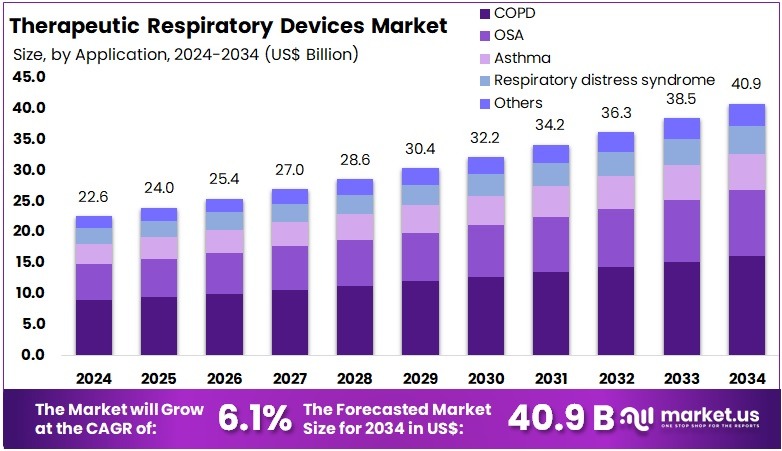
New York, NY – Sep 02, 2026 – The Global Therapeutic Respiratory Devices Market size is expected to be worth around US$ 40.9 Billion by 2034, from US$ 22.6 Billion in 2024, growing at a CAGR of 6.1% during the forecast period from 2025 to 2034. North America held a dominant market position, capturing more than a 39.1% share and holding US$ 8.8 Billion market value for the year.
The global Therapeutic Respiratory Devices Market is experiencing robust growth, driven by the increasing burden of chronic respiratory diseases and the expanding adoption of home-based respiratory care. According to the World Health Organization (WHO), chronic obstructive pulmonary disease (COPD) affected approximately 212 million people globally in 2021 and caused around 3.5 million deaths, accounting for nearly 5% of all global deaths. Asthma affects an estimated 262 million people worldwide, resulting in approximately 455,000 deaths annually.
The growing elderly population, rising air pollution, and increasing smoking-related illnesses continue to boost demand for therapeutic respiratory devices, including ventilators, oxygen concentrators, CPAP and BiPAP systems, nebulizers, and humidifiers. Home healthcare adoption is expanding rapidly as portable and connected respiratory devices improve patient convenience and reduce hospital admissions.
North America remains the leading regional market due to advanced healthcare infrastructure, while Asia-Pacific is witnessing the fastest growth, supported by increasing healthcare investments and expanding access to respiratory treatment.
Technological innovations such as AI-enabled monitoring, Bluetooth connectivity, and remote patient management are improving treatment adherence and clinical outcomes. According to the Global Burden of Disease study, chronic respiratory diseases accounted for more than 500 million prevalent cases worldwide in 2021, highlighting the urgent need for effective respiratory therapies.
Continuous product innovation, supportive reimbursement policies, and increasing awareness of early diagnosis and long-term respiratory disease management are expected to drive sustained market growth over the coming years.
Key Takeaways
- The market is projected to reach nearly US$ 40.9 billion by 2034, rising from US$ 22.6 billion in 2024, supported by a steady 6.1% growth rate.
- Positive Airway Pressure devices were noted as the leading product type in 2024, accounting for over 34.3% of total global revenue share.
- Chronic Obstructive Pulmonary Disease applications represented the largest application segment in 2024, contributing more than 39.5% of the overall market demand.
- Adult patients formed the dominant patient group in 2024, with this segment securing over 42.6% of the total market share.
- Hospitals served as the primary end-user group in 2024, capturing more than 53.0% of total utilization within the therapeutic respiratory devices landscape.
- North America emerged as the leading regional market in 2024, commanding over 39.1% share and generating approximately US$8.8 billion in value.
Market segmentation
- Product Type Analysis: In 2024, Positive Airway Pressure (PAP) devices dominated the Therapeutic Respiratory Devices Market with over 34.3% share. Strong adoption in home healthcare, rising obstructive sleep apnea cases, favorable reimbursement policies, improved patient comfort, and continuous technological advancements sustained their leading market position and long-term demand.
- Application Analysis: In 2024, Chronic Obstructive Pulmonary Disease (COPD) accounted for more than 39.5% of the Therapeutic Respiratory Devices Market. The growing global burden of COPD, increasing need for oxygen therapy and non-invasive ventilation, higher diagnosis rates, and long-term respiratory management supported consistent segment growth.
- Patient Type Analysis: In 2024, the Adult segment held over 42.6% of the Therapeutic Respiratory Devices Market. High prevalence of chronic respiratory diseases, smoking-related disorders, pollution exposure, expanding home-based care, better diagnostic access, and increasing treatment awareness continued driving demand for therapeutic respiratory devices.
- End-User Analysis: In 2024, Hospitals led the Therapeutic Respiratory Devices Market with more than 53.0% share. High patient admissions, advanced respiratory care infrastructure, skilled healthcare professionals, availability of intensive care facilities, and standardized treatment protocols ensured strong adoption of therapeutic respiratory devices across hospital settings.
Statistical Information
- A 2025 clinical validation study of the ROSA (Radar + Pulse Oximeter) sleep apnea diagnostic system analyzed more than 800 hours of overnight recordings from 100 subjects, demonstrating large-scale technical validation.
- The same 2025 study reported an Intraclass Correlation Coefficient (ICC) of 0.9870 between the ROSA system and gold-standard polysomnography (PSG), indicating extremely high agreement for apnea-hypopnea index measurements.
- The ROSA system achieved over 90% diagnostic accuracy across apnea-hypopnea index (AHI) thresholds of 5, 15, and 30 events/hour, demonstrating strong performance for home respiratory monitoring in 2025.
- The FDA granted 510(k) clearance to the ResMed myAir non-continuous ventilator on May 28, 2025, after receiving the submission on March 3, 2025, reflecting a review period of approximately 86 days.
- The DeVilbiss PulmO₂ 10-Liter Oxygen Concentrator received FDA 510(k) clearance on December 9, 2025, following submission on March 17, 2025, representing approximately 267 days of regulatory review.
- The DeVilbiss 5-Liter Oxygen Concentrator (555) obtained FDA clearance on March 26, 2026, after submission on November 14, 2025, corresponding to roughly 132 days of FDA review.
- The same FDA report recommends charging the ventilator battery for a minimum of 5 hours before transporting patients on battery power to ensure safe operation.
Regional Analysis
In 2024, North America dominated the Therapeutic Respiratory Devices Market, accounting for more than 39.1% of global revenue and generating approximately US$ 8.8 billion. The region’s leadership is supported by advanced healthcare infrastructure, high healthcare spending, and widespread adoption of respiratory technologies.
The growing burden of chronic respiratory diseases continues to drive device demand. According to the U.S. CDC, 3.8% of U.S. adults were diagnosed with COPD in 2023, with prevalence rising to 10.5% among adults aged 75 years and older, increasing the need for long-term respiratory support.
Hospitals and home healthcare providers are rapidly adopting ventilators, oxygen concentrators, PAP devices, and connected respiratory monitoring systems to improve patient outcomes. Favorable reimbursement policies in the United States and Canada, combined with increasing use of remote patient monitoring and home oxygen therapy, continue to strengthen market growth.
Strong clinical expertise, early disease diagnosis, and continuous innovation by leading manufacturers ensure North America remains the largest and most technologically advanced regional market for therapeutic respiratory devices.
Business opportunities
The Therapeutic Respiratory Devices Market presents significant business opportunities as the global burden of chronic respiratory diseases continues to increase. Rising cases of COPD, asthma, obstructive sleep apnea, and post-infection respiratory complications are driving demand for advanced treatment solutions.
Manufacturers can capitalize on the growing shift toward home-based respiratory care by developing portable oxygen concentrators, compact ventilators, and user-friendly PAP devices with remote monitoring capabilities. The increasing adoption of telehealth and connected healthcare creates opportunities for AI-enabled respiratory monitoring platforms and cloud-based patient management systems.
Emerging economies in Asia-Pacific, Latin America, and the Middle East offer strong growth potential due to expanding healthcare infrastructure, improving access to medical devices, and supportive government healthcare initiatives.
Companies can also benefit from expanding reimbursement coverage for home respiratory therapies, investing in energy-efficient and lightweight device designs, and partnering with hospitals and home care providers. Continuous innovation in wearable respiratory technologies, digital therapeutics, and personalized respiratory care solutions is expected to create new revenue streams while improving patient outcomes and long-term disease management.
Emerging Trends
- Remote respiratory monitoring is becoming a standard feature in respiratory care: A 2025 peer-reviewed review highlighted that wearable sensors can continuously monitor respiratory rate, oxygen saturation, and breathing patterns, enabling earlier intervention for chronic lung diseases and reducing the need for frequent hospital visits.
- High-capacity oxygen concentrators are expanding treatment options: In 2025, the U.S. FDA cleared the DeVilbiss PulmO₂ 10-Liter Oxygen Concentrator, supporting oxygen delivery of up to 10 liters per minute (L/min) for patients requiring high-flow oxygen therapy.
- Portable respiratory devices are becoming lighter and easier to carry: A 2026 scientific review evaluated 33 portable oxygen concentrators, with device weights ranging from 1.0 kg to 9.1 kg, improving mobility and supporting long-term home respiratory therapy.
- AI-assisted respiratory diagnostics are improving clinical accuracy: A 2025 validation study found that an AI-supported respiratory monitoring system achieved an Intraclass Correlation Coefficient (ICC) of 0.987, demonstrating excellent agreement with laboratory-based sleep studies.
- Global oxygen access initiatives are accelerating device deployment: According to the World Health Organization (2025), approximately 374 million people require medical oxygen annually, encouraging governments and healthcare providers to strengthen respiratory care infrastructure.
Use Cases
- COPD patients rely heavily on therapeutic respiratory devices for long-term care: The World Health Organization (2025) estimates annual medical oxygen demand for COPD patients at approximately 3.2 billion normal cubic meters (Nm³), making oxygen concentrators and ventilators essential for disease management.
- Home oxygen therapy is improving treatment precision: A 2025 clinical study demonstrated automated oxygen titration systems adjusted oxygen flow between 0.9 and 6.8 L/min, helping patients maintain target oxygen saturation levels without frequent manual adjustments.
- Portable oxygen concentrators support active lifestyles: A 2026 technical review reported that portable oxygen concentrators provide an average maximum operating time of 3.8 hours, enabling patients to travel and perform daily activities while receiving continuous oxygen therapy.
- Sleep apnea treatment increasingly depends on PAP devices: A 2025 validation study assessed 100 patients using over 800 hours of overnight respiratory recordings, confirming reliable home monitoring for obstructive sleep apnea diagnosis and follow-up.
- Respiratory devices are widely used in emergency oxygen care: The WHO (2025) recommends oxygen concentrators capable of delivering up to 10 L/min for treating patients with moderate to severe hypoxemia in hospitals and emergency healthcare settings.
Recent development
- In April 2026, Dräger announced a strategic partnership with the Association for Professionals in Infection Control and Epidemiology (APIC) to strengthen infection prevention practices in healthcare environments supporting respiratory care.
- In June 2026, ResMed completed the acquisition of Noctrix Health, expanding its clinical sleep health portfolio with therapies for neurological sleep disorders.
- In June 2026, Dräger announced FDA clearance for Evita V800 Software 3.10, adding advanced ventilation capabilities to its Evita V800 critical care ventilator platform.
Frequently Asked Questions on Therapeutic Respiratory Devices
- What is driving the growth of the Therapeutic Respiratory Devices Market?
The market is growing because of increasing cases of COPD, asthma, sleep apnea, and other chronic respiratory diseases. Rising demand for home healthcare, technological advancements, expanding elderly populations, and greater awareness of early respiratory disease management also support market expansion. - Which therapeutic respiratory device is most widely used?
Positive Airway Pressure (PAP) devices are among the most widely used therapeutic respiratory devices. They are commonly prescribed for obstructive sleep apnea and other breathing disorders due to their effectiveness, ease of use, and increasing adoption in home-care settings. - Who are the major end users in the Therapeutic Respiratory Devices Market?
Hospitals remain the largest end users because they manage critical respiratory emergencies and intensive care patients. Homecare settings are expanding rapidly as portable respiratory devices and remote monitoring technologies enable patients to receive treatment outside traditional healthcare facilities. - Which diseases commonly require therapeutic respiratory devices?
Therapeutic respiratory devices are primarily used for chronic obstructive pulmonary disease (COPD), asthma, obstructive sleep apnea, respiratory distress syndrome, cystic fibrosis, pneumonia, and other conditions that reduce lung function or require assisted breathing and oxygen therapy. - Why is home healthcare important for the Therapeutic Respiratory Devices Market?
Home healthcare allows patients to receive long-term respiratory therapy in a comfortable environment while reducing hospital visits. Portable oxygen concentrators, CPAP devices, and connected monitoring systems improve convenience, treatment adherence, and overall quality of life for patients. - Which region leads the Therapeutic Respiratory Devices Market?
North America leads the market because of advanced healthcare infrastructure, high healthcare expenditure, widespread adoption of respiratory technologies, favorable reimbursement policies, and the growing prevalence of chronic respiratory diseases requiring continuous respiratory care and monitoring. - How is technology transforming therapeutic respiratory devices?
Manufacturers are integrating artificial intelligence, wireless connectivity, cloud platforms, and remote patient monitoring into respiratory devices. These innovations improve treatment accuracy, enable real-time monitoring, support personalized therapy, and enhance communication between patients and healthcare professionals.
Conclusion
The Therapeutic Respiratory Devices Market is expanding steadily as respiratory diseases such as COPD, asthma, and sleep apnea continue to increase worldwide. Growing demand for home-based care, portable respiratory devices, and connected monitoring technologies is transforming patient management and improving treatment outcomes.
Product innovation, including AI-enabled respiratory support systems and advanced oxygen therapy devices, is strengthening clinical efficiency and patient comfort. Hospitals remain the primary end users, while homecare adoption continues to accelerate.
With supportive healthcare policies, increasing awareness of early respiratory disease management, and continuous technological advancements, the market is well-positioned for sustainable long-term growth across developed and emerging healthcare systems.
Discuss your needs with our analyst
Please share your requirements with more details so our analyst can check if they can solve your problem(s)




