


Overview
New York, NY – Sep 18, 2026 – The Global Therapeutic Nuclear Medicine Market size is expected to be worth around US$ 2.32 Billion by 2034 from US$ 1.54 Billion in 2024, growing at a CAGR of 4.2% during the forecast period 2025 to 2034. In 2024, North America led the market, achieving over 41.5% share with a revenue of US$ 639.1 Million.
Therapeutic Nuclear Medicine is witnessing significant growth due to increasing demand for targeted radiopharmaceutical therapies in cancer treatment and precision medicine. Therapeutic nuclear medicine uses radioactive isotopes to deliver radiation directly to diseased cells, enabling effective treatment with reduced impact on surrounding healthy tissues. Key applications include prostate cancer, thyroid cancer, neuroendocrine tumors, and bone metastases.
The rising global cancer burden is a major growth driver. According to the World Health Organization (WHO), around 20 million new cancer cases and 9.7 million cancer deaths were reported worldwide in 2022, while global cancer cases are expected to reach nearly 35 million annually by 2050. This growing disease burden is increasing the adoption of advanced radionuclide therapies.
The market is supported by the increasing use of therapeutic isotopes such as lutetium-177, iodine-131, radium-223, and actinium-225. Radioligand therapies based on Lu-177 have gained attention for treating advanced prostate cancer and neuroendocrine tumors. More than 1.4 million prostate cancer cases are diagnosed each year globally, creating strong demand for targeted therapies.
Advancements in isotope production, nuclear medicine facilities, and clinical research are further supporting market expansion. Over 7,000 nuclear medicine facilities worldwide provide diagnostic and therapeutic services, improving patient access. North America and Europe remain leading regions due to advanced healthcare infrastructure and research investments.
With increasing cancer prevalence, rising clinical trials, and continuous innovation in radiopharmaceutical development, the Therapeutic Nuclear Medicine Market is expected to experience strong growth opportunities through 2034, driven by personalized oncology treatments and improved healthcare capabilities.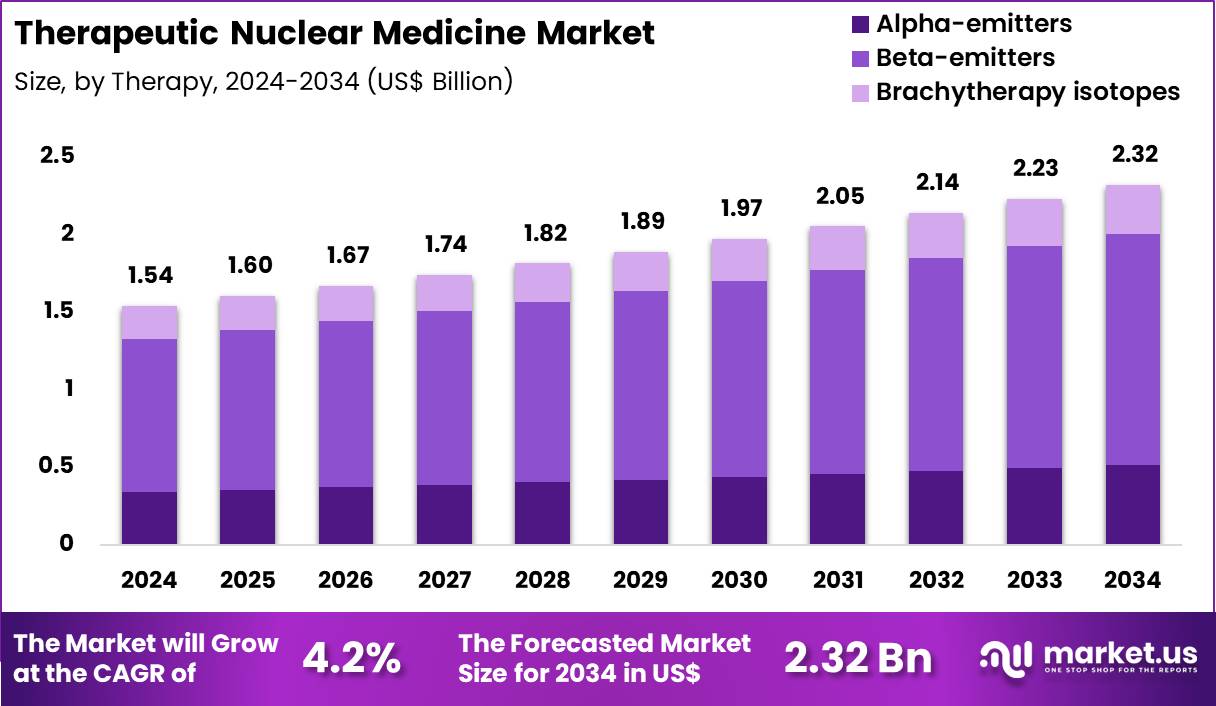
Key Takeaways
- In 2024, the Therapeutic Nuclear Medicine Market generated revenue of US$ 54 billion, registering a CAGR of 4.2%, and is projected to reach US$ 2.32 billion by 2034.
- The Therapy segment includes Alpha-emitters, Beta-emitters, and Brachytherapy isotopes, with Beta-emitters dominating the market in 2024, accounting for a 64.2% market share.
- The Clinical Indication segment comprises Oncology, Bone metastases, Thyroid disease, and Other therapeutic areas, with Oncology leading the segment in 2024 with a 55.6% market share.
- The End-User segment is categorized into Hospitals & Cancer Centers, Radiopharmacies, and Others, where Hospitals & Cancer Centers held the largest market position in 2024 with a 57.3% share.
- North America emerged as the leading regional market in 2024, capturing a significant 41.5% market share due to advanced healthcare infrastructure, increasing adoption of radiopharmaceutical therapies, and strong research activities.
Market Segmentation Overview
- Therapy Analysis: The Therapy segment dominated the Therapeutic Nuclear Medicine Market with Beta-emitters holding a 64.2% market share in 2024. The segment growth is driven by increasing adoption of radiopharmaceutical therapies, especially Lu-177 and Y-90, for cancer treatment. Rising clinical approvals, expanding oncology applications, and improved treatment outcomes continue to support the dominance of beta-emitter therapies.
- Clinical Indication Analysis: The Clinical Indication segment was led by Oncology with a 55.6% market share in 2024 due to the increasing global cancer burden and rising demand for targeted radiotherapies. The growing use of radioligand therapies, including Lu-177-based treatments, for prostate cancer and neuroendocrine tumors is significantly contributing to segment expansion.
- End-User Analysis: The End-User segment was dominated by Hospitals & Cancer Centers with a 57.3% market share in 2024 due to advanced nuclear medicine infrastructure, specialized oncology departments, and availability of radiopharmaceutical treatment facilities. Increasing cancer treatment volumes, adoption of theranostics, and expansion of nuclear medicine services are driving segment growth globally.
Statistical Information
- Pluvicto Trial Delivered Four Month Survival Improvement: FDA clinical-review data for lutetium-177 PSMA-617 therapy showed median overall survival of 15.3 months, compared with 11.3 months for best standard care. This equals a 4.0-month survival improvement. The treatment reduced the risk of death by 38%, with a hazard ratio of 0.62. Median radiographic progression-free survival was 8.7 months, versus 3.4 months for standard care.
- FDA Trial Shows Progression Benefit In Neuroendocrine Tumours: FDA’s NETTER-1 review found that lutetium Lu-177 dotatate reduced the risk of progression or death by 79%, with a hazard ratio of 0.21 versus high-dose octreotide treatment. Median progression-free survival in the control group was 8.4 months, while median progression-free survival had not been reached in the Lutathera treatment group at the primary analysis.
- European Department Adoption Indicates Rising Lutetium Therapy Volumes: A European survey identified 12,553 lutetium-177 PSMA radioligand-therapy cycles between 2016 and 2020. Annual treatment volume increased from 1,026 therapies in 2016 to 3,328 in 2020, an increase of 224%. Participating nuclear-medicine departments rose from 25 to 44, while facilities performing more than 100 therapies annually increased from 16% to 36%.
- Lutathera Response Data Supports Reimbursement and Capacity Planning: FDA evidence from 404 patients with gastroenteropancreatic neuroendocrine tumours reported a best overall response rate of 59% for Lutathera. Median progression-free survival was 30 months, with a 95% confidence interval of 27–33 months. In the product-label study, objective responses occurred in 16% of 360 patients, with median response duration of 35 months among 58 responders.
- Lutetium Radiation Range Enables Targeted Tumour Dose Delivery: FDA labelling states that lutetium-177 has maximum tissue penetration of 2.2 mm and mean penetration of 0.67 mm. In NETTER-1 adult dosimetry data, a full 29.6 GBq four-dose course delivered mean absorbed doses of 25.1 Gy to the spleen, 19.4 Gy to kidneys, 12.8 Gy to the urinary bladder wall, and 8.9 Gy to the liver.
- Late Safety Risks Require Long-Term Nuclear Medicine Surveillance: With median follow-up of 76 months in NETTER-1, myelodysplastic syndrome occurred in 2.3% of Lutathera-treated patients. In the ERASMUS safety dataset, 2.0% developed myelodysplastic syndrome and 0.5% developed acute leukaemia. Median onset was 29 months for myelodysplastic syndrome and 55 months for acute leukaemia, supporting prolonged patient follow-up and haematology monitoring.
Regional Analysis
North America led the market by securing a market share of 41.5% in 2024.
North America holds a leading position in therapeutic nuclear medicine due to advanced cancer-care infrastructure, strong research capabilities, and widespread adoption of radiopharmaceutical therapies. The United States has more than 7,000 nuclear medicine facilities and performs millions of nuclear medicine procedures annually. The region benefits from FDA-approved therapies such as Lu-177-based treatments for prostate cancer and neuroendocrine tumors, along with expanding Y-90 radioembolization applications.
Government initiatives supporting domestic isotope production, including programs from the U.S. Department of Energy, are strengthening supply availability for therapeutic radionuclides. Asia Pacific is witnessing rapid expansion due to rising cancer incidence, improving healthcare infrastructure, and increasing investments in nuclear medicine facilities.
Countries including Japan, South Korea, and China are expanding PET imaging and radiopharmaceutical capabilities. Government-supported isotope production programs, growing oncology treatment centers, and increasing adoption of targeted therapies are driving regional growth.
Business Opportunities
The Therapeutic Nuclear Medicine Market offers significant business opportunities due to increasing demand for targeted cancer therapies, radiopharmaceutical innovation, and expanding nuclear medicine infrastructure.
Pharmaceutical companies have opportunities to develop advanced radioligand therapies using isotopes such as lutetium-177, actinium-225, and radium-223 for oncology applications. Growing investments in isotope production facilities and supply-chain improvements create opportunities for companies involved in radionuclide manufacturing and distribution.
Healthcare providers can benefit from expanding specialized nuclear medicine centers, theranostic platforms, and integrated oncology treatment services. The rising adoption of personalized medicine is encouraging partnerships between pharmaceutical firms, hospitals, research institutions, and radiopharmacy networks. Emerging economies are also creating opportunities through investments in cancer-care infrastructure and regulatory improvements.
Additionally, advancements in alpha-emitter therapies, artificial intelligence-assisted treatment planning, and next-generation radiopharmaceutical development are opening new avenues for innovation. Strategic collaborations, licensing agreements, and clinical research partnerships will remain key growth strategies for companies operating in this market.
Emerging Trends
- Growing Adoption of Radioligand Therapy (RLT): Targeted therapies using Lu-177 are expanding in oncology, with FDA-approved treatments such as Pluvicto supported by the VISION trial involving 831 patients, increasing the use of precision cancer therapies.
- Rising Development of Alpha-Emitter Therapies: Advanced isotopes such as Actinium-225 (Ac-225) and Radium-223 are gaining attention due to their high-energy cancer-cell targeting ability, supporting research in prostate cancer and other difficult-to-treat tumors.
- Expansion of Theranostics in Personalized Medicine: Combining diagnostic imaging with targeted therapy is becoming a major trend. Radiopharmaceuticals such as Lu-177 and I-131 enable physicians to identify suitable patients and deliver customized treatments.
- Improvement in Radioisotope Production and Supply Chains: Governments and healthcare organizations are investing in isotope production capabilities to improve access to therapeutic radionuclides. The IAEA supports global programs for reliable radioisotope availability.
- Increasing Use in Oncology Beyond Traditional Treatments: Therapeutic nuclear medicine applications are expanding beyond thyroid cancer to prostate cancer, neuroendocrine tumors, liver cancer, and bone metastases due to rising global cancer cases of approximately 20 million annually.
Use Cases
- Targeted Prostate Cancer Treatment: Therapeutic nuclear medicine is widely used for advanced prostate cancer through Lu-177 PSMA radioligand therapy, which delivers radiation directly to PSMA-positive cancer cells. The FDA approved Pluvicto in 2022 based on clinical evidence from the 831-patient VISION trial.
- Neuroendocrine Tumor Management: Lu-177 DOTATATE therapy is used for treating somatostatin receptor-positive neuroendocrine tumors. This approach helps deliver targeted radiation to tumor cells and has become an important treatment option for patients with advanced gastrointestinal and pancreatic neuroendocrine cancers.
- Thyroid Cancer and Hyperthyroidism Treatment: Iodine-131 (I-131) remains a standard therapeutic isotope for differentiated thyroid cancer, Graves’ disease, and hyperthyroidism. Radioiodine therapy supports thyroid ablation, reduces recurrence risk, and provides long-term disease management.
- Liver Cancer Radioembolization: Yttrium-90 (Y-90) microsphere therapy is used in interventional oncology for liver tumors, including hepatocellular carcinoma and metastatic liver cancers. The treatment provides localized radiation by delivering radioactive microspheres directly into tumor-feeding blood vessels.
- Bone Metastases Pain Management: Radioisotopes such as Radium-223 (Ra-223) are used for patients with metastatic prostate cancer involving bones. The therapy helps reduce skeletal complications and manage cancer-related bone pain while targeting cancer deposits in bone tissue.
Recent Development
- In 2026, Novartis AG continued expanding its radioligand therapy (RLT) capabilities by investing in manufacturing infrastructure and advancing clinical programs focused on targeted cancer treatments, including therapies based on lutetium-177 (Lu-177) for prostate cancer and neuroendocrine tumors.
- In 2026, Lantheus Holdings strengthened its position in molecular imaging and radiopharmaceutical innovation by expanding its pipeline and supporting the development of diagnostic and therapeutic solutions for oncology applications.
- In 2026, Bayer AG continued advancing its precision oncology strategy through research in targeted radiopharmaceutical therapies, focusing on innovative approaches for cancer treatment using radioactive isotopes and personalized medicine platforms.
- In 2026, Telix Pharmaceuticals progressed its radiopharmaceutical therapy pipeline with clinical development programs targeting prostate cancer, kidney cancer, and other solid tumors using molecularly targeted radionuclide therapies.
- In 2026, Curium Pharma continued strengthening its global radiopharmaceutical capabilities by expanding its portfolio of diagnostic and therapeutic nuclear medicine products and improving isotope production and distribution networks.
- In 2026, Cardinal Health continued supporting nuclear medicine providers through radiopharmaceutical supply-chain solutions, helping hospitals and clinics access time-sensitive radioactive therapies used in oncology and diagnostic procedures.
Frequently Asked Questions About Therapeutic Nuclear Medicine
- How does Therapeutic Nuclear Medicine work?
Therapeutic nuclear medicine uses radioactive isotopes that attach to specific molecules in the body. These isotopes deliver radiation directly to affected cells, helping reduce tumor growth while limiting damage to surrounding healthy tissues through targeted treatment methods. - Why is the Therapeutic Nuclear Medicine Market growing?
The market is growing due to increasing cancer cases, rising demand for personalized medicine, advancements in radiopharmaceutical development, and improved access to nuclear medicine facilities. Growing adoption of radioligand therapies is further supporting market expansion globally. - What are the key isotopes used in Therapeutic Nuclear Medicine?
Major therapeutic isotopes include lutetium-177, iodine-131, yttrium-90, radium-223, and actinium-225. These radioactive agents are used for targeted cancer treatment, thyroid therapy, bone metastases management, and emerging precision oncology applications. - Which region dominates the Therapeutic Nuclear Medicine Market?
North America leads the Therapeutic Nuclear Medicine Market with a 41.5% share in 2024. The region benefits from advanced healthcare infrastructure, strong cancer research programs, FDA-approved therapies, established radiopharmacy networks, and high adoption of radioligand treatments. - What opportunities exist in the Therapeutic Nuclear Medicine Market?
Major opportunities include development of new radiopharmaceutical drugs, expansion of nuclear medicine centers, investment in isotope manufacturing, strategic partnerships, and growing demand for personalized cancer therapies across developed and emerging healthcare markets. - How does Therapeutic Nuclear Medicine support cancer treatment?
Therapeutic nuclear medicine provides targeted radiation therapy by delivering radioactive particles directly to cancer cells. This approach improves treatment precision and is increasingly used for advanced cancers where conventional therapies may have limited effectiveness or reduced response. - What is the future outlook of the Therapeutic Nuclear Medicine Market?
The future outlook remains positive due to rising cancer prevalence, increasing clinical adoption of radiopharmaceutical therapies, technological advancements, and continuous investment in isotope production. Innovation in targeted therapies is expected to create new growth opportunities through 2034.
Conclusion
The Therapeutic Nuclear Medicine Market is experiencing significant growth due to rising cancer prevalence, increasing adoption of targeted radiopharmaceutical therapies, and advancements in precision oncology. Technologies involving Lu-177, I-131, Y-90, and Ra-223 are expanding treatment options for prostate cancer, neuroendocrine tumors, thyroid disorders, and bone metastases.
North America remains a leading region due to strong healthcare infrastructure, while Asia Pacific offers growth opportunities through improving nuclear medicine capabilities. Increasing investments in isotope production, clinical research, and theranostic approaches are expected to further accelerate market development. The future of therapeutic nuclear medicine will be shaped by innovation, accessibility, and personalized treatment solutions.
Discuss your needs with our analyst
Please share your requirements with more details so our analyst can check if they can solve your problem(s)




