


Overview
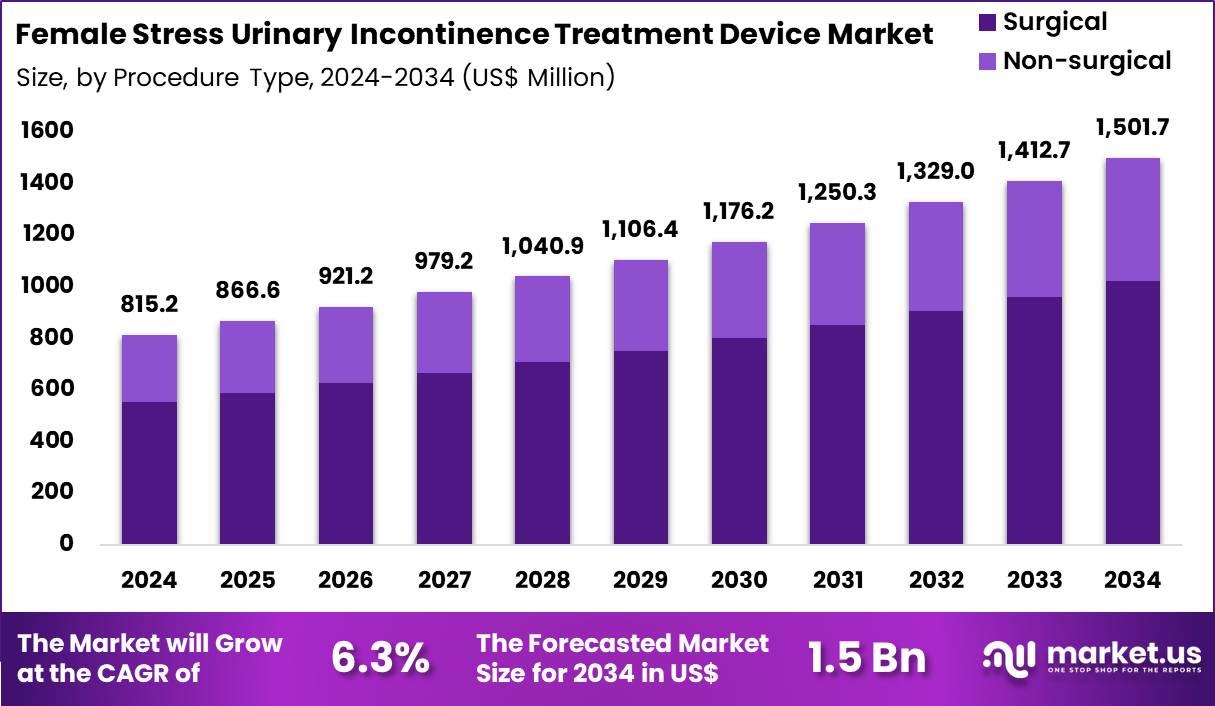
New York, NY – Oct 06, 2026 – The Global Female Stress Urinary Incontinence Treatment Device Market size is expected to be worth around US$ 1501.7 Million by 2034 from US$ 815.2 Million in 2024, growing at a CAGR of 6.3% during the forecast period 2025 to 2034. In 2024, North America led the market, achieving over 39.6% share with a revenue of US$ 322.8 Million.
The female stress urinary incontinence treatment device market is gaining attention as the prevalence of urinary leakage among women continues to increase with aging, childbirth, obesity, and pelvic floor weakness. Stress urinary incontinence occurs when physical activities such as coughing, sneezing, exercising, or lifting place pressure on the bladder, resulting in involuntary urine leakage.
Female stress urinary incontinence treatment devices are designed to provide mechanical support, stimulate or strengthen pelvic floor muscles, or improve bladder control. Key device categories include vaginal pessaries, urethral inserts, pelvic floor electrical stimulation devices, and other non-invasive or minimally invasive solutions. These devices are increasingly being considered as alternatives or complements to medication and surgical procedures.
Market growth is being supported by growing awareness of women’s pelvic health, increasing adoption of non-surgical treatment options, technological advancements, and the development of user-friendly home-based devices. Improvements in device design, portability, digital monitoring, and personalized treatment are also contributing to product adoption.
North America and Europe represent important markets due to established healthcare infrastructure, higher awareness, and favorable reimbursement and treatment practices. Meanwhile, Asia-Pacific is expected to present significant growth opportunities, supported by a large female population, improving healthcare access, and increasing awareness of urinary health.
The market is expected to remain focused on developing safe, effective, comfortable, and convenient treatment solutions for women seeking improved quality of life.
Key Takeaways
- In 2024, the market generated revenue of US$ 815.2 million and is projected to expand at a CAGR of 6.3%, reaching US$ 1,501.7 million by 2034.
- By product type, the market is segmented into mid-urethral slings, vaginal pessaries, urethral bulking agents, urethral seal pads, and others. Mid-urethral slings dominated the segment in 2024, accounting for a 44.7% market share.
- Based on procedure type, the market is categorized into surgical and non-surgical procedures, with the surgical segment*accounting for a significant 68.1% market share in 2024.
- By end user, the market is segmented into hospitals and surgical centres, gynaecology clinics, specialty centers, and others. Hospitals and surgical centres dominated the market, representing the largest revenue share of 66.4% in 2024.
- North America dominated the regional market in 2024, accounting for a leading 39.6% market share.
Key Market Segments
Product Type Analysis: Mid-urethral slings dominated the female stress urinary incontinence treatment device market with a 44.7% share, supported by proven clinical effectiveness, durable symptom relief, and high patient satisfaction. Their ability to provide reliable urethral support has encouraged widespread adoption among gynecologists and urologists. Advancements in sling materials and minimally invasive techniques have further improved safety and recovery outcomes.
Procedure Type Analysis: Surgical procedures accounted for 68.1% of the market, driven by demand for durable and definitive symptom management. Surgical treatment is commonly considered when conservative therapies provide insufficient results.
Improvements in minimally invasive procedures, standardized clinical protocols, and increasing surgeon expertise have supported adoption. High treatment success rates have further strengthened patient and clinician confidence.
End-User Analysis: Hospitals and surgical centres held the largest share at 66.4%, supported by their advanced infrastructure, specialized surgical teams, and integrated diagnostic and postoperative services. High procedural volumes, centralized procurement, and established reimbursement frameworks are expected to sustain the segment’s market leadership.
Regional Analysis
North America
North America led the female stress urinary incontinence treatment device market in 2024, accounting for 39.6% of global revenue. Market growth has been supported by increasing awareness of pelvic health, advanced healthcare infrastructure, and rising adoption of minimally invasive treatments.
Wider use of mid-urethral slings and urethral bulking agents has been encouraged by favorable reimbursement policies and improved outpatient care. Technological advances in device materials and treatment techniques have further enhanced safety, recovery, and patient outcomes. In the U.S., stress urinary incontinence remains the most common form of urinary incontinence among women.
Asia Pacific
Asia Pacific is projected to record the highest CAGR during the forecast period. Growth is being driven by increasing healthcare access, rising awareness of women’s health, and a growing focus on postpartum and age-related pelvic floor disorders.
Adoption of mid-urethral slings, bulking agents, and non-surgical solutions is increasing across the region. Government initiatives, community health programs, and technological developments are expected to improve treatment accessibility, particularly in emerging markets.
In China, female stress urinary incontinence has also been reported at significant levels, supporting future demand.
Emerging Trends
- Growing demand for non-surgical devices: Greater preference is being observed for treatments that avoid surgery. Pessaries, incontinence tampons, and other vaginal support devices can provide mechanical support to the urethra and reduce urine leakage. These products are particularly relevant for women who want to avoid surgery or have predictable leakage during physical activity.
- Development of smaller and more user-friendly devices: Device development is increasingly focused on comfort, easy insertion, removal, and everyday use. Disposable, tampon-like devices are already recognized as an option that can be inserted vaginally for temporary support, indicating a trend toward convenient products that can be used according to individual needs.
- Increasing focus on personalized treatment: Treatment selection is increasingly being linked to symptom severity, age, pregnancy history, physical activity, surgical suitability, and patient preference. Clinical guidance supports vaginal devices for selected women, including those who are older, pregnant, avoiding surgery, or experiencing leakage mainly during specific activities.
- Continued innovation in minimally invasive technologies: Innovation is extending beyond traditional pessaries and slings. Single-incision sling technologies and other minimally invasive approaches are being evaluated, although long-term evidence remains limited for some newer technologies. This is encouraging device innovation while increasing the importance of clinical evidence and safety monitoring.
- Greater regulatory and clinical focus on device safety: Safety and long-term effectiveness are becoming major market factors, particularly for implantable and mesh-based products. The FDA continues to monitor SUI devices and requires appropriate evidence, post-market surveillance, patient information, and follow-up for certain technologies.
Use Cases
- Treatment of leakage during exercise: Female SUI devices can be used by women who experience urine leakage during running, jumping, sports, or other strenuous activities. Vaginal support devices can provide temporary urethral support, making them relevant for women whose symptoms mainly occur during predictable physical activities.
- Management after pregnancy and childbirth: Pregnancy and childbirth are important risk factors for female urinary incontinence because pelvic tissues and muscles can become weakened. Devices may be considered alongside pelvic floor muscle training when leakage continues and additional support is clinically appropriate.
- Treatment for women seeking alternatives to surgery: Pessaries and other vaginal devices provide an option for women who prefer not to undergo surgery. They can also be considered for women who have medical reasons to avoid surgery or who want to avoid repeat surgical procedures.
- Support for older or medically vulnerable women: Vaginal devices can be useful for selected older women, particularly when surgery may carry greater risks. NICE also recognizes that bulking agents may benefit some older or frail women when other surgical options are unsuitable or unacceptable.
- Management of recurrent or persistent SUI: Devices can also be considered when stress incontinence continues or returns after previous treatment. The appropriate option depends on the underlying condition and previous procedures, with clinical guidelines supporting different approaches according to individual patient circumstances.
Frequently Asked Questions About Female Stress Urinary Incontinence Treatment Device
- How do female SUI treatment devices work?
These devices generally provide mechanical support to the urethra or bladder neck, helping prevent urine leakage when abdominal pressure increases. Pessaries, for example, press against vaginal tissues near the urethra, while other devices provide temporary internal support during physical activity. - Who can use female SUI treatment devices?
Women with stress urinary incontinence may be candidates for treatment devices depending on their symptoms, health condition, age, and treatment preferences. Vaginal devices may particularly benefit women avoiding surgery, older women, and those experiencing leakage during predictable physical activities. - Can SUI devices be used during exercise?
Yes, selected vaginal devices can be useful for women whose urine leakage mainly occurs during strenuous or predictable activities. Clinical guidance identifies exercise-related SUI as an appropriate situation for considering pessaries, incontinence tampons, and other intravaginal bladder-support devices. - Are female SUI treatment devices safe?
Generally, appropriate devices can be safely used when properly selected and managed. However, side effects may occur. Pessary users can experience discharge, odor, or tissue erosion, while surgical devices have different risks that require professional assessment and appropriate follow-up. - Can these devices completely cure stress urinary incontinence?
Not necessarily. Many devices are designed to control or reduce leakage rather than permanently cure the underlying condition. Treatment effectiveness varies between women, and some devices provide temporary support. Clinical assessment is therefore important when selecting the most appropriate treatment. - Are disposable female SUI devices available?
Yes. NIDDK describes newer tampon-like disposable products that can be inserted into the vagina for temporary use. These devices expand and provide pressure against the urethra, helping reduce leakage and offering an alternative to continuously worn absorbent products. - What role does technology innovation play in the market?
Technology innovation is focused on improving comfort, ease of use, minimally invasive treatment, and clinical performance. Newer technologies include single-incision slings and other novel approaches, although long-term clinical evidence remains an important consideration for newer products. - Which patient groups represent important opportunities?
Important patient groups include women after childbirth, older women, women with activity-related leakage, women avoiding surgery, and women with recurrent SUI. These groups have different treatment needs, creating opportunities for devices offering temporary support, convenience, or alternatives to invasive procedures.
Conclusion
The female stress urinary incontinence treatment device market is expected to witness steady growth, supported by increasing disease awareness, aging populations, childbirth-related pelvic floor disorders, and rising demand for effective treatment options.
Mid-urethral slings currently represent the leading product segment, while hospitals and surgical centres remain major end users. North America continues to dominate the market, whereas Asia Pacific is expected to provide strong future growth opportunities.
At the same time, demand for non-surgical, minimally invasive, personalized, and user-friendly devices is increasing. Continued technological innovation, improved clinical outcomes, patient comfort, regulatory compliance, and greater healthcare accessibility will remain important factors shaping future market development.
Discuss your needs with our analyst
Please share your requirements with more details so our analyst can check if they can solve your problem(s)




