


Overview
New York, NY – Sep 18, 2026 – The Global Spinal Injectable Market size is expected to be worth around US$ 56.8 Billion by 2034 from US$ 26.8 Billion in 2024, growing at a CAGR of 7.8% during the forecast period 2025 to 2034. In 2024, North America led the market, achieving over 42.5% share with a revenue of US$ 11.4 Billion.
Spinal injectables are expanding due to the rising global burden of spinal disorders, increasing demand for minimally invasive pain management procedures, and advancements in injectable drug formulations. Spinal injectables, including epidural steroid injections, anesthetics, and regenerative therapies, are widely used for treating chronic back pain, herniated discs, spinal stenosis, and degenerative spinal conditions.
The increasing prevalence of low back pain is a major factor supporting market growth. According to global health estimates, approximately 619 million people worldwide experience low back pain, and this number is projected to rise to nearly 843 million cases by 2050 due to population growth and aging demographics. Low back pain remains one of the leading causes of disability globally, increasing the need for effective pain management solutions.
The aging population is another important growth driver, as individuals aged 60 years and above are expected to reach 2.1 billion globally by 2050, leading to higher demand for treatments targeting age-related spinal degeneration. Additionally, increasing healthcare spending, growing adoption of outpatient procedures, and improvements in imaging-guided injection technologies are enhancing treatment accuracy and patient outcomes.
Epidural injections represent one of the most commonly used spinal injectable procedures, with millions of procedures performed annually worldwide for pain relief. The adoption of advanced formulations, including long-acting corticosteroids and biologic-based injectables, is further supporting innovation in this field.
North America holds a strong position due to advanced healthcare infrastructure, high adoption of minimally invasive procedures, and increased prevalence of chronic pain conditions. Meanwhile, Asia-Pacific is expected to witness significant growth due to expanding healthcare facilities, rising awareness, and increasing access to specialized spinal care.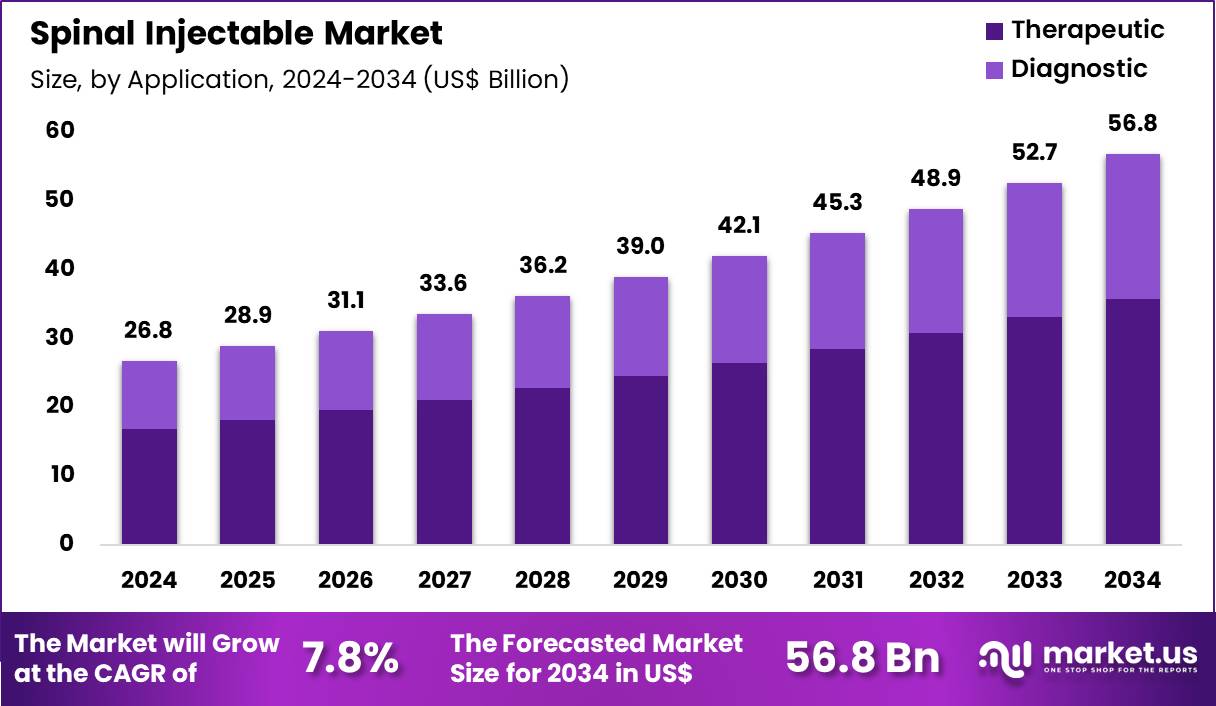
Key Takeaways
- In 2024, the Spinal Injectable Market generated a revenue of US$ 26.8 billion and is projected to grow at a CAGR of 7.8%, reaching approximately US$ 56.8 billion by 2034.
- Based on product type, the market is segmented into epidural injection, trigger point injection, sacroiliac joint injection, provocation discography, and facet joint injection. Among these, epidural injection dominated the market in 2024, accounting for a share of 39.7%.
- Based on spinal region, the market is categorized into thoracic, cervical, and lumbar segments. The thoracic segment held a significant market share of 41.8% in 2024.
- By application, the market is divided into therapeutic and diagnostic segments. The therapeutic segment emerged as the leading segment, capturing the highest revenue share of 62.9%.
- Based on end-user, the market is segmented into hospitals, specialty clinics, diagnostic centers, regenerative sports and spine centers, and ambulatory surgical centers. The hospitals segment led the market with a revenue share of 47.5%.
- Regionally, North America dominated the Spinal Injectable Market in 2024, accounting for a market share of 42.5% due to advanced healthcare infrastructure and increasing adoption of minimally invasive spinal treatments.
Market Segmentation Overview
- Product Type Analysis: The epidural injection segment held the largest share of 39.7% in the Spinal Injectable Market due to its widespread use in treating chronic spinal pain, radiculopathy, and inflammation. Increasing cases of degenerative spinal disorders, rising demand for minimally invasive treatments, and advancements in fluoroscopy and ultrasound-guided procedures are improving injection accuracy, safety, and effectiveness, supporting continued segment dominance.
- Spinal Region Analysis: Thoracic spinal region accounted for a significant share of 41.8% due to increasing cases of mid-spine pain, posture-related disorders, trauma injuries, and occupational strain. Growing diagnosis of thoracic radiculopathy and adoption of image-guided injection techniques are improving treatment outcomes. Rising geriatric population and increasing prevalence of spine-related conditions are further supporting growth of this segment.
- Application Analysis: Therapeutic applications dominated the market with a revenue share of 62.9% due to increasing adoption of injectable treatments for chronic spinal disorders, including disc degeneration, spinal stenosis, and arthritis. Growing preference for non-surgical pain management solutions, rapid symptom relief, and advancements in regenerative and biologic injectable therapies are driving higher utilization of therapeutic spinal injection procedures.
- End-User Analysis: Hospitals led the end-user segment with a market share of 47.5% due to their advanced infrastructure, availability of imaging-guided procedures, and multidisciplinary spine care services. Increasing patient preference for hospital-based pain management programs, rising healthcare investments, and growing demand for minimally invasive spinal interventions are strengthening the role of hospitals in the Spinal Injectable Market.
Statistical Information
- Trial Evidence Shows Limited Six-Week Steroid Benefit: An AHRQ-reviewed randomised trial enrolled 400 patients with lumbar spinal stenosis. At 6 weeks, the proportion achieving at least 50% improvement in leg-pain score was identical at 38.3% in both epidural glucocorticoid-plus-lidocaine and lidocaine-only groups. The result had P = 0.97, indicating no statistically significant added steroid benefit for this outcome at six weeks.
- Dose Limits Shape Spinal Injectable Drug Product Mix: CMS recommends the lowest effective steroid dose and advises maximum per-session doses of 80 mg triamcinolone, 12 mg betamethasone, or 15 mg dexamethasone. An alternative risk-reduction recommendation suggests 40 mg methylprednisolone acetate, 10–20 mg triamcinolone acetate, or 10 mg dexamethasone phosphate. Dose restrictions influence corticosteroid formulation choice, vial size, and clinic inventory management.
- Condoliase Adoption Demonstrates Emerging Intradiscal Injectable Potential: FDA review documentation states that approximately 29,000 patients had received intradiscal condoliase in Japan by August 2024. Earlier data included approximately 24,000 treated patients. Condoliase is a chemonucleolysis therapy used for lumbar disc herniation, illustrating an emerging injectable alternative to conventional pain-relief injections and surgery. FDA noted no observed imbalance in deaths or causally related serious adverse events across available studies
- Phase Three Trial Showed Significant Thirteen-Week Pain Improvement: A U.S. Phase 3 randomised trial found that condoliase improved worst radicular leg-pain scores by 41.7 points at Week 13, compared with 34.2 points for sham injection. The adjusted treatment difference was 7.5 points, with a 95% confidence interval of 14.1 to 0.9 and P = 0.0263. This supports intradiscal condoliase as an emerging single-dose spinal injectable option.
- Condoliase Trial Enrolled More Than Three Hundred Patients: The U.S. Phase 3 condoliase study randomly assigned 352 participants with lumbar disc herniation. The modified intention-to-treat analysis included 341 patients; 169 received condoliase, and 172 received sham injection. At Week 52, leg-pain improvement continued to favour condoliase, although the primary-analysis comparison did not achieve statistical significance, with P = 0.0558.
- Condoliase Treatment-Related Events Require Careful Patient Selection: In the Phase 3 study, at least one treatment-emergent adverse event occurred in 71.9% of condoliase-treated patients, compared with 60.3% of sham-treated patients. Treatment-related adverse events occurred in 28.1% of condoliase patients versus 10.3% of sham patients. Importantly, the study reported 0 treatment-related serious adverse events, supporting outpatient potential with appropriate clinical monitoring.
- Japanese Condoliase Data Showed Strong Six-Month Response Rates: A Japanese clinical study included 52 patients receiving intradiscal condoliase injection for lumbar disc herniation. At six months, 40 patients, or 76.9%, achieved at least 50% reduction in leg-pain scores. Only 3 patients, or 5.8%, underwent herniotomy for residual pain during follow-up. The study reported zero severe adverse events, although patient selection influenced response rates.
Regional Analysis
North America led the market by securing a market share of 42.5% in 2024.
North America dominated the Spinal Injectable Market, accounting for 42.5% of the global market in 2024, driven by the rising burden of chronic spinal disorders, favorable reimbursement policies, and advanced healthcare infrastructure.
According to the U.S. Centers for Disease Control and Prevention (CDC), 24.3% of U.S. adults experienced chronic pain in 2023, while 8.5% reported high-impact chronic pain that limited daily activities. The region has a high adoption of fluoroscopy- and ultrasound-guided spinal injection procedures, improving treatment precision and patient outcomes.
Medicare coverage and expanding outpatient pain management services continue to improve access to minimally invasive spinal therapies. Leading pharmaceutical and medical device companies are investing in long-acting corticosteroids, biologics, and sustained-release injectable formulations to enhance therapeutic effectiveness.
Additionally, the growing elderly population, increasing prevalence of degenerative disc disease and spinal stenosis, and strong clinical adoption of non-surgical pain management approaches continue to support the region’s leadership in the global spinal injectable market.
Business Opportunities
The Spinal Injectable Market presents significant business opportunities as healthcare systems increasingly prioritize minimally invasive pain management over surgical interventions. Rising cases of chronic back pain, spinal stenosis, herniated discs, and degenerative disc disease are creating sustained demand for advanced injectable therapies.
Pharmaceutical companies have opportunities to develop long-acting corticosteroids, biologics, regenerative injectables, and sustained-release drug delivery systems that improve pain relief while reducing repeat procedures.
The expansion of outpatient pain management centers and ambulatory surgical centers is increasing the adoption of image-guided spinal injection procedures, creating opportunities for manufacturers of imaging equipment and injection devices. Growth in the aging population and increasing healthcare expenditure across developed and emerging economies are encouraging investment in innovative spinal care solutions.
Companies can also benefit from partnerships with hospitals, specialty clinics, and research institutions to accelerate product development and clinical adoption. Additionally, expanding reimbursement coverage and increasing physician preference for non-surgical therapies are expected to create long-term commercial opportunities for spinal injectable manufacturers and healthcare providers.
Emerging Trends
- Growing adoption of minimally invasive pain management: Healthcare providers are increasingly using spinal injectable therapies before surgery to manage chronic back pain. The WHO estimates 619 million people lived with low back pain in 2020, with cases projected to reach 843 million by 2050, increasing demand for injectable treatments.
- Increasing use of image-guided spinal injections: Hospitals are expanding the use of fluoroscopy and ultrasound guidance to improve injection accuracy, reduce complications, and enhance patient outcomes. These technologies are becoming the standard for epidural and facet joint injection procedures.
- Rising demand from the aging population: According to the WHO, the global population aged 60 years and older is expected to reach 2.1 billion by 2050, increasing the incidence of degenerative spine disorders and driving demand for spinal injectable therapies.
- Expansion of outpatient spine care services: More spinal injection procedures are being performed in outpatient and ambulatory settings because they reduce hospital stays, lower treatment costs, and enable faster recovery. This trend is supported by broader reimbursement and improved healthcare infrastructure.
- Advancements in biologic and regenerative injectables: Healthcare providers are increasingly evaluating platelet-rich plasma (PRP) and other regenerative therapies for selected spinal conditions. Ongoing clinical research is expanding treatment options for chronic spinal pain while supporting personalized, non-surgical care.
Use Cases
- Chronic Low Back Pain Management: Spinal injectables are widely used to reduce inflammation and relieve chronic low back pain when medication and physical therapy are insufficient. According to the WHO, 619 million people were affected by low back pain in 2020, highlighting the growing need for interventional pain management.
- Treatment of Herniated Discs and Sciatica: Epidural steroid injections are commonly used to reduce nerve inflammation caused by herniated discs and sciatica, helping patients improve mobility and delay or avoid surgery. These procedures are routinely performed under image guidance for greater precision.
- Pain Relief for Spinal Stenosis: Spinal injections are frequently used to manage pain associated with spinal stenosis, particularly in older adults. With the global population aged 60 years and above expected to reach 2.1 billion by 2050, demand for these therapies is expected to continue increasing.
- Outpatient and Ambulatory Pain Procedures: Hospitals and ambulatory surgical centers increasingly perform spinal injectable procedures because they offer shorter recovery times, lower healthcare costs, and faster patient discharge while maintaining high treatment effectiveness.
- Rehabilitation and Functional Recovery: Spinal injectables are used alongside physical therapy and rehabilitation programs to reduce pain, improve movement, and help patients return to daily activities. The WHO recommends combining appropriate clinical treatment with rehabilitation for better long-term outcomes in chronic low back pain.
Recent Development
- In July 2026, Johnson & Johnson (DePuy Synthes) acquired Expanding Innovations, Inc., strengthening its spine portfolio with expandable interbody cage technology and expanding its capabilities in advanced spinal surgery solutions.
- In October 2025, Johnson & Johnson announced plans to separate DePuy Synthes into an independent orthopaedics business, enabling greater focus on innovation across spine, trauma, sports medicine, and joint reconstruction technologies.
- In February 2024, Medtronic reorganized its Medical Surgical Portfolio by creating the Acute Care & Monitoring business unit and confirmed continued investment in advanced spine and musculoskeletal technologies.
- In 2025, Boston Scientific continued expanding its neuromodulation portfolio through investments in minimally invasive technologies for chronic pain management, supporting broader treatment options for patients with spinal pain disorders.
- In February 2025, Zimmer Biomet introduced new digital surgery and navigation enhancements for its spine portfolio, supporting improved surgical planning, implant positioning, and patient outcomes in spinal procedures.
Frequently Asked Questions About Spinal Injectables
- What factors are driving the growth of the Spinal Injectable Market?
The market is driven by the increasing prevalence of chronic spinal disorders, growing geriatric population, rising demand for minimally invasive procedures, technological advancements in image-guided injections, and greater awareness of non-surgical pain management solutions. - Which spinal region holds the largest market share?
The thoracic segment holds a significant share due to the increasing incidence of posture-related disorders, spinal injuries, and degenerative conditions. Growing use of targeted injection therapies is also supporting demand across this spinal region. - Which region dominates the Spinal Injectable Market?
North America dominates the market due to its advanced healthcare infrastructure, favorable reimbursement policies, widespread adoption of minimally invasive treatments, and high prevalence of chronic spinal disorders requiring interventional pain management. - Which region is expected to witness the fastest growth?
Asia Pacific is expected to register the fastest growth due to increasing healthcare investments, aging populations, expanding access to advanced pain management services, and rising awareness of minimally invasive spinal treatment options. - What are the key opportunities in the Spinal Injectable Market?
Major opportunities include the development of biologic injectables, regenerative therapies, sustained-release drug formulations, image-guided technologies, and expansion of outpatient pain management centers in both developed and emerging healthcare markets. - How are technological advancements influencing the market?
Technological innovations such as fluoroscopy-guided procedures, ultrasound-assisted injections, digital imaging systems, and advanced drug delivery technologies are improving treatment precision, patient safety, and overall clinical outcomes. - What challenges does the Spinal Injectable Market face?
The market faces challenges such as stringent regulatory requirements, procedure-related risks, reimbursement limitations in some regions, and the availability of alternative pain management therapies, including surgery and long-term medication. - What is the future outlook for the Spinal Injectable Market?
The market is expected to grow steadily as demand for non-surgical pain management increases, healthcare infrastructure expands, regenerative injectable therapies advance, and aging populations contribute to a higher incidence of chronic spinal disorders.
Conclusion
The Spinal Injectable Market is poised for steady growth, supported by the increasing prevalence of chronic spinal disorders, rising demand for minimally invasive pain management, and continuous advancements in image-guided injection technologies. Growing adoption of therapeutic spinal injections, expanding outpatient care services, and favorable reimbursement policies are further strengthening market development.
North America remains the leading regional market, while Asia Pacific offers strong growth potential due to improving healthcare infrastructure and an aging population. Ongoing innovation in biologics, sustained-release formulations, and regenerative therapies, combined with strategic investments by leading companies, is expected to enhance treatment outcomes and create long-term growth opportunities for the global market.
Discuss your needs with our analyst
Please share your requirements with more details so our analyst can check if they can solve your problem(s)




