


Overview
New York, NY – Sep 18, 2026 –The Global Dermal Sprays Market size is expected to be worth around US$ 3.0 Billion by 2034 from US$ 1.4 Billion in 2024, growing at a CAGR of 7.9% during the forecast period 2025 to 2034. In 2024, North America led the market, achieving over 40.7% share with a revenue of US$ 0.6 Billion.
Dermal Sprays are gaining significant momentum due to the rising burden of wounds, burns, skin infections, and chronic dermatological conditions requiring effective topical treatment. According to the World Health Organization (WHO), an estimated 180,000 people die from burns each year, with the majority occurring in low- and middle-income countries.
The International Diabetes Federation (IDF) reported that approximately 589 million adults (20–79 years) were living with diabetes in 2025, and nearly 1 in 3 people with diabetes may develop a diabetic foot ulcer during their lifetime.
In the United States, the Centers for Disease Control and Prevention (CDC) estimates that more than 38 million people have diabetes, increasing the demand for advanced wound-care products such as dermal sprays.
Their touch-free application reduces cross-contamination, improves patient compliance, and supports rapid wound healing, making them increasingly preferred in hospitals, emergency departments, outpatient clinics, and home healthcare. Dermal Sprays are witnessing strong demand due to the increasing preference for hygienic, touch-free topical treatment solutions in wound care, dermatology, and first-aid applications.
The market is supported by the growing incidence of skin infections, burns, cuts, and chronic wounds, along with rising awareness of infection prevention. Medicated dermal sprays account for nearly 49% of total product demand, while retail pharmacies contribute approximately 45% of overall sales.
In addition, aerosol-based formulations represent around 56% of product offerings. Continuous innovation in spray technologies, portable packaging, and advanced skin-healing formulations is expected to support sustained market growth over the coming years.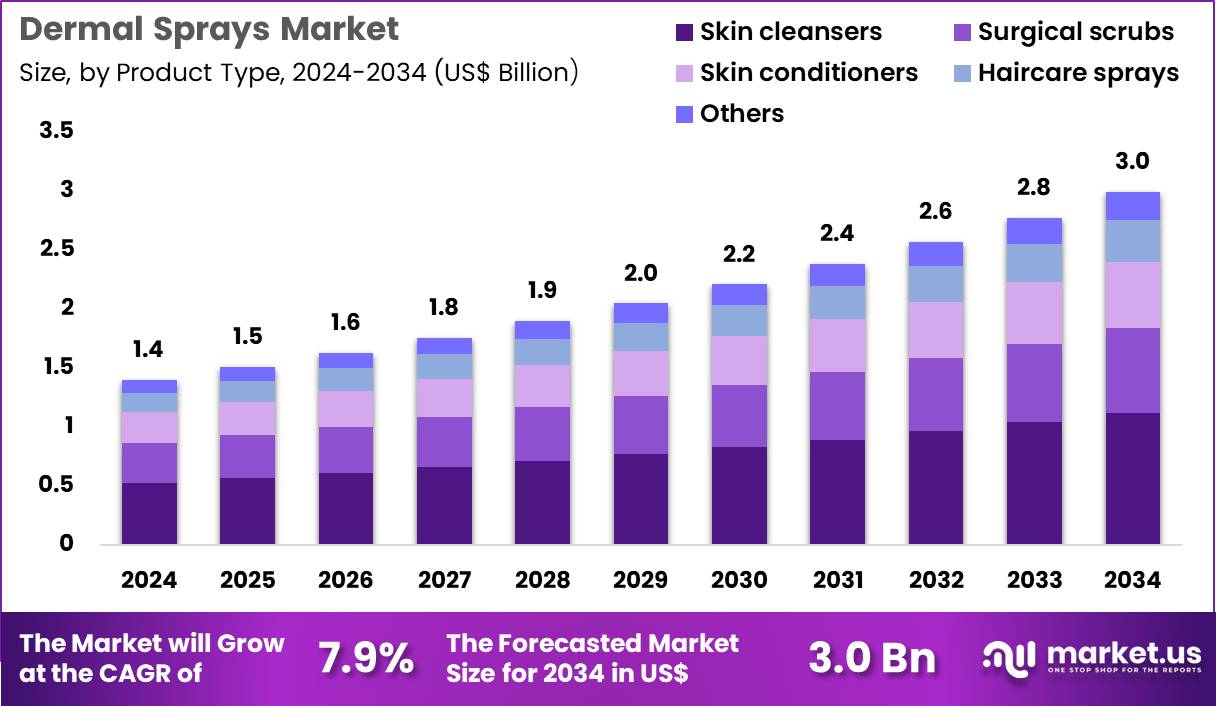
Key Takeaways
- In 2024, the Dermal Sprays Market was valued at approximately US$ 1.4 Billion and is projected to reach around US$ 3.0 Billion by 2034, registering a CAGR of 7.9% during the forecast period.
- Based on product type, the market is categorized into skin cleansers, surgical scrubs, skin conditioners, haircare sprays, and others, with skin cleansers accounting for the largest share of 37.4% in 2024.
- By distribution channel, the market comprises retail pharmacies, specialty clinics, online pharmacies, hospital pharmacies, and cosmetic stores, with retail pharmacies leading the segment with a 42.6% market share in 2024.
- North America emerged as the dominant regional market, capturing 40.7% of the global revenue share in 2024.
Market Segmentation Overview
- Product Type Analysis: Skin cleansers accounted for 37.4% of the dermal sprays market in 2024, supported by rising demand for convenient, no-rinse skincare solutions. Increasing cases of acne, sensitive skin, and environmental pollution have encouraged the use of spray-based cleansers. Product innovations featuring antimicrobial, hydrating, and soothing ingredients continue to strengthen consumer preference and expand adoption across both medical and personal care applications.
- Distribution Channel Analysis: Retail pharmacies held the largest market share of 42.6% in 2024, driven by their widespread accessibility and strong consumer trust. These outlets offer professional guidance, immediate product availability, and a broad range of branded dermal sprays. Growing pharmacy chains, promotional campaigns, and increasing demand for dermatologist-recommended skincare products continue to reinforce their leading position in the global market.
Statistical Information
- Hypochlorous Acid Spray Demonstrated Rapid Antimicrobial Activity: A wound-care study found hypochlorous acid killed tested microorganisms within 12 seconds. The evaluated hypochlorous-acid concentrations were 0.25%, 0.025%, and 0.0125% in vitro, while 0.25% and 0.025% concentrations were assessed in vivo. Fast antimicrobial action supports use of dermal sprays for wound cleansing, irrigation, infection prevention, and post-procedure skin-care applications.
- Diabetic Foot Wound Study Favoured Hypochlorous Acid Spray: An open-label study compared hypochlorous-acid treatment in 110 patients with povidone-iodine treatment in 108 patients with infected diabetic foot wounds or ulcers. Median healing time was 43 days for hypochlorous acid versus 55 days for povidone-iodine, a 12-day improvement. No skin reactions occurred among 110 hypochlorous-acid patients, compared with 18 reactions among 108 povidone-iodine patients.
- Stabilized Hypochlorous Solution Improved Early Acute Wound Healing: A randomised controlled trial found that stabilised hypochlorous-acid solution increased wound re-epithelialisation by 14% on Day 4 versus control treatment. The 95% confidence interval was 6.8%–20%, and the result was statistically significant with P = 0.00051. On Day 10, healing remained non-inferior to control, with a difference of 0.3% and P < 0.0001.
- Lower Concentration Dermal Sprays Support Frequent Wound Application: Wound-care guidance identifies modern hypochlorous-acid sprays with concentrations around 0.014%–0.033% as suitable for use at each dressing change in infected or high-risk wounds. Older full-strength Dakin’s solution contains 0.50% hypochlorous acid and half-strength formulations contain 0.25%. Higher concentrations may be cytotoxic to developing tissue, supporting demand for lower-concentration dermal sprays for repeated use.
- Povidone Iodine Wound Spray Uses Dual Antiseptic Analgesic Formula: A DailyMed-listed wound-care spray contains povidone-iodine delivering 2% available iodine and lidocaine at 2% w/v for pain relief. The product claims to kill up to 99% of surface germs within 15 seconds or less. This demonstrates a separate dermal-spray segment combining antiseptic, local-anaesthetic, bitter-agent, and anti-licking functions for wound and post-surgical-care applications.
- Dermatology Review Included Forty-One Hypochlorous Acid Reports: A dermatology review screened and included 41 reports assessing hypochlorous-acid efficacy and safety. The review covered infection prevention, wound care, scar management, inflammatory modulation, atopic dermatitis, and pruritus. It identified wound- and mucous-membrane antiseptic activity at concentrations of 300 mg/L and 500 mg/L with contact times of 5–10 minutes, supporting therapeutic dermal-spray formulation development.
Regional Analysis
North America led the market by securing a market share of 40.7% in 2024.
North America held 40.7% of the global Dermal Sprays Market in 2024, driven by advanced healthcare infrastructure, high awareness of wound care, and increasing adoption of non-contact topical therapies. The region has a growing patient population requiring treatment for chronic wounds, burns, diabetic ulcers, and skin infections, supporting demand for antiseptic and medicated dermal sprays.
According to the Centers for Disease Control and Prevention (CDC), approximately 38.4 million people in the United States were living with diabetes in 2024, increasing the need for effective wound management products.
Strong consumer spending on skincare, widespread availability of over-the-counter dermal sprays, and continuous product innovation further support market growth. Meanwhile, Asia Pacific is expected to register the fastest CAGR during the forecast period due to expanding healthcare infrastructure, rising skincare awareness, increasing cases of skin disorders, rapid urbanization, growing pharmaceutical manufacturing, and improving access to advanced dermal spray products through retail and online distribution channels.
Business Opportunities
The Dermal Sprays Market offers significant business opportunities as demand rises for convenient, hygienic, and fast-acting topical treatment solutions. Manufacturers can capitalize on the growing preference for spray-based formulations by developing products for wound care, burns, skin infections, pain relief, and chronic dermatological conditions.
Increasing consumer interest in multifunctional products with antimicrobial, moisturizing, and skin-repair properties creates opportunities for product innovation and premium offerings. The expansion of over-the-counter healthcare products, online pharmacies, and e-commerce platforms enables companies to reach a broader consumer base. Emerging markets in Asia-Pacific, Latin America, and the Middle East present strong growth potential due to improving healthcare infrastructure and rising healthcare expenditure.
Partnerships with hospitals, dermatology clinics, and retail pharmacy chains can strengthen market penetration and brand visibility. In addition, investments in eco-friendly packaging, preservative-free formulations, and advanced spray delivery technologies are expected to help manufacturers differentiate their products and capture long-term growth opportunities in the global Dermal Sprays Market.
Emerging Trends
- Growing Demand for Touch-Free Wound Care: Healthcare providers are increasingly adopting dermal sprays because they reduce direct skin contact and lower contamination risk. The CDC continues to emphasize infection prevention in healthcare settings, encouraging safer wound-care practices through hygienic application methods and proper wound management.
- Advanced Spray Formulations: Manufacturers are introducing dermal sprays containing antimicrobial agents, hydrogels, nanoparticles, and bioactive ingredients that improve healing and skin protection. Research published through PubMed highlights that these advanced topical technologies enhance wound healing and support treatment of chronic and acute wounds.
- Rising Need from Diabetes Patients: Increasing diabetes prevalence is expanding demand for dermal sprays used in chronic wound management. The CDC estimates that 38.4 million Americans have diabetes, creating a larger patient population requiring effective skin protection and wound-care products.
- Expansion of Outpatient Skin Care: More wound treatments are shifting from hospitals to outpatient clinics and primary care. A recent PubMed study estimated 45.1 million outpatient cutaneous wound visits in the U.S., highlighting strong demand for convenient topical products, including dermal sprays.
- Focus on Eco-Friendly and Easy-to-Use Packaging: Companies are investing in portable pump and aerosol spray systems that improve dosing accuracy and patient convenience. Easy-to-carry packaging supports home healthcare and self-treatment, making dermal sprays increasingly attractive for both medical and personal skincare applications.
Use Cases
- Chronic Wound Management: Dermal sprays are widely used for diabetic foot ulcers, pressure ulcers, and venous leg ulcers. The FDA notes that chronic wounds affect around 2% of the general population, creating sustained demand for advanced topical wound-care products.
- Emergency and First-Aid Treatment: Dermal sprays are commonly applied to cuts, burns, abrasions, and minor injuries because they are quick to use and reduce contamination. The CDC recommends prompt wound care after injuries to help prevent infection and improve healing.
- Dermatology Treatments: Dermatologists increasingly prescribe dermal sprays for eczema, dermatitis, psoriasis, acne, and post-procedure skin care. Spray formulations improve patient comfort by delivering medication without rubbing sensitive or damaged skin, supporting better treatment adherence.
- Home Healthcare Applications: Home-based wound care is expanding as aging populations and chronic disease patients require convenient treatment options. Portable dermal sprays simplify daily wound management, reduce clinic visits, and improve patient compliance with prescribed skin-care routines.
- Post-Surgical Wound Care: Hospitals and surgical centers increasingly use dermal sprays to protect surgical incisions, reduce infection risk, and maintain a moist healing environment. The FDA recognizes topical wound products for managing surgical and other acute wounds, supporting their broader clinical use.
Recent Development
- In March 2026, ConvaTec Group expanded the availability of its advanced wound care solutions across key international markets, with continued emphasis on antimicrobial dressings and chronic wound management products for healthcare providers.
- In April 2026, Mölnlycke Health Care strengthened its surgical and wound care business by investing in innovative antimicrobial dressing technologies and expanding production capabilities to meet increasing global demand.
- In May 2026, Medline Industries broadened its skin health and wound care portfolio by increasing the supply of advanced dressings and skin protection products for hospitals, ambulatory care centers, and home healthcare providers.
- In June 2026, Johnson & Johnson (Ethicon) continued advancing its surgical wound closure technologies by expanding solutions that improve post-operative recovery and support infection prevention in healthcare facilities.
- In July 2026, Laboratoires Urgo expanded its advanced wound management offerings with new skin repair and chronic wound care solutions designed to improve healing outcomes across European healthcare markets.
- In August 2026, Paul Hartmann AG enhanced its wound care portfolio by focusing on absorbent dressings and silicone-based products for effective exudate management and improved patient comfort in acute and chronic wound treatment.
Frequently Asked Questions About Dermal Sprays
- What is driving the growth of the Dermal Sprays Market?
The market is growing due to increasing cases of chronic wounds, skin infections, burns, and dermatological disorders. Rising consumer awareness of skin hygiene, expanding home healthcare, and continuous innovation in spray formulations are further supporting global demand for dermal spray products. - Which region dominates the Dermal Sprays Market?
North America led the global market with a 40.7% share in 2024. Strong healthcare infrastructure, increasing demand for advanced wound care, rising dermatological disorders, and continuous product innovation contribute significantly to the region’s leading market position. - What are dermal sprays commonly used for?
Dermal sprays are widely used for wound cleansing, antiseptic protection, pain relief, burn treatment, moisturizing dry skin, and managing dermatological conditions. Their touch-free application improves hygiene while reducing discomfort during treatment of sensitive or damaged skin. - Why are dermal sprays becoming increasingly popular?
Dermal sprays offer quick, convenient, and hygienic application without direct skin contact. Their portability, ease of use, and ability to provide uniform coverage make them increasingly preferred by healthcare professionals and consumers for both medical and personal care applications. - What role does home healthcare play in market growth?
Home healthcare is becoming an important growth area as more patients manage wounds and skin conditions outside hospitals. Dermal sprays simplify treatment, reduce contamination risk, and improve patient compliance, making them suitable for elderly individuals and chronic disease patients. - What business opportunities exist in the Dermal Sprays Market?
Companies can expand through innovative spray formulations, eco-friendly packaging, online pharmacy partnerships, and entry into emerging economies. Increasing investments in wound care, dermatology, and home healthcare continue to create attractive opportunities for long-term market growth. - What is the future outlook for the Dermal Sprays Market?
The market is expected to witness steady growth through 2034, supported by increasing demand for advanced wound care, rising skincare awareness, expanding healthcare infrastructure, and continuous product innovation. Growing adoption of touch-free topical treatments will further strengthen market development globally.
Conclusion
The Dermal Sprays Market is expected to witness steady growth over the forecast period, driven by increasing demand for convenient, hygienic, and non-contact topical treatment solutions. Rising cases of chronic wounds, skin infections, burns, and dermatological conditions are encouraging greater adoption across hospitals, clinics, and home healthcare settings.
Continuous innovation in spray formulations, advanced delivery technologies, and multifunctional skincare products is further enhancing market opportunities. North America remains the leading regional market, while Asia Pacific is projected to experience the fastest growth. Expanding retail distribution, increasing healthcare investments, and growing consumer awareness will continue to support the long-term development of the global Dermal Sprays Market.
Discuss your needs with our analyst
Please share your requirements with more details so our analyst can check if they can solve your problem(s)




