


Overview
The Global Medical Face Shield Market size is expected to be worth around US$ 875.5 Million by 2034 from US$ 569.2 Million in 2024, growing at a CAGR of 4.4% during the forecast period 2025 to 2034. In 2024, North America led the market, achieving over 38.1% share with a revenue of US$ 216.9 Million.
Medical Face Shield is witnessing consistent growth due to increasing healthcare safety requirements, rising infection prevention initiatives, and expanding adoption of personal protective equipment (PPE) across hospitals, clinics, and diagnostic centers. Medical face shields provide an additional protective barrier against blood splashes, respiratory droplets, and infectious materials during surgical and clinical procedures.
The market gained significant momentum during the COVID-19 pandemic, when global demand for face shields and other PPE products increased rapidly. According to international health agencies, millions of healthcare workers worldwide required continuous access to protective equipment, accelerating production capacity and adoption of advanced face protection solutions. The global PPE market exceeded US$ 90 billion in 2020, highlighting the large-scale demand generated during public health emergencies.
Growing healthcare infrastructure is another major factor supporting market expansion. Global healthcare expenditure has reached more than US$ 9 trillion annually, encouraging hospitals to invest in infection control products and worker safety equipment. Additionally, more than 300 million surgical procedures are performed worldwide every year, creating ongoing demand for reliable protective solutions such as medical face shields.
Manufacturers are focusing on innovations such as anti-fog technology, lightweight polycarbonate shields, adjustable head straps, extended chin protection, and reusable designs to improve comfort and efficiency. Disposable face shields continue to dominate high-risk medical environments due to their convenience, while reusable models are gaining adoption due to sustainability and cost-effectiveness.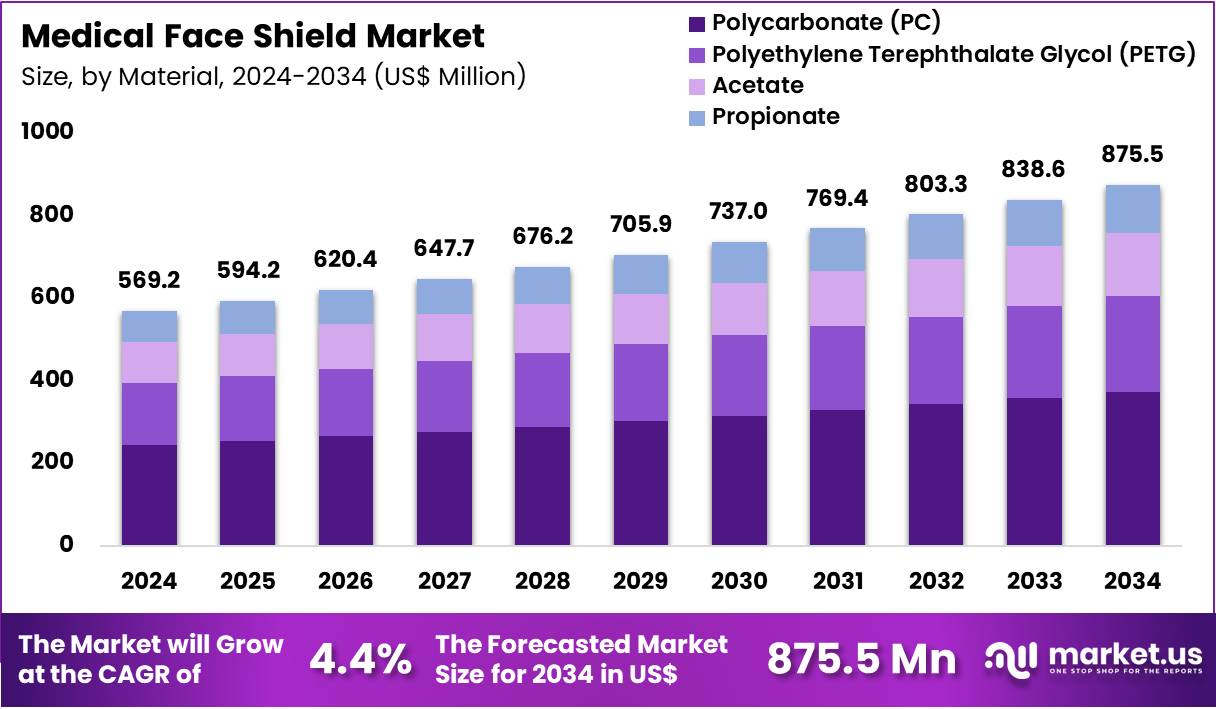
Key Takeaways
- In 2024, the Medical Face Shield Market generated revenue of US$ 569.2 Million and is projected to grow at a CAGR of 4.4%, reaching approximately US$ 875.5 Million by 2034.
- The Material segment includes Polycarbonate (PC), Polyethylene Terephthalate Glycol (PETG), Acetate, and Propionate, with Polycarbonate (PC) dominating the market in 2024 with a 42.7% market share.
- The Product Type segment comprises Anti-Fog shields, Anti-Glare shields, and Others, where Anti-Fog shields accounted for the leading position in 2024 with a 40.1% market share.
- The Usage segment is categorized into Disposable and Reusable face shields, with Disposable face shields holding the largest market share of 65.2% in 2024.
- The Distribution Channel segment consists of Hospital Pharmacies, Retail Pharmacies, and Online Pharmacies, with Hospital Pharmacies leading the segment in 2024 by capturing a 48.9% market share.
- North America dominated the global Medical Face Shield Market in 2024, accounting for a significant 38.1% market share.
Market Segmentation Overview
- Material Analysis: Polycarbonate (PC) dominated the Medical Face Shield Market in 2024 with a 42.7% market share due to its high impact resistance, durability, lightweight design, and excellent optical clarity. PC face shields are widely used in hospitals, emergency rooms, ICUs, and surgical environments where healthcare professionals require reliable protection against fluid splashes, aerosols, and infectious materials during critical medical procedures.
- Product Type Analysis: Anti-Fog shields accounted for the largest Product Type segment with a 40.1% market share in 2024. These shields are preferred because they prevent visibility issues caused by moisture buildup during extended procedures. They are extensively used in surgical rooms, dental clinics, emergency departments, and respiratory care settings where clear vision is essential for accurate medical operations.
- Usage Analysis: Disposable medical face shields held the leading position in the Usage segment with a 65.2% market share in 2024. Their dominance is driven by infection-control practices, single-use safety protocols, and high demand from hospitals, clinics, testing centers, and emergency services. Disposable shields help minimize cross-contamination risks while ensuring convenient and effective protection for healthcare workers.
- Distribution Channel Analysis: Hospital Pharmacies dominated the Distribution Channel segment with a 48.9% market share in 2024 due to continuous procurement by healthcare institutions. Hospitals require large quantities of face shields for intensive care units, operating rooms, emergency departments, and infection-control areas. Institutional purchasing ensures reliable supply availability and supports consistent demand for medical face protection products.
Statistical Information
- Face Shields Reduced Immediate Cough Exposure By Ninety Six Percent: A CDC cough-simulation study found that a face shield reduced a worker’s immediate inhalation exposure to influenza-laden aerosol by 96% at 46 cm (18 inches) from the source. The shield also reduced respirator-surface contamination by 97%. These results support face-shield use for splash and droplet protection during close-range clinical procedures.
- Smaller Aerosols Reduce Medical Face Shield Protection Performance: When aerosol particles were reduced from 8.5 μm to 3.4 μm, the CDC study found face shields blocked only 68% of immediate inhalational exposure. Between 1 and 30 minutes after a cough, protection declined further, with only a 23% reduction in aerosol inhalation. This demonstrates that face shields are protective adjuncts, not replacements for surgical masks or respirators.
- Face Shields Blocked Only Two Per cent As Source Control: A cough-aerosol simulation found a face shield blocked only 2% of expelled aerosol particles when worn by the source. In comparison, an N95 respirator blocked 99%, a medical procedure mask blocked 59%, a three-ply cloth mask blocked 51%, and a double-layer neck gaiter blocked 60%. These results show medical face shields should not be marketed or used as standalone respiratory source-control substitutes.
- Large Particle Size Improves Face Shield Protective Performance: CDC tested face shields against cough aerosols with median particle diameters of 8.5 μm and 3.4 μm. The shield reduced immediate inhalation exposure by 96% for 8.5 μm particles but only 68% for 3.4 μm particles. This 28-percentage-point performance difference shows why face shields are primarily selected for splash and large-droplet protection rather than airborne-respiratory protection.
- Protective Benefits Declined During Extended Aerosol Exposure Periods: During the first moments after a cough, a face shield reduced worker aerosol exposure by 96%. However, during the 1–30 minute period after the cough, when aerosols dispersed through the room, reduction fell to only 23%. The 73-percentage-point decline demonstrates the need for face shields to be combined with masks or respirators during prolonged exposure to respiratory aerosols.
- Six-Foot Distance Reduced Inhaled Aerosol Exposure Ninety-Two Per cent: At a separation distance of 183 cm (6 feet), a simulated healthcare worker wearing a face shield had 92% lower immediate inhaled-virus exposure than an unprotected worker. At 46 cm (18 inches), the reduction was 96%. The smaller protective effect at six feet shows that physical distancing itself is a major protective factor; face shields mainly add splash and eye protection.
Regional Analysis
North America led the market by securing a market share of 38.1% in 2024.
North America leads the Medical Face Shield Market with a 38.1% market share in 2024, supported by advanced healthcare infrastructure, strong infection-control practices, and strict workplace safety regulations.
The region’s high volume of medical procedures, increasing hospital investments, and widespread adoption of PPE in hospitals, dental clinics, and diagnostic laboratories continue to drive demand. In the United States, more than 860 million physician office visits and over 130 million emergency department visits annually create significant requirements for protective equipment.
Regulatory standards from organizations such as OSHA and CDC further support the adoption of face shields across healthcare settings. Asia Pacific is projected to register the fastest growth during the forecast period, driven by expanding healthcare facilities, increasing awareness of infection prevention, and rising demand for medical safety products.
Growing healthcare expenditure, large patient populations, and strong PPE manufacturing capabilities in countries such as China and Southeast Asian nations are contributing to regional market expansion.
Business Opportunities
The Medical Face Shield Market offers significant growth opportunities due to increasing demand for advanced personal protective equipment and rising focus on healthcare worker safety. Manufacturers can capitalize on the growing need for innovative products featuring anti-fog technology, lightweight materials, improved comfort, and enhanced durability.
Expanding healthcare infrastructure in emerging economies, particularly across Asia Pacific and Latin America, creates opportunities for companies to strengthen distribution networks and supply affordable protective solutions. The rising adoption of sustainable healthcare practices is encouraging the development of reusable and recyclable face shields that reduce medical waste and operational costs.
Additionally, digital procurement and e-commerce platforms are opening new sales channels for reaching hospitals, clinics, dental centers, and laboratories. Companies investing in customized solutions, such as pediatric shields, extended-coverage designs, and specialty protective equipment, can gain competitive advantages and expand their market presence.
Emerging Trends
- Advanced Anti-Fog and Lightweight Designs: Medical face shield manufacturers are focusing on anti-fog coatings, ergonomic structures, and lightweight materials to improve comfort during long procedures. Healthcare workers often require continuous protection during surgeries, emergency care, and respiratory procedures where clear visibility is critical.
- Integration of Sustainable Materials: Hospitals are increasingly adopting reusable and recyclable face shields to reduce medical waste and lower long-term costs. Polycarbonate-based shields are gaining attention due to durability, optical clarity, and the ability to withstand repeated cleaning and disinfection processes.
- Growing Demand in Infection Prevention Programs: Face shields are becoming an important component of healthcare infection-control strategies. According to CDC guidance, eye protection is recommended for healthcare workers exposed to respiratory droplets and splashes, supporting continued demand across hospitals and clinics.
- Expansion in Dental and Specialty Care Applications: Rising awareness of aerosol exposure risks is increasing face shield adoption in dental clinics, ENT centers, laboratories, and emergency departments. More than 200,000 dental practices in North America contribute to steady demand for protective face equipment.
- Improved PPE Preparedness and Stockpiling: Governments and healthcare organizations are strengthening PPE supply chains after lessons from COVID-19. The FDA continues supporting the availability of protective equipment, including face shields, to improve readiness for future infectious disease outbreaks and healthcare emergencies.
Use Cases
- Surgical and Operating Room Protection: Medical face shields are widely used during surgeries to protect healthcare professionals from blood splashes, body fluids, and aerosol exposure. Surgeons, nurses, and operating room staff use face shields during procedures requiring close patient contact and high infection-control standards.
- Emergency and Critical Care Applications: Emergency departments and intensive care units use face shields during high-risk procedures such as intubation, suctioning, and resuscitation. In the United States, more than 130 million emergency department visits occur annually, creating continuous demand for protective equipment.
- Dental and Oral Healthcare Procedures: Dental professionals use medical face shields during procedures that generate aerosols, including drilling, cleaning, and oral surgeries. With over 200,000 dental practices in the US and Canada, face shields remain an important safety tool for reducing exposure risks.
- Laboratory and Diagnostic Applications: Face shields are used in microbiology, pathology, and diagnostic laboratories where workers handle biological samples and chemicals. They provide additional protection against accidental splashes during testing, specimen processing, and research activities.
- Public Health and Outbreak Preparedness: Medical face shields support healthcare readiness during infectious disease outbreaks, vaccination campaigns, and mass testing programs. Government health agencies recommend appropriate PPE use to protect healthcare workers involved in patient care and infectious disease response activities.
Recent Development
- In 2026, 3M continued expanding its personal protective equipment portfolio by focusing on advanced safety technologies, improved user comfort, and innovative material solutions. The company strengthened its healthcare safety offerings by supporting hospitals and healthcare professionals with reliable protective equipment designed for infection prevention and workplace safety applications.
- In 2026, Honeywell International enhanced its protective equipment solutions with a focus on improved face protection designs, visibility, and ergonomic comfort. The company continued developing safety products that support healthcare workers and industrial users requiring effective protection against airborne particles, splashes, and workplace hazards.
- In 2026, Cardinal Health strengthened its healthcare supply-chain operations and medical product distribution capabilities. The company continued supporting hospitals, clinics, and healthcare organizations by improving access to essential medical supplies, including infection prevention products and protective equipment required for patient-care environments.
- In 2026, Thermo Fisher Scientific continued expanding its healthcare and laboratory solutions portfolio by investing in technologies that support diagnostics, research, and clinical applications. The company focused on improving healthcare efficiency through advanced solutions used across laboratories, hospitals, and scientific research facilities.
- In 2026, Medline Industries continued developing healthcare supply solutions with a focus on infection prevention, surgical care, and medical safety products. The company expanded its product offerings to support hospitals and healthcare providers with protective solutions that improve safety standards and operational efficiency.
Frequently Asked Questions About Medical Face Shield
- What are the key factors driving the Medical Face Shield Market growth?
Increasing infection prevention awareness, rising healthcare worker safety requirements, growing surgical procedures, and demand for advanced PPE solutions are major factors driving market growth. Hospitals and healthcare facilities continue adopting face shields to improve protection during high-risk medical procedures. - Which material dominates the Medical Face Shield Market?
Polycarbonate (PC) dominated the material segment with a 42.7% market share in 2024. Its high impact resistance, durability, lightweight structure, and optical clarity make it suitable for hospitals, surgical environments, emergency rooms, and intensive care applications. - Which product type holds the largest share in the Medical Face Shield Market?
Anti-Fog shields led the product type segment with a 40.1% market share in 2024. These shields are preferred because they maintain clear visibility during long procedures, reducing fogging issues in surgical rooms, dental clinics, and emergency care environments. - Which region dominates the Medical Face Shield Market?
North America dominated the Medical Face Shield Market with a 38.1% market share in 2024. The region’s advanced healthcare infrastructure, strict occupational safety standards, high medical procedure volumes, and strong PPE adoption support market leadership. - What opportunities exist in the Medical Face Shield Market?
Growth opportunities include expansion into emerging healthcare markets, development of reusable and eco-friendly shields, digital distribution growth, and innovation in specialized products. Increasing healthcare infrastructure investments create opportunities for manufacturers to strengthen global market presence. - What technologies are improving medical face shields?
Manufacturers are incorporating advanced materials, anti-fog coatings, lightweight polycarbonate structures, adjustable headbands, and improved ventilation systems. These technologies enhance user comfort, visibility, and protection, making face shields more effective for long-duration healthcare applications. - What is the future outlook of the Medical Face Shield Market?
The Medical Face Shield Market is expected to maintain steady growth due to increasing healthcare safety awareness, infection prevention programs, and continuous demand for protective equipment. Innovation in sustainable materials and advanced designs will further support market expansion through 2034.
Conclusion
The Medical Face Shield Market is expected to witness steady growth driven by increasing healthcare safety requirements, infection prevention awareness, and rising demand for personal protective equipment. The market reached US$ 569.2 Million in 2024 and is projected to grow at a CAGR of 4.4%, reaching US$ 875.5 Million by 2034.
Polycarbonate materials, anti-fog shields, disposable products, and hospital pharmacy distribution channels continue to dominate market segments. North America leads due to advanced healthcare infrastructure and strict safety standards. Future growth will be supported by sustainable designs, technological innovations, and expanding healthcare facilities across emerging regions.
Discuss your needs with our analyst
Please share your requirements with more details so our analyst can check if they can solve your problem(s)




