


Overview
The Global Safety Needles Market Size is expected to be worth around US$ 6.07 Billion by 2034, from US$ 2.89 Billion in 2024, growing at a CAGR of 7.7% during the forecast period from 2025 to 2034. In 2024, North America held a dominant market position, capturing more than a 38.5% share and holds US$ 1.11 Billion market value for the year.
The global Safety Needles market is witnessing steady growth as healthcare systems prioritize needlestick injury prevention, infection control, and worker safety. Safety needles are engineered with protective mechanisms that reduce accidental needle-stick injuries during injections and blood collection procedures.
Their adoption is increasing across hospitals, clinics, ambulatory surgical centers, and home healthcare settings due to stricter occupational safety regulations and rising awareness of bloodborne disease prevention. According to the World Health Organization (WHO), around 16 billion injections are administered worldwide every year, highlighting the significant need for safer injection devices.
The U.S. Centers for Disease Control and Prevention (CDC) estimates that approximately 385,000 needlestick and sharps-related injuries occur annually among hospital-based healthcare workers in the United States. The U.S. Occupational Safety and Health Administration (OSHA) also mandates the use of safer medical devices whenever feasible to minimize workplace exposure to bloodborne pathogens.
The growing burden of chronic diseases, expanding immunization programs, and increasing surgical procedures continue to drive demand for safety needles. Technological advancements, including passive and active safety mechanisms, retractable needles, and shielded needle systems, are improving user convenience while enhancing patient and healthcare worker protection.
North America remains a leading regional market due to strong regulatory compliance and advanced healthcare infrastructure, while Asia-Pacific is experiencing rapid growth supported by expanding healthcare access and rising vaccination coverage.
Continuous innovation, supportive government policies, and increasing investments in healthcare safety are expected to create significant growth opportunities for the global Safety Needles market over the coming years.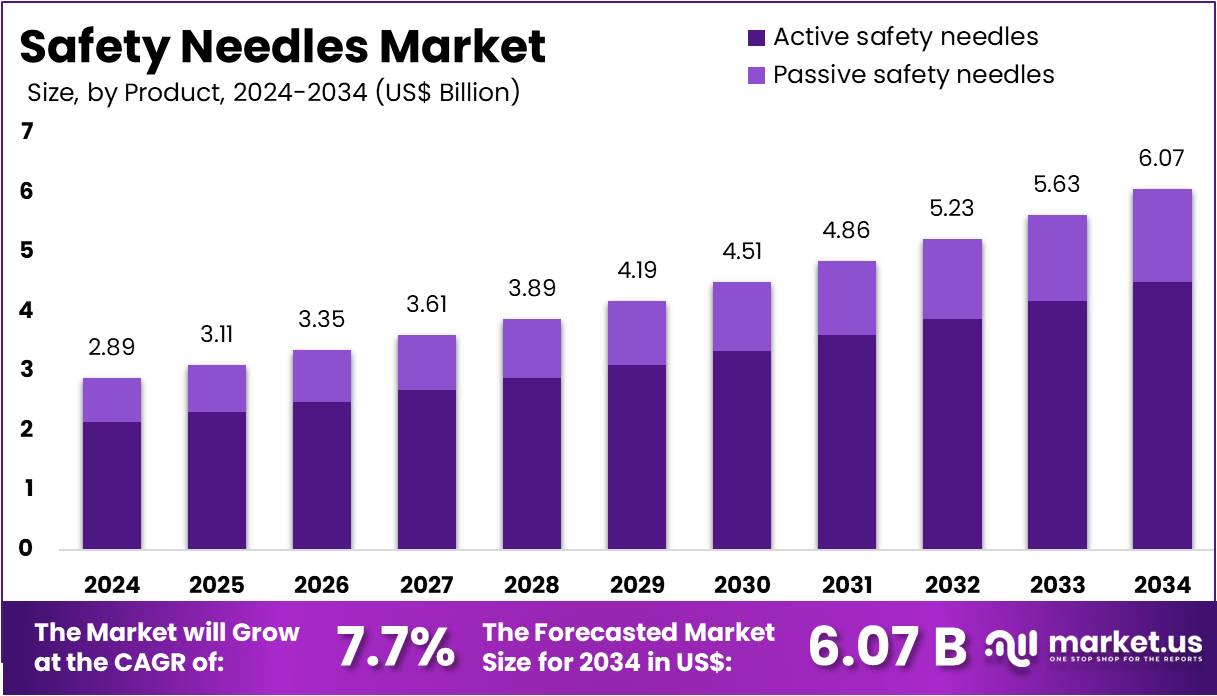
Key Takeaways
- The global safety needles market was estimated by an independent assessment to reach approximately US$6.07 billion by 2034, expanding at a 7.7% CAGR during the forecast period.
- Independent market evaluation indicated that active safety needles held the leading position in 2024, contributing more than 74.2% of the global market share.
- External analysis revealed that drug delivery applications dominated the 2024 market segmentation, accounting for over 61.2% of total safety needle demand.
- A third-party review highlighted that hospitals and ambulatory surgery centres were the major end users in 2024, representing more than 47.8% of overall adoption.
- Market analysis from an external source confirmed North America’s leadership in 2024, capturing a 38.5% market share with an estimated market value of approximately US$1.11 billion.
Statistical Information
- A 2025 evaluation of four safety-engineered port access needles reported a 100% successful activation rate during the second trial for all tested devices after users received operating instructions.
- In the same 2025 port access needle evaluation, the median safety mechanism activation time ranged from 3 seconds to 11 seconds across the tested devices, showing measurable differences in operational speed.
- The 2025 study found that single-handed activation performance reached 75% for one safety needle mechanism during the second trial, while other evaluated systems recorded lower single-hand activation rates.
- The 2025 assessment measured correct activation rates ranging from 19% to 97% among four different port access needle safety mechanisms during the second trial, demonstrating variation in user handling performance.
- The 2025 port access needle study reported that the possibility of safety mechanism deactivation varied between 22% and 97% among tested devices, depending on the protection design.
- A 2026 FDA device review documented needle safety activation-force verification testing performed with 30 test samples (n=30) as part of a safety needle performance evaluation.
- The 2026 FDA review also reported safety lockout force/override force challenge verification conducted using 60 test samples (n=60) to evaluate protective mechanism reliability.
- In the 2025 safety-engineered port needle comparison, device preference testing involved 31 total user preference selections across four systems (5, 2, 1, and 24 preferences, respectively), indicating measurable differences in clinician acceptance.
Regional Analysis
North America dominated the safety needles market in 2024, accounting for more than 38.5% share with a market value of approximately US$ 1.11 billion. The region’s growth is driven by strict occupational safety regulations, advanced healthcare infrastructure, and strong adoption across hospitals, clinics, and home-care environments. In the U.S., the Needlestick Safety and Prevention Act (NSPA) has encouraged healthcare facilities to implement engineered sharps injury prevention devices, accelerating the shift from conventional needles.
Canada’s safety regulations, including requirements for safety-engineered hollow-bore needles, have further supported market expansion. High healthcare expenditure, increasing injection procedures, and rising chronic disease prevalence, including diabetes affecting 56 million adults in North America and the Caribbean region, continue to drive demand. Strong regulatory frameworks, innovation, and established safety practices are expected to sustain North America’s leading position in the global safety needles market.
Emerging Trends
- Growing Adoption of Active Safety Needle Technologies: Healthcare providers are increasingly adopting active safety needles equipped with automatic shielding features to prevent accidental needle exposure. According to the CDC, approximately 385,000 needlestick and sharps injuries occur annually among hospital healthcare workers in the United States, encouraging wider use of engineered safety devices.
- Increasing Regulatory Support for Sharps Injury Prevention: Government authorities are strengthening workplace safety requirements for needle protection systems. The U.S. Needlestick Safety and Prevention Act requires employers to implement safer medical devices where appropriate. Updated standards such as ISO 23908:2024 support evaluation of sharps injury prevention mechanisms.
- Rising Demand for Home-Based Injection Safety: The growth of self-administered therapies, including insulin delivery and injectable medicines, is increasing demand for compact and simple safety needles. The FDA reports that millions of patients use needles and syringes at home for chronic disease management, requiring safer disposal and handling solutions.
- Development of Ergonomic and Patient-Friendly Designs: Safety needle manufacturers are focusing on designs that improve comfort, handling, and activation reliability. Advanced products include visual indicators, automatic locking mechanisms, and lightweight structures. These improvements help reduce user errors and support safer injection practices across hospitals, clinics, and home-care settings.
- Increasing Adoption in Vaccination and Specialty Care: Large-scale vaccination programs and specialty treatments are expanding the use of safety needles. CDC guidelines emphasize the importance of safer injection practices, as sharps injuries can expose healthcare workers to more than 20 bloodborne pathogens, including hepatitis B, hepatitis C, and HIV.
Use Cases
- Hospital and Clinical Injection Procedures: Safety needles are widely used in hospitals for medication administration, blood collection, and routine injections. Healthcare workers perform millions of injections annually, making injury prevention important. These devices help reduce occupational exposure risks by providing protective barriers after needle use.
- Diabetes Management and Insulin Administration: Patients managing diabetes increasingly use safety needles for insulin injections to improve handling safety. The International Diabetes Federation estimates that approximately 537 million adults worldwide were living with diabetes in 2021, increasing the need for safe self-injection solutions and home-care devices.
- Vaccination and Immunization Programs: Safety needles play an important role in vaccination campaigns by protecting healthcare workers during high-volume immunization activities. Global vaccination programs conducted by organizations such as the World Health Organization require billions of injections annually, creating demand for reliable needle safety technologies.
- Emergency Care and Paramedical Applications: Emergency departments and ambulance services use safety needles during rapid treatment situations where accidental injuries can occur. Quick-activation safety features help healthcare professionals manage injections efficiently while reducing exposure risks during urgent medical procedures.
- Home Healthcare and Chronic Disease Treatment: Safety needles are increasingly used in home-care environments for patients requiring regular injections, including biologics and hormone therapies. User-friendly safety mechanisms help elderly patients and caregivers handle needles more safely, supporting the growth of decentralized healthcare and remote patient management.
Frequently Asked Questions on Safety Needles
- What are safety needles used for?
Safety needles are primarily used for injections, blood collection, medication delivery, and vaccination procedures. Their built-in safety features help prevent accidental exposure to contaminated needles, improving workplace safety and reducing infection risks among medical professionals. - What factors are driving the growth of the Safety Needles Market?
The market growth is driven by increasing healthcare worker safety awareness, rising injection procedures, strict needlestick injury prevention regulations, and growing adoption of advanced safety-engineered devices. Healthcare facilities are replacing conventional needles with safer alternatives to improve compliance. - How do safety needles reduce needlestick injuries?
Safety needles include protective features such as shields, retractable mechanisms, and automatic locking systems that cover the sharp tip after use. These technologies minimize accidental needle exposure and help healthcare workers safely handle and dispose of used devices. - Which healthcare sectors use safety needles?
Safety needles are used across hospitals, diagnostic laboratories, outpatient clinics, emergency care centers, vaccination programs, and home-care settings. Increasing chronic disease management and self-administration of injectable medicines are also expanding their usage beyond traditional healthcare facilities. - What types of safety needles are available in the market?
The Safety Needles Market includes active safety needles and passive safety needles. Active safety needles require healthcare workers to activate protective features, while passive safety needles automatically engage safety mechanisms after injection without additional user action. - Why are government regulations important for the Safety Needles Market?
Government regulations encourage healthcare organizations to adopt safety-engineered needles to protect workers from occupational injuries. Regulations such as needlestick prevention standards support the replacement of traditional devices and increase demand for advanced safety needle technologies worldwide. - How does the rising prevalence of chronic diseases impact the market?
Increasing cases of diabetes, cancer, and cardiovascular disorders require frequent injections and medication administration. This growing demand for injectable therapies supports the adoption of safety needles in hospitals, clinics, and home-care environments where repeated procedures are common. - What is the future outlook for the Safety Needles Market?
The future of the Safety Needles Market is expected to focus on advanced safety designs, automation, sustainability, and wider adoption in emerging healthcare systems. Increasing regulatory support and demand for safer medical practices will continue supporting market expansion.
Conclusion
The safety needles market is positioned for significant expansion as healthcare systems worldwide prioritize occupational safety, infection prevention, and improved patient care practices. Growing concerns regarding needlestick injuries, favorable regulatory frameworks, and increasing demand for advanced injection devices are key factors supporting market development.
The rising use of safety-engineered needles in hospitals, diagnostic centers, and home healthcare environments is expected to create new growth opportunities. Technological advancements, including passive and active safety mechanisms, are enhancing product adoption.
With continuous innovation and increasing healthcare investments, the global safety needles market is likely to experience sustainable growth and stronger penetration across developed and emerging regions.
Discuss your needs with our analyst
Please share your requirements with more details so our analyst can check if they can solve your problem(s)




