


Overview
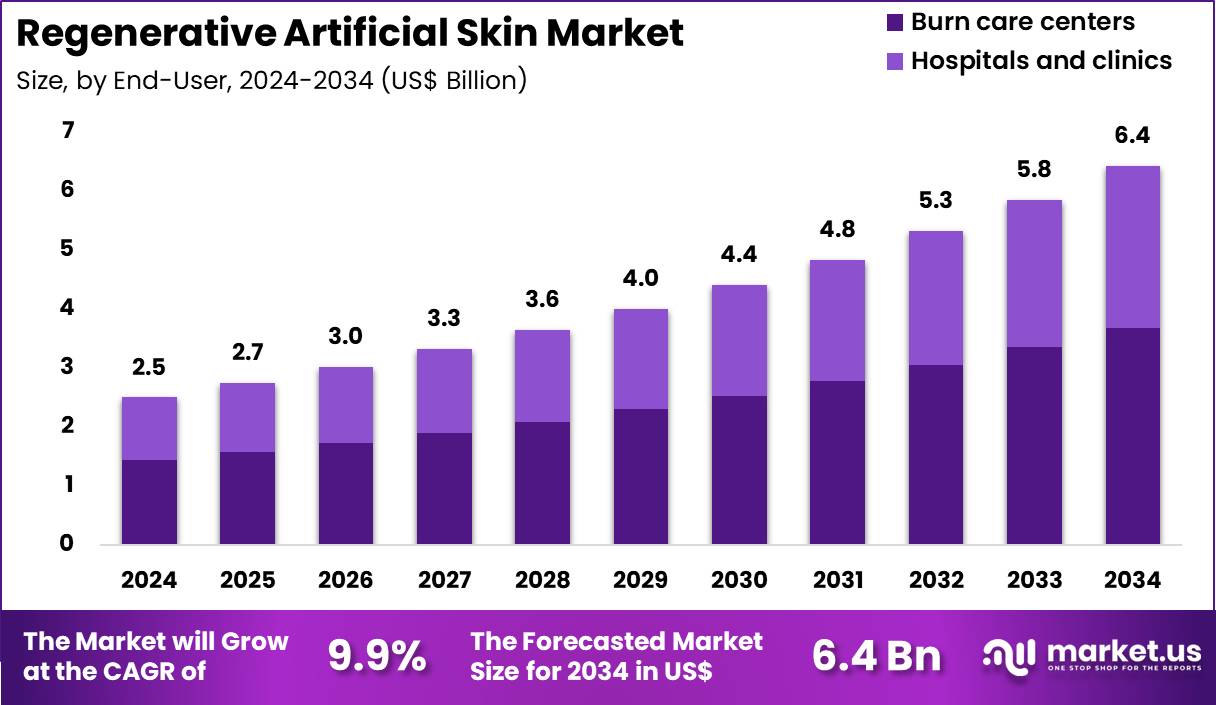
New York, NY – Sep 23, 2026 –The Global Regenerative Artificial Skin Market size is expected to be worth around US$ 6.4 Billion by 2034 from US$ 2.5 Billion in 2024, growing at a CAGR of 9.9% during the forecast period 2025 to 2034. In 2024, North America led the market, achieving over 41.6% share with a revenue of US$ 1.0 Billion.
Regenerative artificial skin is an emerging tissue-engineering technology developed to restore damaged skin by providing structural support while stimulating natural tissue regeneration. Unlike conventional wound coverings, regenerative skin substitutes can incorporate cells, biomaterials, extracellular-matrix components, growth factors, and bioactive molecules to support re-epithelialization, vascularization, and dermal reconstruction. Key applications include severe burns, chronic wounds, traumatic injuries, diabetic ulcers, and reconstructive surgery.
Recent research is accelerating the development of cell-based and bioengineered artificial skin. In a 2025 npj Regenerative Medicine study, human induced-pluripotent-stem-cell-derived mesenchymal cells were incorporated into an established dermal regeneration template at concentrations of 5,000–20,000 cells/cm² and evaluated in a porcine full-thickness burn model.
Clinical evidence is also advancing. A 2025 Phase IIb multicenter trial evaluating bioengineered autologous dermo-epidermal skin grafts reported a mean expansion ratio of 10.76 for denovoSkin compared with 1.70 for split-thickness skin grafts, representing an approximately 7.41-fold higher expansion ratio. By month three, treated areas were fully epithelialized.
Material innovation is another important development. A 2025 ACS Nano study reported a hydrogel-based bioactive synthetic skin incorporating hyaluronic acid and carboxymethyl chitosan, designed to promote regeneration while addressing inflammation and bacterial infection in burn wounds.
These advances indicate that regenerative artificial skin is moving toward more functional, cell-integrated, vascularized, and personalized solutions for complex wound management.
Key Takeaways
- In 2024, the Regenerative Artificial Skin market generated US$ 2.5 billion in revenue, expanding at a 9.9% CAGR, and is projected to reach US$ 6.4 billion by 2034.
- By material, the market is segmented into engineered skin material, bi-layered material, permanent skin material, single-layer material, and temporary skin material. Engineered skin material dominated in 2024, accounting for a 36.9% market share.
- Based on end users, the market is categorized into burn care centers and hospitals & clinics. Burn care centers held a significant position in 2024, capturing 37.3% of the market share.
- Regionally, North America dominated the Regenerative Artificial Skin market in 2024, accounting for a leading 41.6% market share, supported by advanced healthcare infrastructure and increasing adoption of regenerative wound-care technologies.
Market Segmentation
- Material Analysis: Engineered skin material, holding 36.9% market share, is expected to remain dominant because it closely replicates the structure and functions of natural skin. Advanced scaffolds and bioengineered components support tissue regeneration, vascularization, and wound closure. Growing complex burns and chronic wounds, combined with improved biocompatibility, elasticity, durability, and regulatory progress, are strengthening adoption.
- End-User Analysis: Burn care centers, holding 57.3% market share, are projected to lead due to their specialized treatment of severe burns requiring advanced regenerative skin products. These centers increasingly adopt engineered and bi-layered skin substitutes to support faster healing, reduce scarring, and improve functional outcomes. Expanding burn-care infrastructure, clinical research, and healthcare funding further support segment growth.
Statistical Information
- In a 2025 Phase IIb multicenter clinical trial, denovoSkin™ achieved a mean expansion ratio of 10.76, compared with 1.70 for split-thickness skin grafts (STSG), giving a 7.41-fold mean expansion-ratio advantage.
- In the same 2025 clinical trial, both denovoSkin™ and conventional STSG treatment areas reached 100% epithelialization by month 3, demonstrating complete wound closure at the three-month assessment.
- The 2025 clinical study reported a mean denovoSkin™ expansion ratio of 10.76 ± 6.03, while STSG recorded 1.70 ± 0.68, quantitatively demonstrating the substantially greater donor-site expansion capability of the bioengineered graft.
- In the 2025 denovoSkin™ trial, the mean ratio between denovoSkin™ and STSG expansion ratios was 7.41 ± 4.87, with a reported 95% confidence interval of 4.71–10.10.
- The 2025 clinical study found a mean graft-take-to-grafted-area ratio of 72.57% for denovoSkin™ compared with 90.36% for STSG at the 6–10-day assessment.
- In that 2025 porcine burn model, the iMSC-treated wounds demonstrated accelerated closure from approximately day 32, while all experimental and control wounds reached complete closure by day 40.
Regional Analysis
North America remains a key region for the Regenerative Artificial Skin Market, supported by advanced burn-care infrastructure, clinical research, and regulatory activity. In 2025, the FDA recorded a decision for an INTEGRA Dermal Regeneration Template manufacturing-process supplement, demonstrating continued regulatory activity for dermal regeneration technologies.
Asia Pacific offers substantial clinical potential because of its high burden of burn injuries and expanding specialist care capacity. WHO reports that burn incidence requiring medical care is nearly 20 times higher in the Western Pacific Region than in the Americas. WHO also notes that more than 1 million people in India experience moderate or severe burns annually.
In 2025, WHO strengthened regional collaboration on trauma and injury care through its partnership with Siriraj Hospital and Mahidol University in Thailand, supporting improvements in regional injury-management capacity.
Business opportunities
The Regenerative Artificial Skin Market presents significant business opportunities across bioengineered skin, cell-based therapies, 3D bioprinting, chronic wound management, and advanced burn care. Companies can develop autologous and bilayered skin substitutes for severe burns and complex wounds.
In a 2025 Phase IIb trial, denovoSkin achieved a 10.76 mean expansion ratio, compared with 1.70 for split-thickness grafts. (pubmed.ncbi.nlm.nih.gov) Opportunities also exist in scalable manufacturing, biomaterial scaffolds, automated cell culture, and personalized regenerative products.
The FDA’s regenerative-medicine framework covers cell therapies, tissue-engineered products, and combination products, supporting opportunities for biotechnology companies and specialized regulatory-service providers. (fda.gov) Partnerships with hospitals, burn centers, universities, and research organizations can accelerate clinical validation and commercialization.
Growing demand for advanced treatments for burns, diabetic ulcers, traumatic injuries, and reconstructive procedures further creates opportunities for innovative manufacturers to expand regenerative wound-care portfolios and establish specialized production capabilities.
Emerging Trends
- 3D Bioprinting: 3D bioprinting is becoming more personalized, with 2025 research using patient-derived extracellular matrix and autologous cells. These approaches support customized tissue structures, improved cell migration, angiogenesis, and integration with damaged tissue, creating opportunities for personalized regenerative skin solutions.
- Smart Biomaterials: Smart hydrogels are emerging as advanced artificial-skin materials because they can respond to wound conditions. A 2025 study developed a dual-layer hydrogel system with thermally driven contraction, combining physical wound closure with biological healing capabilities.
- Conductive Artificial Skin: Multifunctional artificial skin is gaining attention through conductive materials and 3D bioprinting. A 2025 study developed double-layer conductive skin, combining regenerative functions with electrical properties that could support future wound monitoring, sensing, and bioelectronic applications.
- Regulatory Standardization: Regulatory development is supporting safer commercialization of tissue-engineered products. In 2025, the FDA recognized ASTM F2212-25, which addresses characterization of Type I collagen used as starting material for surgical implants and tissue-engineered medical products.
Use Cases
- Severe Burn Treatment: Regenerative artificial skin is increasingly investigated for extensive burns where donor skin availability is limited. A 2026 case report used a 5 cm² biopsy to produce 500 cm² of bilaminar engineered skin for treating severe full-thickness burns.
- Complex Wound Closure: Bioengineered skin can support closure of deep partial- and full-thickness wounds. A 2025 clinical trial evaluated wound defects measuring up to 98 cm², demonstrating the practical application of regenerative skin for difficult burn injuries.
- Infected Wound Management: Regenerative hydrogels are being developed for wounds requiring both tissue repair and infection control. A 2025 study reported more than 93% bacterial inhibition against E. coli and S. aureus using a multifunctional hydrogel under near-infrared treatment.
- Drug Testing and Skin Modelling: 3D artificial skin models are increasingly used for pharmaceutical testing and disease research. A 2025 study reported more than 90% cell viability after 7 days and approximately 383 kΩ transepithelial electrical resistance in a bioprinted skin model.
- Cancer Reconstruction: 3D-bioprinted tissues are being explored for reconstructive surgery following cancer removal. A 2025 clinical study investigated 3D-bioprinted autologous adipose tissue for skin defects created after wide cancer excision, supporting development of personalized reconstruction techniques.
Recent Development
- In May 2026, Kerecis expanded its fish-skin regenerative technology portfolio with Kerecis Shield Spiral, an extension of its silicone fish-skin combination product range designed to provide more customizable wound-care options.
- In June 2026, Kerecis announced expanded insurance coverage for its fish-skin grafts, adding approximately 40 million covered lives. This development potentially improves patient access to its regenerative fish-skin products for wound treatment.
- In July 2026, Organogenesis announced publication of results from a 206-patient randomized controlled trial evaluating Affinity™ plus standard care versus standard care alone for complex venous leg ulcers. The Affinity combination demonstrated significantly higher wound-closure rates at weeks 12 and 16.
Frequently Asked Questions on the Regenerative Artificial Skin
- What are the major applications of regenerative artificial skin?
Major applications include deep partial-thickness burns, full-thickness burns, traumatic wounds, reconstructive surgery, and extensive skin defects. FDA records include cultured epithelial autografts for burns covering 30% or more of total body surface area. - What are the main benefits of regenerative artificial skin?
Key benefits include expanded wound coverage, reduced dependence on donor skin, tissue regeneration, and potentially improved scar quality. A 2025 clinical trial reported a 10.76 mean expansion ratio for denovoSkin compared with 1.70 for conventional grafts. - What materials are used to manufacture regenerative artificial skin?
Common materials include collagen, extracellular-matrix components, hydrogels, synthetic polymers, and living cells. FDA identifies tissue-engineered products and 3D-printed biomaterial scaffolds containing cells as examples within regenerative medicine development. - What is driving the Regenerative Artificial Skin Market?
Market development is being supported by increasing clinical research, tissue-engineering advances, demand for improved burn treatment, and efforts to overcome limited donor-site availability. A 2025 Phase IIb trial evaluated denovoSkin across 4 clinical sites. - What are the major trends in the Regenerative Artificial Skin Market?
Major trends include autologous cell-based grafts, bilayered skin substitutes, 3D bioprinting, advanced biomaterial scaffolds, and personalized manufacturing. A 2025 Phase III study was listed for adolescents and adults aged 12 years and older with severe burns. - What is the future outlook for regenerative artificial skin?
Future development is focused on improving safety, scalability, vascularization, tissue integration, and long-term skin function. In a pediatric Phase I study, 7 of 10 patients completed five-year follow-up, with grafts remaining clinically stable and without observed tumor formation.
Conclusion
The Regenerative Artificial Skin Market is advancing as healthcare providers seek effective alternatives for severe burns, chronic wounds, traumatic injuries, and reconstructive procedures. Growth is supported by innovations in engineered skin materials, bilayered matrices, cellular therapies, and 3D bioprinting.
Engineered skin materials remain important because they aim to replicate natural skin structure while supporting tissue regeneration. Burn care centers represent a major application area, while North America maintains a strong market position.
Meanwhile, regulatory progress and product innovation are encouraging broader clinical adoption. Increasing investment in biomaterials, personalized tissue engineering, and advanced wound-care technologies is expected to strengthen competition and create new opportunities for manufacturers, biotechnology companies, hospitals, and research institutions.
Discuss your needs with our analyst
Please share your requirements with more details so our analyst can check if they can solve your problem(s)




