


Overview
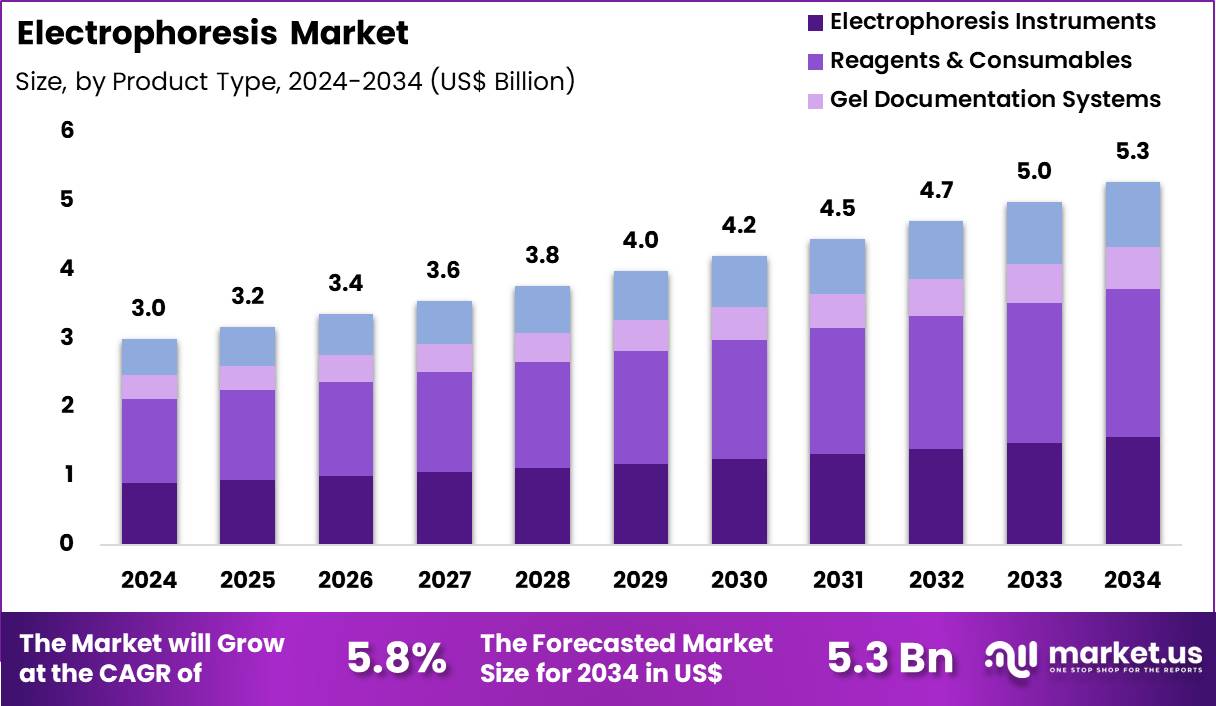
New York, NY – Sep 22, 2026 –The Global Electrophoresis Market size is expected to be worth around US$ 5.3 Billion by 2034 from US$ 3.0 Billion in 2024, growing at a CAGR of 5.8% during the forecast period 2025 to 2034. In 2024, North America led the market, achieving over 37.2% share with a revenue of US$1.1 billion.
Electrophoresis is a laboratory separation technique that uses an electric field to move charged molecules through a supporting medium. It is extensively used for analyzing DNA, RNA, proteins, peptides, and other biomolecules in molecular biology, biotechnology, clinical diagnostics, pharmaceutical research, and genetic analysis. Depending on the application, electrophoresis can be performed using agarose gels, polyacrylamide gels, or capillary-based systems.
Agarose gel electrophoresis can effectively separate DNA fragments ranging from approximately 100 base pairs to 25 kilobases, making it valuable for DNA characterization and molecular biology workflows. DNA carries a negative charge because of its phosphate backbone and therefore migrates toward the positively charged electrode during electrophoresis. Fragment separation primarily depends on molecular size, gel concentration, DNA conformation, voltage, buffer composition, and other operating conditions.
Standard agarose electrophoresis protocols commonly operate at approximately 1–5 V/cm, while electrophoretic mobility can vary substantially with electric-field strength and agarose concentration. Research has demonstrated measurable differences in DNA mobility between 0.6 and 4.6 V/cm, highlighting the importance of controlling operating conditions for reproducible separation.
Electrophoresis also supports automated genetic analysis. The U.S. FDA describes clinical genetic analyzers that use capillary electrophoresis or related polymer-based separation methods to distinguish DNA fragments by size and charge. In 2025, FDA records listed 2 reported events associated with this device category.
Key Takeaways
- In 2024, the market generated a revenue of US$ 3.0 billion, with a CAGR of 5.8%, and is expected to reach US$5.3 billion by the year 2034.
The product type segment is divided into electrophoresis instruments, reagents & consumables, gel documentation systems and software, with reagents & consumables taking the lead in 2023 with a market share of 41.0%. - Considering the application, the market is divided into genomics & molecular biology, proteomics & protein characterization, medical research, food, environmental & agricultural testing, pharmaceutical & bioprocess quality control and others. Among these, medical research held a significant share of 48.3%.
- Furthermore, concerning the end-user segment, the market is segregated into pharmaceutical & biotechnology companies, academic & research institutions, hospitals & diagnostic laboratories and others. The pharmaceutical & biotechnology companies sector stands out as the dominant player, holding the largest revenue share of 45.6% in the market.
- North America led the market by securing a market share of 37.2% in 2024.
Market Segmentation
- Product Type Analysis – Reagents and consumables, holding 41.0%, are expected to dominate as electrophoresis workflows require recurring buffers, gels, stains, ladders, and cartridges. Increasing testing volumes in genomics, proteomics, and quality control raise consumption. Pre-cast gels, safer stains, ready-to-use buffers, and validated products improve efficiency, reproducibility, and standardization, supporting continued demand across academic, clinical, and industrial laboratories.
- Application Analysis – Medical research, holding 48.3%, is projected to lead because electrophoresis remains essential for DNA, RNA, and protein separation. Oncology, immunology, and neurological research generate sustained testing requirements for biomarker validation, protein characterization, and genetic analysis. Integration with blotting and mass spectrometry, combined with cost-effective workflows and broad laboratory familiarity, further strengthens adoption across research programs.
- End-User Analysis – Pharmaceutical and biotechnology companies, holding 45.6%, are expected to dominate end-user demand because electrophoresis supports drug discovery, bioprocessing, quality control, and molecular characterization. Increasing biologics development strengthens demand for protein analysis, purity assessment, and impurity profiling. Standardized analytical procedures, regulatory requirements, automation, and scalable laboratory workflows further encourage pharmaceutical and biotechnology companies to adopt electrophoresis technologies.
Statistical Information
- A 2025 capillary electrophoresis study for dapagliflozin achieved a linear analytical range of 50–175 µg/mL, with a correlation coefficient of R² > 0.999, demonstrating strong quantitative linearity.
- The same 2025 electrophoresis method reported limits of detection and quantification of 6.2 µg/mL and 18.8 µg/mL, respectively, indicating the concentration levels measurable by the analytical procedure.
- In the 2025 dapagliflozin study, intraday precision produced an RSD of 2.55%, while interday precision produced an RSD of 2.52%, based on repeated electrophoretic measurements.
- Electrophoretic analysis of dapagliflozin achieved average recoveries ranging from 101.22% to 104.63%, with an overall recovery of 102.72%, demonstrating quantitative analytical performance.
- During robustness testing in 2025, changing the electrophoresis injection time to 4 seconds and 6 seconds produced mean RSD values of 2.88% and 1.93%, respectively.
- Changing the electrophoresis voltage to 13.5 kV and 14.5 kV in the 2025 dapagliflozin method produced mean RSD values of only 0.64% and 0.26%, respectively.
- A 2025 capillary electrophoresis method for enalapril used a 13 kV separation voltage, 4-second injection, 25°C capillary temperature, and achieved a migration time of 6.3 minutes.
- The 2025 enalapril electrophoresis method demonstrated a linear concentration range of 100–3,000 ng/mL, with limits of detection and quantitation of 30 ng/mL and 50 ng/mL, respectively.
Regional Analysis
North America remains an important region for electrophoresis research because of its strong biomedical and academic research infrastructure. In the United States, higher-education institutions recorded US$ 97.8 billion in research and development expenditures in FY2022, including nearly US$54 billion in federally funded R&D. This extensive research base supports laboratory activities involving molecular biology, genomics, proteomics, and analytical sciences, where electrophoresis is routinely used.
Asia Pacific is increasingly important for scientific and technological development. According to the World Intellectual Property Organization, offices located in Asia received approximately 2.44 million patent applications in 2023, representing 68.7% of global filings. China, Japan, and South Korea accounted for substantial portions of Asian patent activity, reflecting the region’s strong innovation ecosystem.
These developments can support continued advancement of analytical technologies, including electrophoretic techniques used in biotechnology, pharmaceutical research, and laboratory diagnostics.
Business Opportunities
The Electrophoresis Market offers significant business opportunities through automation, capillary electrophoresis, advanced consumables, clinical diagnostics, biopharmaceutical quality control, proteomics, and molecular research. Manufacturers can develop automated systems that simplify sample processing, improve reproducibility, and support high-throughput DNA, RNA, and protein analysis.
Recurring demand for precast gels, buffers, stains, molecular-weight ladders, cartridges, and capillaries also creates attractive consumables opportunities. Capillary electrophoresis has growing applications in pharmaceutical quality control, impurity analysis, protein characterization, genetic testing, and biomarker research.
Companies can further differentiate through microfluidic electrophoresis platforms requiring smaller sample volumes and compact instruments suitable for decentralized laboratories. Integration of artificial intelligence and digital software can automate electropherogram interpretation, peak identification, result comparison, and reporting.
Sustainable products using reduced reagent volumes, safer staining chemistries, and lower-waste consumables can address laboratory sustainability requirements. Opportunities also exist in emerging laboratory markets through affordable, compact systems for universities, biotechnology companies, pharmaceutical manufacturers, and diagnostic centers.
Emerging Trends
- Microfluidic electrophoresis: Miniaturized electrophoresis systems are becoming more useful for automated and remote testing. A 2026 system operated for up to 30 days without maintenance and delivered measurements every 45 minutes, highlighting opportunities for continuous, low-maintenance analytical monitoring.
- Advanced capillary coatings: Protein adsorption on capillary walls remains an important technical challenge. Research published in 2026 is focusing on physical and chemical coating methods to improve protein separation efficiency, supporting more reliable electrophoresis workflows for complex biological samples.
- Electrophoresis–mass spectrometry integration: CE-MS is gaining importance in advanced biomolecular analysis. A 2025 review highlights its use in top-down proteomics for studying complex proteoforms and biological samples, strengthening electrophoresis applications beyond conventional DNA and protein separation.
- Multiple electrophoresis formats: Modern electrophoresis development increasingly covers 4 major formats: slab gel, capillary, microchip or microfluidic capillary, and isotachophoresis. This wider technology base allows laboratories to select systems according to speed, sensitivity, resolution, capacity, and application requirements.
- Peptide-focused applications: Electrophoresis is expanding in peptide analysis, including separation, profiling, sequence analysis, and characterization. A 2026 review examined developments covering 2023 through mid-2025, demonstrating continued technical progress in capillary and microchip electroseparation methods.
Use Cases
- Environmental water monitoring: Electrophoresis can support continuous monitoring of inorganic nutrients in natural water. A 2026 system achieved detection limits of 30 ppb chloride, 121 ppb nitrate, and 75 ppb sulfate, demonstrating practical use for sensitive environmental measurements.
- Protein characterization: Capillary electrophoresis is increasingly applied to protein analysis where surface interactions can affect separation. Recent research focuses on specialized capillary coatings to reduce protein adsorption and improve separation performance for complex protein samples.
- Pharmaceutical analysis: Electrophoresis supports pharmaceutical research through separation and characterization of peptides, proteins, and other biomolecules. Recent reviews describe applications involving synthetic peptides, isolated peptides, biological fluids, and tissue extracts, supporting drug-development analytical workflows.
- Proteomics research: CE-MS provides a specialized workflow for top-down proteomics, enabling researchers to examine intact proteins and proteoforms. A 2025 review identifies its relevance to complex biomolecular research, particularly where detailed molecular characterization is required.
- Clinical and biochemical analysis: Electrophoresis continues to support clinical diagnostics and biochemical research. A 2025 review identifies applications across clinical diagnostics, genomics, proteomics, pharmaceutical analysis, and environmental monitoring, demonstrating its broad analytical role across laboratory settings.
Recent Development
- In July 2025, Bio-Rad Laboratories updated its laboratory-startup offering to include its electrophoresis portfolio, including horizontal electrophoresis systems and related DNA electrophoresis equipment. The company continues to provide dedicated electrophoresis solutions for nucleic-acid and protein analysis.
- In July 2025, Thermo Fisher Scientific highlighted its Invitrogen precast electrophoresis gels and E-Gel systems for molecular-biology workflows, covering different gel chemistries, percentages, gradients, and sample-well configurations. The company also continued promoting electrophoresis systems for new molecular-research laboratories.
- In November 2025, Merck KGaA showcased its mPAGE® Lux Gel Casting System, designed to simplify and accelerate polyacrylamide gel preparation. The system can cure a mini gel in approximately 1.5 minutes, while the overall casting process can take less than 3 minutes.
Frequently Asked Questions About the Electrophoresis
- What is gel electrophoresis used for?
Gel electrophoresis is primarily used to separate DNA, RNA, and proteins. Agarose gels are commonly used for nucleic acids, while polyacrylamide gels provide high-resolution separation of proteins and smaller molecular fragments. - Why is electrophoresis important in molecular biology?
Electrophoresis helps researchers separate and examine nucleic acids and proteins, allowing them to evaluate molecular size, purity, and structural differences. It supports genomic research, protein studies, disease investigations, and laboratory quality-control procedures. - Which industries use electrophoresis technology?
Pharmaceutical, biotechnology, healthcare, academic research, forensic science, and clinical laboratories use electrophoresis. Applications include protein characterization, DNA analysis, clinical protein fractionation, pharmaceutical testing, and genetic investigations. - What is driving innovation in the electrophoresis market?
Innovation is increasingly focused on automated operation, capillary formats, microfluidic systems, improved detection, and integration with advanced analytical technologies. These developments aim to improve separation efficiency, reproducibility, throughput, and analytical capabilities. - What is the future outlook for electrophoresis technology?
Electrophoresis is expected to remain important as laboratories expand genomic, proteomic, pharmaceutical, and clinical testing. Continued development of automated and miniaturized platforms can improve analytical workflows while supporting more efficient molecular characterization.
Conclusion
The Electrophoresis Market is advancing as molecular biology, genomics, proteomics, pharmaceutical research, and clinical diagnostics increasingly require accurate molecular separation and characterization. Reagents and consumables remain important because electrophoresis workflows require recurring laboratory supplies, while medical research represents a major application area.
Pharmaceutical and biotechnology companies continue adopting electrophoresis for protein characterization, quality control, and bioprocessing activities. North America maintains a strong position because of its established research infrastructure and biotechnology ecosystem, while Asia Pacific offers expanding opportunities through scientific investment and laboratory development.
Automation, capillary electrophoresis, microfluidics, artificial intelligence, and electrophoresis–mass spectrometry integration are creating new opportunities for improved efficiency, reproducibility, and analytical capabilities.
Discuss your needs with our analyst
Please share your requirements with more details so our analyst can check if they can solve your problem(s)




