


Overview
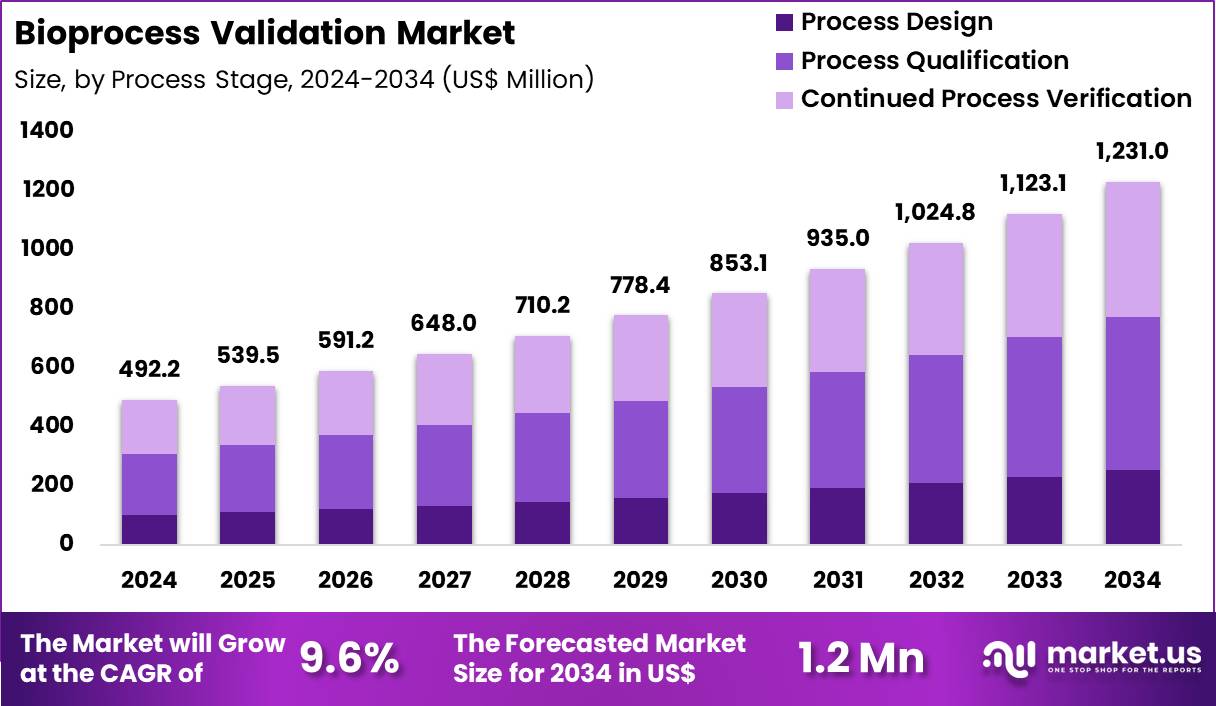
New York, NY – Sep 23, 2026 –The Global Bioprocess Validation Market size is expected to be worth around US$ 1231.0 Million by 2034 from US$ 492.2 Million in 2024, growing at a CAGR of 9.6% during the forecast period 2025 to 2034. In 2024, North America led the market, achieving over 42.4% share with a revenue of US$ 208.7 million.
Bioprocess Validation is a critical quality and regulatory activity used to demonstrate that biopharmaceutical manufacturing processes can consistently produce products meeting predefined quality, safety, purity, potency, and performance requirements.
It covers upstream and downstream operations, including cell culture, fermentation, filtration, chromatography, purification, formulation, and aseptic processing. The U.S. FDA’s process-validation framework emphasizes a lifecycle approach involving process design, process qualification, and continued process verification.
Bioprocess validation is increasingly important as biologics, vaccines, recombinant proteins, cell therapies, and gene therapies become more complex. FDA guidance indicates that validation programs should identify and control process variability while maintaining a continuing state of control throughout manufacturing.
For API-related processes, FDA guidance uses three consecutive successful production batches as a general guide for prospective or concurrent validation, although additional runs may be necessary for complex processes.
The regulatory environment is also evolving. In 2025, FDA recorded multiple biological product approvals, while in 2026 the agency introduced additional CMC flexibility for human cell and gene therapy products to support development and BLA preparation. FDA reported that CBER had approved close to 50 cell and gene therapies over the previous decade, highlighting the growing need for robust validation strategies.
Consequently, demand for bioprocess validation is being supported by increasing biologics manufacturing, stricter quality expectations, advanced analytical technologies, process monitoring, automation, and lifecycle-based validation practices.
Key Takeaways
- In 2024, the Bioprocess Validation Market generated revenue of US$ 492.2 million and is projected to expand at a CAGR of 9.6%, reaching approximately US$ 1,231.0 million by 2034.
- By testing type, the market is segmented into extractables/leachables testing, microbiological testing, integrity testing, viral clearance testing, physicochemical testing, residuals testing, compatibility testing, and others. Extractables/leachables testing dominated in 2023, accounting for 29.8% of the market.
- Based on the process stage, the market is categorized into process design, process qualification, and continued process verification. Process qualification held the leading position, representing a significant 42.3% market share.
- By process component, the market is segmented into filter elements, media containers & bags, freezing & thawing process bags, mixing systems, bioreactors, and others. Filter elements accounted for the largest revenue share, reaching 24.5%.
- Based on mode, the market is divided into in-house validation and outsourced validation. In-house validation dominated the segment, holding a substantial 78.1% revenue share.
- By end user, the market is segmented into pharmaceutical & biotechnology companies, medical device companies, CROs and CDMOs, and academic institutions and research laboratories. Pharmaceutical & biotechnology companies held the largest share at 47.7%.
- Regionally, North America dominated the Bioprocess Validation Market in 2024, accounting for a leading 42.4% market share.
Market Segmentation
- Testing Type Analysis: Extractables and leachables testing, with a 29.8% share, is expected to dominate due to growing regulatory emphasis on patient safety and product integrity. Increasing use of single-use systems, polymer containers, and flexible tubing creates chemical migration risks, driving demand for comprehensive testing and characterization.
- Process Stage Analysis: Process qualification, accounting for 42.3%, is projected to lead because it verifies that bioprocesses consistently operate within predefined parameters before commercial manufacturing. Rising biologics production, stringent regulatory requirements, lifecycle validation approaches, and digital monitoring technologies further increase demand for robust qualification activities.
- Process Component Analysis: Filter elements, holding a 24.5% share, are expected to remain dominant because filtration is essential for clarification, sterilization, and viral removal. Increasing biologics production, greater adoption of single-use filtration systems, and stricter contamination-control requirements are strengthening demand for validated filtration components.
- Mode Analysis: In-house validation, representing 78.1%, is projected to dominate as pharmaceutical and biotechnology companies seek greater control over quality, compliance, and validation activities. Internal teams provide faster responses, improved data security, stronger operational integration, and better audit readiness while reducing dependence on external providers.
- End-User Analysis: Pharmaceutical and biotechnology companies, holding 47.7%, are expected to lead because they are major manufacturers of regulated biologics and advanced therapies. Expanding pipelines, facility investments, stricter regulatory requirements, and adoption of quality-by-design practices are increasing validation activities across development and commercial manufacturing.
Statistical Information
- A 2025 Bioresource Technology study found that AI-assisted Raman/NIR bioprocess models delivered predictions within 1 minute, compared with more than 2 hours for conventional detection methods, demonstrating a substantial improvement in process-monitoring response time.
- The same 2025 study evaluated 13 machine-learning algorithms to develop predictive models for glucose, ammonium, biomass, and gentamicin C1a during automated fed-batch fermentation.
- Orthogonal feature selection in the 2025 bioprocess study improved spectral-model performance by 9.2% to 100.4% based on the coefficient of determination (R²), supporting more accurate process monitoring and validation.
- The combined NIR-Raman model achieved R² >0.99 during external validation, indicating very high predictive agreement for the monitored bioprocess parameters.
- AI-controlled feeding maintained glucose at approximately 5 g/L with an accuracy and coefficient of variation of below 2%, demonstrating tight control of a critical process parameter.
- AI-based precision feeding increased gentamicin C1a concentration to 346.5 mg/L, representing a 33.0% increase compared with traditional intermittent feeding.
- A 2025 Pharmaceutics study used Raman spectroscopy across 5 CHO cell cultures operated at 10 L scale, with PLS models developed from 4 batches and subsequently evaluated using blind test data.
Regional Analysis
North America remains a major hub for bioprocess validation because of stringent regulatory oversight, advanced biologics manufacturing, and continued investment in domestic pharmaceutical production.
In 2025, FDA reported that approximately 53% of branded drug products and 69% of generic drug products distributed in the United States were manufactured outside the country, highlighting efforts to strengthen domestic manufacturing capacity. FDA’s PreCheck initiative is scheduled to begin activities in 2026, supporting earlier technical engagement with manufacturers.
Asia Pacific is experiencing increasing biopharmaceutical manufacturing activity as countries strengthen domestic production capabilities and regulatory infrastructure. Singapore and other regional manufacturing hubs are expanding capabilities for complex biologics, vaccines, and advanced therapies. Increasing adoption of automated processing, analytical technologies, and risk-based validation approaches is supporting regional demand for bioprocess validation.
Overall, both regions are strengthening manufacturing quality systems, with North America emphasizing regulatory modernization and supply-chain resilience, while Asia Pacific focuses on capacity expansion and technological advancement.
Business opportunities
The Bioprocess Validation Market presents strong business opportunities through increasing adoption of advanced biomanufacturing, single-use technologies, continuous processing, automation, and process analytical technology. Companies can provide validation services covering equipment qualification, process qualification, analytical methods, filter integrity, extractables and leachables, and continued process verification.
Growing development of cell and gene therapies, vaccines, monoclonal antibodies, and recombinant proteins is creating demand for specialized validation expertise covering aseptic processing, contamination control, viral clearance, comparability, and process characterization. AI-enabled monitoring, digital twins, and real-time analytics also create opportunities for predictive validation and automated deviation detection.
Additionally, pharmaceutical and biotechnology companies can outsource validation activities to specialized CROs, CDMOs, and consulting providers, particularly for regulatory documentation and inspection readiness. Integrated digital validation platforms combining quality management, electronic records, data integrity, deviation management, and compliance monitoring represent another promising opportunity.
Emerging Trends
- AI-based process monitoring: FDA lists predictive modeling and closed-loop bioreactor control among accepted emerging technologies for biological manufacturing. These systems can continuously assess process conditions and support faster deviation detection, improving validation and control of critical manufacturing parameters.
- Digital model-driven validation: A 2025 peer-reviewed study conducted 20,000 digital experiments for cell and gene therapy process optimization. The approach improved combined cost, yield, and throughput objectives by up to 38%, while reducing development time by 81%.
- Continuous manufacturing adoption: EMA identifies continuous manufacturing, process models, decentralized manufacturing, and personalized medicines as innovative manufacturing approaches. This trend is shifting validation toward continuous monitoring, process control, and lifecycle-based assessment rather than relying only on fixed production batches.
- Greater cell and gene therapy focus: FDA reported that its Center for Biologics Evaluation and Research had approved close to 50 cell and gene therapies over the previous decade. Growing product complexity is increasing the need for specialized process, analytical, and manufacturing validation approaches.
- Flexible regulatory validation: In 2026, FDA introduced greater CMC flexibility for cell and gene therapies and emphasized lifecycle-based process and method validation. This approach allows validation strategies to evolve as products progress through development, supporting more adaptable manufacturing programs.
Use Cases
- Bioreactor process control: Advanced process-control systems can monitor critical parameters such as temperature, pH, dissolved oxygen, and nutrient levels during production. FDA specifically recognizes closed-loop bioreactor control as an emerging biological-manufacturing technology, creating opportunities for automated validation and real-time quality assurance.
- Cell and gene therapy manufacturing: Validation is increasingly applied to complex CGT manufacturing processes, including process controls, analytical methods, and manufacturing changes. FDA’s 2026 guidance provides flexibility around CMC requirements while maintaining expectations for product quality, safety, and potency.
- Process optimization: Digital models can test numerous manufacturing scenarios before physical experiments. A 2025 study evaluated 20,000 simulated processes and achieved up to 57% lower process-development costs, demonstrating the practical value of computational approaches for bioprocess development and validation.
- Manufacturing-change validation: FDA guidance supports lifecycle-based management of manufacturing changes for cell and gene therapies. Comparability studies can assess whether process modifications affect product quality, making validation important during scale-up, technology transfer, facility changes, and process improvements.
- Advanced analytical testing: FDA identifies next-generation sequencing and multi-attribute methods as emerging technologies for biological manufacturing. These approaches can support characterization, contamination assessment, and product-quality testing, strengthening validation programs for increasingly complex biologics and advanced therapies.
Recent development
- In October 2025, Lonza announced the acquisition of Redberry SAS, adding the Red One™ solid-phase cytometry platform for rapid sterility and bioburden testing and expanding automated pharmaceutical quality-control capabilities.
- In April 2026, Thermo Fisher Scientific opened a new Bioprocess Design Center in Plainville, Massachusetts, providing customers with collaborative access to bioprocessing specialists and technologies for addressing complex manufacturing and process-development challenges.
- In July 2026, Sartorius Stedim Biotech launched the Ambr 250 HT Cell Therapies Vessel and expanded the Pionic platform with Quad and Cross modules for intensified continuous bioprocessing, including flexible chromatography and integrated ultrafiltration/diafiltration workflows.
Frequently Asked Questions About the Bioprocess Validation
- Why is Bioprocess Validation important?
Bioprocess validation helps manufacturers control process variability, maintain product quality, identify potential risks, and demonstrate regulatory compliance. It is particularly important for complex biologics where manufacturing conditions can significantly influence product characteristics and therapeutic performance. - What are the main stages of Bioprocess Validation?
The major stages include process design, process qualification, and continued process verification. These stages establish process understanding, confirm manufacturing performance, and maintain ongoing control by continuously reviewing production data and identifying changes requiring investigation. - What does process qualification involve?
Process qualification evaluates whether facilities, equipment, utilities, systems, and manufacturing processes can consistently operate under defined conditions. Qualification activities generate documented evidence supporting reliable production before routine commercial manufacturing begins. - What testing is included in Bioprocess Validation?
Bioprocess validation may include extractables and leachables, microbiological, integrity, viral clearance, physicochemical, residuals, and compatibility testing. These assessments help demonstrate that materials, equipment, and processing steps do not compromise product quality or safety. - What is continued process verification?
Continued process verification involves ongoing collection and analysis of manufacturing information to confirm that a validated process remains controlled. Manufacturers evaluate trends, variability, deviations, and critical parameters to identify potential problems and maintain consistent production. - What factors are driving the Bioprocess Validation Market?
Key factors include increasing biologics production, expansion of cell and gene therapies, adoption of single-use technologies, stricter quality requirements, automation, advanced analytical methods, and greater emphasis on lifecycle-based process monitoring and continued verification. - What is the future of Bioprocess Validation?
The future is expected to emphasize real-time monitoring, advanced process analytics, automation, digital systems, artificial intelligence, and lifecycle-based validation. These approaches can improve process understanding, strengthen quality control, and support more efficient manufacturing of complex biological products.
Conclusion
The Bioprocess Validation Market is gaining importance as biopharmaceutical manufacturers focus on consistent quality, regulatory compliance, and reliable production of complex biologics. Growing adoption of single-use technologies, advanced analytical tools, continuous manufacturing, and lifecycle-based validation is creating new opportunities across testing and process qualification.
Extractables and leachables testing, process qualification, filter elements, and in-house validation remain important areas of activity. North America continues to represent a major regional market, supported by strong biopharmaceutical manufacturing capabilities and regulatory oversight.
Meanwhile, emerging technologies such as artificial intelligence, digital twins, automation, and real-time monitoring are expected to further strengthen validation efficiency and process control across biologics manufacturing.
Discuss your needs with our analyst
Please share your requirements with more details so our analyst can check if they can solve your problem(s)




