


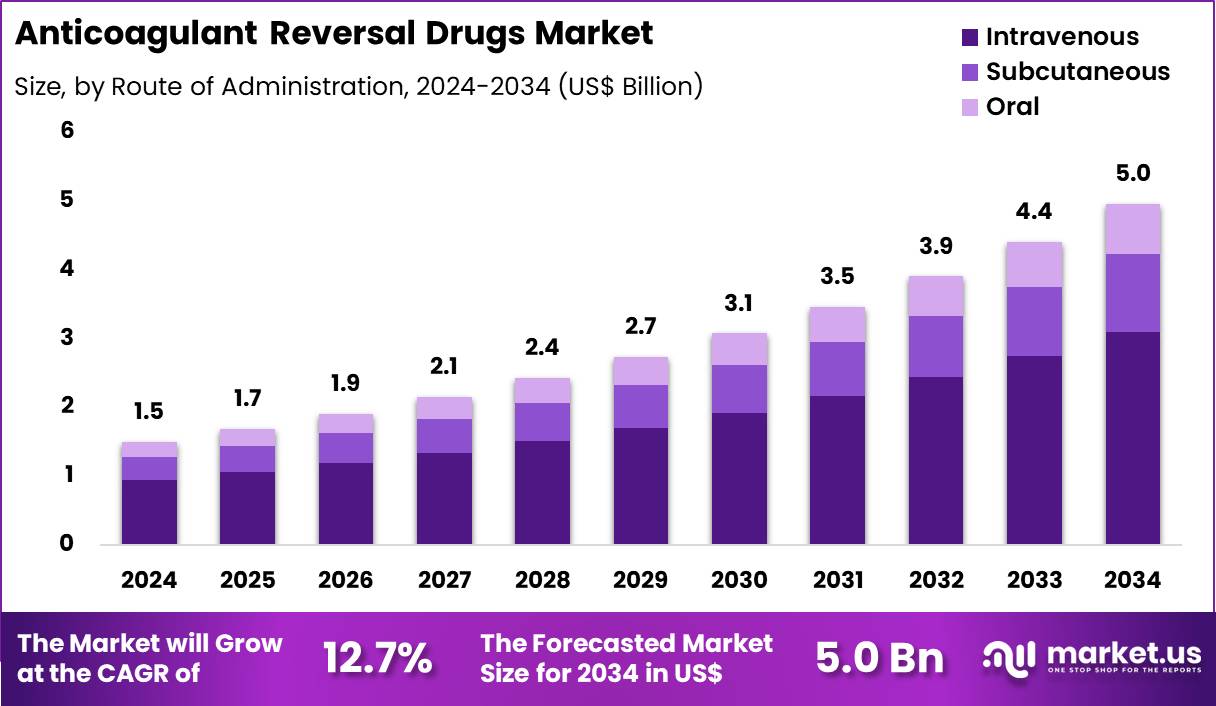
The Global Anticoagulant Reversal Drugs Market size is expected to be worth around US$ 5.0 Billion by 2034 from US$ 1.5 Billion in 2024, growing at a CAGR of 12.7% during the forecast period 2025 to 2034. In 2024, North America led the market, achieving over 40.3% share with a revenue of US$ 604.5 Million.
Anticoagulant reversal drugs are specialized medicines and hemostatic agents used to rapidly counteract the effects of blood-thinning medications during life-threatening or uncontrolled bleeding, emergency surgery, or urgent invasive procedures.
Common reversal approaches include vitamin K and four-factor prothrombin complex concentrate (4F-PCC) for warfarin, idarucizumab for dabigatran, and factor Xa-targeted reversal therapy for selected direct oral anticoagulants (DOACs).
The clinical importance of these therapies is increasing as DOAC use expands. The FDA reported that anticoagulants are among the most commonly prescribed medicines in the United States, while the first generic rivaroxaban tablets were approved in March 2025, potentially broadening access to anticoagulant therapy.
Recent evidence also highlights the need to balance rapid bleeding control with thrombotic risks. In the ANNEXA-I trial, andexanet alfa demonstrated a 14.6% thrombosis rate versus 6.9% with usual care at 30 days. Thrombosis-related deaths were 2.5% versus 0.9%, respectively.
In 2025, clinical research continued advancing reversal strategies, including studies of concentrated clotting-factor products. A 2025 ACC-reported study found that 4F-PCC reduced major bleeding risk by nearly 50% compared with frozen plasma during cardiac surgery.
Key Takeaways
- In 2024, the Anticoagulant Reversal Drugs Market generated US$ 1.5 billion in revenue, registering a 12.7% CAGR, and is projected to reach US$ 5.0 billion by 2034.
- By product, the market is segmented into vitamin K antagonists, prothrombin complex concentrates (PCC), fresh frozen plasma (FFP), protamine sulfate, idarucizumab, andexanet alfa, and others. PCC dominated in 2024 with a 35.6% market share.
- By indication, the market is segmented into bleeding, perioperative/pre-surgical reversal, and supratherapeutic drug levels. The bleeding segment held the largest share in 2024, accounting for 46.1%.
- By route of administration, the market is divided into intravenous, subcutaneous, and oral. The intravenous segment dominated in 2024, capturing a 62.4% revenue share.
- By distribution channel, the market is categorized into hospital pharmacies, retail pharmacies, and online pharmacies. Hospital pharmacies led the market in 2024, accounting for a 55.7% revenue share.
- Regionally, North America dominated the Anticoagulant Reversal Drugs Market in 2024, securing a 40.3% share of the global market.
Market segmentation
- Product Analysis: Prothrombin Complex Concentrates (PCC), holding 35.6%, are expected to lead the product segment due to their rapid reversal of vitamin K antagonist effects during severe bleeding. Their faster action, lower administration volume, and growing use in emergency care support adoption. Increasing anticoagulant use among aging populations further strengthens PCC demand.
- Indication Analysis: Bleeding, holding 46.1%, is projected to dominate the indication segment because anticoagulant-associated hemorrhage requires immediate intervention. Rising cardiovascular disease prevalence increases anticoagulant use and bleeding risks. Greater clinical awareness, rapid diagnosis, and established reversal protocols support timely treatment for intracranial, gastrointestinal, and trauma-related bleeding.
- Route of Administration Analysis: Intravenous administration, holding 62.4%, is expected to dominate because it provides rapid systemic drug delivery during emergencies. Hospitals widely use intravenous protocols for predictable dosing and immediate response. Increasing adoption of PCC and antibody-based reversal agents, particularly in intensive care and emergency settings, further reinforces this route’s dominance.
- Distribution Channel Analysis: Hospital pharmacies, holding 55.7%, are projected to lead because anticoagulant reversal drugs are primarily required in emergency and inpatient settings. Hospitals maintain these medicines for rapid access, controlled storage, and appropriate administration. Growing emergency admissions, pharmacy stewardship programs, and investments in hospital infrastructure further strengthen this distribution channel.
Statistical Information
- In the FARES-II 2025 randomized trial, 4F-PCC reduced the risk of needing additional bleeding-control intervention by 44% compared with frozen plasma during cardiac surgery.
- The same 2025 trial found that 4F-PCC reduced the risk of severe or massive bleeding by 49% compared with frozen plasma during the 1–24-hour period after treatment initiation.
- In FARES-II, 420 patients undergoing cardiac surgery were randomized to 4F-PCC or frozen plasma; 213 received PCC and 207 received frozen plasma.
- In the FARES-II study, PCC dosing was 1,500 IU or 2,000 IU, depending on patient weight, while the frozen-plasma group received 3 or 4 units.
- A 2025 study of fixed-dose 4F-PCC involving 592 patients found that 89% of warfarin-treated patients achieved an INR below 2 after reversal.
- In the same 2025 study, less than 5% of patients in both the warfarin and DOAC groups required a repeat 4F-PCC dose.
- The 2025 fixed-dose PCC study reported 12% bleeding events and 5% thrombotic events within 30 days in both the warfarin and DOAC treatment groups.
- Fixed-dose 4F-PCC generated median per-patient cost savings of US$1,567 for warfarin reversal and US$3,936 for DOAC management in the 2025 study.
- The same study reported annualized median hospital cost savings of US$176,239 for warfarin reversal and US$146,733 for DOAC management after implementing fixed-dose PCC.
Regional Analysis
North America is expected to maintain a leading position in the Anticoagulant Reversal Drugs Market, supported by established emergency-care infrastructure and extensive clinical experience with direct oral anticoagulants.
A 2025 clinical guidance recommends specific reversal agents for life-threatening bleeding, including andexanet for apixaban or rivaroxaban and idarucizumab for dabigatran, while PCCs remain alternatives when specific agents are unavailable.
Asia Pacific is positioned for strong growth as anticoagulant use expands among aging populations and atrial fibrillation patients. A 2025 study involving 21,142 Asian patients receiving DOAC therapy evaluated bleeding-risk prediction, highlighting the importance of improved risk assessment and reversal preparedness. Additionally, 2025 evidence supports broader clinical adoption of structured reversal pathways across the region.
Business Opportunities
The Anticoagulant Reversal Drugs Market presents opportunities for pharmaceutical companies to develop faster, safer, and more targeted reversal agents for direct oral anticoagulants. Innovation in prothrombin complex concentrates, specific antidotes, and ready-to-use formulations can improve emergency treatment for severe bleeding and urgent surgical procedures.
Another opportunity lies in integrating reversal therapies with rapid point-of-care diagnostic technologies, enabling healthcare professionals to identify anticoagulant activity and select appropriate treatments more efficiently. Digital clinical decision-support systems can further improve dosing decisions by incorporating medication history, laboratory results, renal function, and bleeding severity.
Asia Pacific offers additional opportunities through localized manufacturing, affordable products, hospital partnerships, and regulatory expansion. Companies can also pursue collaborations with hospitals, biotechnology firms, and academic institutions to develop next-generation antidotes.
Cost-efficient reversal products, improved safety profiles, and personalized treatment protocols can strengthen adoption while addressing healthcare providers’ concerns about treatment costs and thrombotic complications.
Emerging Trends
- Faster reversal protocols: Rapid treatment is becoming a major focus in anticoagulant reversal. A 2025 clinical review recommends achieving reversal within the first 60–90 minutes of hospital presentation for intracerebral hemorrhage, supporting faster emergency assessment and administration of appropriate reversal therapies
- Greater use of PCC: Four-factor PCC is gaining importance as a practical reversal option for factor Xa inhibitors. Recent clinical evidence and guidance increasingly recognize PCC-based treatment, particularly where specific antidotes are unavailable or unsuitable. This is encouraging hospitals to strengthen PCC availability and dosing protocols.
- Expansion of stewardship programs: Anticoagulation stewardship is becoming increasingly important following changes in the reversal landscape. A 2026 review highlights the need for structured programs to optimize reversal decisions, improve access, and update hospital protocols following the U.S. withdrawal of andexanet alfa.
- Growth of universal antidote research: Development of broad-spectrum reversal agents is emerging as an important trend. Ciraparantag is currently progressing through Phase III development, potentially providing a future reversal option across multiple anticoagulant therapies rather than requiring separate antidotes.
- Greater focus on safety: Reversal strategies are increasingly evaluated for both bleeding control and thrombotic complications. A 2025 systematic review covering 16 studies and 2,977 patients compared andexanet alfa with 4F-PCC, highlighting continued attention to balancing reversal effectiveness with patient safety.
Use Cases
- Intracranial hemorrhage: Anticoagulant reversal drugs are increasingly used in emergency management of intracranial bleeding, where rapid intervention is critical. Current 2025 evidence supports vitamin K plus 4F-PCC for vitamin K antagonist-associated bleeding, idarucizumab for dabigatran, and PCC or andexanet for factor Xa inhibitors.
- Emergency neurosurgery: Reversal agents are being used before urgent neurosurgical procedures in patients receiving factor Xa inhibitors. A 2026 study evaluated 32 procedures in 31 patients, comparing 4F-PCC in 18 procedures with andexanet alfa in 14 procedures.
- Cardiac surgery: PCCs are increasingly relevant when rapid coagulation-factor replacement is required during cardiac procedures. The 2025 FARES-II trial enrolled 420 patients, providing clinical evidence for PCC use as an alternative to plasma in patients requiring bleeding management.
- Dabigatran-related bleeding: Idarucizumab remains an important targeted treatment for patients experiencing serious bleeding while taking dabigatran. The therapy specifically binds dabigatran, allowing clinicians to rapidly counter its anticoagulant effect when urgent reversal is required.
- Factor Xa inhibitor emergencies: PCC-based reversal is increasingly used for urgent bleeding associated with factor Xa inhibitors, particularly when specific reversal therapy is unavailable. Current evidence supports its application in emergency departments, intensive-care settings, trauma cases, and urgent surgical interventions.
Recent Development
- In February 2025, Novartis announced an agreement to acquire Anthos Therapeutics for up to US$ 3.1 billion, including US$ 925 million upfront and up to US$2.15 billion in milestone payments. Anthos is developing abelacimab, a factor XI inhibitor for the prevention of stroke and thrombosis, expanding Novartis’s cardiovascular anticoagulation pipeline.
- In October 2025, Lupin Ltd. launched rivaroxaban oral suspension 1 mg/mL in the United States following FDA approval. Although rivaroxaban is an anticoagulant rather than a reversal drug, its availability increases the relevance of reversal strategies for serious bleeding associated with factor Xa inhibition.
- In September 2025, Lupin Ltd. received U.S. FDA approval for rivaroxaban oral suspension 1 mg/mL, a generic equivalent of Xarelto oral suspension. The product is used for pediatric venous thromboembolism treatment and thromboprophylaxis, expanding Lupin’s anticoagulation portfolio.
Frequently Asked Questions About Anticoagulant Reversal Drugs
- What is the role of PCC in anticoagulant reversal?
Four-factor PCC supplies coagulation factors II, VII, IX, and X and is established for urgent vitamin K antagonist reversal. PCC can also provide an alternative approach for factor Xa inhibitor-related bleeding when specific antidotes are unavailable. - How quickly can reversal treatment work?
The speed depends on the reversal agent and anticoagulant involved. Andexanet alfa previously demonstrated restoration of thrombin generation within 2–5 minutes, while treatment selection and administration timing remain critical during emergency bleeding management. - What is driving the Anticoagulant Reversal Drugs Market?
Market demand is supported by continued anticoagulant use, increasing emergency-care requirements, and the need for rapid management of severe bleeding. Hospitals increasingly emphasize structured reversal pathways, appropriate drug selection, monitoring, and timely anticoagulation restart. - Which product category is important in this market?
Four-factor PCC remains an important reversal product because it provides coagulation-factor replacement and is established for vitamin K antagonist reversal. It is also considered for some factor Xa inhibitor emergencies when specific reversal agents are unavailable. - Where are anticoagulant reversal drugs mainly used?
Anticoagulant reversal drugs are primarily used in emergency departments, intensive-care units, stroke centers, trauma facilities, and surgical settings. Their application is particularly important when uncontrolled bleeding or urgent procedures require rapid correction of anticoagulant effects.What is the future outlook for anticoagulant reversal drugs?
Future development is expected to focus on safer reversal approaches, improved treatment selection, and individualized management. The 2026 ACC scientific statement emphasizes patient-specific assessment of bleeding risk, anticoagulant choice, dosing, interactions, and reversal management.
Conclusion
The Anticoagulant Reversal Drugs Market is advancing as anticoagulant use increases and healthcare systems prioritize rapid management of life-threatening bleeding. Prothrombin complex concentrates remain important because of their rapid action, while targeted reversal therapies provide options for specific anticoagulants.
Growing emergency-care capabilities, improved clinical protocols, and ongoing pharmaceutical innovation are supporting market development. North America currently represents a leading regional market, while Asia Pacific offers substantial opportunities through expanding healthcare infrastructure and increasing anticoagulant use.
Future progress will depend on safer reversal agents, cost-effective treatment options, improved hospital preparedness, and continued clinical research focused on balancing rapid bleeding control with thrombotic risk.
Discuss your needs with our analyst
Please share your requirements with more details so our analyst can check if they can solve your problem(s)




