


Overview
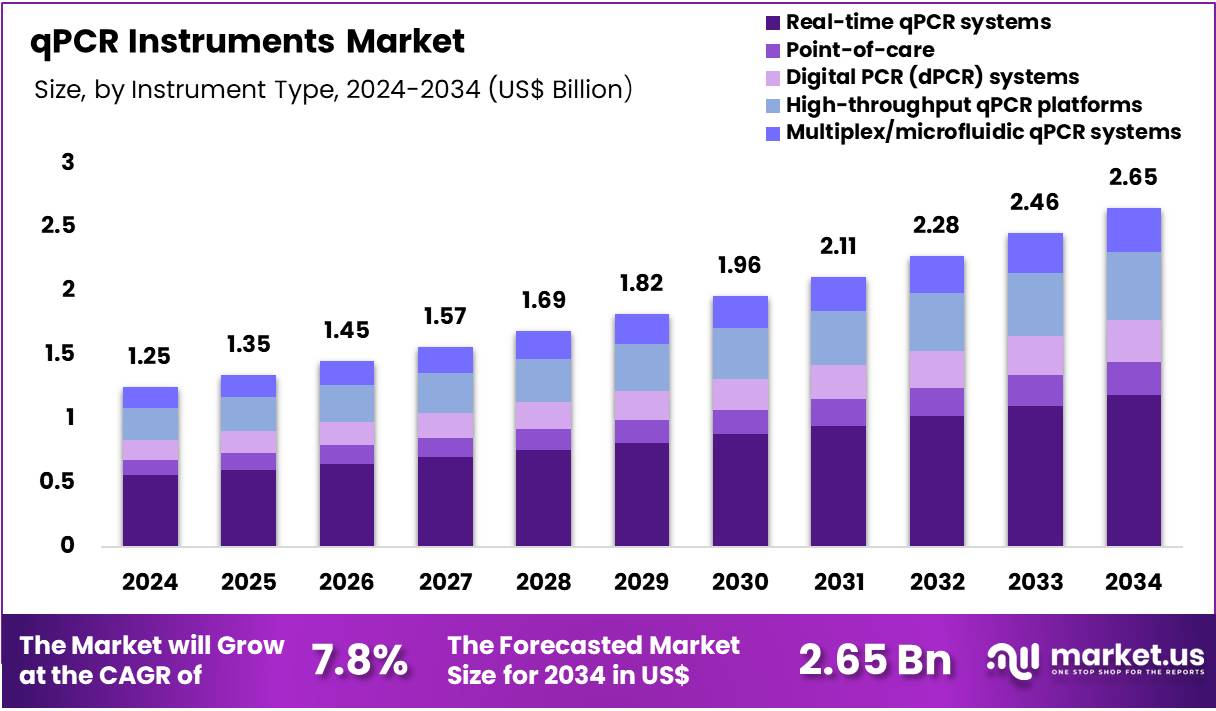
New York, NY – Aug 31, 2026 – The Global qPCR Instruments Market size is expected to be worth around US$ 2.65 Billion by 2034 from US$ 1.25 Billion in 2024, growing at a CAGR of 7.8% during the forecast period 2025 to 2034. In 2024, North America led the market, achieving over 38.4% share with a revenue of US$ 480.0 Million.
The global qPCR (Quantitative Polymerase Chain Reaction) Instruments Market continues to expand as healthcare systems, research laboratories, and diagnostic centers increase the use of molecular testing for infectious diseases, cancer, genetic disorders, and precision medicine. qPCR instruments provide rapid, accurate, and highly sensitive detection of DNA and RNA targets, making them essential in both clinical diagnostics and life science research.
The market is witnessing strong demand due to the growing adoption of molecular diagnostics, expanding genomics research, and rising investments in biotechnology. Technological improvements, including high-throughput systems, multiplex testing capabilities, automated workflows, and cloud-enabled data management, are enhancing laboratory efficiency and reducing turnaround times. The integration of artificial intelligence and digital PCR-compatible platforms is further supporting innovation across research and diagnostic applications.
According to the World Health Organization (WHO), molecular diagnostic testing remains a critical tool for disease surveillance and outbreak response. Meanwhile, the U.S. Centers for Disease Control and Prevention (CDC) continues to recommend PCR-based testing for the detection of several infectious diseases due to its high analytical sensitivity. Modern qPCR instruments can process 96 to 384 samples per run, deliver results in approximately 30 to 120 minutes, and detect multiple genetic targets in a single reaction through multiplex assays.
Growing investments in precision medicine, expanding clinical laboratory infrastructure, and continuous product innovation are expected to support long-term market growth, creating new opportunities for instrument manufacturers, diagnostic laboratories, pharmaceutical companies, and academic research institutions worldwide.
Key Takeaways
- In 2024, the global qPCR instruments market was valued at US$ 1.25 billion and is projected to reach US$ 2.65 billion by 2034, expanding at a CAGR of 7.8% during the forecast period.
- By Instrument Type, the market is segmented into Real-time qPCR systems, Point-of-care, Digital PCR (dPCR) systems, High-throughput qPCR platforms, and Multiplex/microfluidic qPCR systems. Among these, Real-time qPCR systems dominated the market in 2024, accounting for 44.8% of the total share.
- By Application, the market is categorized into Infectious disease diagnostics, Oncology & cancer biomarker testing, Genetic/genomic research and gene expression profiling, Agricultural/animal health testing, and Other applications. Infectious disease diagnostics emerged as the leading application segment, capturing 42.5% of the market share in 2024.
- By End User, the market is classified into Diagnostic laboratories, Hospitals & clinics, Pharma & biotech companies, and Other end-users.
- Diagnostic laboratories held the largest share in 2024, representing 38.7% of the global market.
- North America accounted for the largest regional share in 2024, contributing 38.4% of the global qPCR instruments market revenue.
Statistical Information
- A 2025 government procurement specification requires real-time PCR instruments to support both 96-well and 384-well reaction blocks operating independently for scalable, high-throughput workflows.
- The same 2025 specification requires at least 6 independently controlled temperature-gradient columns for the 96-well block and at least 16 gradient columns for the 384-well block.
- The required linear temperature-gradient capability is 32°C (96-well format) and 20°C (384-well format), both with 0.1°C adjustment resolution.
- Another 2025 government technical specification requires real-time PCR instruments to operate over a thermal block range of 4°C to 100°C.
- The same 2025 specification requires thermal block accuracy of ±0.2°C to ±0.25°C for precise amplification control.
- The required thermal uniformity across the PCR block is ±0.3°C, ensuring consistent amplification between wells.
- The 2025 specification requires instruments to provide at least 6 excitation filters and 6 emission filters for multiplex fluorescence detection.
- The required minimum thermal ramp rate is 5°C per second or higher to support rapid PCR cycling.
Regional Analysis
North America held the leading position in the qPCR instruments market due to its well-developed healthcare infrastructure, extensive molecular diagnostics network, and strong investment in genomics research. The region benefits from widespread adoption of real-time PCR systems across hospitals, clinical laboratories, research institutes, and pharmaceutical companies.
High testing volumes for infectious diseases, cancer biomarkers, and genetic disorders continue to support demand for advanced qPCR platforms. The presence of leading biotechnology companies, academic research centers, and government-backed research programs further strengthens market growth. In addition, regulatory support and continuous innovation in molecular diagnostics contribute to the region’s dominant position.
Asia Pacific is projected to register the fastest growth during the forecast period. Rising healthcare investments, expanding diagnostic laboratory networks, and increasing adoption of precision medicine are driving demand for qPCR instruments across China, India, Japan, South Korea, and Southeast Asia.
Government initiatives supporting disease surveillance, genomic research, and biotechnology development, along with growing testing for infectious diseases such as tuberculosis, dengue, influenza, and respiratory infections, are accelerating the adoption of high-throughput and digital qPCR technologies throughout the region.
Emerging Trends
- Growth of digital PCR alongside qPCR platforms: Clinical and research laboratories are increasingly adopting instruments that support both qPCR and digital PCR workflows. According to the U.S. National Institute of Standards and Technology (NIST), digital PCR provides absolute nucleic acid quantification without requiring a standard curve, improving measurement accuracy for reference materials and precision diagnostics.
- Higher demand for respiratory virus molecular testing: Healthcare systems continue expanding molecular testing capacity for respiratory infections. The U.S. CDC recommends testing for viruses such as COVID-19 and influenza, while rapid diagnosis supports timely treatment decisions. This sustained testing demand encourages laboratories to upgrade to faster, high-throughput qPCR instruments.
- Improved automation in public-health laboratories: Public-health agencies are modernizing disease surveillance systems to improve laboratory efficiency. In 2025, the CDC outlined 6 major modernization goals for surveillance, including faster workflows, improved data quality, automated reporting, and easier outbreak management, supporting greater integration of automated qPCR platforms.
- Greater focus on highly accurate viral quantification: Recent scientific studies show growing interest in digital PCR for virology because it offers improved sensitivity, precision, repeatability, and resistance to inhibitors compared with conventional qPCR. These advantages are encouraging laboratories to invest in next-generation molecular testing instruments.
- Expansion of wastewater surveillance testing: Government and academic laboratories are increasing wastewater monitoring to detect infectious diseases. A 2025 comparative study evaluated 3 digital PCR platforms for viral detection in wastewater, highlighting the growing need for advanced PCR instruments capable of handling complex environmental samples.
Use Cases
- Infectious disease diagnosis: qPCR instruments are widely used to identify pathogens causing tuberculosis, influenza, COVID-19, RSV, HIV, and other infectious diseases. Their high sensitivity enables laboratories to detect very small amounts of viral or bacterial genetic material, supporting faster clinical decisions and effective disease control.
- Cancer biomarker testing: Hospitals and research laboratories use qPCR systems to measure gene expression, detect mutations, and monitor cancer biomarkers. These instruments help physicians select personalized treatments, evaluate therapy response, and improve molecular oncology research with highly reproducible genetic analysis.
- Public health surveillance: Government laboratories use qPCR instruments to monitor outbreaks and detect emerging pathogens through national surveillance programs. Molecular testing supports rapid identification of disease clusters, enabling faster public-health responses and more effective monitoring of infectious disease transmission.
- Environmental and wastewater monitoring: Environmental laboratories apply qPCR instruments to detect viruses and microbial contamination in wastewater. Monitoring wastewater provides early warning of disease circulation within communities, allowing health authorities to identify outbreaks before large numbers of clinical cases are reported.
- Reference material validation and laboratory quality control: National standards laboratories use advanced PCR instruments to validate DNA and RNA reference materials. NIST applies digital PCR for accurate quantification of genetic standards, helping improve calibration, assay reproducibility, and quality assurance across clinical and research laboratories.
Frequently Asked Questions on qPCR Instruments
- What factors are driving the growth of the qPCR Instruments Market?
Growing demand for molecular diagnostics, rising infectious disease surveillance, expanding genetic research, and increasing investments in biotechnology are key growth drivers. Government funding for genomic programs and the wider adoption of automated laboratory workflows are also encouraging healthcare organizations to purchase advanced qPCR instruments. - Which industries are the major users of qPCR Instruments?
Hospitals, diagnostic laboratories, pharmaceutical companies, biotechnology firms, academic research institutes, food testing laboratories, and environmental monitoring agencies are the primary users. These organizations rely on qPCR instruments for disease detection, drug development, quality control, pathogen identification, and genetic analysis. - What are the major technologies used in modern qPCR Instruments?
Modern qPCR instruments feature multiplex detection, high-throughput sample processing, automated data analysis, touchscreen interfaces, cloud connectivity, and improved thermal cycling performance. Many systems also support multiple fluorescent channels, enabling simultaneous detection of several genetic targets within a single reaction. - Which region leads the qPCR Instruments Market?
North America currently leads the qPCR Instruments Market due to its advanced healthcare infrastructure, strong biotechnology sector, high research funding, and broad adoption of molecular diagnostics. Europe and the Asia-Pacific are also experiencing rapid growth because of expanding laboratory capacity and healthcare investments. - What challenges does the qPCR Instruments Market face?
High instrument costs, expensive maintenance, the need for trained laboratory professionals, and strict regulatory requirements remain significant challenges. Small laboratories may also face budget limitations, while competition from emerging molecular diagnostic technologies creates additional pressure on manufacturers to continuously innovate. - How are technological advancements improving qPCR Instruments?
Manufacturers are introducing faster thermal cycling, AI-supported data interpretation, remote monitoring, automated sample handling, and compact portable platforms. These innovations improve workflow efficiency, reduce human error, increase testing capacity, and make molecular testing more accessible in clinical and decentralized laboratory settings. - What opportunities exist in the qPCR Instruments Market?
Opportunities are growing in point-of-care molecular testing, personalized medicine, infectious disease surveillance, cancer diagnostics, veterinary diagnostics, and agricultural genomics. Rising investments in genomic research and expanding laboratory infrastructure across emerging economies are expected to create long-term demand for advanced qPCR systems.
Conclusion
The global qPCR instruments market is poised for steady growth as molecular diagnostics become increasingly important across healthcare, life sciences, agriculture, and environmental testing. Rising demand for rapid, accurate, and high-throughput nucleic acid detection, combined with technological advancements in automation and multiplex testing, will continue to support market expansion.
Real-time qPCR systems remain the dominant product segment due to their broad clinical and research applications. North America leads the market with strong diagnostic infrastructure and research investments, while Asia-Pacific is emerging as a high-growth region. Continuous innovation, expanding precision medicine, and infectious disease surveillance are expected to create significant long-term opportunities.
Discuss your needs with our analyst
Please share your requirements with more details so our analyst can check if they can solve your problem(s)




