


Overview
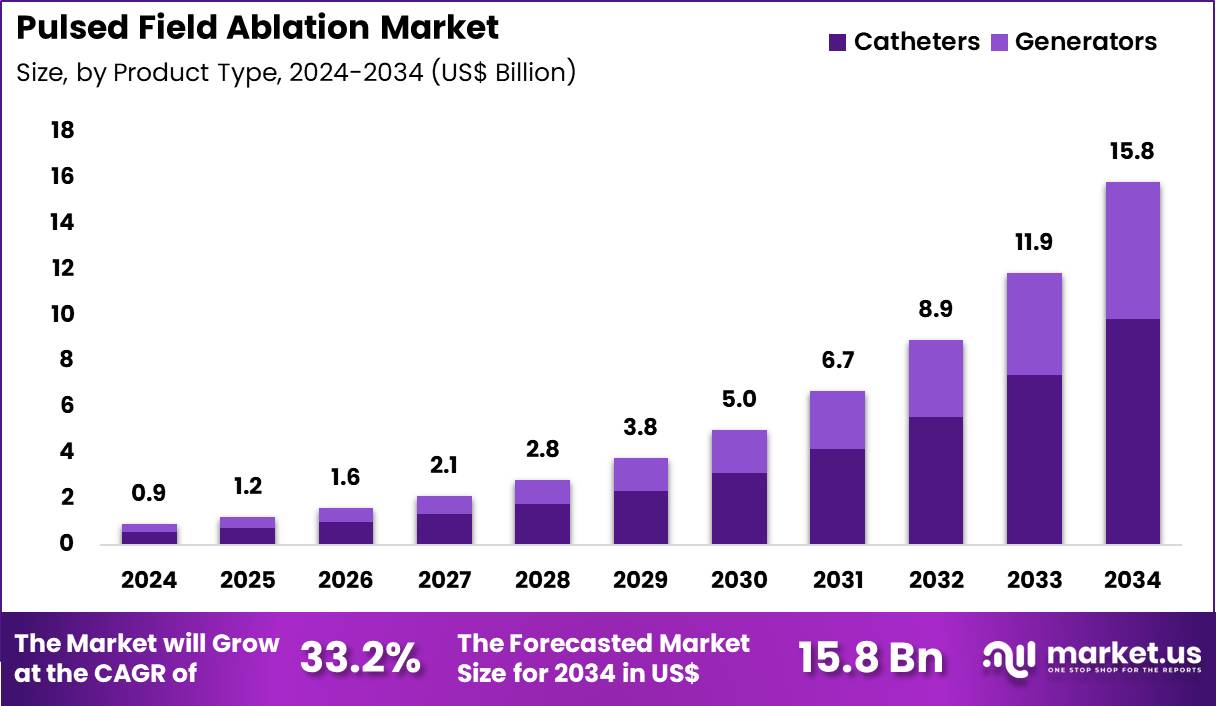
New York, NY – Oct 29, 2026 – Global Pulsed Field Ablation Market size is expected to be worth around US$ 15.8 Billion by 2034 from US$ 0.9 Billion in 2024, growing at a CAGR of 33.2% during the forecast period 2025 to 2034. In 2024, North America led the market, achieving over 42.1% share with a revenue of US$ 0.4 Billion.
Pulsed Field Ablation (PFA) is an advanced, minimally invasive cardiac procedure used to treat certain types of abnormal heart rhythms, particularly atrial fibrillation (AF). The procedure uses short bursts of high-voltage electrical pulses to selectively target and eliminate heart tissue responsible for irregular electrical signals.
Unlike conventional thermal ablation techniques, which use heat or extreme cold to destroy targeted tissue, PFA primarily relies on a process called irreversible electroporation. This approach is designed to reduce damage to surrounding structures, including the esophagus, blood vessels, and nerves, while treating the targeted cardiac tissue.
PFA is performed using specialized catheter-based systems that are guided into the heart through blood vessels. The technology has gained growing attention due to its potential to improve procedural efficiency, enhance tissue selectivity, and support a favorable safety profile.
As the global burden of atrial fibrillation continues to increase, PFA is emerging as an important development in electrophysiology and the broader cardiac care landscape. Ongoing clinical research, technological advancements, and expanding clinical adoption are expected to influence the evolution of this treatment approach.
With its distinctive mechanism of action and potential clinical benefits, Pulsed Field Ablation represents a significant advancement in the treatment of cardiac arrhythmias, offering new possibilities for physicians and patients seeking effective rhythm management.
Key Takeaways
- In 2024, the market was valued at US$ 0.9 billion and is projected to grow at a CAGR of 33.2%, reaching US$ 15.8 billion by 2034.
- By product type, the market is segmented into catheters and generators, with catheters dominating the market with a 62.4% share.
- By indication, the market is categorized into atrial fibrillation and non-atrial fibrillation, with atrial fibrillation accounting for the largest share of 71.8%.
- By end use, the market is divided into inpatient and outpatient facilities, with inpatient facilities holding the dominant revenue share of 66.1%.
- Regionally, North America led the market with a 42.1% share.
Key Market Segments
- Product Type Analysis: Catheters dominated the pulsed field ablation market, accounting for 62.4% of the product type segment. Their essential role in delivering electrical pulses to targeted cardiac tissue drives demand. Increasing procedure volumes, technological improvements, catheter replacement requirements, and integration with advanced mapping systems further support adoption across electrophysiology laboratories.
- Indication Analysis: Atrial fibrillation dominated the pulsed field ablation market, accounting for 71.8% of the indication segment. The high prevalence of atrial fibrillation and growing demand for effective rhythm management support segment growth. Increasing adoption of pulmonary vein isolation, expanding clinical evidence, and rising preference for non-thermal ablation techniques further strengthen demand.
- End-Use Analysis: Inpatient facilities accounted for 66.1% of the pulsed field ablation market by end use. Hospitals benefit from established electrophysiology departments, advanced cardiac care infrastructure, and comprehensive patient monitoring capabilities. Investments in next-generation ablation systems, specialist training, and expanding arrhythmia treatment programs continue to support adoption across hospital-based facilities.
Regional Analysis
North America Leads the Pulsed Field Ablation Market
North America dominated the pulsed field ablation market, accounting for 42.1% of the global market in 2024. Growth has been supported by regulatory approvals, rising atrial fibrillation cases, advanced cardiac care infrastructure, and increasing adoption of non-thermal ablation technologies. Key players, including Boston Scientific and Medtronic, have expanded market adoption through their FARAPULSE and PulseSelect systems.
Strong clinical research, specialist training programs, and investments in electrophysiology laboratories further support regional growth. According to the CDC, more than 454,000 hospitalizations annually in the United States involve atrial fibrillation as the primary diagnosis.
Asia Pacific Expected to Record the Highest CAGR
Asia Pacific is projected to register the highest CAGR during the forecast period, driven by an aging population, increasing cardiovascular disease burden, and expanding access to specialized cardiac care.
Growing healthcare investments, technological advancements, international collaborations, and physician training initiatives are expected to accelerate adoption across Japan, China, India, South Korea, and Australia. Rising awareness and improvements in healthcare infrastructure will further support regional market expansion.
Emerging Trends
- Growing adoption of non-thermal ablation technology: PFA uses short electrical pulses to damage targeted heart tissue instead of relying on heat or freezing. This approach may reduce injury to nearby structures, such as the oesophagus and nerves, making it an important alternative to conventional ablation methods.
- Development of advanced catheter and mapping systems: Manufacturers are developing catheter designs and integrated mapping technologies to improve treatment accuracy, tissue coverage, and ease of use. Better integration of electrical mapping and energy delivery may help hospitals improve procedure consistency and support wider clinical adoption.
- Increasing focus on shorter procedure times: PFA systems can deliver treatment rapidly, and clinical studies have reported improved procedural efficiency compared with some thermal ablation approaches. Hospitals may benefit from better laboratory utilisation, although actual time savings depend on the device, workflow, and patient condition.
- Expansion of regulatory approvals and clinical evidence: Regulatory authorisations and ongoing clinical studies are strengthening the evidence base for PFA. For example, the US FDA approved the PulseSelect system in December 2023 and the Globe Pulsed Field System in August 2025 for specified atrial fibrillation indications.
- Research into broader cardiac applications: Research is examining PFA for additional heart rhythm disorders, including ventricular arrhythmias and more complex atrial fibrillation cases. These applications could expand future demand, but commercial opportunities will depend on clinical validation, regulatory clearance, and evidence of long-term safety and effectiveness.
Use Cases
- Treatment of paroxysmal atrial fibrillation: PFA is used to treat intermittent atrial fibrillation, in which abnormal heart rhythms start and stop. The procedure commonly targets tissue around the pulmonary veins to prevent abnormal electrical signals from triggering irregular heartbeats.
- Treatment of selected persistent atrial fibrillation cases: Some PFA systems are approved for selected patients with persistent atrial fibrillation. Treatment aims to control abnormal electrical activity and reduce arrhythmia recurrence. Patient selection depends on clinical assessment, disease duration, and the system’s authorised indications.
- Pulmonary vein isolation: Pulmonary vein isolation is a central application of PFA. Electrical pulses create targeted lesions around the pulmonary vein openings to block abnormal signals entering the left atrium. This procedure is a key driver of clinical demand for PFA catheters and generators.
- Additional lesion creation for complex atrial fibrillation: Researchers are evaluating PFA for additional treatment areas, including posterior wall isolation, in selected patients with persistent atrial fibrillation. These strategies may address more complex electrical pathways, but their added benefits and long-term outcomes remain under investigation.
- Emerging use in ventricular arrhythmias: PFA is being explored for ventricular arrhythmias, including abnormal rhythms originating in the lower chambers of the heart. Its ability to target cardiac tissue selectively is of research interest, but its suitability and availability depend on further evidence and specific regulatory authorisations.
Frequently Asked Questions About Pulsed Field Ablation
- How does pulsed field ablation work?
PFA uses a process called irreversible electroporation, which disrupts cell membranes through electrical pulses. This creates lesions in targeted heart tissue without relying on heat or freezing, potentially reducing damage to nearby structures compared with conventional thermal techniques. - What conditions can pulsed field ablation treat?
PFA is primarily used for atrial fibrillation, including selected paroxysmal and persistent cases, depending on device approval. Researchers are also examining its potential for ventricular arrhythmias and more complex cardiac rhythm disorders. - What are the main benefits of pulsed field ablation?
PFA offers rapid energy delivery and may reduce injury to nearby structures, particularly the oesophagus. Clinical evidence indicates that its effectiveness can be comparable to thermal ablation, although outcomes depend on the device, treatment strategy, and patient characteristics. - Does pulsed field ablation permanently cure atrial fibrillation?
PFA can reduce atrial fibrillation episodes, but it does not guarantee a permanent cure. Arrhythmias may return after treatment, and some patients require medication, follow-up monitoring, or another procedure to maintain effective rhythm control. - What factors are driving the pulsed field ablation market?
Market development is supported by demand for atrial fibrillation treatment, interest in non-thermal technologies, clinical evidence, and regulatory approvals. Potential improvements in procedure efficiency and reduced injury to nearby tissues are also encouraging hospitals to evaluate PFA systems. - Which region is important for pulsed field ablation market development?
The United States is an important market because several PFA systems have received FDA approval, supporting clinical use and further evidence generation. Other countries may offer growth opportunities as regulatory pathways, hospital capabilities, reimbursement, and specialist access develop. - What role do regulatory approvals play in market growth?
Regulatory approvals establish whether specific devices can be marketed for defined medical uses. They can support hospital procurement and clinical adoption, while additional approvals may expand eligible patient groups. Requirements differ across countries, and each device’s authorised indications must be checked. - What is the future outlook for the pulsed field ablation market?
The market outlook will depend on clinical adoption, technological improvements, long-term patient outcomes, pricing, and reimbursement. Research into additional cardiac applications may create new opportunities, but sustained growth will require reliable evidence, appropriate regulation, and wider access to specialised treatment facilities.
Conclusion
The global pulsed field ablation market is poised for substantial growth, driven by the rising prevalence of atrial fibrillation, increasing adoption of non-thermal ablation technologies, and continued advancements in cardiac care.
Valued at US$ 0.9 billion in 2024, the market is projected to reach US$ 15.8 billion by 2034, registering a CAGR of 33.2%. Catheters, atrial fibrillation treatment, and inpatient facilities remain key market segments, while North America maintains a leading position. Meanwhile, Asia Pacific is expected to witness the fastest growth, supported by healthcare investments, expanding clinical access, and technological innovation.
Discuss your needs with our analyst
Please share your requirements with more details so our analyst can check if they can solve your problem(s)



