


Overview
New York, NY – Sep 09, 2026 – The Global Polymyxin Resistance Testing Market size is expected to be worth around US$ 249.0 Million by 2034 from US$ 133.9 Million in 2024, growing at a CAGR of 6.4% during the forecast period 2025 to 2034. In 2024, North America led the market, achieving over 37.7% share with a revenue of US$ 50.5 Million.
The global Polymyxin Resistance Testing Market is witnessing significant growth as antimicrobial resistance (AMR) continues to rise worldwide. Polymyxins, including colistin and polymyxin B, are considered last-line antibiotics for treating severe infections caused by multidrug-resistant (MDR) Gram-negative bacteria. According to the World Health Organization (WHO), bacterial AMR was associated with 4.95 million deaths globally in 2019, including 1.27 million deaths directly caused by resistant bacterial infections.
The U.S. Centers for Disease Control and Prevention (CDC) reports that antimicrobial-resistant bacteria cause more than 2.8 million infections and over 35,000 deaths annually in the United States. The growing spread of mobilized colistin resistance (mcr) genes has increased the need for accurate diagnostic testing.
Since mcr-1 was first identified in 2015, scientists have discovered 10 mcr gene families (mcr-1 to mcr-10). The WHO GLASS surveillance network now includes 130+ countries and territories, supporting global monitoring of antimicrobial resistance.
Broth microdilution (BMD) remains the reference method recommended by CLSI and EUCAST, while PCR assays, automated antimicrobial susceptibility testing systems, MALDI-TOF MS, and whole-genome sequencing are increasingly adopted. Molecular methods can provide results in 2–6 hours, compared with 24–48 hours for conventional culture methods.
The market is supported by increasing hospital-acquired infections, expanding antimicrobial stewardship programs, rising investments in microbiology laboratories, and stronger government surveillance initiatives.
North America leads due to advanced laboratory infrastructure, while Asia-Pacific is expected to grow rapidly because of increasing healthcare expenditure, improving diagnostic capabilities, and greater awareness of rapid resistance testing technologies.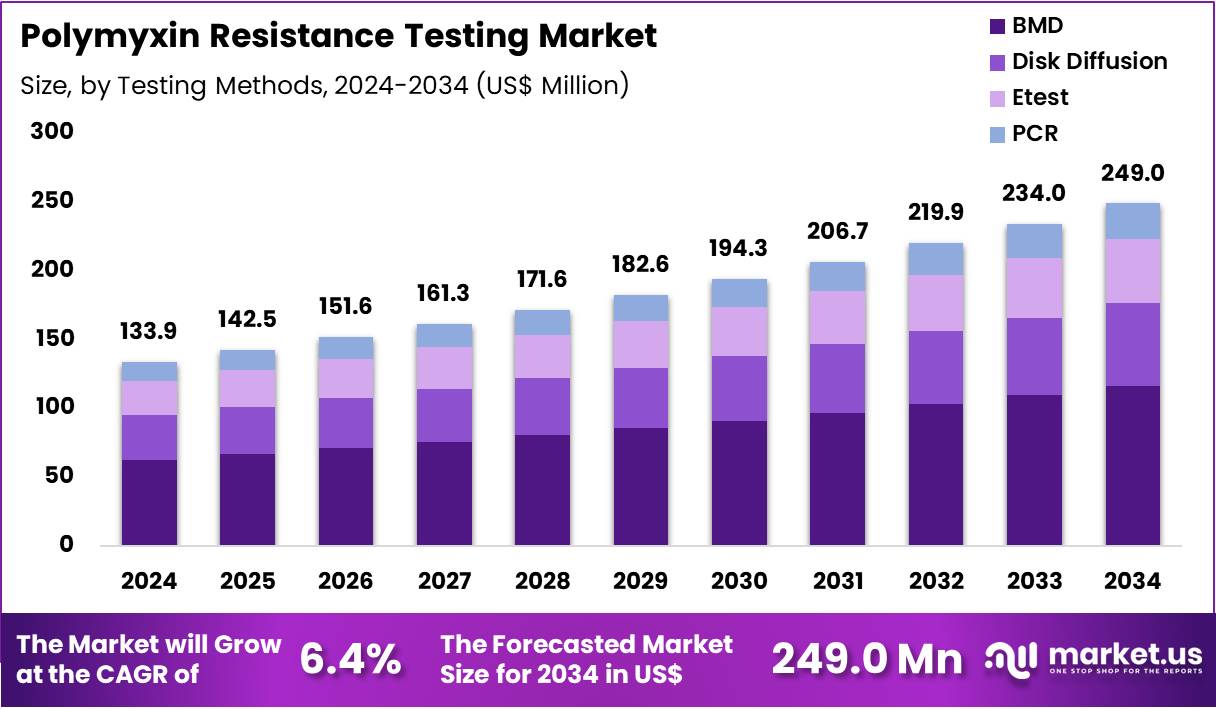
Key Takeaways
- The global Polymyxin Resistance Testing Market was valued at US$ 133.9 million in 2024 and is projected to reach US$ 249.0 million by 2034, expanding at a CAGR of 6.4% during the forecast period.
- By product type, the market is segmented into testing systems, test kits & identification panels, and reagents & consumables. Among these, testing systems dominated the market in 2024, accounting for 44.3% of the total revenue share.
- Based on testing method, the market comprises broth microdilution (BMD), disk diffusion, Etest, and PCR. Broth microdilution (BMD) emerged as the leading segment, capturing 46.8% of the market share in 2024.
- In terms of end users, the market is categorized into clinical laboratories, academic & research institutions, pharmaceutical/biotechnology companies, and others. Clinical laboratories held the largest share, contributing 48.5% of the overall market revenue in 2024.
- North America remained the leading regional market in 2024, representing 37.7% of the global market share, supported by advanced diagnostic infrastructure and widespread adoption of antimicrobial resistance testing.
Statistical Information
- Global polymyxin resistance burden in hospitals: Worldwide, polymyxin B resistance in carbapenem‑resistant Pseudomonas aeruginosa is generally 5%, with some hotspots like Singapore at 53% non‑susceptibility. Europe reports around 5% colistin resistance on average, but certain countries show 80% colistin‑resistant A. baumannii and 25–35% resistant K. pneumoniae, driving substantial demand for polymyxin resistance testing in tertiary hospitals.
- Regional resistance trends impacting testing volumes: Data from European surveillance (EARS‑Net) and Brazilian hospitals show marked increases: colistin‑resistant K. pneumoniae rising from 1.8% to 35.5% (2009–2015) in Brazil, and K. pneumoniae colistin resistance up to 25.8% in parts of Europe. These trends translate into higher polymyxin MIC testing volumes and increased reliance on validated laboratory
- Prescribing patterns and stewardship influences: Comparative outcome data show colistin‑based regimens with 30‑day mortality around 32% and renal injury rates of 81%, versus significantly lower mortality and toxicity with alternative agents such as ceftazidime‑avibactam. These findings underpin antimicrobial stewardship policies that restrict empiric polymyxin use and require susceptibility confirmation, boosting test utilization per treatment course.
- Hospital infection burden and resistance testing implications: Global estimates suggest 136 million hospital‑associated resistant infections annually (95% CI 26–246 million). High‑income countries report 3.5–12% hospital‑acquired infection incidence, with ICU infection rates near 40% of patients. Given frequent last‑line polymyxin use against resistant Gram‑negative pathogens, this burden translates into substantial demand for reliable polymyxin resistance testing capacity worldwide.
- Polymyxin susceptibility testing methods error rates: An evaluation of polymyxin B susceptibility testing found 8.5% of 281 clinical isolates resistant, with E‑test very major error rates of 0.7–1% compared with broth microdilution. These quantified error profiles highlight the importance of choosing validated methods and directly influence how laboratories invest in polymyxin testing technologies and quality‑control processes.
- ICU mortality in colistin-resistant Gram-negative infections: A 2026 cohort from Qassim reported overall in‑hospital mortality of 54.1% in patients with colistin‑resistant Gram‑negative infections. Mortality reached 70.8% in ICU patients versus 32.4% in non‑ICU settings. Colistin resistance rates were 100% in Acinetobacter and Pseudomonas and 82.8% in Enterobacterales, illustrating severe clinical and economic pressure to deploy comprehensive polymyxin resistance testing.
Regional Analysis
North America led the market by securing a market share of 37.7% in 2024.
North America dominated the Polymyxin Resistance Testing Market in 2024, accounting for 37.7% of the global market. The region’s leadership is supported by advanced healthcare infrastructure, strong antimicrobial resistance (AMR) surveillance programs, and widespread adoption of standardized susceptibility testing.
The CDC Antimicrobial Resistance Laboratory Network operates across all 50 U.S. states, Puerto Rico, and major cities, providing nationwide capacity for rapid detection of resistant pathogens. According to the CDC, the network tested more than 230,000 patient specimens during 2021–2022, strengthening laboratory preparedness and accelerating the use of broth microdilution and molecular diagnostics.
Asia Pacific is expected to register the fastest growth during the forecast period. The WHO Global Antimicrobial Resistance and Use Surveillance System (GLASS) continues to expand surveillance across the region, encouraging investments in microbiology laboratories and rapid diagnostic technologies.
Increasing antimicrobial stewardship initiatives, rising healthcare expenditure, and growing adoption of automated susceptibility testing platforms are expected to drive sustained market growth across Asia Pacific.
Emerging Trends
- Increasing Adoption of Rapid Molecular Resistance Detection: The demand for rapid molecular testing is increasing as hospitals require faster identification of polymyxin-resistant pathogens. PCR-based assays and genomic technologies help detect resistance genes such as mcr-1 within hours, supporting early treatment decisions and infection-control measures. WHO GLASS includes surveillance of emerging AMR threats to improve detection capabilities globally.
- Expansion of Global Antimicrobial Resistance Surveillance Networks: Global AMR surveillance is becoming a major trend supporting polymyxin resistance testing adoption. The WHO GLASS program expanded to 141 countries, territories, and areas by December 2024, creating greater demand for standardized antimicrobial susceptibility testing methods, laboratory infrastructure, and resistance monitoring systems.
- Growing Use of Broth Microdilution for Accurate Polymyxin Testing: Broth microdilution (BMD) is becoming increasingly important because healthcare laboratories need reliable minimum inhibitory concentration (MIC) results for colistin and polymyxin B. International guidelines recommend standardized testing methods to reduce inaccurate resistance reporting and improve antibiotic selection for critically ill patients.
- Integration of Whole-Genome Sequencing in Resistance Surveillance: Whole-genome sequencing (WGS) is emerging as an advanced tool for identifying resistance mechanisms, tracking outbreaks, and understanding transmission patterns. Public health laboratories increasingly use genomic approaches alongside traditional susceptibility testing to characterize resistant bacteria and support national AMR surveillance programs.
- Expansion of Automated Antimicrobial Susceptibility Testing Platforms: Clinical laboratories are adopting automated susceptibility testing systems to improve workflow efficiency and reduce reporting delays. These platforms help analyze bacterial isolates, determine antibiotic response patterns, and support antimicrobial stewardship programs. Increasing laboratory automation is strengthening demand for advanced polymyxin resistance testing solutions.
Use Cases
- Hospital Infection Control and Outbreak Prevention: Polymyxin resistance testing is widely used in hospitals to identify resistant Gram-negative bacteria and prevent transmission among vulnerable patients. Intensive care units, transplant centers, and oncology wards use susceptibility testing to monitor high-risk infections and implement targeted infection-control strategies.
- Clinical Decision Support for Multidrug-Resistant Infections: Testing helps physicians select effective antibiotics when treating severe infections caused by resistant organisms. Since polymyxins are often reserved for difficult-to-treat infections, accurate susceptibility results support personalized therapy and reduce unnecessary antibiotic exposure.
- Public Health Surveillance of Emerging Resistance Genes: Government laboratories use polymyxin resistance testing to monitor the spread of resistance genes, including plasmid-mediated mcr genes. WHO GLASS supports standardized reporting systems that allow countries to compare resistance patterns and identify emerging threats.
- Pharmaceutical and Diagnostic Research Applications: Pharmaceutical companies and research institutions use polymyxin resistance testing during antibiotic development, resistance mechanism studies, and diagnostic validation. Reference bacterial isolates from organizations such as FDA and CDC help evaluate the performance of new antimicrobial susceptibility technologies.
- Supporting Antimicrobial Stewardship Programs: Polymyxin resistance testing supports antimicrobial stewardship by helping healthcare providers select appropriate antibiotics and reduce unnecessary use of last-line drugs. WHO recommends strong surveillance, laboratory capacity, and responsible antibiotic use to control AMR development worldwide.
Frequently Asked Questions on Polymyxin Resistance Testing
- Which testing method is commonly used for polymyxin resistance detection?
Broth microdilution (BMD) is the preferred reference method for polymyxin susceptibility testing recommended by organizations such as CLSI and EUCAST. Other methods include PCR-based assays, automated antimicrobial susceptibility testing systems, disk diffusion, and molecular diagnostic technologies. - What are mcr genes and their role in polymyxin resistance?
mcr genes are mobile genetic elements responsible for transferable colistin resistance. Since the discovery of mcr-1 in 2015, multiple variants including mcr-1 to mcr-10 have been identified, increasing the need for molecular surveillance and resistance testing. - Which end users use polymyxin resistance testing solutions?
Clinical laboratories are major end users of polymyxin resistance testing solutions. Hospitals, academic research institutions, pharmaceutical companies, biotechnology organizations, and public health laboratories use these technologies for diagnosis, surveillance, research, and antimicrobial development. - How do molecular tests improve polymyxin resistance detection?
Molecular tests improve resistance detection by identifying specific resistance genes rapidly and accurately. PCR-based technologies can provide results within hours compared with traditional culture methods, allowing clinicians to make faster treatment decisions and implement infection-control measures. - What role do hospitals play in polymyxin resistance testing adoption?
Hospitals are major users of polymyxin resistance testing because they frequently manage severe infections caused by multidrug-resistant bacteria. Intensive care units, transplant centers, and critical-care departments rely on susceptibility testing to guide antibiotic selection and prevent outbreaks. - Which regions are leading the polymyxin resistance testing market?
North America leads the polymyxin resistance testing market due to advanced healthcare infrastructure, strong AMR surveillance networks, and widespread laboratory adoption. Asia Pacific is expected to experience significant growth due to increasing healthcare investments and expanding diagnostic capabilities. - What technologies are emerging in polymyxin resistance testing?
Emerging technologies include automated susceptibility testing platforms, PCR-based molecular diagnostics, whole-genome sequencing, artificial intelligence-assisted analysis, and rapid identification systems. These innovations aim to improve testing speed, accuracy, and integration with hospital infection-control workflows. - What is the future outlook for the polymyxin resistance testing market?
The future of the polymyxin resistance testing market is expected to be supported by rising AMR cases, expanding surveillance networks, increasing laboratory automation, and growing demand for rapid diagnostics. Continuous innovation will improve resistance detection and clinical decision-making worldwide.
Conclusion
The Polymyxin Resistance Testing Market is expected to witness steady growth as antimicrobial resistance continues to increase globally. Rising cases of multidrug-resistant bacterial infections, expanding AMR surveillance programs, and growing adoption of advanced diagnostic technologies are driving demand for accurate resistance detection solutions.
Clinical laboratories, hospitals, and research institutions are increasingly adopting broth microdilution, molecular diagnostics, and automated testing platforms to improve treatment decisions. Government initiatives from organizations such as WHO, CDC, and FDA are strengthening laboratory capabilities and surveillance networks. Continuous innovation in rapid testing methods will further support market expansion and improve global efforts to combat antibiotic resistance.
Discuss your needs with our analyst
Please share your requirements with more details so our analyst can check if they can solve your problem(s)




