


Overview
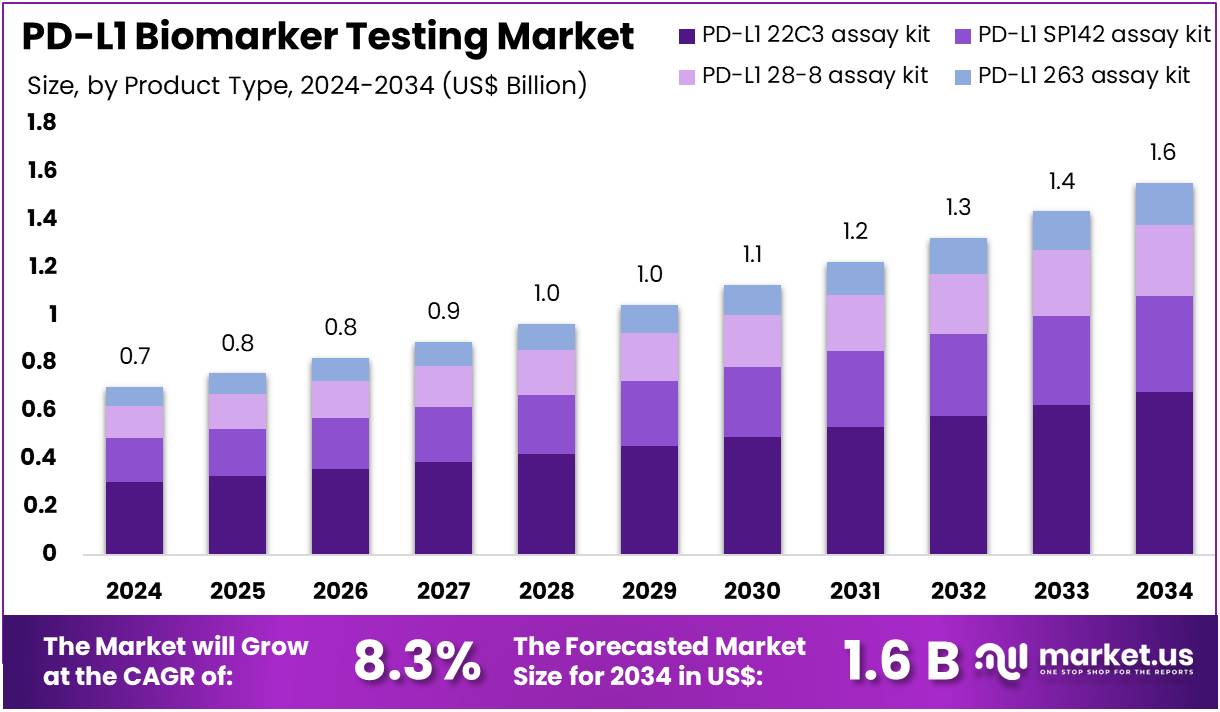
New York, NY – Aug 28, 2026 – The PD-L1 Biomarker Testing Market Size is expected to be worth around US$ 1.6 Billion by 2034 from US$ 0.7 Billion in 2024, growing at a CAGR of 8.3% during the forecast period 2025 to 2034. North America held a dominant market position, capturing more than a 41.4% share and holds US$ 0.3 Billion market value for the year.
PD-L1 biomarker testing plays a vital role in modern precision oncology by helping physicians identify cancer patients who are most likely to benefit from immune checkpoint inhibitor therapies. The test measures the expression of the programmed death-ligand 1 (PD-L1) protein in tumor cells or immune cells, enabling more personalized treatment decisions. It is widely used in the diagnosis and treatment planning for non-small cell lung cancer (NSCLC), melanoma, bladder cancer, head and neck cancer, triple-negative breast cancer, and several other solid tumors.
The growing global cancer burden continues to drive demand for PD-L1 biomarker testing. According to the World Health Organization (WHO), approximately 20 million new cancer cases and 9.7 million cancer-related deaths were recorded worldwide in 2022. The International Agency for Research on Cancer (IARC) projects that annual cancer cases could exceed 35 million by 2050, representing an increase of about 77% compared with 2022 levels. These trends are accelerating the adoption of biomarker-guided diagnostics.
PD-L1 testing is primarily performed using immunohistochemistry (IHC) assays, with companion diagnostic tests approved for multiple immunotherapy drugs. Continuous advancements in digital pathology, automated staining platforms, and artificial intelligence-assisted image analysis are improving test accuracy and workflow efficiency.
Increasing regulatory approvals for immunotherapies, expanding biomarker testing guidelines, and rising investments in precision medicine are expected to support sustained growth in the PD-L1 biomarker testing market over the coming years.
Key Takeaways
- In 2024, the global PD-L1 Biomarker Testing Market was valued at US$ 0.7 billion and is projected to reach US$ 1.6 billion by 2034, expanding at a CAGR of 8.3% during the forecast period.
- By product type, the market is segmented into PD-L1 22C3 assay kit, PD-L1 SP142 assay kit, PD-L1 28-8 assay kit, and PD-L1 263 assay kit. Among these, the PD-L1 22C3 assay kit dominated the market with a 43.7% share in 2023.
- Based on application, the market includes non-small cell lung cancer (NSCLC), renal cell carcinoma, ovarian cancer, melanoma, haematological malignancies, gastrointestinal tract malignancy, and others. The non-small cell lung cancer (NSCLC) segment accounted for the largest market share of 50.6%.
- By end user, the market is categorized into hospitals, cancer research institutes, diagnostic laboratories, and others. Hospitals emerged as the leading segment, capturing the highest revenue share of 47.4%.
- North America held the leading regional position in the market, accounting for 41.4% of the global market share in 2023.
Statistical Information
- Approximately 89% of patients with metastatic non-small cell lung cancer (mNSCLC) received PD-L1 testing in a 2025 U.S. community oncology study after combining structured records with NLP-based identification.
- The NLP algorithm used to identify undocumented PD-L1 tests achieved 89% sensitivity, 86% specificity, and an F1 score of 90%, improving capture of real-world testing.
- The same 2025 study identified an additional 313 PD-L1-tested patients from 541 patients lacking structured testing records, substantially improving real-world testing documentation.
- The 2025 IGNITE public dataset for AI-assisted PD-L1 biomarker development contains 887 fully annotated regions of interest collected from 155 unique NSCLC patients.
- The dataset supports 3 independent computational tasks: tissue segmentation, nuclei detection, and PD-L1-positive tumor cell detection, enabling the development of automated PD-L1 image analysis algorithms.
- The dataset includes 16 tissue classes covering both primary and metastatic NSCLC, providing quantitative training data for digital pathology systems evaluating PD-L1 expression.
- The 2025 IGNITE PD-L1 dataset was generated using images from multiple centers and multiple scanners, incorporating specimens from 155 patients to improve the robustness of AI-based PD-L1 detection algorithms across laboratories.
- The publicly released dataset includes 887 manually annotated image regions, making it one of the largest openly available resources specifically supporting quantitative PD-L1 biomarker algorithm development in 2025.
Regional Analysis
North America dominated the PD-L1 biomarker testing market with a 41.4% revenue share in 2024, supported by advanced oncology infrastructure, widespread adoption of companion diagnostics, and strong regulatory support. The region benefits from multiple FDA-approved PD-L1 assays, including PD-L1 IHC 22C3 pharmDx, 28-8 pharmDx, SP142, and SP263, which are widely used to guide immunotherapy decisions for cancers such as non-small cell lung cancer, urothelial carcinoma, and gastric cancer.
Continuous expansion of FDA-approved companion diagnostics and broad reimbursement coverage have increased routine PD-L1 testing across hospitals and diagnostic laboratories. The American Cancer Society estimated 2,001,140 new cancer cases in the U.S. during 2024, reinforcing demand for precision oncology testing.
Asia Pacific is expected to register the fastest CAGR during the forecast period due to rising cancer incidence, expanding molecular pathology infrastructure, and growing government investment in precision medicine. Countries including China, Japan, South Korea, and India are strengthening access to immunohistochemistry (IHC)-based PD-L1 testing through national cancer programs, laboratory modernization, and digital pathology initiatives.
Increasing adoption of biomarker-guided immunotherapy for lung, gastric, and esophageal cancers is further accelerating demand. According to the International Agency for Research on Cancer (IARC), Asia accounted for approximately 10 million new cancer cases in 2022, highlighting the substantial need for biomarker-driven cancer diagnostics across the region.
Emerging Trends
- Growth of companion diagnostic testing: PD-L1 testing is increasingly used as a companion diagnostic before immunotherapy. The U.S. FDA has authorized multiple PD-L1 companion diagnostic indications across cancers, including new approvals in 2026 for ovarian and esophageal cancers using PD-L1 IHC 22C3 and 28-8 assays. This trend is expanding precision oncology and improving patient selection.
- Standardization of PD-L1 testing methods: Healthcare organizations are promoting standardized testing to reduce result variability. The College of American Pathologists (CAP) guideline provides 6 evidence-based recommendations, encouraging laboratories to use validated immunohistochemistry (IHC) assays and standardized percentage scoring for better clinical decision-making in non-small cell lung cancer.
- Expansion of PD-L1 testing across multiple cancers: PD-L1 biomarker testing is no longer limited to lung cancer. Regulatory approvals now support its use in gastric, esophageal, cervical, ovarian, and several other solid tumors. FDA-authorized companion diagnostics continue expanding into new cancer types, increasing the number of patients eligible for personalized immunotherapy.
- Greater adoption of validated laboratory-developed tests (LDTs): Hospitals are increasingly using validated laboratory-developed PD-L1 assays where approved companion diagnostics are unavailable. CAP recommends that LDTs undergo proper technical validation against FDA-approved assays, improving testing access while maintaining quality and analytical performance across pathology laboratories.
- Digital pathology and AI supporting PD-L1 analysis: Research organizations are developing artificial intelligence tools to improve PD-L1 scoring accuracy. A 2025 publicly released NSCLC dataset includes 887 annotated regions of interest from 155 patients, supporting AI development for automated PD-L1-positive cell detection and standardized pathology workflows.
Use Cases
- Selecting patients for immunotherapy: PD-L1 testing identifies patients most likely to benefit from immune checkpoint inhibitors before treatment begins. FDA states companion diagnostics help determine whether patients are suitable for specific therapies, improving treatment effectiveness while avoiding unnecessary exposure to costly immunotherapies.
- Supporting treatment decisions in lung cancer: In advanced non-small cell lung cancer, pathologists report PD-L1 expression as a percentage score using validated IHC assays. CAP recommends combining PD-L1 testing with other genomic biomarkers to guide the selection of immune checkpoint inhibitor therapies and improve clinical outcomes.
- Companion diagnostics for multiple cancer therapies: PD-L1 assays such as 22C3, 28-8, SP142, and SP263 are used alongside approved immunotherapy drugs. FDA continues expanding approved companion diagnostic indications, enabling clinicians to match patients with targeted cancer treatments using validated biomarker results.
- Improving laboratory quality and reporting: Clinical laboratories use validated PD-L1 assays and standardized reporting practices to deliver consistent biomarker results. CAP recommends appropriate validation across specimen types and fixatives, helping laboratories improve reproducibility and reduce variability in routine cancer diagnostics.
- Developing AI-powered pathology solutions: Research institutions are using large annotated PD-L1 image datasets to train artificial intelligence models for automated tumor cell detection. The 2025 dataset containing 887 annotated regions from 155 patients supports faster analysis, improved consistency, and future digital pathology applications.
Frequently Asked Questions on PD-L1 Biomarker Testing
- Which cancers commonly require PD-L1 biomarker testing?
PD-L1 biomarker testing is widely used for non-small cell lung cancer, triple-negative breast cancer, urothelial carcinoma, cervical cancer, gastric cancer, esophageal cancer, and head and neck cancers. Regulatory approvals continue to expand the use of PD-L1 testing across additional oncology indications. - What factors are driving the PD-L1 biomarker testing market?
The market is growing due to increasing cancer incidence, rising adoption of precision medicine, expanding approvals for immunotherapy drugs, greater availability of companion diagnostics, and improvements in pathology laboratories. Government-supported cancer screening and research initiatives also contribute to market expansion worldwide. - What technologies are used in PD-L1 biomarker testing?
Most PD-L1 tests rely on immunohistochemistry (IHC), which detects PD-L1 protein in tumor tissue using specific antibodies. Digital pathology, automated staining platforms, artificial intelligence-assisted image analysis, and standardized scoring methods are improving testing accuracy, consistency, and laboratory efficiency. - What challenges affect the PD-L1 biomarker testing market?
Differences in testing assays, scoring systems, tissue sample quality, and interpretation can create variability in results. High testing costs, limited laboratory infrastructure in developing regions, and the need for trained pathologists remain important challenges for broader market adoption. - Which end users contribute most to the PD-L1 biomarker testing market?
Hospitals, cancer treatment centers, pathology laboratories, diagnostic laboratories, and academic research institutes are the primary end users. Pharmaceutical companies also contribute by developing companion diagnostics that support regulatory approval and clinical use of immunotherapy medicines. - What are the future opportunities in the PD-L1 biomarker testing market?
Future growth opportunities include AI-powered pathology, multiplex biomarker testing, integration with genomic sequencing, faster automated diagnostic platforms, and increasing demand for personalized oncology. Expanding healthcare infrastructure in emerging economies is also expected to create significant market opportunities. - How does PD-L1 biomarker testing support precision medicine?
PD-L1 testing enables personalized treatment by matching patients with therapies based on tumor biology instead of using the same treatment for everyone. This targeted approach improves treatment selection, enhances patient outcomes, and helps healthcare systems use oncology resources more efficiently. - What is the outlook for the global PD-L1 biomarker testing market?
The global PD-L1 biomarker testing market is expected to experience steady growth as cancer cases increase and immunotherapy becomes more widely adopted. Continuous regulatory approvals, technological innovations, and investments in companion diagnostics are likely to strengthen market demand over the coming years.
Conclusion
The PD-L1 biomarker testing market is entering a phase of consistent growth as biomarker-based treatment decisions become increasingly important in oncology. The expanding use of immunotherapies for lung, breast, gastric, and other cancers has increased the need for reliable PD-L1 testing before treatment initiation.
Technological innovations in immunohistochemistry, digital pathology, and laboratory automation are improving testing efficiency and reproducibility. Strong investments in precision diagnostics, supportive clinical guidelines, and increasing global cancer screening efforts will continue to drive long-term market expansion.
Discuss your needs with our analyst
Please share your requirements with more details so our analyst can check if they can solve your problem(s)




