
Overview
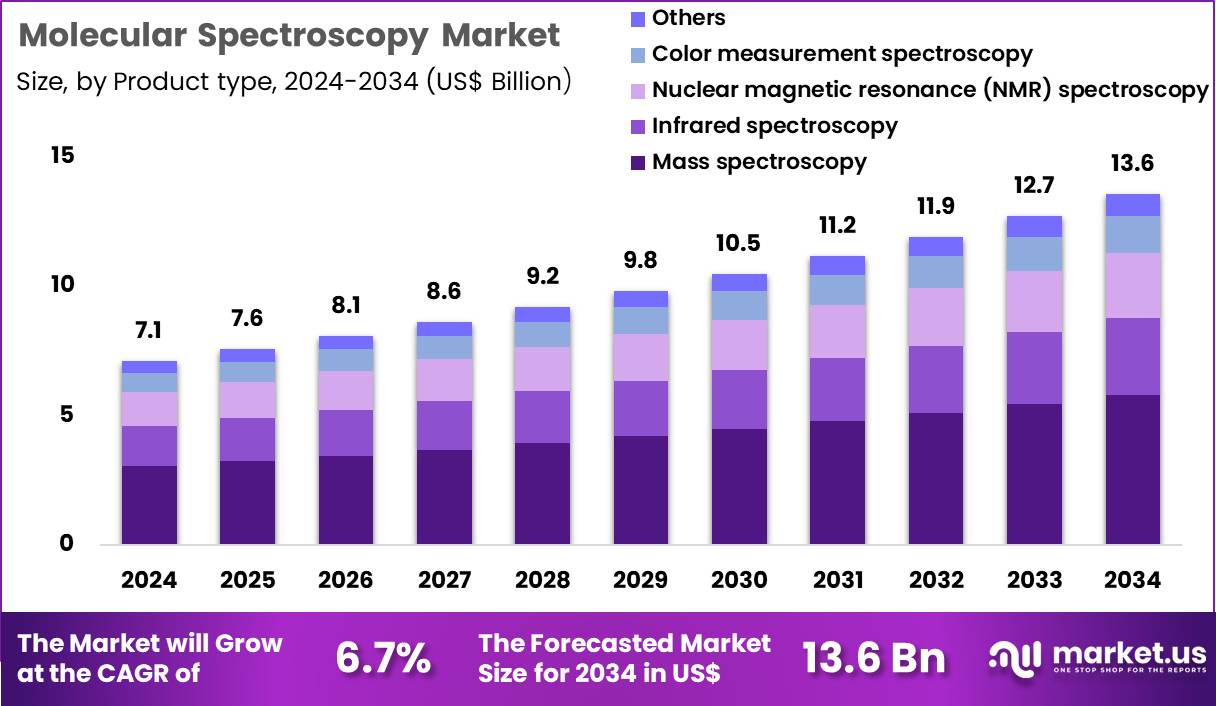
New York, NY – Oct 14, 2026 – Global Molecular Spectroscopy Market size is expected to be worth around US$ 13.6 Billion by 2034 from US$ 7.1 Billion in 2024, growing at a CAGR of 6.7% during the forecast period 2025 to 2034. In 2024, North America led the market, achieving over 38.5% share with a revenue of US$ 2.7 Billion.
Molecular spectroscopy is an analytical technique used to study the interaction of electromagnetic radiation with molecules. It provides valuable information about molecular structure, chemical composition, bonding, and energy levels. The technique is widely used across pharmaceutical, chemical, biotechnology, food and beverage, environmental, and materials science industries.
Molecular spectroscopy includes several techniques, such as infrared (IR) spectroscopy, Raman spectroscopy, ultraviolet-visible (UV-Vis) spectroscopy, nuclear magnetic resonance (NMR) spectroscopy, and microwave spectroscopy. Each technique examines different molecular properties, enabling researchers to identify substances, characterize chemical compounds, and monitor molecular interactions.
The growing adoption of molecular spectroscopy is driven by increasing demand for accurate analytical methods, rapid testing, quality control, and advanced research capabilities. Its applications include drug discovery and development, pharmaceutical quality assurance, chemical analysis, food safety testing, environmental monitoring, and the characterization of advanced materials.
Technological advancements, including automation, miniaturized instruments, improved detection systems, and artificial intelligence-enabled data analysis, are further enhancing the efficiency and accessibility of spectroscopic techniques. These developments are supporting faster analysis, improved measurement accuracy, and more reliable research outcomes.
As industries increasingly prioritize precision, efficiency, and data-driven decision-making, molecular spectroscopy is expected to remain an important analytical tool. Its expanding role in scientific research, industrial testing, and product development continues to create opportunities for innovation and technological advancement across multiple sectors.
Key Takeaways
- In 2024, the molecular spectroscopy market was valued at US$ 7.1 billion and is projected to grow at a CAGR of 6.7%, reaching US$ 13.6 billion by 2034.
- By product type, the market is segmented into mass spectroscopy, infrared spectroscopy, nuclear magnetic resonance (NMR) spectroscopy, color measurement spectroscopy, and others. Mass spectroscopy dominated the market, accounting for 42.7% of the total market share.
- By application, the market is categorized into pharmaceuticals, research institutes, food and beverage testing, biotechnology, and others. The pharmaceuticals segment led the market, capturing a revenue share of 46.8%.
- North America dominated the molecular spectroscopy market, accounting for a market share of 38.5%.
Key Market Segments
- Product Type Analysis: Mass spectroscopy dominated the product type segment, accounting for 42.7% of the market share. Its high sensitivity and accuracy support molecular identification, drug discovery, impurity analysis, and metabolite profiling. Technological advancements, automation, and integration with chromatography systems continue to strengthen adoption across pharmaceutical, clinical, environmental, and research laboratories.
- Application Analysis: The pharmaceuticals segment led the application category, accounting for 46.8% of the market share. Growing drug development activities, stringent regulatory requirements, and increasing quality control needs are driving adoption. Molecular spectroscopy supports compound identification, stability testing, impurity profiling, and formulation analysis, strengthening demand across pharmaceutical research and manufacturing operations.
Regional Analysis
North America Leads the Molecular Spectroscopy Market
North America accounted for 38.5% of the molecular spectroscopy market in 2024, driven by growing demand from pharmaceutical quality control, clinical research, and materials science. Pharmaceutical companies increasingly use spectroscopy for molecular characterization, impurity detection, and formulation analysis.
Investments in academic research, environmental testing, and advanced laboratory infrastructure further support regional growth. The U.S. National Institutes of Health reported research funding of US$ 47.5 billion in fiscal year 2023, supporting scientific research and analytical capabilities.
Asia Pacific Expected to Record the Highest CAGR
Asia Pacific is projected to register the highest CAGR during the forecast period, supported by expanding pharmaceutical manufacturing, research activities, and industrial testing. Government investments in scientific infrastructure and rising demand for food safety, environmental monitoring, and semiconductor testing are strengthening market opportunities.
China’s research and development expenditure exceeded US$ 440 billion in 2022, reflecting its growing research capacity. Increasing local instrument production and improved affordability are expected to accelerate adoption across the region.
Emerging Trends
- Growing use of spectroscopy in pharmaceutical quality testing: Near-infrared spectroscopy is increasingly important in pharmaceutical analysis because it can help verify drug identity, strength, quality, purity, and potency. The US Food and Drug Administration (FDA) provides guidance on developing and validating NIR analytical procedures for pharmaceutical products.
- Increasing adoption of AI-based spectral analysis: Advanced data analysis and machine learning are being explored to interpret complex molecular spectra more efficiently. These methods can help identify chemical patterns in biological samples, distinguish between sample types, and support the development of faster analytical and diagnostic workflows.
- Development of high-resolution molecular imaging: Infrared and Raman imaging are enabling researchers to examine the chemical composition of cells and tissues at increasingly detailed spatial scales. Newer approaches, including optical photothermal infrared spectroscopy, are expanding opportunities for studying proteins, lipids, nucleic acids, and other biological components.
- Expansion of non-invasive medical analysis: Raman and infrared spectroscopy are being investigated for analyzing biological samples without conventional chemical labels and, in some applications, without extensive sample preparation. Research is exploring their potential for disease assessment, biomarker identification, and tissue characterization, although routine clinical adoption still requires validation.
- Greater focus on instrument calibration and measurement reliability: As spectroscopy is used for more quantitative applications, calibration standards and performance validation are becoming increasingly important. The US National Institute of Standards and Technology (NIST) develops reference materials and methods that support reliable Raman and fluorescence measurements.
Use Cases
- Pharmaceutical manufacturing and quality control: Molecular spectroscopy is used to identify raw materials, examine drug composition, and assess product consistency. NIR spectroscopy can support pharmaceutical quality testing and process monitoring, helping manufacturers evaluate materials without relying entirely on slower, conventional laboratory methods.
- Medical research and disease assessment: Infrared and Raman techniques can examine the molecular composition of cells, tissues, and body fluids. Researchers are investigating their potential to identify biochemical changes associated with cancer, infectious diseases, and other health conditions.
- Food quality and authenticity testing: Spectroscopic analysis can help measure the chemical composition of food ingredients and agricultural products. Depending on the method and its validation, it can support assessments of moisture, fats, proteins, ingredient consistency, and potential adulteration.
- Environmental and chemical monitoring: Molecular spectroscopy can support the identification and measurement of selected chemical substances in environmental samples. Applications include laboratory investigations of pollutants, chemical composition, and water quality, subject to the sensitivity and selectivity of the chosen analytical method.
- Materials science and industrial research: Spectroscopic methods help characterize polymers, coatings, minerals, and other materials by examining their molecular structure and chemical bonds. This supports material identification, research into product properties, and the investigation of changes caused by manufacturing or aging.
Frequently Asked Questions About Molecular Spectroscopy
- What are the main types of molecular spectroscopy?
The main types include infrared spectroscopy, Raman spectroscopy, and near-infrared spectroscopy. Each technique measures different molecular responses to radiation, making it suitable for particular analytical tasks, including chemical identification, pharmaceutical testing, biological research, and material characterization. - How does molecular spectroscopy work?
Molecular spectroscopy measures the interaction between molecules and radiation, such as absorption or light scattering. The resulting spectrum contains characteristic signals that can be interpreted to identify substances, study molecular bonds, or estimate the concentration of selected chemical components. - What are the benefits of molecular spectroscopy?
Molecular spectroscopy can provide detailed chemical information, support rapid measurements, and reduce the need for extensive sample preparation in suitable applications. Some methods are non-destructive or label-free, allowing researchers to investigate samples while preserving material for further examination. - What factors affect the accuracy of molecular spectroscopy?
Accuracy depends on instrument calibration, sample quality, measurement conditions, spectral interference, and the analytical method used. Reliable results also require suitable reference materials, validated procedures, and appropriate data interpretation, particularly when measurements are used for regulated pharmaceutical or clinical applications. - What factors are driving the molecular spectroscopy market?
Market demand is supported by the need for reliable chemical identification, pharmaceutical quality testing, advanced biological research, and improved analytical efficiency. Regulatory guidance for pharmaceutical NIR procedures also supports the use of spectroscopy in appropriate quality assessment applications. - Which technologies are important in the molecular spectroscopy market?
Infrared, Raman, and near-infrared spectroscopy are important technologies, each offering different analytical capabilities. Their selection depends on sample characteristics, required sensitivity, measurement speed, operating conditions, and whether the application involves routine quality testing or specialized scientific research. - What is the future outlook for the molecular spectroscopy market?
Future opportunities are linked to advances in molecular imaging, automated spectral analysis, pharmaceutical process monitoring, and biomedical research. Wider clinical use will depend on reliable performance, standardized procedures, suitable instrument costs, and evidence demonstrating practical benefits in real-world settings.
Conclusion
The molecular spectroscopy market is poised for steady growth, driven by increasing demand for accurate analytical techniques, pharmaceutical quality control, and advanced scientific research. Valued at US$ 7.1 billion in 2024, the market is projected to reach US$ 13.6 billion by 2034, growing at a CAGR of 6.7%. North America currently leads the market, while Asia Pacific is expected to experience the fastest growth.
Technological advancements in automation, artificial intelligence, miniaturized instruments, and molecular imaging are further expanding applications. Continued innovation and rising investments in healthcare, biotechnology, and industrial research are expected to create significant growth opportunities.
Discuss your needs with our analyst
Please share your requirements with more details so our analyst can check if they can solve your problem(s)