


Overview
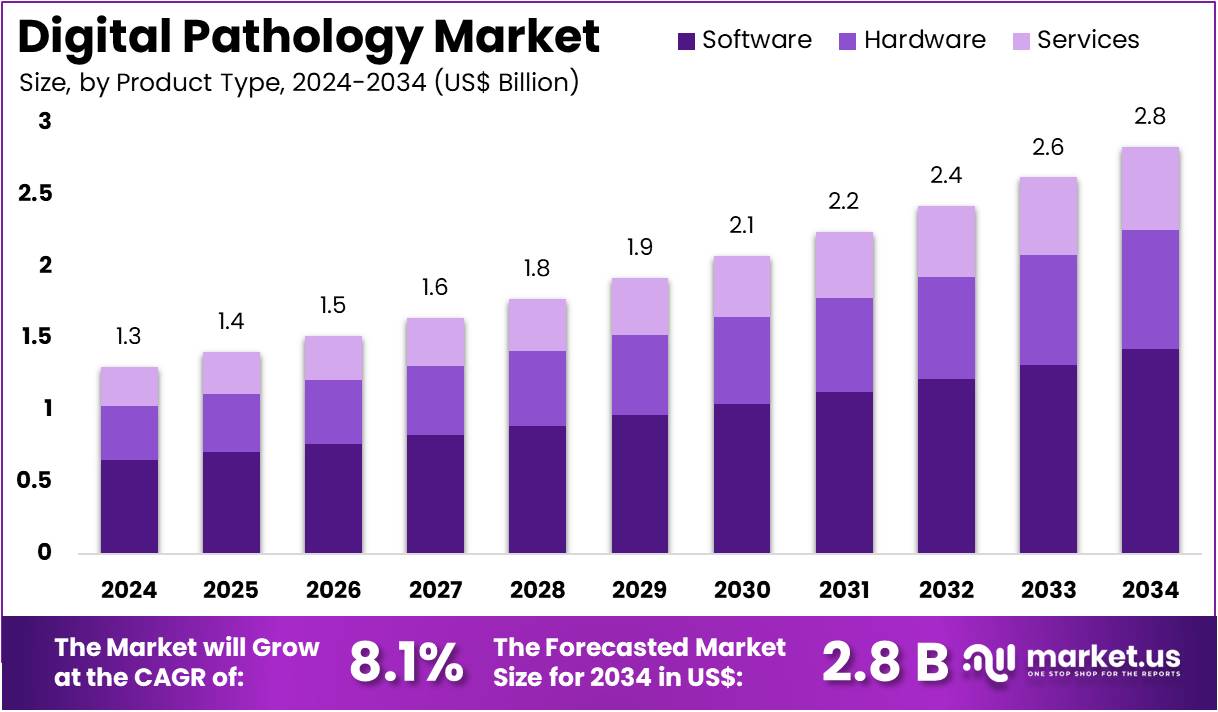
New York, NY – July 09, 2026 – Global Digital Pathology Market size is expected to be worth around US$ 2.8 Billion by 2034 from US$ 1.3 Billion in 2024, growing at a CAGR of 8.1% during the forecast period 2025 to 2034.
Digital pathology is an advanced technology that converts traditional glass pathology slides into high-resolution digital images for viewing, analysis, storage, and sharing. By using whole-slide imaging scanners, pathology laboratories can create accurate digital records that support efficient diagnosis and collaboration among healthcare professionals.
This technology allows pathologists to examine tissue samples on computer screens instead of using conventional microscopes. Digital pathology can improve workflow efficiency by reducing the time required to retrieve, review, and share slides. It also enables remote consultation, allowing specialists in different locations to provide second opinions quickly and effectively.
In addition to diagnostic applications, digital pathology supports medical education, research, and quality assurance. The ability to store and analyze large volumes of image data helps researchers identify patterns and develop new insights into disease progression. Integration with artificial intelligence and image analysis tools further enhances the potential for improved diagnostic accuracy and decision support.
The growing adoption of digital pathology is driven by increasing demand for faster diagnostic services, advancements in imaging technology, and the need for more efficient healthcare systems. As healthcare organizations continue to modernize their pathology workflows, digital pathology is expected to play an important role in improving patient care and enabling more connected and data-driven diagnostic practices.
Key Takeaways
- In 2024, the digital pathology market generated revenue of US$ 1.3 billion and is projected to reach US$ 2.8 billion by 2034, growing at a CAGR of 8.1%.
- By product type, the market is segmented into software, hardware, and services. The software segment led the market in 2023, accounting for 50.3% of the market share.
- Based on technology, the market is categorized into whole slide imaging, virtual microscopy, and artificial intelligence. Among these, whole slide imaging held the largest share, representing 55.6% of the market.
- By application, the market is divided into disease diagnosis, research and development, and education. The disease diagnosis segment dominated the market with the highest revenue share of 58.8%.
- In terms of end users, the market includes hospitals, diagnostic laboratories, and research institutes. The hospitals segment led the market, contributing 44.5% of total revenue.
- Regionally, North America held the leading position in 2023, capturing 40.8% of the global market share.
Regional Analysis
North America leads the digital pathology market, accounting for 40.8% of global revenue in 2023. The region’s dominance is driven by the increasing adoption of whole slide imaging (WSI) for primary diagnosis, the expansion of telepathology services, and the integration of artificial intelligence (AI) to improve diagnostic accuracy.
The rising incidence of cancer and other complex diseases has further increased the need for faster and more precise pathology services. Digital pathology enhances collaboration among pathologists, supports remote consultations, and streamlines laboratory workflows, thereby improving healthcare efficiency.
The region also benefits from strong investments by major diagnostics companies. For example, Roche’s Diagnostics Division reported sales growth of 4% in 2024, while Danaher’s Diagnostics segment recorded continued growth in advanced diagnostic tools. Additionally, the high burden of cancer in the United States continues to support demand for innovative diagnostic technologies.
Asia Pacific is expected to register the highest CAGR during the forecast period. This growth is attributed to the region’s large aging population, increasing prevalence of chronic diseases, rising healthcare expenditure, and government initiatives promoting digital health infrastructure. Countries such as China, India, Japan, and Australia are investing in healthcare modernization, creating significant opportunities for digital pathology adoption.
Emerging Trends
- AI Integration in Digital Pathology: Artificial intelligence and machine learning are transforming digital pathology by improving the speed and accuracy of image analysis. AI algorithms can identify patterns, detect abnormalities, and assist pathologists in diagnosing diseases such as cancer with greater precision and efficiency.
- Advancements in Imaging Technology: Advancements in imaging technology enable digital pathology systems to produce high-resolution scans of tissue slides. These detailed digital images improve visualization, enhance diagnostic accuracy, and allow pathologists to examine tissue samples more efficiently than traditional microscope-based methods.
- Enhancing Accessibility and Collaboration: Digital pathology enhances accessibility by enabling pathologists to share digital slides with specialists worldwide. This capability supports collaborative diagnosis, improves access to expert consultations in underserved regions, and contributes to better patient care through collective medical expertise.
- Optimizing Laboratory Workflow: The adoption of digital pathology systems streamlines laboratory operations by reducing manual slide handling and simplifying case management. These improvements decrease turnaround times, lower storage requirements, and enhance overall operational efficiency in pathology laboratories.
- Regulatory and Billing Progress: Regulatory advancements and the introduction of dedicated billing codes are supporting the wider adoption of digital pathology. These developments ensure appropriate reimbursement for digital pathology services and facilitate their integration into mainstream healthcare systems.
Use Cases
- Remote Diagnostics: Digital pathology enables remote diagnosis by allowing pathologists to review digital slides from any location. This capability expands access to specialist expertise, particularly in remote or underserved areas, and ensures timely and accurate disease diagnosis.
- Educational Tools: Digital pathology serves as a valuable educational tool by providing students and trainees access to a wide range of pathological cases. Interactive digital slides support detailed case analysis and enhance the quality of medical training.
- Quantitative Analysis: Artificial intelligence enhances digital pathology by enabling quantitative analysis of tissue samples, including cell counting and tumor marker measurement. These capabilities support personalized treatment planning and provide clinicians with accurate data for improved decision-making.
- Cancer Research and Diagnosis: Digital pathology plays a crucial role in cancer research and diagnosis by enabling detailed examination of tumor samples. This technology supports the development of targeted therapies and improves the accuracy and efficiency of cancer diagnosis.
- Integration with Molecular Pathology: The integration of digital pathology with molecular pathology combines structural and molecular data to provide a comprehensive understanding of disease mechanisms. This approach enhances diagnostic accuracy and supports research into complex diseases, including cancer.
Frequently Asked Questions on Digital Pathology
- How does digital pathology work?
Digital pathology works by using a whole-slide imaging scanner to capture detailed digital images of tissue samples. Pathologists can then examine these images on computer screens, apply image analysis tools, and share findings with colleagues remotely. - What are the advantages of digital pathology?
The advantages of digital pathology include faster diagnosis, improved workflow efficiency, easier slide storage, enhanced collaboration among healthcare professionals, and the ability to use advanced image analysis and artificial intelligence for diagnostic support. - What is whole-slide imaging?
Whole-slide imaging is a technology used in digital pathology to scan an entire glass slide at high resolution. The resulting digital image can be viewed, zoomed, analyzed, and shared electronically for diagnostic and research purposes. - How is artificial intelligence used in digital pathology?
Artificial intelligence in digital pathology helps analyze tissue images by identifying patterns, detecting abnormalities, and assisting pathologists in diagnosis. AI tools can improve accuracy, reduce interpretation time, and support decision-making in complex cases. - Is digital pathology used for remote diagnosis?
Yes, digital pathology enables remote diagnosis by allowing pathologists to access and review digital slides from different locations. This capability supports telepathology services, improves access to specialist expertise, and facilitates faster consultation in urgent cases. - What is the future of digital pathology?
The future of digital pathology is expected to involve greater integration of artificial intelligence, cloud-based platforms, and advanced image analytics. These developments will likely enhance diagnostic precision, improve efficiency, and expand remote pathology services. - Which regions are leading the digital pathology market?
North America currently leads the digital pathology market due to advanced healthcare infrastructure, high adoption of digital technologies, and significant investment in research. Europe and Asia-Pacific are also experiencing substantial market growth. - How is telepathology influencing the digital pathology market?
Telepathology is influencing the digital pathology market by enabling remote consultation and diagnosis. This capability increases access to pathology expertise, supports underserved regions, and helps healthcare providers deliver timely diagnostic services.
Conclusion
Digital pathology is transforming diagnostic healthcare by replacing traditional glass slide analysis with high-resolution digital imaging. Its ability to improve workflow efficiency, enable remote consultation, and support AI-driven image analysis makes it a valuable tool for modern pathology laboratories.
The market is expected to grow steadily due to increasing demand for faster and more accurate diagnostic services, advancements in imaging technology, and expanding digital healthcare infrastructure. North America currently leads the market, while Asia Pacific is projected to experience the highest growth. Overall, digital pathology is expected to enhance diagnostic precision, improve patient care, and support more connected, data-driven healthcare practices worldwide.
Discuss your needs with our analyst
Please share your requirements with more details so our analyst can check if they can solve your problem(s)




