
Overview
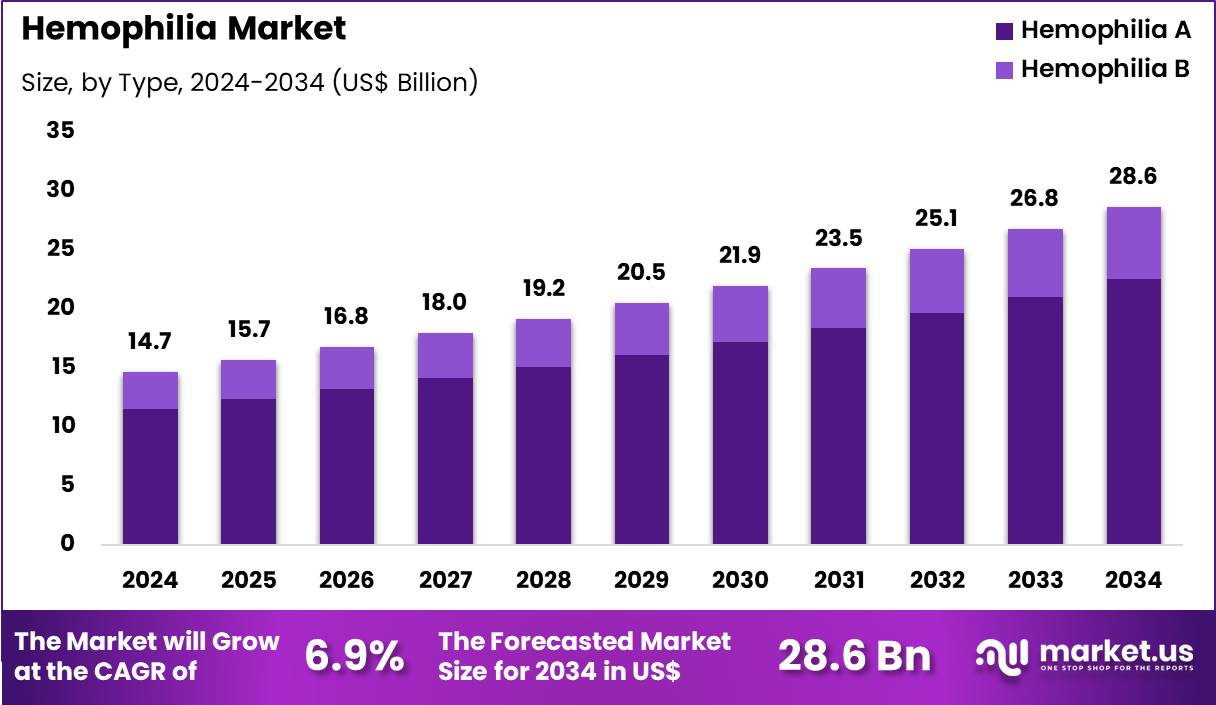
New York, NY – Oct 14, 2026 – The Global Hemophilia Market size is expected to be worth around US$ 28.6 Billion by 2034 from US$ 14.7 Billion in 2024, growing at a CAGR of 6.9% during the forecast period 2025 to 2034. In 2024, North America led the market, achieving over 40.7% share with a revenue of US$ 6.0 Billion.
Hemophilia is a rare, inherited bleeding disorder in which the blood does not clot properly due to a deficiency or absence of specific clotting factors. The condition can lead to prolonged bleeding following injuries, surgery, or dental procedures and, in severe cases, spontaneous bleeding into joints and muscles.
The two most common types are Hemophilia A, caused by a deficiency of clotting factor VIII, and Hemophilia B, caused by a deficiency of clotting factor IX. The condition primarily affects males, while females are often carriers, although they may also experience bleeding symptoms.
Common symptoms include frequent bruising, prolonged bleeding, nosebleeds, and pain or swelling in the joints due to internal bleeding. If left untreated, recurrent bleeding can cause permanent joint damage and other serious complications.
Although hemophilia is a lifelong condition, advances in medical care have significantly improved its management. Treatment options include replacement therapy with the missing clotting factor, non-factor therapies, and other preventive treatments designed to reduce bleeding episodes. Early diagnosis, regular medical monitoring, and appropriate treatment are essential for improving quality of life and preventing complications.
Raising awareness about hemophilia is important to encourage timely diagnosis, improve access to specialized care, and promote better understanding of the challenges faced by affected individuals and their families. Continued research and advances in treatment offer opportunities for improved long-term outcomes.
Key Takeaways
- In 2024, the hemophilia market generated revenue of US$ 14.7 billion and is projected to reach US$ 28.6 billion by 2034, growing at a CAGR of 6.9%.
- By type, the market is segmented into hemophilia A and hemophilia B, with hemophilia A dominating the market with a 78.6% share.
- By treatment type, the market is categorized into on-demand and prophylaxis, with on-demand treatment accounting for 57.2% of the market share.
- By therapy, the market is divided into factor replacement therapy, gene therapy, and non-factor replacement therapy, with factor replacement therapy leading with a 61.9% revenue share.
- By distribution channel, the market is segmented into specialty treatment centers, hospitals, retail pharmacies, and others, with specialty treatment centers holding the largest revenue share at 49.5%.
- Regionally, North America dominated the hemophilia market, accounting for a 40.7% market share.
Key Market Segments
- Type Analysis: Hemophilia A dominated the type segment with a 78.6% market share, driven by its higher prevalence, established diagnostic methods, and well-defined treatment pathways. Long-term therapy requirements, improved patient awareness, extended half-life products, and broader treatment access are expected to support continued segment leadership.
- Treatment Type Analysis: On-demand treatment held a 57.2% market share, supported by its widespread use for managing acute bleeding episodes, lower initial treatment requirements, and flexible administration. Limited access to prophylaxis and cost considerations across developing regions further contribute to adoption, supporting the segment’s continued market presence.
- Therapy Analysis: Factor replacement therapy accounted for 61.9% of the market, supported by established clinical guidelines, proven efficacy, and widespread use in preventing and controlling bleeding episodes. Improved product safety, extended half-life formulations, and established treatment practices are expected to sustain demand and segment leadership.
- Distribution Channel Analysis: Specialty treatment centers captured 49.5% of the market, driven by specialized hematology services, multidisciplinary care, advanced diagnostics, and individualized treatment planning. Patient education, home infusion training, and access to advanced therapies further strengthen their role, supporting continued dominance in hemophilia treatment delivery.
Regional Analysis
North America Hemophilia Market Analysis
In 2024, North America accounted for 40.7% of the global hemophilia market, supported by advanced healthcare infrastructure, innovative therapies, and improved patient management. The adoption of recombinant clotting factors, extended half-life products, and gene therapies has enhanced treatment options and reduced infusion frequency.
Increased use of prophylactic treatment, comprehensive patient registries, and multidisciplinary specialty centers has further strengthened disease management. Regulatory approvals and growing awareness have improved access to innovative therapies, including treatments for patients with inhibitors. According to the US Centers for Disease Control and Prevention (CDC), approximately 33,000 males in the United States are living with hemophilia.
Asia Pacific Hemophilia Market Analysis
The Asia Pacific region is expected to record the highest CAGR during the forecast period, driven by improved diagnosis, expanding healthcare infrastructure, and increasing access to hemophilia treatments. Government initiatives, public healthcare funding, and growing awareness are supporting earlier diagnosis and treatment adoption.
Investments in recombinant clotting factors, extended half-life therapies, and local manufacturing are expected to improve affordability and accessibility. The World Federation of Hemophilia reported 36,209 identified hemophilia patients in China in 2024, highlighting the region’s growing demand for specialized care.
Emerging Trends
- Growing adoption of gene therapy: Gene therapy is emerging as an alternative to repeated clotting-factor treatment for eligible patients. The FDA approved Hemgenix for certain adults with hemophilia B in 2022 and Roctavian for eligible adults with severe hemophilia A in 2023. These treatments aim to increase the body’s production of clotting factors, although treatment response and long-term durability can vary.
- Shift toward non-factor preventive medicines: Treatment options are expanding beyond direct replacement of missing clotting factors. Emicizumab, for example, helps replace the function of factor VIII and can be administered under the skin. Such options can reduce treatment burden and support preventive care for suitable patients with hemophilia A.
- Continued development of advanced factor therapies: Recombinant factor VIII and factor IX products remain important treatment options. Research and product development are focused on improving the duration of protection, reducing infusion frequency, and managing bleeding more effectively. These developments can support better treatment adherence and expand options for patients who are not suitable for gene therapy.
- Greater focus on early diagnosis and patient identification: Improved diagnosis is an important market development area because undetected cases can delay access to treatment. The WFH’s 2022 registry report included 11,374 people with hemophilia across 115 treatment centres in 44 countries. The report also highlighted differences in diagnosis and care between income groups.
- Increasing emphasis on long-term outcomes and access to care: Treatment decisions are increasingly concerned with joint health, daily functioning, bleeding prevention, and long-term safety. However, access remains uneven. In the WFH’s 2022 registry, only 30% of adults and 32% of children with severe hemophilia received preventive treatment. This gap highlights the need for wider access to care.
Use Cases
- Prevention of recurrent bleeding: Preventive treatment, also called prophylaxis, is used to reduce the frequency of bleeding episodes in people with hemophilia. Factor replacement products and suitable non-factor medicines can help lower the risk of spontaneous bleeding and related complications.
- Treatment of active bleeding episodes: Clotting-factor concentrates and other appropriate medicines are used to control bleeding after injuries, during spontaneous bleeding episodes, or around certain medical procedures. Prompt treatment is important for reducing complications, particularly when bleeding affects joints, muscles, or internal organs.
- Long-term treatment through gene therapy: Gene therapy may be considered for eligible adults with specific forms of hemophilia. Hemgenix and Roctavian are examples of approved treatments in the United States. Patient selection, safety monitoring, treatment response, and the possibility of reduced effectiveness over time are important considerations.
- Diagnosis and monitoring of treatment complications: Blood tests help identify clotting-factor deficiencies and assess disease severity. Additional testing can identify inhibitors, which are antibodies that interfere with clotting-factor treatment. These services support treatment selection, ongoing monitoring, and changes in care when a medicine becomes less effective.
- Joint protection and rehabilitation: Physiotherapy, safe physical activity, and regular joint assessments help people with hemophilia maintain movement and muscle strength. These services are particularly important for patients with repeated joint bleeding, which can cause lasting damage and reduce mobility.
Frequently Asked Questions About Hemophilia
- What are the main types of hemophilia?
The two main types are hemophilia A and hemophilia B. Hemophilia A results from low levels of clotting factor VIII, while hemophilia B results from low levels of factor IX. Hemophilia A is approximately three to four times more common. - What are the common symptoms of hemophilia?
Common symptoms include prolonged bleeding after injuries or dental procedures, easy bruising, and pain or swelling caused by bleeding into joints. Severe cases may involve spontaneous bleeding or dangerous internal bleeding that requires urgent medical attention. - How is hemophilia treated?
Hemophilia treatment depends on the type and severity of the condition. Options include clotting-factor replacement, preventive medicines, and gene therapy for selected patients. Treatment aims to prevent bleeding, control active episodes, and reduce long-term complications. - What factors are driving the hemophilia market?
Market demand is supported by the need for preventive treatment, improved diagnosis, advanced clotting-factor products, and newer therapies. Greater patient identification and efforts to reduce bleeding-related complications are also increasing the importance of effective hemophilia care. - What challenges affect the growth of the hemophilia market?
Market development is affected by high treatment costs, unequal access to specialist care, delayed diagnosis, and differences in treatment availability. Gene therapy also requires careful patient selection and follow-up, while some patients develop inhibitors that reduce the effectiveness of factor replacement. - What is the role of early diagnosis in the hemophilia market?
Early diagnosis enables patients to receive suitable treatment before repeated bleeding causes serious complications. Better identification also supports accurate patient records, treatment planning, and healthcare resource allocation, particularly in regions where access to specialist services remains limited. - What opportunities exist in emerging hemophilia markets?
Opportunities include expanding access to diagnostic testing, strengthening specialist treatment centres, improving preventive care, and increasing the availability of suitable medicines. These areas are particularly relevant in countries where many patients remain undiagnosed or lack regular access to treatment.
Conclusion
The hemophilia market is expected to experience steady growth, supported by advances in treatment technologies, increasing disease awareness, and improved access to specialized healthcare services. Hemophilia A and factor replacement therapy continue to account for significant market shares, while gene therapy and non-factor treatments are expanding treatment options.
North America remains a leading regional market, whereas Asia Pacific offers opportunities through improved diagnosis, healthcare infrastructure, and treatment accessibility. However, high treatment costs and unequal access to care remain key challenges. Continued research, early diagnosis, and patient-focused treatment strategies will be essential for improving outcomes and supporting long-term market development.
Discuss your needs with our analyst
Please share your requirements with more details so our analyst can check if they can solve your problem(s)