


Overview
The Global Patient Identification Wristbands Market size is expected to reach around US$ 5.78 Billion by 2034, up from US$ 1.75 Billion in 2024, growing at a CAGR of 12.7% during the forecast period 2025 to 2034. In 2024, North America led the market, achieving over 38.9% market share with revenue of US$ 680.8 Million.
Patient Identification Wristbands are gaining significant attention as healthcare providers increasingly prioritize patient safety, error prevention, and digital identification systems. Patient identification wristbands are widely used in hospitals, emergency departments, laboratories, and ambulatory care centers to ensure accurate patient verification during medication administration, diagnostics, surgery, and discharge processes. The market growth is supported by rising hospital admissions, increasing healthcare expenditure, and the adoption of barcode and RFID-based identification technologies.
According to the World Health Organization (WHO), unsafe healthcare practices result in millions of patient harm incidents globally each year, with medication errors and patient misidentification being major contributors. Studies published through healthcare safety programs indicate that implementing barcode-based patient identification systems can reduce medication administration errors by more than 40%–50% in hospital settings by enabling real-time verification before clinical procedures.
The increasing demand for hospital services is creating strong opportunities for identification solutions. The United States reported approximately 33 million hospital admissions in 2022, according to national healthcare statistics, requiring efficient patient tracking and identification processes. Additionally, the Centers for Medicare & Medicaid Services (CMS) reported that U.S. national healthcare expenditure reached around $4.9 trillion in 2023, representing nearly 17.6% of GDP, reflecting continued investment in healthcare infrastructure and safety technologies.
Barcode wristbands currently represent a widely adopted solution due to their low cost and compatibility with electronic health record (EHR) platforms. RFID-enabled wristbands are gaining momentum because they provide real-time location tracking, automated data capture, and improved workflow efficiency. Hospitals are also adopting antimicrobial and tamper-resistant wristbands to enhance infection control and patient security.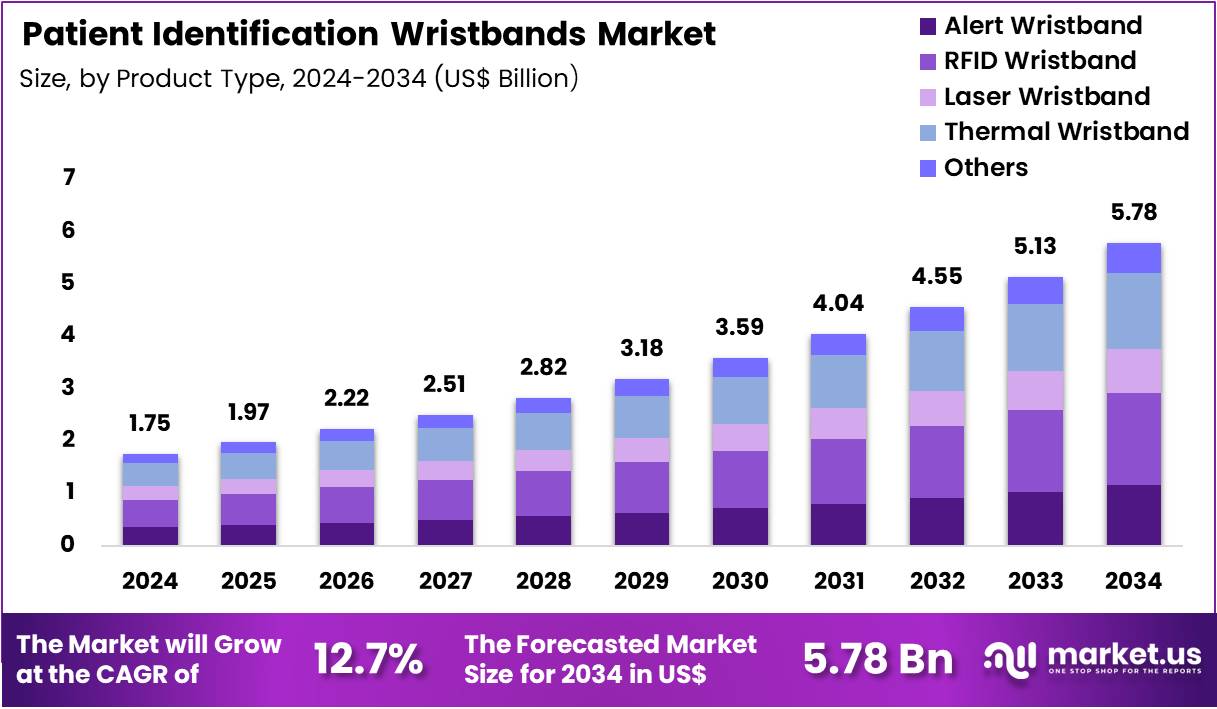
Key Takeaways
- In 2024, the Patient Identification Wristbands Market generated revenue of US$ 1.75 billion and is projected to grow at a CAGR of 12.7%, reaching approximately US$ 5.78 billion by 2034.
- Based on Product Type, the market is segmented into Alert Wristbands, RFID Wristbands, Laser Wristbands, Thermal Wristbands, and Others. Among these, RFID Wristbands dominated the market in 2024, accounting for a 30.5% market share.
- Based on Material Type, the market is categorized into Vinyl, Tyvek, Synthetic, Trilaminate, and Non-tear Paper. The Vinyl segment held the leading position in 2024, capturing a 38.8% market share.
- Based on End User, the market is segmented into Hospitals (Inpatient Care), Specialty Clinics, Ambulatory Surgical Centers (Outpatient Surgery), Long-term Care Centers, Rehabilitation Centers, and Others. Hospitals led the market in 2024 with a 58.9% market share due to the high adoption of patient identification solutions in inpatient settings.
- Regionally, North America dominated the Patient Identification Wristbands Market in 2024, accounting for a 38.9% market share, supported by advanced healthcare infrastructure, increasing adoption of digital patient safety systems, and widespread use of barcode and RFID technologies.
Market Segmentation Overview
- Product Type Analysis: RFID wristbands dominate the patient identification wristbands market with a 30.5% share in 2024 due to digital healthcare adoption and improved safety features. Other product types, including alert and laser wristbands, continue to support demand through visual identification, barcode integration, and efficient patient data management across hospitals, clinics, and surgical facilities.
- Material Type Analysis: Vinyl wristbands lead the material segment with a 38.8% share in 2024 due to their durability, waterproof properties, and suitability for extended hospital stays. Other materials, including Tyvek, synthetic, and trilaminate wristbands, contribute to market growth through lightweight designs, flexibility, resistance to sanitization, and reliable identification performance.
- End-User Analysis: Hospitals represent the largest end-user segment with a 58.9% share in 2024 due to high patient admissions and strict safety requirements. Specialty clinics, ambulatory surgical centers, and long-term care facilities are also increasing adoption as patient verification, workflow efficiency, and safety monitoring become more important across healthcare settings.
Statistical Information
- Barcode Wristbands Reduce Medication Errors in Hospitals: A study conducted in a 735-bed hospital found that barcode technology reduced medication dispensing errors by 85%, decreasing errors from 0.37% to 0.06%. The system was estimated to prevent nearly 13,000 dispensing errors and 6,000 potential adverse drug events annually when applied across medication workflows.
- Barcode Medication Administration Improves ICU Patient Safety: A clinical study involving 1,465 medication administrations among 92 ICU patients found that barcode-assisted medication administration reduced medication errors by 56%, decreasing error rates from 19.7% to 8.7% after implementation.
- Electronic Wristband Identification Supports Safer Medication Processes: A hospital study analyzing 14,041 medication administrations showed barcode electronic medication administration reduced non-timing medication errors by 41.4%, lowering error rates from 11.5% to 6.8%. Potential adverse drug events related to these errors declined by approximately 50.8%.
- Barcode Systems Reduce Harmful Medication Errors: A healthcare implementation study covering medication administration data from 2007 to 2013 found that barcode medication administration reduced reported medication administration errors by 43.5%. Harmful medication errors declined from 0.65 per 100,000 medications to 0.29 per 100,000 medications after implementation.
- Hospitals Require Accurate Wristband Information for Patient Verification: A College of American Pathologists study reviewed 451,436 wristband checks across 204 hospitals and reported a 5.7% wristband error rate. Errors included missing wristbands, incorrect information, and unreadable identifiers, highlighting the need for durable and accurate wristband solutions.
- Barcode Technology Improves Accuracy Across Medication Workflows: In a hospital pharmacy evaluation, barcode implementation reduced dispensing errors by 85% and reduced potential adverse drug events by 63%. The study estimated that a large hospital dispensing 6 million medication doses annually could avoid thousands of preventable medication-related incidents.
- Barcode Wristbands Reduce Hospital Medication Errors: A meta-analysis of 14 studies involving 483 patients/cases found that barcode-enabled wristband medication scanning reduced medical errors by 57.5% in hospital settings. The study supports barcode wristbands as an effective tool for improving patient identification and medication safety.
- Wristband Identification Errors Affect Hospital Safety: A College of American Pathologists study evaluated 451,436 wristband checks across 204 hospitals and identified 25,800 wristband errors, representing a 5.7% overall error rate. Missing wristbands accounted for 64.6% of errors, highlighting the importance of reliable patient identification systems.
- Continuous Monitoring Improves Wristband Accuracy: The CAP Q-Tracks study analyzed 1,757,730 wristbands across 217 healthcare institutions over two years. The average wristband error rate decreased from 7.40% to 3.05%, showing that continuous monitoring and quality improvement programs can significantly improve patient identification accuracy.
- Hospitals Use Wristbands for Multiple Patient Safety Applications: A hospital-based evaluation of 385 inpatient cases found that 95.8% of patients had identification wristbands, while 83.9% had correctly identified wristbands according to hospital standards. Around 11.9% had identification errors, including missing information, illegibility, or incorrect identifiers.
Regional Analysis
North America led the market by securing a market share of 38.9% in 2024.
North America holds a strong position due to advanced healthcare infrastructure, widespread adoption of electronic health records, and strict patient safety practices. The United States healthcare system emphasizes accurate patient identification through barcode scanning, electronic medication administration records, and standardized safety protocols.
Organizations such as The Joint Commission recommend using at least two patient identifiers before care delivery, supporting demand for reliable wristband solutions. High hospital admissions, surgical procedures, and investments in healthcare IT continue to drive adoption across hospitals and specialty care centers. Asia Pacific is witnessing increasing adoption of patient identification wristbands due to healthcare modernization, expanding hospital networks, and digital transformation initiatives.
Countries including Japan, China, South Korea, and Australia are implementing electronic healthcare systems and automated identification technologies. Rising healthcare access, growing surgical procedures, and increasing focus on patient safety are encouraging hospitals to adopt barcode and RFID-enabled wristbands for efficient clinical workflows.
Business Opportunities
The Patient Identification Wristbands Market offers significant business opportunities due to increasing healthcare digitalization, patient safety requirements, and adoption of automated identification systems. Hospitals are investing in barcode-enabled and RFID wristbands to improve medication administration accuracy, specimen tracking, and clinical workflow efficiency.
Growing demand for electronic health records and connected hospital infrastructure creates opportunities for companies providing smart wristband solutions integrated with healthcare IT platforms. Expansion of ambulatory surgical centers, specialty clinics, and long-term care facilities further supports demand for cost-effective identification products.
Opportunities are also increasing in developing healthcare systems where hospitals are upgrading patient safety processes. Manufacturers focusing on durable, waterproof, antimicrobial, and customizable wristbands can address diverse clinical needs. Integration of advanced technologies such as RFID tracking, near-field communication, and real-time location systems may create new growth avenues for healthcare identification providers.
Emerging Trends
- Growing Adoption of RFID and Barcode Wristbands: Hospitals are increasingly implementing RFID and barcode-enabled wristbands to improve patient identification accuracy, medication verification, and workflow efficiency. A meta-analysis of 14 studies found barcode systems reduced medication errors by 57.5%, supporting wider adoption of automated identification technologies.
- Integration With Electronic Health Records (EHRs): Patient wristbands are increasingly connected with electronic health systems to enable real-time access to patient information. RFID-based healthcare systems help link patient identity data with hospital databases, supporting faster clinical decisions and reducing manual documentation errors.
- Expansion of Closed-Loop Medication Administration: Healthcare facilities are using barcode wristbands as part of closed-loop medication systems, where nurses verify patients before drug administration. Studies show barcode medication systems can significantly reduce administration errors and improve medication safety practices.
- Increasing Demand for Durable and Antimicrobial Wristbands: Hospitals are focusing on wristbands that resist water, chemicals, and frequent cleaning procedures. A study involving 451,436 wristband checks across 204 hospitals identified a 5.7% wristband error rate, highlighting the need for improved durability and readability.
- Use of RFID Wristbands for Real-Time Location Tracking: Healthcare providers are adopting RFID-enabled wristbands for patient movement monitoring, emergency identification, and infant security applications. These systems improve tracking capabilities in critical care, neonatal units, and high-risk hospital environments.
Use Cases
- Medication Administration Safety: Barcode-enabled wristbands are widely used in hospitals to verify patient identity before medication delivery. Nurses scan wristbands and medications to ensure correct patient matching. Studies show barcode medication systems can reduce medication errors by approximately 57.5%, improving treatment accuracy.
- Patient Admission and Registration: Hospitals use wristbands during admission to assign unique patient identifiers, including names, medical record numbers, and barcodes. This helps prevent identity mismatches during hospitalization and supports accurate documentation across departments.
- Blood Transfusion Verification: Patient wristbands are used to confirm identity before blood collection and transfusion procedures. Barcode scanning helps match patients with blood samples and transfusion records, reducing the risk of wrong-patient transfusion events.
- Laboratory Sample Tracking: Healthcare facilities use barcode wristbands to connect patients with laboratory specimens such as blood, urine, and tissue samples. This improves specimen labeling accuracy and reduces errors caused by manual identification processes.
- Surgical Procedure Identification: Surgical centers use patient wristbands to verify identity before anesthesia, surgery, and post-operative care. Multiple identifier checks help prevent wrong-site and wrong-patient procedures, supporting surgical safety standards.
Recent Development
- In 2026, Zebra Technologies Corporation continued strengthening its healthcare patient identification portfolio with barcode and RFID-enabled wristband solutions designed to improve patient safety, scanning accuracy, and workflow efficiency. The company’s healthcare wristbands support adult, pediatric, and neonatal applications with integration into hospital identification systems.
- In 2026, Precision Dynamics Corporation PDC Healthcare continued expanding its patient identification solutions with barcode, RFID, and color-coded wristband technologies. The company focused on improving positive patient identification, reducing clinical errors, and supporting healthcare facilities with durable wristbands for hospitals and specialty care environments.
- In 2026, Medline Industries LP continued supporting healthcare providers with patient safety products and identification solutions designed for hospitals, long-term care facilities, and clinical environments. The company focused on improving healthcare workflows, infection prevention practices, and efficient patient management systems.
- In 2026, Thermo Fisher Scientific Inc. continued advancing healthcare workflow solutions supporting accurate sample identification, laboratory tracking, and clinical data management. The company’s healthcare technologies help improve traceability between patient information and diagnostic processes.
- In 2026, Endur ID Inc. continued developing durable patient identification wristbands designed for healthcare environments requiring long-lasting barcode readability, moisture resistance, and compatibility with hospital workflows. The company focused on providing reliable identification solutions for inpatient and clinical applications.
- In 2026, IdentiSys Inc. continued enhancing identification technology solutions, including barcode printing and patient identification systems for healthcare organizations. The company focused on improving secure identification processes, automation, and integration with healthcare information systems.
Frequently Asked Questions on Patient Identification Wristbands
- What is driving the growth of the Patient Identification Wristbands Market?
The growth of the Patient Identification Wristbands Market is driven by increasing focus on patient safety, rising hospital admissions, healthcare digitalization, and adoption of barcode and RFID-based identification systems. Hospitals are implementing these solutions to reduce identification errors and improve clinical workflow efficiency. - Why are RFID wristbands gaining popularity in hospitals?
RFID wristbands are gaining popularity because they enable automated patient identification, real-time location tracking, and connection with digital healthcare platforms. These solutions support emergency care, neonatal monitoring, intensive care management, and efficient patient movement tracking within healthcare facilities. - How do patient identification wristbands improve healthcare safety?
Patient identification wristbands improve healthcare safety by ensuring correct patient verification before medication administration, surgery, blood transfusion, and laboratory procedures. Barcode and RFID technologies reduce manual errors, improve data accuracy, and support safer clinical decision-making. - Which end-user segment dominates the Patient Identification Wristbands Market?
Hospitals represent the leading end-user segment due to high patient volumes, strict safety protocols, and increasing adoption of electronic identification systems. Wristbands are widely used across emergency departments, intensive care units, surgical centers, oncology units, and inpatient healthcare settings. - What are the major challenges in the Patient Identification Wristbands Market?
The major challenges include damaged wristbands, barcode readability issues, incorrect patient information, and difficulties integrating identification systems with existing hospital infrastructure. Healthcare providers must maintain accurate data and regular monitoring to ensure effective patient identification. - How does RFID technology support neonatal care?
RFID wristbands support neonatal care by enabling infant tracking, mother-infant identification, and newborn security monitoring. These systems help hospitals reduce identification risks, improve safety, and provide better control over infant movement within maternity and neonatal care units. - Which regions are showing strong growth in patient identification wristbands adoption?
North America leads adoption due to advanced healthcare infrastructure and strong patient safety regulations. Asia Pacific is experiencing rapid growth due to expanding hospitals, digital healthcare investments, increasing surgical procedures, and rising adoption of automated identification technologies. - What is the future outlook for the Patient Identification Wristbands Market?
The future outlook is positive due to increasing healthcare automation, patient safety initiatives, and adoption of advanced identification technologies. Hospitals are expected to continue investing in barcode, RFID, and smart wristband solutions to improve operational efficiency and clinical accuracy.
Conclusion
The Patient Identification Wristbands Market is witnessing steady growth due to increasing emphasis on patient safety, healthcare digitalization, and adoption of advanced identification technologies. Barcode and RFID-enabled wristbands are becoming essential tools for reducing medical errors, improving workflow efficiency, and supporting accurate patient verification across hospitals, clinics, and long-term care facilities.
Growing integration with electronic health records, real-time tracking systems, and smart healthcare platforms is creating new opportunities for market expansion. With rising healthcare infrastructure investments and stricter safety standards worldwide, patient identification wristbands will continue to play a critical role in improving healthcare quality and operational accuracy.
Discuss your needs with our analyst
Please share your requirements with more details so our analyst can check if they can solve your problem(s)




