
Overview
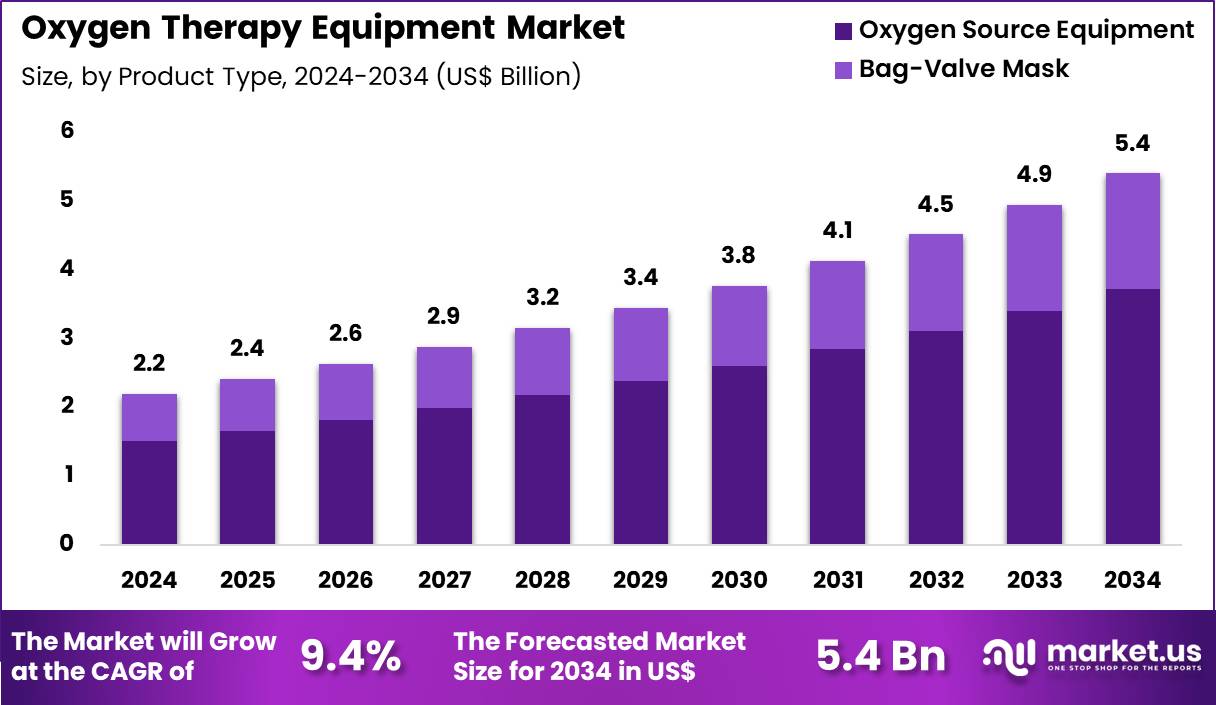
New York, NY – Oct 28, 2026 – Global Oxygen Therapy Equipment Market size is expected to be worth around US$ 5.4 Billion by 2034 from US$ 2.2 Billion in 2024, growing at a CAGR of 9.4% during the forecast period 2025 to 2034. In 2024, North America led the market, achieving over 40.4% share with a revenue of US$ 0.9 Billion.
Oxygen therapy equipment plays a vital role in modern healthcare by supporting patients who require supplemental oxygen due to respiratory conditions and other medical disorders. These devices are widely used in hospitals, clinics, emergency care facilities, and home healthcare settings to help maintain adequate oxygen levels in the body.
The market includes a broad range of products, such as oxygen concentrators, oxygen cylinders, liquid oxygen systems, oxygen delivery devices, and oxygen therapy accessories. Among these, oxygen concentrators are gaining importance due to their portability, ease of use, and suitability for long-term home-based care.
The growth of the oxygen therapy equipment market is being supported by the rising prevalence of chronic respiratory diseases, an ageing population, increasing demand for home healthcare services, and continuous improvements in medical technology. The growing preference for portable and energy-efficient devices is also encouraging manufacturers to develop advanced solutions that offer improved mobility and patient convenience.
North America and Europe represent established markets, while Asia-Pacific is expected to offer growth opportunities due to expanding healthcare infrastructure, increasing healthcare expenditure, and improved access to respiratory care.
Looking ahead, technological advancements, product innovation, and the expansion of home healthcare services are expected to shape the competitive landscape. Manufacturers are focusing on developing reliable, user-friendly, and cost-effective oxygen therapy solutions to address the evolving needs of patients and healthcare providers worldwide.
Key Takeaways
- In 2024, the oxygen therapy equipment market was valued at US$ 2.2 billion and is projected to reach US$ 5.4 billion by 2034, growing at a CAGR of 9.4%.
- By product type, the market is segmented into oxygen source equipment and bag-valve masks, with oxygen source equipment dominating with a 68.9% market share.
- Based on portability, the market is categorized into stationary and portable devices, with stationary devices accounting for a significant 61.7% market share.
- By application, the market is segmented into COPD, asthma, pneumonia, cystic fibrosis, and others. COPD emerged as the leading segment, accounting for 44.6% of the market revenue.
- By end user, the market is divided into hospitals and clinics, home care settings, ambulatory surgical centers, and others, with hospitals and clinics holding the largest share of 56.4%.
- Regionally, North America dominated the oxygen therapy equipment market, accounting for 40.4% of the total market share.
Key Market Segments
- Product Type Analysis: Oxygen source equipment dominated the market with a 68.9% share, driven by its essential role in providing a reliable oxygen supply for respiratory care. Hospitals depend on oxygen concentrators, cylinders, and liquid oxygen systems to support patients. Rising respiratory diseases and healthcare infrastructure investments are expected to sustain segment growth.
- Portability Analysis: Stationary devices accounted for 61.7% of the market, supported by their ability to provide continuous oxygen delivery in hospitals and clinics. These systems are widely used in intensive care units, emergency departments, and inpatient wards. Increasing respiratory admissions and demand for reliable oxygen supply are expected to support segment expansion.
- Application Analysis: COPD accounted for 44.6% of the market, driven by the growing need for long-term oxygen therapy among patients with chronic respiratory conditions. An ageing population, smoking-related lung damage, and increasing disease diagnosis contribute to demand. Greater awareness and improved access to respiratory care are expected to support continued segment growth.
- End-User Analysis: Hospitals and clinics held 56.4% of the market, reflecting their critical role in treating acute respiratory conditions and managing complex cases. Emergency departments, intensive care units, and inpatient wards require reliable oxygen delivery systems. Expanding healthcare infrastructure and increasing demand for respiratory care are expected to strengthen segment growth.
Regional Analysis
North America is Leading the Oxygen Therapy Equipment Market
North America accounted for 40.4% of the global oxygen therapy equipment market in 2024, supported by advanced healthcare infrastructure, rising respiratory disorders, and increasing demand for home-based oxygen therapy.
Established manufacturers, including Philips Respironics and Invacare Corporation, are developing portable oxygen concentrators with improved battery performance and enhanced mobility. The region’s well-developed home healthcare services and growing adoption of remote patient monitoring are further supporting market expansion.
Asia-Pacific is Expected to Register the Highest CAGR
The Asia-Pacific oxygen therapy equipment market is expected to record the highest CAGR during the forecast period, driven by increasing healthcare investments, rising air pollution, and a growing burden of respiratory diseases. Countries such as China and India are strengthening oxygen generation capacity and improving access to respiratory care.
Government initiatives, expanding healthcare infrastructure, and increasing demand for affordable oxygen delivery systems are creating growth opportunities. Additionally, local manufacturing, improved distribution networks, and greater awareness of respiratory health are expected to support regional market development.
Emerging Trends
- Growing adoption of home-based oxygen therapy: Home-based oxygen therapy is becoming an important part of respiratory care for patients who require prescribed oxygen outside hospitals. The use of concentrators and portable oxygen systems supports continued treatment at home and reduces dependence on hospital-based equipment.
- Development of portable oxygen equipment: Portable oxygen equipment is supporting patients who need oxygen while moving around their homes or travelling. Smaller devices and portable cylinders can improve mobility, although suitability depends on the patient’s oxygen requirements, prescribed flow, and device performance.
- Increased focus on oxygen monitoring: Oxygen monitoring is an important part of respiratory treatment, as healthcare professionals need to assess patients’ oxygen levels and adjust care when required. Pulse oximeters and patient monitors are used alongside oxygen delivery equipment in hospitals and other healthcare settings.
- Greater investment in hospital oxygen infrastructure: Healthcare systems are placing greater emphasis on reliable oxygen sources, storage, distribution, and delivery systems. Government health programmes and healthcare facilities are focusing on equipment quality, regular maintenance, and dependable supply to improve access to medical oxygen during routine care and emergencies.
- Improved equipment maintenance and user training: Training and preventive maintenance are receiving greater attention because oxygen equipment must operate safely and reliably. The World Health Organization provides technical guidance to help healthcare workers and biomedical technicians operate, inspect, clean, and maintain oxygen concentrators, cylinders, and related respiratory devices.
Use Cases
- Treatment of chronic respiratory diseases: Oxygen therapy equipment is used for patients with certain chronic respiratory conditions who cannot maintain adequate blood oxygen levels. Depending on clinical assessment, oxygen concentrators or cylinders may be prescribed to support breathing and provide supplemental oxygen during daily activities or sleep.
- Emergency and critical care: Hospitals use oxygen delivery systems to support patients experiencing severe breathing difficulties, pneumonia, trauma, or other acute medical conditions. Oxygen may be delivered in emergency departments and intensive care units, with appropriate monitoring and clinical supervision based on each patient’s condition.
- Newborn and maternal healthcare: Medical oxygen equipment is used in maternity wards and newborn care units when mothers or infants require oxygen support. Reliable oxygen sources and suitable delivery devices are important in these settings, where equipment selection, monitoring, and trained healthcare staff help support safe clinical care.
- Surgical and post-operative care: Oxygen therapy equipment is used in operating theatres and recovery areas to support patients who need supplemental oxygen during or after surgery. Oxygen sources, flow-control devices, delivery interfaces, and patient monitors help clinical teams provide and assess respiratory support throughout treatment.
- Medical transport and patient transfer: Oxygen cylinders and suitable portable delivery systems are used during emergency transport and patient transfers when supplemental oxygen is required. These systems help maintain access to prescribed oxygen outside fixed hospital beds, subject to available supplies, equipment suitability, and trained staff supervision.
Frequently Asked Questions About Oxygen Therapy Equipment
- What are the main types of oxygen therapy equipment?
The main types include stationary oxygen concentrators, portable oxygen concentrators, compressed oxygen cylinders, liquid oxygen systems, oxygen delivery accessories, and monitoring devices. Equipment selection depends on the patient’s medical condition, prescribed oxygen needs, mobility, and treatment environment. - How does an oxygen concentrator work?
An oxygen concentrator draws in surrounding air, removes much of its nitrogen, and provides concentrated oxygen through a delivery interface. Unlike oxygen cylinders, it does not require regular cylinder refilling, but it needs a suitable power source and proper maintenance. - What factors are driving the oxygen therapy equipment market?
Market demand is supported by the need for respiratory care, home-based treatment, emergency medical services, and reliable hospital oxygen infrastructure. Greater attention to oxygen availability, equipment maintenance, and healthcare preparedness also supports demand for appropriate oxygen delivery systems. - Which end users purchase oxygen therapy equipment?
Hospitals, clinics, emergency medical services, home healthcare providers, and long-term care facilities are important end users. Their requirements differ according to patient volume, treatment complexity, oxygen supply infrastructure, mobility needs, and the availability of trained medical and technical personnel. - What role does technology play in oxygen therapy equipment development?
Technology supports improvements in oxygen concentration, portability, flow regulation, patient monitoring, and equipment performance. However, safe and effective use also depends on suitable device selection, regular servicing, trained operators, and compliance with applicable medical device standards. - How is home healthcare influencing the oxygen therapy equipment market?
Home healthcare creates demand for oxygen concentrators, portable systems, and supporting accessories for patients requiring prescribed respiratory support. Equipment suitability, ease of operation, maintenance arrangements, and reliable power supply are important considerations when oxygen therapy is provided outside hospitals. - What is the future outlook for the oxygen therapy equipment market?
The market outlook is linked to continued demand for respiratory treatment, improved access to medical oxygen, and investment in healthcare infrastructure. Future opportunities may arise from portable devices, home-based care, and better equipment servicing, although growth will vary by region.
Conclusion
The global oxygen therapy equipment market is expected to experience significant growth, driven by the rising prevalence of respiratory diseases, an ageing population, and increasing demand for home healthcare services. Valued at US$ 2.2 billion in 2024, the market is projected to reach US$ 5.4 billion by 2034, growing at a CAGR of 9.4%.
North America currently leads the market, while Asia-Pacific offers promising growth opportunities. Technological advancements, portable oxygen solutions, and improved healthcare infrastructure are expected to support market expansion. Manufacturers focusing on product innovation, affordability, reliability, and patient convenience will be well-positioned for future growth.
Discuss your needs with our analyst
Please share your requirements with more details so our analyst can check if they can solve your problem(s)