


Overview
New York, NY – Aug 05, 2026 –The Global Orthopaedic Power Tools Market Size is expected to be worth around US$ 2.6 billion by 2034 from US$ 1.8 billion in 2024, growing at a CAGR of 3.9% during the forecast period 2025 to 2034. North America held a dominant market position, capturing more than a 39.7% share and holding a US$ 0.7 billion market value for the year.
The global orthopedic power tools market is witnessing steady growth, driven by the increasing burden of musculoskeletal disorders, a rapidly aging population, and continuous innovation in surgical technologies. Orthopedic power tools, including drills, saws, reamers, and burrs, play a vital role in joint replacement, trauma fixation, spinal fusion, and sports medicine procedures by improving surgical precision and reducing operating time.
According to the National Institutes of Health (NIH), musculoskeletal disorders affect more than 50% of adults in the United States, making them one of the leading causes of disability and surgical intervention. Additionally, the growing elderly population, which is expected to exceed 1.5 billion people globally by 2050 according to the World Health Organization (WHO), is increasing the demand for orthopedic surgeries.
The Agency for Healthcare Research and Quality (AHRQ) also reports that more than 1.6 million arthroplasty procedures are performed annually in the United States, highlighting the expanding need for reliable orthopedic surgical equipment. Technological advancements are reshaping the market, with manufacturers introducing lightweight, battery-powered, and cordless orthopedic power tools that improve surgeon mobility, reduce fatigue, and enhance operating room efficiency.
Smart ergonomic designs and improved battery performance are further supporting widespread adoption across hospitals and ambulatory surgical centers. Strategic acquisitions are strengthening industry competitiveness. In May 2022, ConMed acquired In2Bones Global for approximately US$ 245 million, expanding its orthopedic portfolio and accelerating innovation. Furthermore, the increasing preference for single-use sterile attachments and disposable handpieces is improving infection prevention, supporting patient safety, and creating new growth opportunities across healthcare facilities worldwide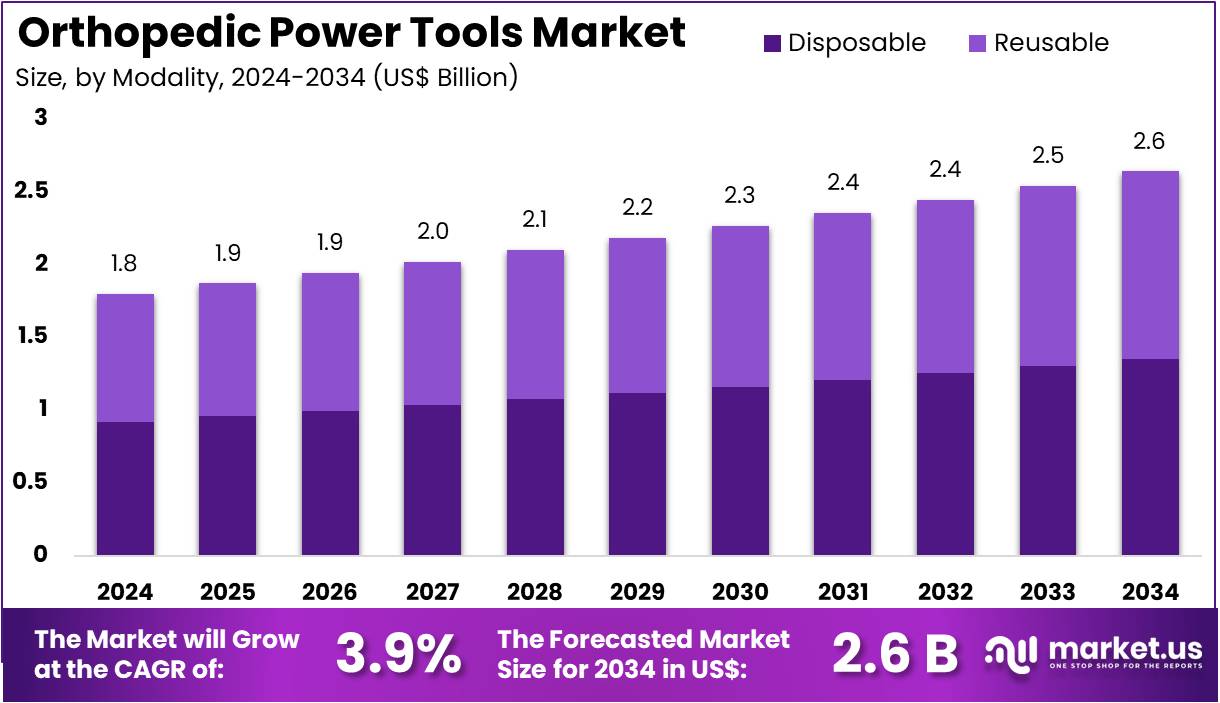
Key Takeaways
- In 2024, the global orthopedic power tools market was valued at US$ 1.8 billion and is projected to reach US$ 2.6 billion by 2034, expanding at a CAGR of 3.9% during the forecast period.
- By product type, the market is segmented into large bone orthopedic power tools, small bone orthopedic power tools, high-speed orthopedic power tools, and others. The large bone orthopedic power tools segment dominated the market with a 42.6% share.
- Based on technology, the market is categorized into battery-powered systems, pneumatic-powered systems, and electric-powered systems. Among these, battery-powered systems accounted for the largest market share of 37.5%.
- By modality, the market is divided into disposable and reusable orthopedic power tools. The disposable segment held the leading position, capturing 51.3% of the total market revenue.
- Based on end user, the market is segmented into hospitals and outpatient facilities, with the hospitals segment leading the market by accounting for 58.6% of the total revenue.
- North America emerged as the leading regional market, holding a 39.7% share of the global orthopedic power tools market.
Statistical Information
- Rising Burden of Arthritis and Musculoskeletal Disorders: Musculoskeletal disorders continue to drive demand for orthopedic surgeries and surgical power tools. According to the U.S. Centers for Disease Control and Prevention (CDC), 53.2 million U.S. adults (21.2%) had diagnosed arthritis during 2019–2021. Adults aged 45 years and older represented 88.3% of all arthritis cases, while 48.3% of arthritis patients were aged 65 years or older, indicating the growing need for orthopedic interventions in the elderly.
- Aging Population Increasing Demand for Orthopedic Procedures: The global aging population is expected to significantly increase orthopaedic surgical volumes. According to the World Health Organization (WHO), the number of people aged 60 years and older will increase from 1 billion in 2020 to 1.4 billion by 2030, and reach 2.1 billion by 2050. Older adults are more susceptible to osteoporosis, osteoarthritis, fractures, and degenerative joint diseases requiring orthopedic surgery.
- High Volume of Joint Replacement Procedures: Joint replacement surgeries remain one of the largest application areas for orthopedic power tools. The CDC reports that approximately 1 million hip and knee joint replacement procedures are performed annually in the United States, with 99% being associated with arthritis-related pain and functional limitations.
- Growing Hospital Burden of Musculoskeletal Procedures: Hospital data demonstrate the increasing demand for orthopedic surgical equipment. The U.S. Agency for Healthcare Research and Quality (AHRQ) reported that hospitals performed more than 3.4 million musculoskeletal procedures annually, representing about 9% of all hospitalizations. These procedures generated approximately US$31.5 billion in hospital costs.
- Rapid Growth in Knee Arthroplasty and Spinal Fusion Procedures: Orthopedic surgeries requiring drills, saws, and reamers continue to increase. AHRQ data show that knee arthroplasty procedures increased by 69%, hip replacements by 32%, and spinal fusion procedures by 73% over the study period, reflecting sustained demand for orthopedic power tools.
- Consumer Preference Driven by Aging Patients: Older adults account for the majority of orthopedic surgical procedures. According to AHRQ, 555,800 knee arthroplasties and 383,500 hip replacements were performed in hospitals, with most procedures occurring in patients aged 65–84 years, demonstrating that elderly patients remain the primary users of orthopedic surgical devices.
- Battery-Powered Surgical Systems Reflect Healthcare Preference for Mobility: Medical device manufacturers are increasingly investing in cordless orthopedic systems to improve operating room efficiency. In May 2022, CONMED Corporation completed its acquisition of In2Bones Global for approximately US$245 million, expanding its orthopedic product portfolio and strengthening innovation in extremity orthopedic solutions.
- Arthritis Creates Significant Healthcare Utilization: The CDC estimates that 9.9 million office-based physician visits each year list osteoarthritis as the primary diagnosis, while arthritis is documented in 10.6% of all physician office visits in the United States. This reflects the substantial healthcare utilization associated with musculoskeletal disorders and supports long-term demand for orthopedic treatment technologies.
Regional Analysis
North America dominated the orthopedic power tools market due to its advanced healthcare infrastructure, high adoption of technologically advanced surgical equipment, and growing number of orthopedic procedures. The United States has a strong demand for orthopedic power tools driven by the rising prevalence of musculoskeletal disorders, sports injuries, and age-related joint conditions.
According to the CDC, arthritis affects a significant portion of the adult population, increasing the need for joint replacement and trauma surgeries. The presence of leading medical device manufacturers and well-established surgical facilities further strengthens regional growth. Asia Pacific is expected to witness the fastest growth during the forecast period, supported by an aging population, improving healthcare facilities, and rising healthcare investments.
Countries such as China, Japan, and South Korea are expanding their orthopedic care capabilities and adopting advanced surgical technologies. Increasing awareness of minimally invasive procedures and government initiatives to enhance healthcare access are also contributing to the growing adoption of orthopedic power tools across the region.
Emerging Trends
- Growing Adoption of Battery-Powered Orthopedic Tools: Hospitals are increasingly adopting cordless orthopedic power systems due to improved mobility, reduced operating room restrictions, and enhanced surgical efficiency. These tools are widely used in trauma, spine, and joint replacement procedures where precision and flexibility are critical.
- Integration of Robotics and Navigation Technologies: Robotic-assisted surgery and computer navigation systems are becoming important trends in orthopedic procedures. These technologies improve bone cutting accuracy, implant positioning, and surgical planning, supporting better outcomes in complex orthopedic surgeries.
- Rising Demand Due to Aging Population: The increasing elderly population is driving demand for orthopedic surgeries such as hip and knee replacements. According to WHO, the global population aged 60 years and older is expected to reach 2.1 billion by 2050, increasing the need for advanced orthopedic surgical equipment.
- Development of Lightweight and Ergonomic Instruments: Manufacturers are focusing on lightweight orthopedic power tools with improved battery life, reduced vibration, and better handling features. These innovations help surgeons perform longer procedures with greater comfort and operational control.
- Expansion of Healthcare Infrastructure in Emerging Markets: Developing countries are investing in hospitals, surgical centers, and advanced medical technologies. Increasing healthcare access in Asia Pacific, Latin America, and Middle East regions is supporting the adoption of modern orthopedic power tools.
- Increasing Use of Minimally Invasive Surgical Techniques: The growing preference for minimally invasive orthopedic procedures is boosting demand for high-precision power tools. These systems enable smaller incisions, faster recovery, reduced tissue damage, and improved surgical accuracy.
Use Cases
- Joint Replacement Surgeries: Orthopedic power tools are widely used in hip, knee, and shoulder replacement procedures for precise bone cutting, drilling, and implant placement. According to the American Joint Replacement Registry (AJRR), hundreds of thousands of joint replacement surgeries are performed annually in the U.S., supporting strong demand for these instruments.
- Trauma and Fracture Repair: Orthopedic surgeons use power drills, reamers, and saws to repair fractures caused by road accidents, sports injuries, and falls. The World Health Organization (WHO) estimates that approximately 1.19 million people die annually from road traffic crashes, with millions more sustaining fractures requiring orthopedic treatment.
- Spinal Surgery Procedures: Orthopedic power tools are essential in spinal fusion, decompression, and vertebral fixation surgeries. High-speed drills and burrs improve surgical precision while minimizing tissue damage, making them valuable for treating degenerative spine diseases and spinal injuries.
- Sports Medicine and Arthroscopy: Power tools are extensively used in minimally invasive sports injury treatments, including ligament reconstruction and cartilage repair. According to the CDC, millions of sports- and recreation-related injuries are treated each year in the United States, increasing demand for advanced orthopedic surgical equipment.
- Veterinary Orthopedic Surgery: Veterinary hospitals increasingly use orthopedic power tools for fracture repair, joint stabilization, and bone reconstruction in companion animals. Rising pet ownership and greater access to advanced veterinary surgical care are expanding the use of orthopedic power systems beyond human healthcare.
Frequently Asked Questions on Orthopedic Power Tools Market
- What factors are driving the growth of the orthopedic power tools market?
The orthopedic power tools market is growing due to increasing orthopedic surgeries, rising cases of musculoskeletal disorders, aging populations, technological advancements, and greater adoption of minimally invasive procedures. Expansion of healthcare infrastructure is also supporting global market growth. - Which procedures commonly use orthopedic power tools?
Orthopedic power tools are commonly used in hip and knee replacements, fracture fixation, spine surgeries, sports medicine procedures, and bone reconstruction. These instruments help surgeons perform accurate cutting, drilling, and shaping during complex orthopedic operations. - Which region dominates the orthopedic power tools market?
North America dominates the orthopedic power tools market due to advanced healthcare infrastructure, high orthopedic surgery volumes, strong adoption of innovative surgical technologies, and the presence of major medical device companies. The region also has high demand for joint replacement procedures. - What technological advancements are influencing orthopedic power tools?
Key advancements include battery-powered systems, robotic-assisted surgery integration, surgical navigation, lightweight designs, and improved infection-control features. These innovations enhance accuracy, reduce procedure time, and improve surgeon handling during orthopedic operations. - What are the major applications of orthopedic power tools?
Major applications include joint replacement surgeries, trauma and fracture repair, spinal procedures, sports medicine, and reconstructive surgeries. Orthopedic power tools assist surgeons in drilling, cutting, reaming, and preparing bones for implants and fixation devices. - How does the aging population impact the orthopedic power tools market?
The increasing elderly population contributes to higher cases of arthritis, osteoporosis, and joint disorders, increasing the demand for orthopedic surgeries. Growing numbers of hip and knee replacement procedures create continuous demand for advanced surgical power instruments. - What role do robotic technologies play in orthopedic power tools?
Robotic technologies improve surgical accuracy by assisting with precise bone preparation, implant alignment, and procedure planning. Integration of robotics with orthopedic power tools supports minimally invasive surgery and helps surgeons achieve improved clinical outcomes.
Conclusion
The orthopedic power tools market is witnessing steady growth due to the rising number of orthopedic surgeries, increasing prevalence of musculoskeletal disorders, and growing demand for advanced surgical solutions. North America remains a leading region because of strong healthcare infrastructure and high adoption of innovative technologies, while Asia Pacific is emerging as a high-growth market supported by aging populations and healthcare expansion.
Advancements such as battery-powered systems, robotic integration, and minimally invasive surgical tools are transforming orthopedic procedures. Continued investment in surgical innovation and improved healthcare access will further drive the adoption of orthopedic power tools globally.
Discuss your needs with our analyst
Please share your requirements with more details so our analyst can check if they can solve your problem(s)




