


Overview
New York, NY – Sep 17, 2026 –The Global Organ Transport Devices Market size is expected to be worth around US$ 717.2 Million by 2034 from US$ 440.3 Million in 2024, growing at a CAGR of 5.0% during the forecast period 2025 to 2034. In 2024, North America led the market, achieving over 38.4% share with a revenue of US$ 169.1 Million.
Organ Transport Devices experiencing steady expansion, driven by the increasing burden of chronic diseases, rising organ failure cases, and growing demand for organ transplantation worldwide. Organ transport devices are designed to preserve donor organs under controlled conditions, ensuring safe transportation while maintaining organ viability.
According to the Global Observatory on Donation and Transplantation (GODT), more than 172,000 organ transplants are performed each year globally, including approximately 103,000 kidney, 39,000 liver, 9,500 heart, 6,700 lung, and 2,500 pancreas transplants.
Despite these numbers, the World Health Organization (WHO) estimates that only around 10% of the global demand for organ transplantation is currently met, highlighting a significant unmet medical need. The growing prevalence of chronic kidney disease, liver cirrhosis, heart failure, and end-stage lung disease is increasing transplant requirements.
According to the U.S. Health Resources and Services Administration (HRSA), more than 104,000 patients are currently on the U.S. national transplant waiting list, while over 48,000 organ transplants were performed in the United States in 2024, representing one of the highest annual totals on record.
On average, 17 people die every day in the U.S. while waiting for a life-saving organ transplant, underscoring the importance of efficient preservation and transportation technologies. Technological advancements are significantly improving organ preservation outcomes.
Modern hypothermic and normothermic machine perfusion systems can preserve donor organs for 12–24 hours or longer depending on the organ type, compared with conventional static cold storage methods that offer more limited preservation windows.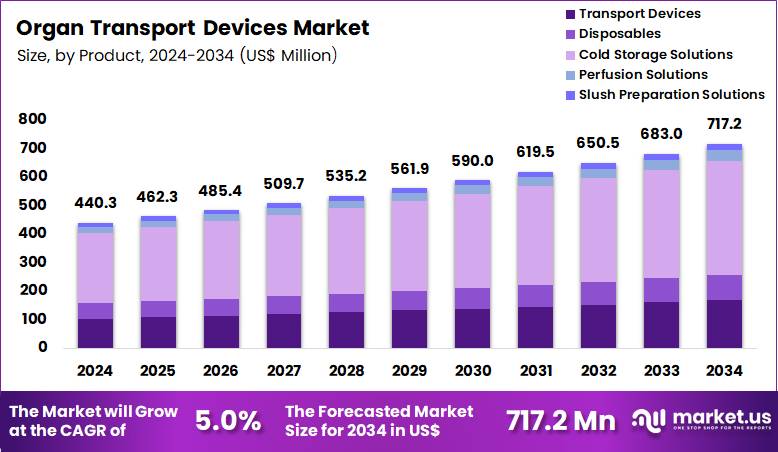
Key Takeaways
- In 2024, the Organ Transport Devices Market generated US$ 440.3 million in revenue and is projected to reach US$ 717.2 million by 2034, expanding at a CAGR of 5.0% during the forecast period.
- By Product, the market is segmented into Transport Devices, Disposables, Cold Storage Solutions, Perfusion Solutions, and Slush Preparation Solutions. The Transport Devices segment dominated the market in 2024, accounting for 64.7% of the total market share.
- By Organ Type, the market is categorized into Kidney, Liver, Heart, Lung, Pancreas, and Other Organs. The Kidney segment held the largest share of 53.6% in 2024.
- By End User, the market is segmented into Hospitals, Transplant Centers, and Organ Procurement Organizations (OPOs). The Transplant Centers segment led the market with a 58.3% share in 2024.
- North America emerged as the leading regional market, capturing 38.4% of the global Organ Transport Devices Market share in 2024.
Market Segmentation Overview
- Product Analysis: Transport Devices dominated the Organ Transport Devices Market with a 64.7% market share in 2024 due to their essential role in preserving donor organs during transportation. Increasing transplant procedures, growing inter-regional organ sharing, and advancements in temperature monitoring, insulation, and portable preservation technologies continue to drive demand for these systems across transplant centers and hospitals.
- Organ Type Analysis: Kidney emerged as the leading organ type, accounting for 53.6% of the market share in 2024, supported by the highest transplant volumes globally. Kidney transport devices enable preservation for approximately 18–24 hours, facilitating long-distance transportation while maintaining organ viability. Rising chronic kidney disease cases and expanding donor programs continue to strengthen segment growth.
- End-User Analysis: Transplant Centers held the largest 58.3% market share in 2024, driven by their high volume of complex organ transplant procedures and rapid adoption of advanced preservation technologies. These centers increasingly utilize machine perfusion systems, specialized transport devices, and real-time monitoring solutions to improve organ quality, enhance transplant success rates, and support multi-organ transplantation programs.
Statistical Information
- Record Number of U.S. Organ Transplants: The United States performed a record 48,149 organ transplants in 2024, averaging 132 transplants every day. The milestone was supported by 16,988 deceased donors and 7,030 living donors, highlighting the growing demand for advanced organ transport and preservation systems.
- Kidney Transplants Account for the Largest Share: According to the OPTN/SRTR 2024 Annual Report, 28,492 kidney transplants were performed in the U.S. during 2024, compared with 11,458 liver, 4,636 heart, 3,404 lung, 847 pancreas, and 97 intestine transplants. Kidney remains the largest organ category requiring transport and preservation.
- Organ Donor Numbers Continue to Grow: The U.S. recorded 24,013 organ donors in 2024, including 16,989 deceased donors and 7,024 living donors. The increasing donor pool is driving demand for temperature-controlled transport devices, preservation solutions, and nationwide organ logistics.
- Donation After Circulatory Death (DCD) is Expanding: DCD kidney transplants increased from 10.5% in 2013 to 30.5% in 2024. DCD liver transplants increased from 4.8% to 26.7%, while DCD lung transplants rose from 1.8% to 13.0% during the same period, increasing demand for advanced preservation and transport technologies.
- Organ Transplants Have Increased Significantly Over the Past Decade: Between 2013 and 2024, kidney, liver, heart, and lung transplants in the U.S. increased by 61.4% to 81.5%. This sustained growth is driving higher utilization of transport devices, cold storage containers, perfusion systems, and preservation solutions.
- Organ Transplants Increased 23.3% in Five Years: HRSA reported that 48,149 organ transplants were performed in 2024, representing a 23.3% increase over the past five years and a 3.3% increase compared with 2023, reflecting growing demand for organ transport devices.
- Organ Donation Registration Remains High in the U.S.: According to the 2025 HRSA National Survey of Organ Donation Attitudes and Practices, 58.6% of U.S. adults reported they are registered organ donors, while 90.9% support organ donation. This continued public support contributes to higher transplant activity and increased demand for organ transport systems.
- Nearly Half of Americans Trust the Organ Transplant System: According to the 2025 HRSA National Survey, 43.7% of respondents believe the U.S. organ transplant system is headed in the right direction. Confidence was higher (48.2%) among registered organ donors than non-donors (38.3%).
Regional Analysis
North America led the market by securing a market share of 38.4% in 2024.
North America dominated the Organ Transport Devices Market in 2024, accounting for 38.4% of the global market, driven by its advanced transplant infrastructure, high organ donation rates, and well-established organ procurement network. According to the United Network for Organ Sharing (UNOS), the United States performed a record 48,149 organ transplants in 2024, including more than 28,000 kidney transplants, creating sustained demand for organ transport devices and preservation technologies.
The region benefits from 56 federally designated Organ Procurement Organizations (OPOs) that coordinate organ recovery and transportation across the country. The widespread adoption of machine perfusion systems, real-time temperature monitoring, and GPS-enabled transport devices has improved organ preservation and transplant outcomes.
In addition, continued support from the Health Resources and Services Administration (HRSA), increasing investments in transplant centers, and the presence of leading manufacturers developing innovative transport solutions continue to strengthen North America’s leadership in the global Organ Transport Devices Market.
Business Opportunities
The Organ Transport Devices Market offers significant business opportunities as organ transplantation continues to increase globally and healthcare systems invest in advanced preservation technologies. Rising adoption of machine perfusion, portable organ transport systems, and smart temperature-monitoring devices is creating demand for innovative solutions that improve organ viability and reduce transportation-related losses.
The expansion of transplant centers, Organ Procurement Organizations (OPOs), and cross-border organ-sharing programs presents opportunities for manufacturers to develop integrated logistics and preservation systems. Companies can also benefit from incorporating GPS tracking, cloud-based monitoring, IoT-enabled sensors, and real-time data analytics into transport devices to enhance regulatory compliance and operational efficiency.
Emerging markets in Asia-Pacific, Latin America, and the Middle East are investing in transplant infrastructure, creating new revenue opportunities for both global and regional manufacturers. In addition, partnerships with hospitals, transplant centers, airlines, and medical logistics providers, along with continued research into next-generation perfusion technologies and reusable transport systems, are expected to drive long-term business growth and product innovation.
Emerging Trends
- Growing adoption of machine perfusion technologies: Machine perfusion is increasingly replacing conventional cold storage for kidney, liver, heart, and lung preservation. The U.S. performed 48,149 organ transplants in 2024, encouraging wider adoption of advanced preservation systems that improve organ viability and transplant success.
- Increasing use of smart transport monitoring systems: Organ transport devices are being integrated with GPS tracking, RFID, and real-time temperature sensors to improve shipment visibility and reduce transportation risks. HRSA recommends digital monitoring to strengthen organ logistics and regulatory compliance.
- Expansion of portable organ preservation devices: FDA-cleared portable perfusion systems are gaining popularity for preserving heart, liver, and lung donor organs by maintaining oxygenation and controlled temperature throughout transportation, enabling longer transport distances than conventional cold storage.
- Digital modernization of transplant logistics: The U.S. Health Resources and Services Administration (HRSA) is modernizing the Organ Procurement and Transplantation Network (OPTN) with improved digital infrastructure, helping transplant centers and Organ Procurement Organizations manage organ allocation and transportation more efficiently.
- Rising utilization of Donation after Circulatory Death (DCD) organs: According to the SRTR 2024 Annual Report, 30.5% of kidney transplants and 26.7% of liver transplants in the U.S. were from DCD donors, increasing demand for advanced transport and preservation technologies.
Use Cases
- Kidney Organ Transportation: Kidney transplants represent the largest share of transplant procedures. According to the SRTR 2024 Annual Report, 28,492 kidney transplants were performed in the U.S. in 2024, driving extensive use of insulated transport devices and cold-storage systems for safe long-distance organ preservation.
- Heart and Lung Transport Using Machine Perfusion: FDA-cleared portable perfusion systems are increasingly used to transport heart and lung donor organs while maintaining oxygenation and controlled temperature. These technologies help improve organ viability during transportation and support better transplant outcomes.
- Long-Distance Organ Logistics Between Transplant Centers: Organ Procurement Organizations (OPOs) transport organs between hospitals using air and ground networks. In 2024, the U.S. completed 48,149 organ transplants, highlighting the need for reliable transport devices with temperature monitoring and tracking capabilities.
- Organ Shipment Tracking and Cold Chain Monitoring: Healthcare providers increasingly use GPS-enabled transport systems and real-time temperature monitoring to protect donor organs during transit. HRSA recommends digital logistics technologies to improve shipment visibility, compliance, and patient safety throughout the transportation process.
- Support for Multi-Organ Transplant Programs: Advanced organ transport devices allow transplant centers to coordinate multiple donor organs simultaneously. According to UNOS, the U.S. performed an average of 132 organ transplants per day in 2024, increasing demand for specialized transport carriers and preservation systems.
Recent Development
- In 2026, XVIVO Perfusion AB continued expanding its perfusion technology portfolio focused on improving lung and organ preservation outcomes. The company reported continued growth in perfusion services, with Q2 2026 net sales reaching SEK 239 million, supported by increasing adoption of advanced organ preservation solutions.
- In 2026, Paragonix Technologies launched the upgraded SherpaPak® Cardiac Transport System with TempLock™ technology, designed to maintain controlled temperatures between 4–8°C during extended heart transportation. The company also reached 1,000 clinical cases using its FDA-cleared KidneyVault® Portable Renal Perfusion System in March 2026.
- In 2026, Franz Köhler Chemie GmbH continued strengthening its organ preservation product portfolio, including preservation solutions used for kidney, liver, pancreas, and other transplant applications. The company focuses on maintaining reliable cold-storage preservation solutions for global transplant programs.
- In 2026, Bridge to Life Ltd continued advancing organ preservation solutions, including cold storage solutions and machine perfusion products. The company expanded adoption of preservation technologies designed to support kidney and liver transplantation by improving organ viability during transportation.
- In 2026, OrganOx Ltd continued expanding the clinical use of its metra® normothermic perfusion system for liver transplantation. The technology supports continuous oxygenated preservation, helping transplant teams assess and utilize donor livers that may not be suitable for conventional cold storage.
- In 2026, TransMedics announced plans to establish a dedicated European transplant logistics network through strategic investment in PAD Aviation Service GmbH. The initiative aims to expand organ transportation infrastructure supporting its Organ Care System (OCS™) platform for heart, lung, and liver transplantation.
- In 2026, Terumo Corporation continued development of advanced cardiovascular and transplant-related technologies through its medical device portfolio. The company focuses on improving surgical outcomes and supporting healthcare providers with advanced blood management and perfusion-related solutions.
Frequently Asked Questions on Organ Transport Devices
- What are the major factors driving the Organ Transport Devices Market growth?
Growth is driven by increasing organ failure cases, rising transplant volumes, advancements in machine perfusion technologies, expanding transplant infrastructure, increasing organ donation programs, and growing demand for reliable transportation systems that improve donor organ preservation. - Which product segment dominates the Organ Transport Devices Market?
The Transport Devices segment dominated the market with a 64.7% share in 2024. These systems are widely used because they provide essential protection, temperature control, and safe movement of donor organs during short- and long-distance transportation. - Which organ type segment holds the largest market share?
The Kidney segment accounted for the largest share of 53.6% in 2024 due to the high number of kidney transplant procedures globally. Increasing kidney disease prevalence and demand for transplantation continue to drive kidney transport device adoption. - Why is cold storage widely used in organ transportation?
Cold storage remains a preferred preservation method because it is reliable, cost-effective, and compatible with multiple organ types. It reduces metabolic activity and helps maintain organ quality during transportation, especially for kidney and liver transplant procedures. - Why is Asia Pacific considered a growing market for organ transport devices?
Asia Pacific is experiencing rapid growth due to increasing transplant programs, rising healthcare investments, expanding hospital infrastructure, and growing awareness of organ donation. Countries including China, Japan, South Korea, and Australia are strengthening transplant capabilities. - What technologies are used in modern organ transport devices?
Modern organ transport devices use technologies such as GPS tracking, real-time temperature monitoring, IoT sensors, automated alerts, and digital data recording. These technologies improve transportation visibility, maintain preservation conditions, and enhance coordination among healthcare providers. - What are the key applications of organ transport devices?
Organ transport devices are mainly used for kidney, liver, heart, lung, and pancreas transplantation. They support donor organ retrieval, preservation, long-distance transportation, and safe delivery to transplant centers while maintaining optimal organ quality before surgery. - What opportunities exist in the Organ Transport Devices Market?
Opportunities include development of portable perfusion systems, integration of artificial intelligence and digital monitoring, expansion of transplant programs in emerging countries, strategic partnerships, and innovations aimed at extending organ preservation time and improving transplant success rates.
Conclusion
The Organ Transport Devices Market is witnessing steady growth due to increasing transplant procedures, rising organ failure cases, and advancements in preservation technologies. With the market expected to grow from US$ 440.3 million in 2024 to US$ 717.2 million by 2034, demand for advanced transport devices, machine perfusion systems, and smart monitoring solutions is increasing.
Kidney transplantation remains the major application area, while transplant centers continue to drive adoption. North America leads the market due to strong healthcare infrastructure and transplant networks. Future growth will be supported by digital innovations, expanding donation programs, and improved organ preservation technologies worldwide.
Discuss your needs with our analyst
Please share your requirements with more details so our analyst can check if they can solve your problem(s)




