


Overview
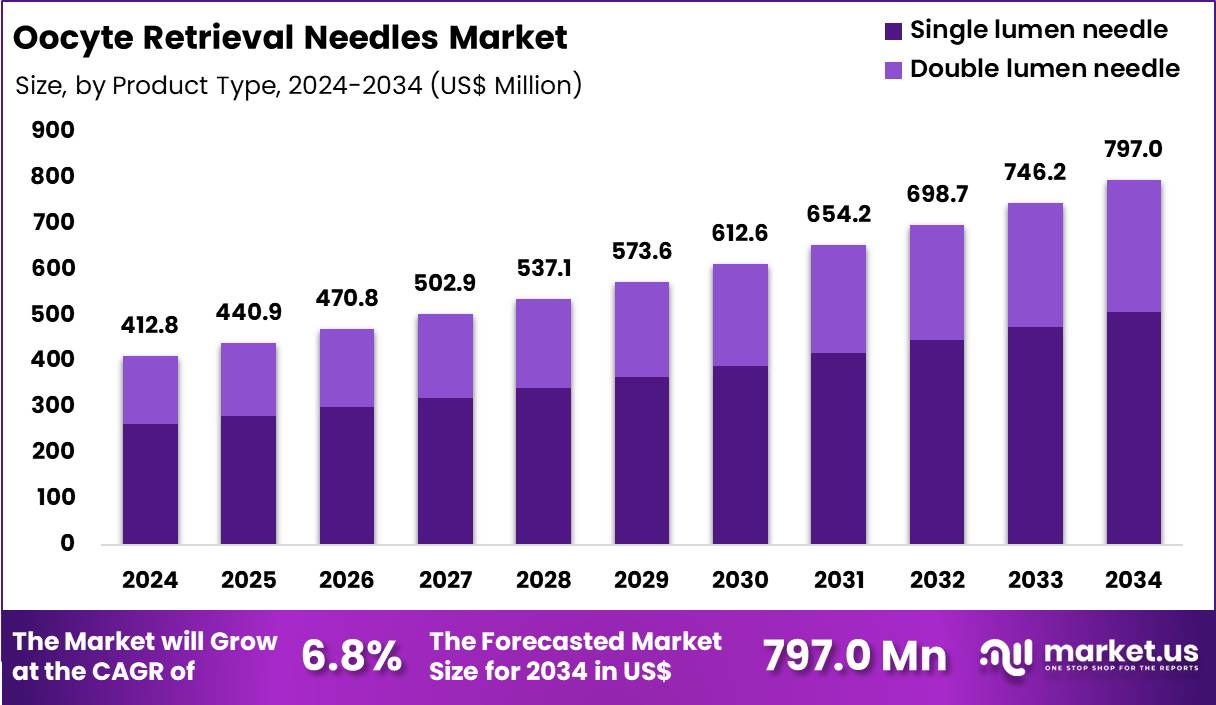
New York, NY – Sep 22, 2026 – Global Oocyte Retrieval Needles Market size is expected to be worth around US$ 797.0 Million by 2034 from US$ 412.8 Million in 2024, growing at a CAGR of 6.8% during the forecast period 2025 to 2034. In 2024, North America led the market, achieving over 36.4% share with a revenue of US$ 150.3 Million.
The Oocyte Retrieval Needles market comprises specialized medical devices used during assisted reproductive procedures, particularly in-vitro fertilization (IVF), to aspirate and collect mature oocytes from ovarian follicles.
These needles are typically used under ultrasound guidance and are designed to provide controlled follicular aspiration while minimizing tissue trauma. The U.S. Food and Drug Administration (FDA) classifies oocyte retrieval needles as Class II assisted reproduction devices under 21 CFR 884.6100, with product code MQE.
Modern oocyte retrieval needles are available in single-lumen and double-lumen configurations, supporting aspiration and, in selected designs, simultaneous flushing. FDA-cleared products are available in sizes such as 16G to 21G, with lengths generally ranging from 25 cm to 35 cm. Some recent devices include 17G and 18G single-lumen and 17G double-lumen models, reflecting continued product diversification.
Technological development increasingly focuses on echogenic needle tips, optimized cannula dimensions, ergonomic handles, and improved aspiration systems to enhance ultrasound visibility, procedural control, and oocyte recovery.
For example, FDA documentation describes a tapered needle with a 0.60 mm inner diameter and available 30 cm and 35 cm lengths. In November 2024, the FDA cleared VitaVitro’s single- and double-lumen oocyte retrieval needles, demonstrating continued innovation and regulatory activity within this medical-device segment.
Key Takeaways
- In 2024, the Oocyte Retrieval Needles Market generated revenue of US$ 412.8 million and is projected to reach US$ 797.0 million by 2034, registering a CAGR of 6.8% during the forecast period.
- By product type, the market is segmented into single-lumen needles and double-lumen needles. The single-lumen needle segment dominated in 2024, accounting for a 63.8% market share.
- Based on end-user, the market is categorized into hospitals, fertility clinics, clinical research institutes, and surgical centers. Among these, hospitals held the leading position in 2024, capturing a 48.7% market share
- Regionally, North America dominated the global Oocyte Retrieval Needles Market in 2024, accounting for the largest market share of 36.4%.
Market segmentation
Product Type Analysis
The single lumen needle segment, holding 63.8%, is expected to maintain dominance due to its simple design, precise follicular aspiration, and ease of maneuverability during IVF procedures. Advancements in needle geometry and ultrasound visibility further support accurate retrieval, while increasing IVF procedure volumes continue to drive segment demand globally.
End-User Analysis
The hospitals segment, accounting for 48.7%, is projected to remain dominant due to their advanced reproductive care facilities, trained specialists, and integrated imaging infrastructure. Rising infertility treatment demand, increasing IVF procedures, and greater investments in hospital-based reproductive medicine departments are expected to expand oocyte retrieval needle utilization.
Statistical Information
- A 2025 peer-reviewed study analyzed 223 oocyte-retrieval cycles using reduced needles with a 20-gauge tip and 17-gauge shaft, comparing aspiration pressures of 230 mmHg and 160 mmHg.
- In the 2025 study, 113 cycles were performed using 230 mmHg aspiration pressure, while 110 cycles used 160 mmHg, providing a direct technical comparison of two pressure settings for reduced oocyte-retrieval needles.
- Among patients with AMH ≥1.2, procedure time decreased from 11.0 ± 4.1 minutes at 230 mmHg to 9.4 ± 4.1 minutes at 160 mmHg, with the difference statistically significant at p=0.009.
- For patients with AMH <1.2, procedure time measured 6.3 ± 2.8 minutes at 230 mmHg compared with 5.5 ± 2.5 minutes at 160 mmHg, although the difference was not statistically significant (p=0.11).
- In the AMH ≥1.2 subgroup, the 230-mmHg group punctured an average of 21.3 ± 14.7 follicles, compared with 17.4 ± 12.0 follicles at 160 mmHg, with p=0.19.
- The same subgroup retrieved 14.2 ± 10.0 oocytes per cycle at 230 mmHg versus 12.2 ± 8.0 oocytes at 160 mmHg; the difference was not statistically significant (p=0.51).
- For patients with AMH <1.2, the average number of retrieved oocytes was 2.8 ± 2.5 at 230 mmHg and 3.2 ± 3.5 at 160 mmHg, with p=0.84, indicating no significant retrieval difference between pressure settings.
- In the AMH ≥1.2 group, fertilized-oocyte counts were 8.0 ± 6.6 at 230 mmHg and 7.8 ± 6.6 at 160 mmHg, producing a p-value of 0.96 and showing comparable fertilization output.
- In the AMH <1.2 subgroup, fertilized-oocyte counts were 1.5 ± 1.5 at 230 mmHg versus 2.3 ± 2.7 at 160 mmHg, with p=0.42, indicating no statistically significant difference.
Regional Analysis
North America remains a leading region for the Oocyte Retrieval Needles Market, supported by extensive adoption of assisted reproductive technologies and advanced fertility-care infrastructure. The CDC reported 435,426 ART cycles across 457 U.S. clinics in 2022, demonstrating substantial procedural activity and demand for specialized retrieval equipment. FDA regulatory activity also supports product availability; in November 2024, the agency cleared 17G and 18G single-lumen and 17G double-lumen oocyte retrieval needles.
Asia Pacific is positioned for continued expansion as infertility remains an important reproductive-health concern. WHO estimates lifetime infertility prevalence at 23.2% in the Western Pacific Region, the highest among its assessed regions. Increasing attention to affordable, accessible fertility services and the 2025 WHO infertility guideline further supports development of reproductive-care capacity across the region.
Business opportunities
The Oocyte Retrieval Needles Market offers significant business opportunities through innovation in minimally invasive fertility procedures and growing access to assisted reproductive technologies.
Manufacturers can focus on developing advanced single- and double-lumen needles with improved echogenicity, ergonomic handles, optimized bevel geometry, and controlled aspiration characteristics to support precise follicular puncture and efficient oocyte collection.
Another opportunity lies in cost-effective, sterile, single-use retrieval needles, particularly for emerging fertility-care markets where affordability and accessibility remain important challenges. Companies can also expand distribution networks across Asia Pacific, Latin America, the Middle East, and Africa as infertility services develop. Partnerships with fertility clinics can support product testing, physician training, and workflow optimization.
Further opportunities include integrating retrieval needles with aspiration tubing, flushing systems, collection accessories, and other IVF consumables. Investment in regulatory-compliant products and ultrasound-guided technologies can strengthen competitive positioning. Overall, product innovation, affordability, clinic partnerships, geographic expansion, and integrated IVF solutions represent key business opportunities.
Emerging Trends
- Reduced-needle technology: In 2025, researchers evaluated 223 oocyte retrieval cycles using a reduced needle combining a 20-gauge tip and 17-gauge shaft. This trend focuses on improving patient comfort while maintaining effective follicular aspiration during IVF procedures.
- Aspiration-pressure optimization: A 2025 clinical study compared 230 mmHg and 160 mmHg aspiration pressures during oocyte retrieval. The findings highlight growing interest in selecting appropriate pressure levels to improve procedural efficiency while maintaining effective oocyte recovery.
- Single-lumen needle development: A 2025 systematic review included 5 studies comparing single- and double-lumen needles. Single-lumen needles demonstrated shorter retrieval procedures, while several reproductive outcomes showed no significant differences between the two needle designs.
- Affordable fertility technologies: WHO’s 2025 infertility guideline includes 40 recommendations covering prevention, diagnosis, and treatment. This is encouraging healthcare providers and manufacturers to develop simpler, affordable fertility technologies that can improve access to assisted reproductive services.
- Needle design diversification: FDA documentation identifies oocyte retrieval needles as Class II devices and lists 3 configurations, including 17G and 18G single-lumen and 17G double-lumen designs, supporting continued development of specialized retrieval instruments.
Use Cases
- Routine IVF procedures: Transvaginal ultrasound-guided follicular aspiration is widely recognized as the standard approach for oocyte retrieval. Both single- and double-lumen needles are used during these procedures to collect oocytes for subsequent fertilization and embryo-development processes.
- High-volume fertility clinics: CDC surveillance recorded 435,426 ART cycles across 457 U.S. clinics in 2022. This large procedural workload demonstrates the importance of reliable oocyte retrieval needles for fertility centers performing repeated assisted reproductive procedures.
- Fertility preservation: Oocyte retrieval needles are used during egg-freezing procedures. CDC reported 184,423 banking cycles in 2022 in which all resulting eggs or embryos were frozen, supporting continued demand for dependable retrieval equipment.
- Infertility treatment pathways: The WHO defines infertility as failure to achieve pregnancy after 12 months or more of regular unprotected intercourse. Oocyte retrieval needles support ART treatment pathways when IVF or related assisted reproductive procedures are clinically selected.
- Expanding fertility services: WHO reported in 2025 that approximately 1 in 6 people of reproductive age experience infertility during their lifetime. This substantial patient population supports broader use of reliable oocyte retrieval equipment across fertility-care services.
Recent development
- In March 2026, Rocket Medical released an updated Needle Guides document for transvaginal ultrasound-guided oocyte harvesting. The guides are designed to attach needles to specified ultrasound transducers and provide a supporting channel during oocyte retrieval procedures.
- In May 2026, Rocket Medical updated its CRAFT™ and CRAFT™ DUO-VAC™ suction-pump documentation for use with Embryon® single- and double-lumen oocyte aspiration needles. The updated instructions reinforce integration between aspiration pumps, patient tubing and retrieval needles during IVF procedures.
- In June 2026, Rocket Medical issued updated documentation for its Oocyte Aspiration Pump and associated patient-connection products. The revised materials specify compatibility with oocyte aspiration needles and reinforce the company’s integrated aspiration-system approach for IVF and related gynecological procedures.
Frequently Asked Questions About Oocyte Retrieval Needles
- What are the main types of oocyte retrieval needles?
The two primary types are single-lumen and double-lumen needles. Single-lumen needles provide an aspiration pathway, while double-lumen designs provide separate aspiration and flushing pathways, allowing clinicians to select equipment according to their retrieval procedure. - Are oocyte retrieval needles single-use devices?
Many oocyte retrieval needles are designed for single use to support sterility and consistent performance during IVF procedures. FDA-cleared double-lumen retrieval needles, for example, are described as sterile, single-use devices intended for oocyte aspiration. - Why is ultrasound guidance important for oocyte retrieval?
Ultrasound guidance enables clinicians to visualize ovarian follicles and accurately direct the retrieval needle. FDA regulations specifically recognize needle guides used with ultrasound, supporting controlled positioning during assisted-reproduction and follicular aspiration procedures. - Which needle is better, single-lumen or double-lumen?
A 2025 systematic review covering 5 studies found that both needle types effectively support oocyte retrieval. Oocyte yield and mature-oocyte numbers showed no significant difference, while single-lumen needles were associated with shorter procedural duration. - What factors influence needle selection?
Clinicians may consider needle gauge, length, lumen configuration, ultrasound visibility, aspiration requirements, and compatibility with connected equipment. Patient anatomy and the fertility center’s established IVF protocol can also influence selection of an appropriate retrieval needle. - How is the Oocyte Retrieval Needles Market developing?
The market is supported by continued development of different needle configurations and technical designs. FDA records show assisted-reproduction needles classified as Class II devices, with continued regulatory activity for products used during fertility procedures. - What are the major opportunities in the Oocyte Retrieval Needles Market?
Major opportunities include improving needle ergonomics, ultrasound visibility, aspiration control, and compatibility with IVF equipment. Development of specialized single- and double-lumen systems can help manufacturers address different clinical workflows and procedural requirements.
Conclusion
The Oocyte Retrieval Needles Market is positioned for steady growth as assisted reproductive technologies become more widely adopted and fertility clinics increasingly focus on precise, minimally invasive procedures. Single-lumen needles remain important because of their simplicity and maneuverability, while double-lumen designs provide additional flushing capabilities.
Hospitals and fertility clinics continue to represent important end-user settings, supported by expanding reproductive-care infrastructure. Technological advancements in needle visibility, ergonomic design, aspiration control, and specialized configurations are expected to strengthen clinical efficiency.
North America remains a key regional market, while Asia Pacific offers substantial opportunities through improving fertility awareness, healthcare access, and investments in assisted reproductive technologies.
Discuss your needs with our analyst
Please share your requirements with more details so our analyst can check if they can solve your problem(s)




