


Overview
New York, NY – July 29, 2026 – The Global Manual Resuscitator Market size is expected to be worth around US$ 1.1 Billion by 2034 from US$ 0.6 Billion in 2024, growing at a CAGR of 5.9% during the forecast period 2025 to 2034. In 2024, North America led the market, achieving over 39.5% share with a revenue of US$ 0.2 Billion.
The global manual resuscitator market is witnessing steady growth, driven by the rising burden of cardiovascular and respiratory diseases, increasing emergency medical care requirements, and continuous advancements in resuscitation technologies. Manual resuscitators, commonly known as bag valve masks (BVMs), remain essential life-saving devices used in hospitals, ambulances, emergency departments, and pre-hospital settings to provide immediate ventilation during respiratory failure and cardiac arrest.
According to the World Health Organization (WHO), cardiovascular diseases caused approximately 19.8 million deaths in 2022, accounting for nearly 32% of all global deaths, highlighting the urgent need for effective emergency respiratory support devices. In addition, WHO estimates that more than 380 million people live with chronic obstructive pulmonary disease (COPD), while over 350 million people are affected by asthma worldwide, creating sustained demand for manual resuscitation equipment. The U.S. Centers for Disease Control and Prevention (CDC) further reports that more than 356,000 out-of-hospital cardiac arrests occur annually in the United States, emphasizing the importance of rapid ventilation during emergency response.
Technological innovation is also strengthening market growth, with manufacturers introducing lightweight, ergonomic, and single-use manual resuscitators to improve infection control and patient safety. The growing expansion of emergency medical services (EMS), wider CPR training programs, and increased healthcare investments across developed and emerging economies continue to support market adoption. Furthermore, the rising preference for disposable resuscitators following the COVID-19 pandemic is creating new opportunities, positioning the manual resuscitator market for sustained long-term growth across global healthcare systems.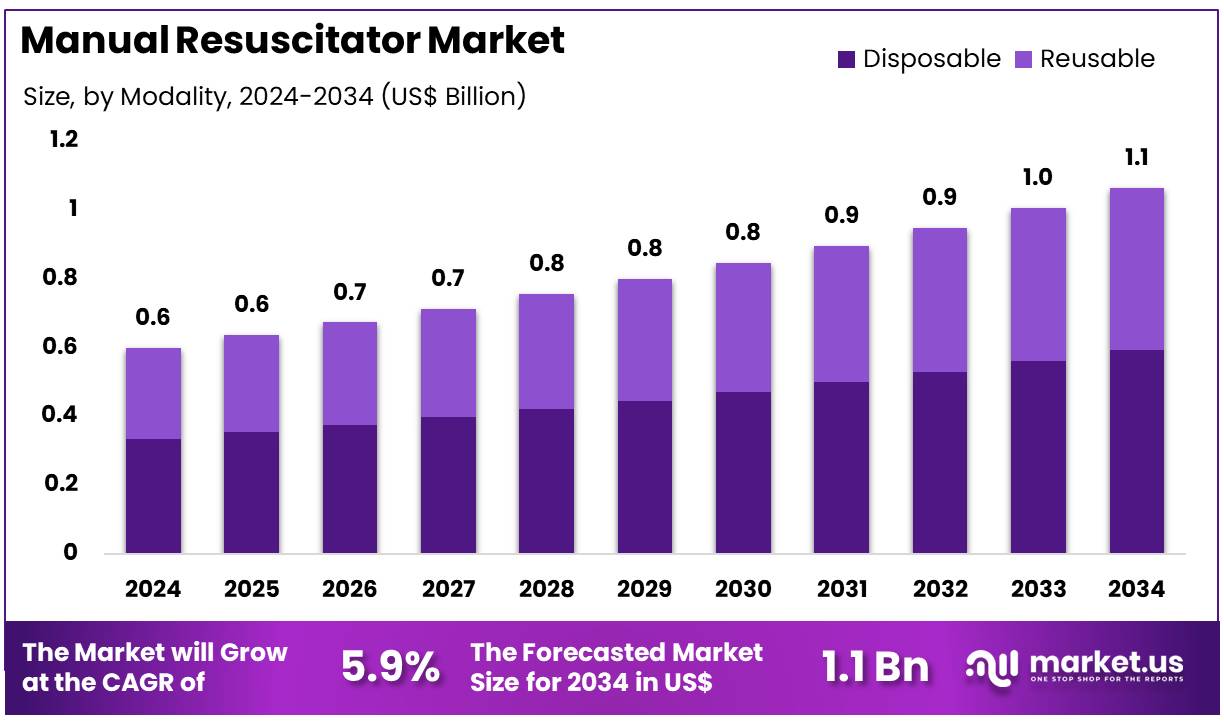
Key Takeaways
- The global manual resuscitator market was valued at US$ 0.6 billion in 2024 and is projected to reach US$ 1.1 billion by 2034, expanding at a CAGR of 5.9% during the forecast period.
- By product type, the market is segmented into self-inflating, flow inflating, and T-piece. Among these, the self-inflating segment dominated the market with a 40.2% share.
- Based on modality, the market is categorized into disposable and reusable manual resuscitators. The disposable segment accounted for the largest market share of 55.7%.
- In terms of technology, the market is classified into pop-off valve, PEEP valve, and others. The pop-off valve segment emerged as the leading category, capturing 49.8% of the total market revenue.
- By application, the market is segmented into chronic obstructive pulmonary disease (COPD), cardiopulmonary arrest, and others. The COPD segment held the highest market share at 42.1%.
- Based on material, the market includes silicon, PVC, and rubber. Among these, PVC accounted for the largest share, representing 48.9% of the market.
- By end user, the market is divided into hospitals, ambulatory surgical centers (ASCs), and others. The hospitals segment led the market with a 55.1% revenue share.
- North America remained the leading regional market, accounting for 39.5% of the global manual resuscitator market share in 2024.
Statistical Information
- Rising Burden of Cardiovascular Diseases Drives Emergency Resuscitation Demand: Cardiovascular diseases (CVDs) remain the leading cause of death globally, creating continuous demand for emergency ventilation devices such as manual resuscitators. According to the World Health Organization (WHO), 19.8 million people died from CVDs in 2022, representing 32% of all global deaths. Around 85% of these deaths were due to heart attacks and strokes, conditions that frequently require immediate resuscitation support.
- High Global Prevalence of Respiratory Diseases Supports Manual Resuscitator Use: Chronic respiratory diseases continue to increase the need for emergency respiratory care. WHO estimates that 363 million people were living with asthma in 2023, while chronic obstructive pulmonary disease (COPD) affects hundreds of millions of people worldwide and remains one of the leading causes of death globally. These patients are at greater risk of respiratory failure requiring assisted ventilation.
- EMS Frequently Uses Bag-Valve-Mask Ventilation During Cardiac Arrest: Data from the U.S. National Emergency Medical Services Information System (NEMSIS) found that EMS responded to over 570,000 adult out-of-hospital cardiac arrest events. Among these cases, bag-valve-mask ventilation was performed in 10.1% of documented emergency responses, confirming its routine use in pre-hospital care.
- Faster Emergency Response Improves Survival Outcomes: NEMSIS data shows the median EMS response time was 7 minutes, with a median scene time of 17 minutes. Because brain damage can begin within minutes of oxygen deprivation, manual resuscitators are essential for providing immediate ventilation before advanced airway management.
- Increasing Asthma Burden Creates More Emergency Respiratory Cases: WHO estimates that 363 million people worldwide were living with asthma in 2023, and the disease caused approximately 442,000 deaths globally. Severe asthma attacks often require emergency ventilation support using manual resuscitators until definitive treatment is available.
- Growing Burden of Premature Cardiac Arrest Supports EMS Expansion: CDC research estimates that approximately 1,000 out-of-hospital cardiac arrests are assessed by EMS every day in the United States, while nearly 90% of patients do not survive. These figures continue to drive investment in emergency response systems and essential resuscitation equipment.
- Occupational Outlook for Market Research Analysts: The U.S. Occupational Outlook Handbook reports that employment of market research analysts is projected to grow 7% from 2024 to 2034, faster than the average for all occupations, reflecting rising demand for data-driven marketing and consumer insight.
- Workplace Internet Use in EU Non‑Financial Business Economy: In 2024, 62.9% of people employed in the European Union’s non‑financial business economy used the internet at the workplace for business purposes, according to Eurostat’s regional digital society statistics.
- Adoption of Artificial Intelligence by EU Enterprises: In 2024, 13.5% of enterprises with 10 or more persons employed in the EU’s non‑financial business economy made use of AI technologies in their business operations, based on the EU survey on ICT usage and e‑commerce in enterprises.
Regional Analysis
North America dominated the manual resuscitator market in 2024 with a 39.5% market share, supported by advanced healthcare systems, strong emergency medical services (EMS), and a high burden of respiratory and cardiac emergencies. The United States continues to report millions of adults living with chronic respiratory diseases such as chronic obstructive pulmonary disease (COPD), increasing the need for manual ventilation devices during emergency treatment.
Government agencies also continue to invest in emergency preparedness and medical innovation. The National Science Foundation (NSF) has supported the development of next-generation bag-valve-mask technologies designed to improve patient safety and simplify emergency use. In addition, continued investments in EMS infrastructure, workforce development, and disaster preparedness strengthen demand for reliable manual resuscitators across hospitals, ambulances, and emergency response settings.
Asia Pacific is projected to register the fastest growth during the forecast period due to expanding healthcare infrastructure, increasing emergency care capacity, and growing awareness of cardiopulmonary resuscitation (CPR). Countries across the region are strengthening emergency medical services through government-led healthcare initiatives and WHO-supported emergency medical team programs.
The region also faces a high burden of respiratory diseases, creating sustained demand for portable resuscitation equipment in hospitals and pre-hospital care. Public awareness campaigns, CPR training programs, and investments in ambulance services are improving emergency response capabilities, while rising healthcare spending and expanding access to critical care services are expected further to accelerate the adoption of manual resuscitators across Asia Pacific.
Emerging Trends
- Growing focus on emergency preparedness: Governments are strengthening emergency and critical care systems, increasing demand for manual resuscitators in hospitals, ambulances, and disaster response units. The World Health Organization includes adult and pediatric bag-valve-mask resuscitators in its essential emergency equipment list for first-referral healthcare facilities.
- Development of user-friendly resuscitation devices: Manufacturers are designing manual resuscitators with pressure-limiting valves, ergonomic grips, and better oxygen delivery to reduce ventilation errors. These improvements help healthcare workers provide safer respiratory support while reducing complications caused by excessive ventilation pressure.
- Increasing demand from respiratory disease management: Rising respiratory illnesses continue to support market growth. According to the CDC, more than 15 million U.S. adults live with chronic obstructive pulmonary disease (COPD), creating consistent demand for emergency ventilation devices in hospitals and pre-hospital care.
- Greater emphasis on infection prevention: Healthcare facilities increasingly use bacterial filters, disposable accessories, and improved respiratory protection during manual ventilation procedures. CDC respiratory protection guidance encourages proper infection-control practices, supporting the adoption of safer resuscitation equipment in healthcare settings.
- Expansion of neonatal and pediatric resuscitation programs: Healthcare providers are expanding newborn and pediatric emergency care, increasing demand for specialized neonatal manual resuscitators. WHO recommends dedicated adult and pediatric resuscitation equipment as part of essential emergency care to improve survival during respiratory emergencies.
Use Cases
- Emergency medical services (EMS): Manual resuscitators are widely used by ambulance teams to provide immediate ventilation for patients experiencing cardiac arrest, trauma, drowning, or respiratory failure before reaching hospitals. WHO recommends these devices as essential emergency equipment for frontline healthcare facilities.
- Hospital emergency departments and ICUs: Hospitals use manual resuscitators during respiratory emergencies, patient transport, and ventilator disconnections. They provide immediate breathing support until mechanical ventilation is available, helping maintain oxygen delivery during critical care procedures.
- Operating rooms and anesthesia support: Manual resuscitators are routinely used before intubation, during anesthesia induction, and after surgical procedures. They provide temporary ventilation whenever patients cannot breathe independently, ensuring continuous oxygen supply throughout perioperative care.
- Neonatal resuscitation after birth: Neonatal manual resuscitators help newborns with breathing difficulties immediately after delivery. WHO recommends appropriate neonatal resuscitation equipment to improve newborn survival, especially in facilities managing high-risk births and emergency obstetric care.
- Disaster response and remote healthcare: Manual resuscitators are essential during natural disasters, humanitarian emergencies, and field hospitals because they operate without electricity. Their portability and simple design make them valuable in remote locations where advanced ventilators are unavailable.
Frequently Asked Questions on Manual Resuscitator
- Who uses manual resuscitators?
Manual resuscitators are used by emergency medical technicians, paramedics, physicians, nurses, anesthesiologists, and respiratory therapists. These devices are essential for providing immediate respiratory support during emergencies, surgeries, patient transport, and intensive care treatment. - What are the main components of a manual resuscitator?
A manual resuscitator consists of a self-inflating bag, patient valve, face mask, oxygen reservoir, and oxygen tubing. Some advanced models also include pressure-relief valves and bacterial filters to improve ventilation safety and reduce infection risks. - Why are manual resuscitators important in emergency care?
Manual resuscitators provide lifesaving ventilation during cardiac arrest, respiratory failure, drowning, trauma, and anaesthesia-related emergencies. They help maintain oxygen delivery until patients receive mechanical ventilation or recover spontaneous breathing, improving survival during critical situations. - What types of manual resuscitators are available?
Manual resuscitators are available for adults, children, and newborns. They come in reusable and disposable versions with different bag sizes, oxygen reservoir capacities, and pressure-control features designed for various clinical and emergency healthcare applications. - Which region dominates the manual resuscitator market?
North America leads the market due to advanced healthcare infrastructure, well-established emergency medical systems, and a high burden of respiratory diseases. Continued investments in medical technology and emergency preparedness further support the region’s market leadership. - Which region is expected to witness the fastest market growth?
Asia Pacific is projected to record the highest CAGR because of improving healthcare facilities, expanding emergency medical services, increasing healthcare expenditure, and growing awareness of cardiopulmonary resuscitation (CPR), especially in developing countries across the region.
Conclusion
The manual resuscitator market is expected to witness steady growth, driven by the increasing prevalence of respiratory diseases, expanding emergency medical services, and rising investments in healthcare infrastructure worldwide. North America remains the leading regional market due to its advanced healthcare system and strong focus on emergency preparedness.
At the same time, Asia Pacific is projected to experience the fastest growth because of improving healthcare access and growing awareness of CPR and critical care. Continuous innovations, including ergonomic designs, infection-control features, and neonatal-specific devices, are enhancing product performance and patient safety. Increasing adoption across hospitals, ambulances, and disaster response settings will continue to support long-term market expansion.
Discuss your needs with our analyst
Please share your requirements with more details so our analyst can check if they can solve your problem(s)




