


Overview
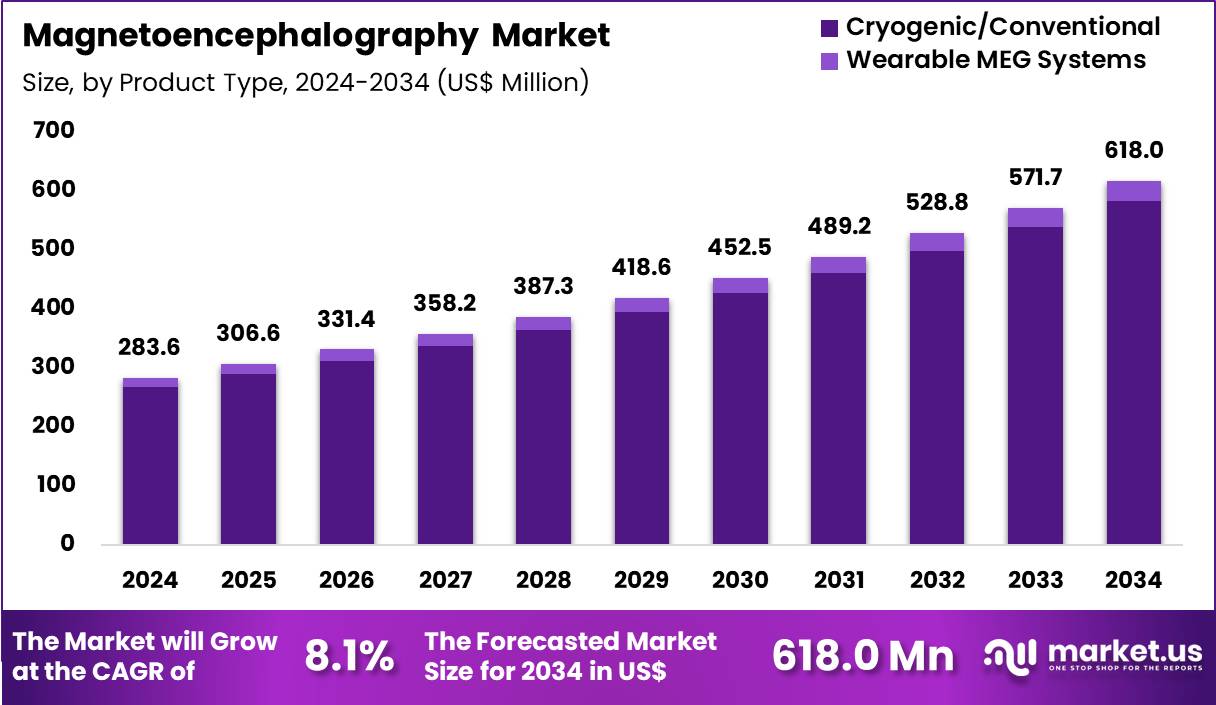
New York, NY – Sep 28, 2026 – The Global Magnetoencephalography Market size is expected to be worth around US$ 618.0 Million by 2034 from US$ 283.6 Million in 2024, growing at a CAGR of 8.1% during the forecast period 2025 to 2034. In 2024, North America led the market, achieving over 41.4% share with a revenue of US$ 117.4 Million.
Magnetoencephalography (MEG) is a non-invasive brain-monitoring technology that measures the very weak magnetic fields produced by electrical activity in the brain. Unlike electroencephalography (EEG), which measures electrical signals from the scalp, MEG detects magnetic signals using highly sensitive sensors positioned around the head. The technology provides excellent time resolution, allowing brain activity to be observed at millisecond scale, while also supporting accurate localization of active brain regions.
MEG is mainly used in epilepsy evaluation and for mapping important brain functions before neurosurgery. It can help identify areas associated with abnormal electrical activity and functional regions responsible for movement, hearing, vision, and other activities. The U.S. FDA has cleared MEG systems for non-invasive localization of brain activity and epileptic activity, with information potentially supporting neurosurgical planning.
From a market perspective, demand is supported by increasing neurological disease burden, greater use of advanced brain-mapping technologies, and improvements in MEG equipment. The World Health Organization reported in 2025 that neurological conditions affect more than 40% of the global population and remain a major cause of ill health and disability.
Key Takeaways
- In 2024, the market was valued at US$ 283.6 million, growing at a CAGR of 8.1%, and is projected to reach US$ 618.0 million by 2034.
- By product type, the market is segmented into cryogenic/conventional and wearable MEG systems. Cryogenic/conventional MEG systems dominated the market in 2023, accounting for 94.3% of the market share.
- By application, the market is categorized into clinical and research applications, with clinical applications accounting for a significant market share of 72.8%.
- By end user, the market is segmented into hospitals and neurology clinics, imaging centers, and academic and research institutions. Hospitals and neurology clinics held the largest revenue share of 45.1%.
- Regionally, North America dominated the market in 2024, accounting for 41.4% of the total market share.
Key Market Segments
- Product Type Analysis: Cryogenic or conventional MEG systems dominated the market, accounting for 94.3% of the share. Their high signal accuracy, established clinical validation, and integration with existing diagnostic workflows support widespread adoption in hospitals and specialized neurological centers.
- Application Analysis: Clinical applications accounted for 72.8% of the market, driven by increasing demand for advanced neurological diagnosis, epilepsy surgery planning, and functional brain mapping. High temporal accuracy, noninvasive assessment, and growing adoption across specialized neurological centers further support segment growth.
- End-User Analysis: Hospitals and neurology clinics held 45.1% of the market, supported by rising demand for advanced neurological diagnostics and presurgical brain mapping. Established imaging infrastructure, specialized clinical expertise, high patient volumes, and integration across neurology and neurosurgery departments drive adoption.
Regional Analysis
North America Magnetoencephalography Market
North America accounted for 41.4% of the global magnetoencephalography (MEG) market in 2024, supported by substantial investments in neurological research and advanced brain mapping technologies. The region benefits from established hospitals, leading academic institutions, and increasing adoption of MEG for epilepsy surgery planning and functional brain mapping.
Research funding, technological advancements, and collaborations between pharmaceutical companies and research institutions further support market development. The growing need for neurological diagnosis, including epilepsy and dementia, is also contributing to regional demand. Improvements in sensor technology and clinical applications are expected to support continued adoption.
Asia Pacific Magnetoencephalography Market
Asia Pacific is projected to register the highest CAGR during the forecast period, driven by rising healthcare investments, expanding neurological facilities, and growing awareness of advanced diagnostic technologies. Government initiatives, international research collaborations, and increasing adoption of MEG-MRI systems are supporting regional market growth.
The substantial epilepsy burden across low- and middle-income countries further highlights the need for improved neurological diagnostic infrastructure.
Emerging Trends
- Development of More Comfortable MEG Systems: Newer MEG systems are being developed with improved patient comfort, easier positioning, and more flexible system designs. These developments can support wider clinical and research use, particularly where long recording sessions are required.
- Integration With MRI and EEG: MEG is increasingly being combined with MRI and EEG data. This approach provides both anatomical and functional information, helping clinicians understand where brain activity occurs and how it relates to brain structure.
- Growing Use of Artificial Intelligence: Advanced signal-processing, machine-learning, and brain-network analysis methods are being investigated to improve interpretation of MEG data. These technologies may support more automated identification of abnormal patterns and neurological biomarkers.
- Expansion Beyond Epilepsy: Although epilepsy and pre-surgical brain mapping remain established applications, research is expanding toward Alzheimer’s disease, autism spectrum disorder, traumatic brain injury, schizophrenia, Parkinsonian disorders, and other neurological conditions.
- Increasing Focus on Neurological Disease Management: The growing global burden of neurological conditions is supporting interest in technologies that can provide detailed information about brain function. WHO reported that neurological conditions affect more than one-third of people worldwide, strengthening the need for improved neurological assessment and care.
Use Cases
- Epilepsy Evaluation: MEG is widely used to locate abnormal brain activity associated with epilepsy. The information can help identify potential seizure-generating regions and support treatment planning, particularly for patients being considered for epilepsy surgery.
- Pre-Surgical Brain Mapping: MEG can identify functional areas of the brain involved in movement, hearing, vision, and other activities. This information can be combined with anatomical imaging to support planning for neurosurgical procedures.
- Neurological Disease Research: MEG is used in research involving Alzheimer’s disease, Parkinsonian disorders, autism, schizophrenia, stroke, and traumatic brain injury. Researchers can study changes in brain networks and patterns of neural activity.
- Cognitive and Brain-Function Studies: Because MEG records brain activity with millisecond-level timing, it is useful for studying language, memory, perception, attention, sensory processing, and other cognitive functions.
- Development of Neurological Biomarkers: MEG data are increasingly being studied for identifying measurable patterns associated with neurological disorders. Advanced connectivity analysis and machine-learning techniques may support future biomarker development and disease characterization.
Frequently Asked Questions About Magnetoencephalography
- What is MEG mainly used for?
MEG is mainly used for locating epileptic brain activity and mapping important functional brain areas before surgery. It is also used in neuroscience research to investigate language, perception, memory, cognition, and neurological disorders. - How is MEG different from EEG?
EEG records electrical potentials from electrodes placed on the scalp, whereas MEG measures magnetic fields generated by brain activity. Both provide excellent temporal information, but MEG can offer advantages for localizing certain cortical sources because magnetic signals experience less distortion from the skull. - Is Magnetoencephalography safe?
MEG is a non-invasive measurement technique and does not expose patients to ionizing radiation. During an examination, sensors detect magnetic signals outside the head. MEG is therefore suitable for repeated measurements when clinically or scientifically appropriate. - Which application is important in the MEG market?
Clinical applications, particularly epilepsy evaluation and pre-surgical brain mapping, represent important areas of MEG adoption. MEG can provide information about epileptic activity and functional brain regions that may support neurosurgical planning alongside other diagnostic methods. - Which factors may limit market expansion?
High equipment and operating costs, specialized infrastructure requirements, magnetic shielding needs, and the availability of trained specialists can limit MEG adoption. These requirements can make MEG less accessible than conventional neurological testing in some healthcare settings. - What is the future outlook for the MEG market?
The market outlook is linked to continued improvements in sensor technology, data analysis, artificial intelligence, multimodal imaging, and clinical research. Expansion into additional neurological and cognitive applications could broaden the addressable market over the longer term.
Conclusion
The magnetoencephalography market is poised for substantial growth, driven by rising neurological disease prevalence, increasing demand for advanced diagnostic technologies, and continuous improvements in MEG systems. Cryogenic/conventional systems and clinical applications continue to dominate, while hospitals and neurology clinics remain key end users.
North America maintains a leading position, whereas Asia Pacific is expected to experience the fastest growth during the forecast period. Technological advancements, including wearable sensors, artificial intelligence, and integration with MRI and EEG, are expected to expand clinical applications. However, high equipment costs, infrastructure requirements, and limited specialist availability may influence future market expansion.
Discuss your needs with our analyst
Please share your requirements with more details so our analyst can check if they can solve your problem(s)




