


Overview
New York, NY – Sep 24, 2026 – The Global Laryngoscopes Market size is expected to be worth around US$ 985.8 Million by 2034 from US$ 510.6 Million in 2024, growing at a CAGR of 6.8% during the forecast period 2025 to 2034. In 2024, North America led the market, achieving over 37.5% share with a revenue of US$ 191.5 Billion.
Laryngoscopes are specialized medical instruments used to examine the larynx and vocal cords and to facilitate endotracheal intubation during surgical procedures, emergency care, and anesthesia. These devices provide healthcare professionals with a clear view of the airway, supporting safe airway management and diagnosis of conditions affecting the throat and larynx.
Laryngoscopes are available in several types, including direct, video, and flexible laryngoscopes. Traditional direct laryngoscopes use a blade and light source to provide a direct view of the airway. Video laryngoscopes incorporate a camera and display system, enabling an enlarged view of the airway and supporting intubation in patients with difficult airway anatomy. Flexible laryngoscopes are commonly used for diagnostic examinations and procedures requiring access through the nose or mouth.
Technological advancements have contributed to the development of compact, portable, and high-resolution devices with improved visualization capabilities. The increasing emphasis on patient safety, rising surgical volumes, and growing demand for advanced airway management solutions are supporting the adoption of modern laryngoscopy systems.
Hospitals, ambulatory surgical centers, emergency departments, and specialty clinics represent key end-use settings. Increasing healthcare infrastructure, particularly in emerging economies, is also expected to create opportunities for laryngoscope manufacturers. The market continues to evolve toward improved visualization, ease of use, portability, and integration with digital healthcare technologies.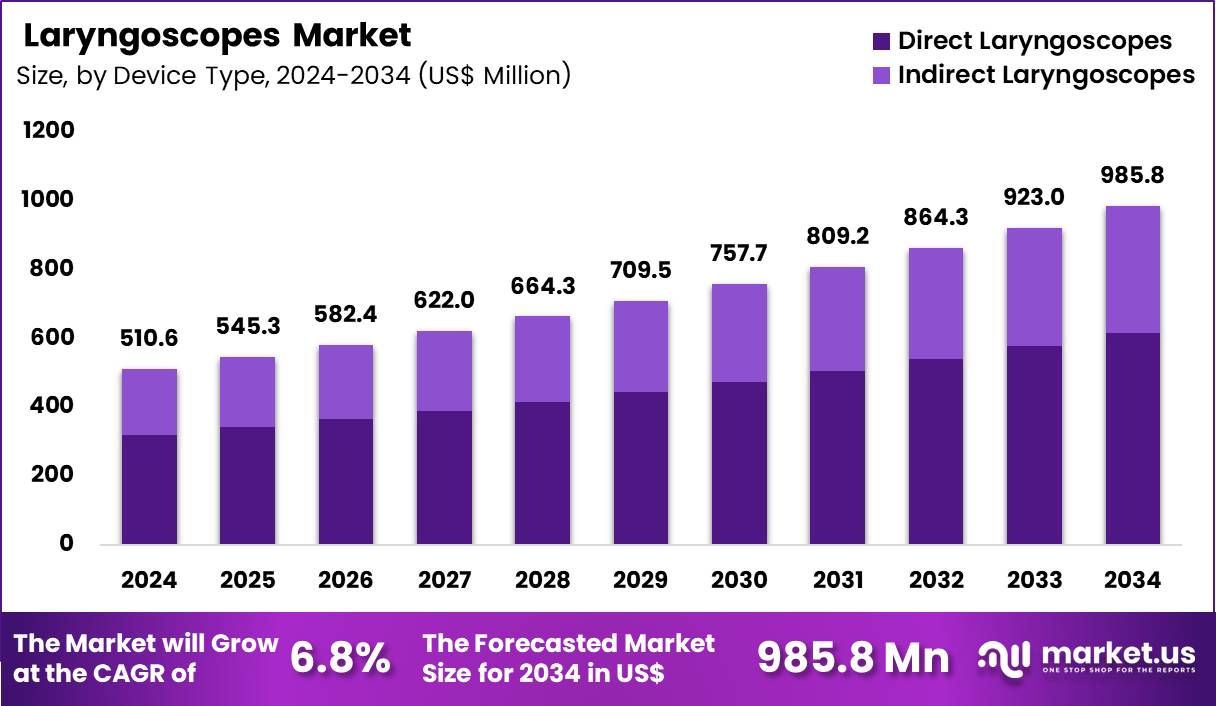
Key Takeaways
- The global laryngoscopes market was valued at US$ 510.6 million in 2024 and is projected to reach US$ 985.8 million by 2034, registering a CAGR of 6.8% during the forecast period.
- Direct laryngoscopes dominated the device type segment in 2024, accounting for a 62.6% market share.
- Video laryngoscopes led the type segment with a significant 71.4% revenue share.
- Reusable laryngoscopes accounted for the largest share of the usability segment, representing 65.8% of the market.
- Macintosh blades dominated the blade design segment with a 59.9% revenue share.
- Airway management was the leading application, accounting for 37.2% of the market.
- Hospitals represented the largest end-user segment, contributing 56.5% of the total market revenue.
- North America led the global market in 2024, accounting for 37.5% of the market share.
Key Market Segments
- Device Type Analysis: Direct laryngoscopes, accounting for 62.6%, are projected to maintain dominance due to their simplicity, reliability, rapid deployment, and cost-effectiveness. Their widespread use in routine airway management, emergency procedures, and clinical training, combined with established familiarity among healthcare professionals, supports sustained demand across healthcare facilities.
- Type Analysis: Video laryngoscopes, holding 71.4%, are expected to lead the segment owing to enhanced airway visualization and growing adoption for difficult intubation procedures. Increasing use in emergency care, critical care, and training programs, alongside technological improvements in imaging and portability, is supporting market expansion.
- Usability Analysis: Reusable laryngoscopes, representing 65.8%, are anticipated to dominate due to their long-term cost efficiency and durability. Established sterilization practices, repeated clinical use, and reduced recurring procurement requirements support adoption. Hospitals also increasingly consider sustainability and operational efficiency when selecting airway management equipment.
- Blade Design Analysis: Macintosh blades, accounting for 59.9%, are projected to remain dominant because of their established clinical acceptance, versatility, and widespread availability. Their extensive use in medical training, compatibility with direct and video laryngoscopes, and predictable performance continue to support strong demand across healthcare settings.
- Application Analysis: Airway management, holding 37.2%, is expected to remain the leading application due to the essential role of laryngoscopes in intubation procedures. Rising surgical activity, emergency care requirements, intensive care admissions, and continued airway management training are supporting consistent demand for reliable laryngoscopy devices.
- End-User Analysis: Hospitals, representing 56.5%, are projected to dominate end-user demand due to high volumes of surgical, emergency, and critical care procedures. Comprehensive equipment requirements, centralized procurement, advanced training programs, and established infection-control infrastructure further support laryngoscope adoption across hospital operating rooms and intensive care units.
Regional Analysis
North America led the global laryngoscopes market in 2024, accounting for 37.5% of the market share. Regional growth is supported by advanced healthcare infrastructure, high adoption of video laryngoscopy, and increasing demand for sophisticated airway management solutions. Growing surgical volumes, emergency care requirements, and the rising prevalence of difficult airway cases are contributing to sustained demand.
Hospitals are also adopting disposable and technologically advanced laryngoscopy systems to strengthen infection control and procedural efficiency. Established clinical training programs and the presence of major medical device manufacturers further support market development.
Asia Pacific is projected to register the highest CAGR during the forecast period. Market expansion is being supported by improving healthcare infrastructure, increasing healthcare expenditure, and rising demand for advanced diagnostic and airway management technologies.
Growing surgical activity, expanding critical care capacity, and investments in medical training are encouraging the adoption of video and fiberoptic laryngoscopes. Increasing awareness of infection prevention and the expansion of healthcare services across emerging economies are expected to further accelerate regional demand.
Emerging Trends
- Growing adoption of video laryngoscopes: Video laryngoscopy is becoming an important alternative to traditional direct laryngoscopy. These devices use a camera and display to provide a view of the vocal cords, which can make airway visualization easier. A 2024 meta-analysis of emergency intubations found higher first-attempt success with video laryngoscopy compared with direct laryngoscopy.
- Development of compact and portable devices: Manufacturers are increasingly focusing on equipment that can be used outside the operating room, including emergency departments, intensive-care units, ambulances, and other critical-care environments. This trend is supported by evidence on video laryngoscopy in out-of-hospital intubation, where studies have examined its use by physicians, nurses, and paramedics.
- Greater focus on difficult-airway management: Laryngoscope development is increasingly centered on improving visibility in patients where conventional intubation can be difficult. Recent clinical reviews report that several video laryngoscope designs can improve the laryngeal view and, in some settings, first-pass success.
- Standardization and regulatory focus on video technology: The regulatory environment is also adapting to video laryngoscopy. In 2025, the U.S. FDA recognized ISO 7376-2:2025, which specifies requirements for electrically powered video laryngoscopes, including the handle, rigid blade, light source, camera, and image display. This indicates increasing standardization of video-enabled airway devices. FDA Access Data
- Increasing focus on measurable clinical outcomes: Research and product evaluation are increasingly concentrating on measurable outcomes such as first-pass success, intubation time, glottic view, complications, and esophageal intubation. A recent systematic review of critically ill adults reported improved first-attempt success with video laryngoscopy, although the authors noted substantial variation between studies and limited certainty for some outcomes.
Use Cases
- Endotracheal intubation during surgery: Laryngoscopes are widely used to visualize the airway and guide placement of an endotracheal tube during general anesthesia. Both direct and video laryngoscopes are used depending on the patient, procedure, and clinical setting.
- Emergency airway management: Laryngoscopes are used when rapid airway control is required, including serious trauma, respiratory failure, and other emergencies. Evidence from emergency-intubation studies indicates that video laryngoscopy can improve first-attempt success in several emergency settings.
- Intensive-care unit airway management: Critically ill patients can require urgent endotracheal intubation because of respiratory failure or inability to maintain adequate oxygenation. Video laryngoscopy is increasingly evaluated in ICUs because improved visualization may assist airway management in challenging patients.
- Pre-hospital and ambulance services: Portable laryngoscopes are used by emergency medical teams for airway management before a patient reaches a hospital. A systematic review covering 25 studies and 35,489 out-of-hospital intubations found that video laryngoscopy was associated with improved first-pass success in several clinician groups, although substantial differences existed between studies.
- Cardiac arrest and resuscitation: Laryngoscopes can be used to establish an advanced airway during cardiopulmonary resuscitation. However, recent ILCOR-supported evidence found that while video laryngoscopy may improve some process measures, there is currently no evidence that it improves return of spontaneous circulation or survival compared with direct laryngoscopy during cardiac arrest.
Frequently Asked Questions About Laryngoscopes
- What are the main types of laryngoscopes?
The main types include direct laryngoscopes, video laryngoscopes, flexible laryngoscopes, and rigid laryngoscopes. These devices differ in design, visualization method, flexibility, illumination, and intended clinical applications across airway management and diagnostic procedures. - Where are laryngoscopes commonly used?
Laryngoscopes are primarily used in hospitals, ambulatory surgical centers, emergency departments, intensive care units, operating rooms, and specialized clinics. Their applications include airway management, intubation, laryngeal examination, and certain surgical procedures. - What are the benefits of video laryngoscopes?
Video laryngoscopes can provide improved airway visualization through an integrated camera and monitor. They may support difficult airway management, reduce the need for direct line-of-sight visualization, and facilitate teaching, documentation, and clinical collaboration. - What factors are driving the laryngoscopes market?
Market growth is supported by increasing surgical procedures, rising demand for effective airway management, technological advancements in video visualization, growing healthcare expenditure, and increasing adoption of advanced devices for difficult airway management. - What are the major market trends in laryngoscopes?
Key trends include increasing adoption of video laryngoscopy, development of compact and portable devices, integration of high-resolution imaging, greater use of disposable components, improved ergonomics, and technological development for challenging airway procedures. - How is technological innovation influencing the laryngoscopes market?
Technological innovation is supporting improved visualization, portability, image quality, device ergonomics, and connectivity. Integration of cameras, digital displays, recording capabilities, and advanced imaging technologies is contributing to product differentiation and clinical adoption. - What is the outlook for the laryngoscopes market?
The market outlook remains linked to increasing surgical volumes, demand for effective airway management, healthcare infrastructure development, and continued adoption of video-based technologies. Product innovation and expanding healthcare access are expected to influence future market development.
Conclusion
The global laryngoscopes market is expected to witness steady growth, supported by rising surgical volumes, increasing demand for effective airway management, and continued technological advancements. Video laryngoscopes are gaining importance due to enhanced visualization and growing use in difficult-airway procedures, emergency care, and critical care.
Reusable devices and Macintosh blades continue to maintain significant market positions because of their established clinical acceptance and cost efficiency. North America remains a leading regional market, while Asia Pacific is expected to experience comparatively faster expansion as healthcare infrastructure and expenditure increase.
Overall, product innovation, portability, infection-control requirements, and expanding healthcare access are expected to shape future market development.
Discuss your needs with our analyst
Please share your requirements with more details so our analyst can check if they can solve your problem(s)




