


Overview
New York, NY – Sep 17, 2026 – The Global Laryngeal Mask Market size is expected to be worth around US$ 1,410.7 Million by 2034 from US$ 765.8 Million in 2024, growing at a CAGR of 6.3% during the forecast period 2025 to 2034. In 2024, North America led the market, achieving over 42.8% share with a revenue of US$ 327.8 Million.
Laryngeal Mask is an essential supraglottic airway device widely used for airway management during anesthesia, emergency medicine, and intensive care. It provides effective ventilation without entering the trachea, reducing airway trauma compared with endotracheal intubation. The device is available in 8 standard sizes, suitable for patients ranging from less than 5 kg to over 100 kg, and can typically be inserted in 20–30 seconds by trained healthcare professionals.
The increasing number of surgical procedures worldwide continues to drive the use of laryngeal masks. According to the World Health Organization (WHO), nearly 313 million surgical procedures are performed globally every year.
The World Federation of Societies of Anaesthesiologists (WFSA) estimates that more than 500 million anesthetic procedures are administered annually, all of which require safe and effective airway management. Additionally, the Global Burden of Disease Study reports over 27 million emergency department admissions related to trauma annually, further supporting demand for rapid airway devices.
Modern second-generation laryngeal masks provide oropharyngeal leak pressures of 30–40 cm H₂O, improving ventilation efficiency while lowering aspiration risk through integrated gastric drainage channels.
Clinical studies report first-attempt insertion success rates exceeding 90–95% in routine anesthesia. Disposable laryngeal masks have gained popularity, helping reduce the incidence of healthcare-associated infections, which affect approximately 1 in every 31 hospitalized patients on any given day, according to the U.S. CDC.
With global healthcare expenditure exceeding US$ 9.8 trillion annually (WHO), expanding hospital infrastructure, rising surgical volumes, and increasing adoption of advanced airway management technologies are expected to sustain strong demand for laryngeal masks across hospitals, ambulatory surgical centers, and emergency care settings.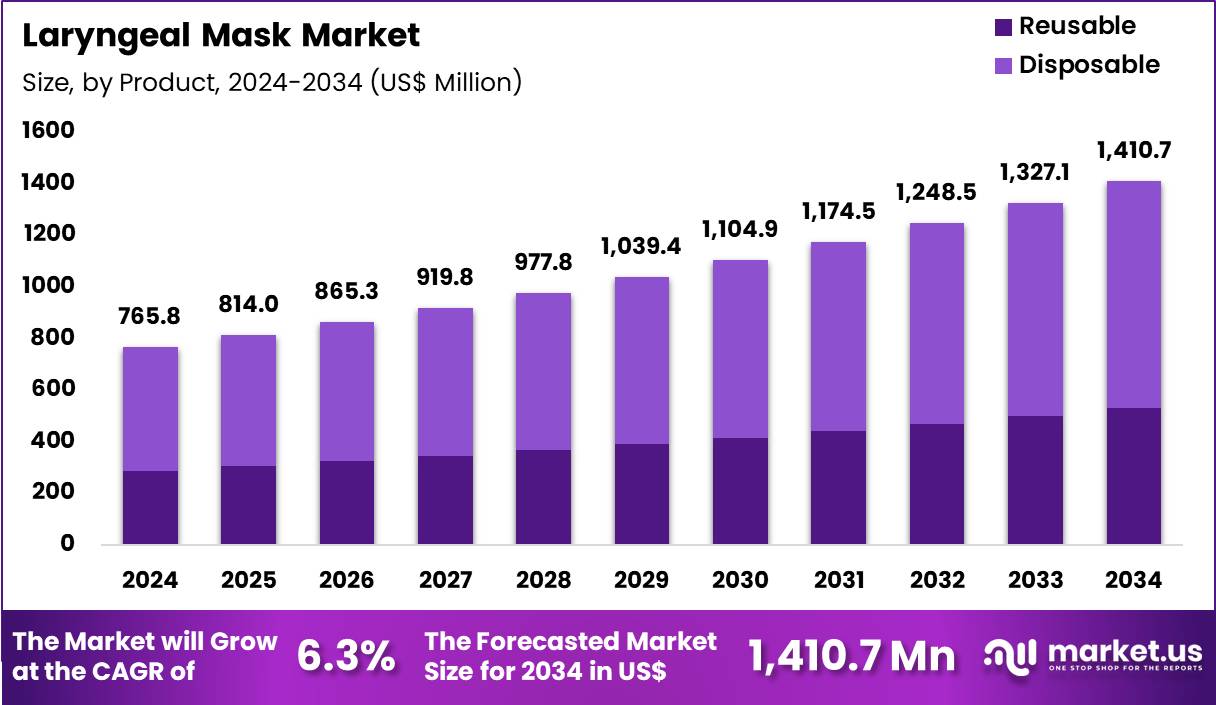
Key Takeaways
- The global Laryngeal Mask Market was valued at US$ 765.8 million in 2024 and is projected to reach US$ 1,410.7 million by 2034, expanding at a CAGR of 6.3% during the forecast period.
- By Product, the market is categorized into Reusable and Disposable, with the Disposable segment accounting for the largest share of 62.5% in 2024.
- By Age Group, the market is segmented into Adults, Pediatric, and Geriatric, with the Adults segment dominating the market with a 58.9% share in 2024.
- By End User, the market is classified into Hospitals & Clinics, Ambulatory Surgical Centers (ASCs), and Diagnostic Centers, with Hospitals & Clinics holding the leading share of 59.3% in 2024.
- North America emerged as the leading regional market, capturing a 42.8% share of the global market in 2024.
Market Segmentation Overview
- Product Analysis: Disposable laryngeal masks held the largest market share of 62.5% in 2024, driven by stringent infection-control protocols and rising demand for single-use airway devices. They eliminate cross-contamination risks, require no sterilization, and are widely used in emergency care. Modern disposable LMAs with gastric drainage channels and reinforced tubes improve patient safety, while reusable silicone LMAs can withstand 30–40 sterilization cycles for cost-efficient hospital use.
- Age-Group Analysis: The Adults segment accounted for 58.9% of the laryngeal mask market in 2024, supported by the high number of adult surgical procedures worldwide. Adult LMAs are extensively used in general anesthesia, laparoscopic, orthopedic, and emergency surgeries. Available in multiple sizes for patients weighing 30–100+ kg, they provide effective ventilation, while pediatric LMAs continue gaining adoption in specialized children’s surgical units.
- End-User Analysis: Hospitals & Clinics dominated the market with a 59.3% share in 2024, reflecting their high volume of surgical, emergency, and intensive care procedures. Laryngeal masks are widely used in operating rooms, ICUs, and trauma centers because they enable rapid airway management. Growing outpatient surgeries are also boosting adoption in Ambulatory Surgical Centers, where faster anesthesia recovery and improved procedural efficiency are key priorities.
Statistical Information
- Hospitals Reduced Major Infection Rates in 2024: CDC data shows measurable improvements in hospital infection prevention during 2024, including a 9% reduction in central line-associated bloodstream infections (CLABSI), a 10% reduction in catheter-associated urinary tract infections (CAUTI), an 11% reduction in C. difficile infections, a 7% reduction in MRSA bloodstream infections, and a 4% reduction in colon surgery surgical-site infections. These initiatives continue to support the use of sterile disposable airway devices.
- CMS Payment Policies Cover Approximately 4,000 Hospitals and 6,000 Ambulatory Surgical Centers: According to the U.S. Centers for Medicare & Medicaid Services (CMS), the 2026 Hospital Outpatient Prospective Payment System (OPPS) affects approximately 4,000 hospitals and 6,000 Ambulatory Surgical Centers (ASCs). The continued expansion of outpatient surgical services supports demand for rapid airway management devices, including laryngeal masks.
- CDC Tracks Infection Outcomes in More Than 3,281 Acute Care Hospitals: The CDC’s National Healthcare Safety Network (NHSN) collected surgical infection data from 3,281 acute care hospitals, covering approximately 2.82 million surgical procedures in one reporting period. This extensive surveillance emphasizes the healthcare industry’s focus on infection prevention and supports greater use of disposable airway devices.
- Laryngeal Masks Were Used in 28% of General Anesthesia Cases: A university ambulatory surgery study reported 6,430 general anesthetic procedures over two years, with 1,831 procedures (28%) using a laryngeal mask airway. The findings highlight the widespread acceptance of LMAs in outpatient surgery due to their ease of insertion and rapid recovery.
- WHO Surgical Safety Checklist Reduced Deaths by More Than 40%: The WHO reported that implementation of the Surgical Safety Checklist across 7,688 patients in 8 hospitals reduced major complications from 11.0% to 7.0% and lowered inpatient mortality from 1.5% to 0.8%, representing a reduction of more than 40% in surgical deaths.
- Checklist Compliance Increased From 36% to 68%: WHO pilot hospitals reported that adherence to essential surgical safety practices increased from 36% to 68% after introducing the Surgical Safety Checklist. Several hospitals achieved compliance rates approaching 1b00%, improving anesthesia safety and operating room performance.
- Emergency Surgery Carries Over Four Times Higher Aspiration Risk: According to the WHO Safe Surgery Guidelines, pulmonary aspiration occurs in approximately 2.6 per 10,000 elective surgical procedures compared with 11 per 10,000 emergency surgeries. For procedures using a laryngeal mask airway, the reported aspiration rate is approximately 2 per 10,000 cases.
- Outpatient Laryngopharyngeal Surgeries Increased to Nearly 190,000 Cases: Analysis of the U.S. National Survey of Ambulatory Surgery showed outpatient laryngopharyngeal surgeries increased from 176,305 procedures in 1996 to 189,930 procedures in 2006, reflecting growing demand for airway management devices in ambulatory surgical environments.
Regional Analysis
North America led the market by securing a market share of 42.8% in 2024.
North America dominated the global Laryngeal Mask Market with a 42.8% market share in 2024, driven by advanced healthcare infrastructure, high surgical volumes, and widespread adoption of modern airway management technologies.
According to the American Society of Anesthesiologists (ASA), nearly 80 million anesthetics are administered annually in the United States, creating substantial demand for laryngeal masks during surgical and emergency procedures. The Centers for Medicare & Medicaid Services (CMS) reports that approximately 4,000 hospitals and 6,000 Ambulatory Surgical Centers (ASCs) operate under the Medicare outpatient payment system, supporting high utilization of airway devices.
Additionally, the American Heart Association (AHA) recognizes supraglottic airway devices, including laryngeal masks, as appropriate advanced airway options during cardiopulmonary resuscitation by trained providers. Rising infection-control measures have also accelerated the use of disposable laryngeal masks. Continuous product innovation, strong reimbursement systems, and increasing outpatient surgical procedures continue to reinforce North America’s leadership in the global market.
Business Opportunities
The laryngeal mask market offers significant business opportunities driven by rising surgical volumes, expanding ambulatory care, and increasing emphasis on patient safety. According to the World Health Organization (WHO), more than 313 million surgical procedures are performed each year globally, creating sustained demand for airway management devices. Growing adoption of disposable laryngeal masks presents opportunities for manufacturers to develop infection-resistant, single-use products that align with stricter hospital hygiene protocols.
The rapid expansion of ambulatory surgical centers (ASCs) and outpatient procedures is increasing demand for airway devices that enable faster recovery and efficient patient turnover. Opportunities also exist in developing advanced second-generation laryngeal masks featuring gastric drainage channels, improved sealing pressures of 30–40 cm H₂O, and enhanced patient comfort.
Emerging healthcare investments across Asia-Pacific, Latin America, and the Middle East are expanding access to surgical services and emergency care. Additionally, partnerships with hospitals, emergency medical services, and government healthcare programs can help manufacturers strengthen distribution networks and increase market penetration globally.
Emerging Trends
- Growing Adoption of Disposable Laryngeal Masks: Hospitals are increasingly shifting toward disposable laryngeal masks to reduce healthcare-associated infections. According to the CDC, 1 in 31 hospitalized patients has at least one healthcare-associated infection on any given day, encouraging greater use of sterile single-use airway devices in operating rooms and emergency care.
- Development of Advanced Supraglottic Airway Standards: Device manufacturers are focusing on safer and more efficient airway products. In 2024, the U.S. FDA recognized ISO 11712:2023, which establishes international design and performance standards for supralaryngeal airways, including sizing, connectors, and compatibility requirements to improve patient safety.
- Increasing Use Beyond Operating Rooms: Laryngeal masks are now widely used in intensive care units, emergency departments, and prehospital emergency services. The NCBI StatPearls review highlights that since their introduction in 1983, LMAs have expanded from operating rooms to multiple emergency settings because they are easier and faster to place than traditional intubation in many situations.
- Innovation in Third-Generation Airway Devices: Manufacturers are introducing third-generation supraglottic airway devices with vision-guided placement, improved sealing cuffs, and gastric drainage channels. These innovations are designed to increase insertion accuracy, reduce airway complications, and improve ventilation during complex surgical and emergency procedures.
- Growing Regulatory Focus on Product Quality: Regulatory agencies continue strengthening oversight of airway devices. The FDA requires laryngeal masks marketed in the U.S. to meet stringent performance, biocompatibility, and safety requirements through recognized standards and premarket review, encouraging continuous product improvements and higher-quality airway management solutions.
Use Cases
- Routine General Anesthesia Procedures: Laryngeal masks are extensively used during elective surgeries requiring general anesthesia. With more than 313 million surgical procedures performed globally each year, these devices provide reliable airway management while reducing airway trauma compared with endotracheal intubation.
- Emergency Airway Management: LMAs are increasingly used as rescue airway devices during difficult or failed intubation. According to NCBI, they provide rapid oxygenation and ventilation in emergencies and are commonly used by emergency physicians, anesthesiologists, and trained prehospital providers.
- Ambulatory and Day-Care Surgeries: Outpatient surgical centers are adopting laryngeal masks because they support quick insertion, stable ventilation, and faster patient recovery. Their use helps improve operating room efficiency and enables high patient turnover during same-day surgical procedures.
- Difficult Airway and Intensive Care Applications: Healthcare providers use laryngeal masks as temporary airway devices in intensive care units and for patients with difficult airways. Modern devices can also serve as conduits for endotracheal intubation, improving airway access during critical interventions.
- Pediatric Airway Management: Laryngeal masks are widely used in pediatric anesthesia because they are available in multiple sizes and reduce airway irritation compared with endotracheal tubes. Standardized sizing requirements under ISO 11712:2023 help ensure compatibility and safe airway management across different patient age groups.
Recent Development
- In February 2025, Teleflex Incorporated announced its plan to separate into two publicly traded companies. One company (NewCo) will include the Urology, Acute Care, and OEM businesses, while the remaining company (RemainCo) will focus on hospital-based businesses, including vascular access, surgical, and respiratory/airway solutions.
- In December 2025, Teleflex Incorporated signed an agreement to divest its Acute Care and Interventional Urology businesses to Intersurgical Ltd. and its OEM business to Montagu Private Equity and Kohlberg & Company in a transaction valued at approximately US$2.03 billion, with completion expected in 2026.
- In 2026, Intersurgical Ltd. continued expanding its global respiratory and airway management portfolio through the planned acquisition of Teleflex’s Acute Care business, strengthening its presence in anesthesia and airway management solutions following the expected completion of the transaction.
- In 2026, Ambu A/S continued expanding its single-use airway management portfolio by strengthening its range of disposable airway devices and supporting healthcare providers with infection-control-focused solutions across anesthesia and emergency care.
- In 2026, Medtronic Plc continued investing in advanced respiratory and airway management technologies, focusing on innovations that improve ventilation efficiency, patient safety, and perioperative care across hospitals and surgical centers.
Frequently Asked Questions on Laryngeal Mask
- What is driving the growth of the Laryngeal Mask Market?
The market is growing due to rising surgical volumes, increasing demand for minimally invasive airway management, expanding ambulatory surgical centers, and greater adoption of disposable airway devices. Continuous product innovation and improved infection-control practices are also supporting market expansion. - Which end-user segment dominates the Laryngeal Mask Market?
Hospitals and clinics held the largest market share of 59.3% in 2024. These facilities perform high volumes of surgeries, emergency procedures, and intensive care treatments where laryngeal masks provide reliable and efficient airway management. - Why are disposable laryngeal masks becoming more popular?
Disposable laryngeal masks help reduce healthcare-associated infection risks and improve infection control. They are supplied sterile, require no reprocessing, lower maintenance costs, and support faster patient turnover, making them increasingly popular in hospitals and outpatient surgical facilities. - Which region leads the Laryngeal Mask Market?
North America led the global market with a 42.8% share in 2024. The region benefits from advanced healthcare infrastructure, high surgical procedure volumes, strong emergency medical systems, and widespread adoption of innovative airway management technologies. - How do ambulatory surgical centers support market growth?
The increasing number of outpatient procedures has boosted demand for laryngeal masks because they enable rapid airway placement, shorter anesthesia recovery times, and efficient patient turnover. These benefits make them well suited for ambulatory surgical center workflows. - What challenges does the Laryngeal Mask Market face?
The market faces challenges including competition from endotracheal tubes, limited suitability for certain high-risk airway cases, strict regulatory requirements, and pricing pressure. However, continuous product innovation and expanding surgical demand continue to support long-term growth. - Who are the leading companies in the Laryngeal Mask Market?
Major companies operating in the market include Teleflex Incorporated, Ambu A/S, Intersurgical Ltd, Medtronic Plc, Smiths Medical, Medline Industries, SunMed, Vyaire Medical, Flexicare Medical Ltd, Well Lead Medical Co., Ltd, and several other global manufacturers. - How is innovation shaping the future of the Laryngeal Mask Market?
Manufacturers are investing in ergonomic designs, improved cuff technologies, integrated gastric access channels, and single-use materials. These advancements enhance clinical performance, simplify airway management, and support safer anesthesia and emergency care procedures.
Conclusion
The Laryngeal Mask Market is poised for steady growth, driven by rising global surgical volumes, increasing demand for safe and efficient airway management, and the expanding adoption of disposable medical devices. Technological advancements, including second-generation laryngeal masks with enhanced sealing and gastric drainage features, are improving patient outcomes and clinical efficiency.
Hospitals and ambulatory surgical centers remain the primary end users, while North America continues to lead the market due to its advanced healthcare infrastructure. Growing investments in healthcare, stronger infection-control measures, and expanding emergency medical services are expected to create new opportunities, supporting sustained market growth over the forecast period.
Discuss your needs with our analyst
Please share your requirements with more details so our analyst can check if they can solve your problem(s)




