


Overview
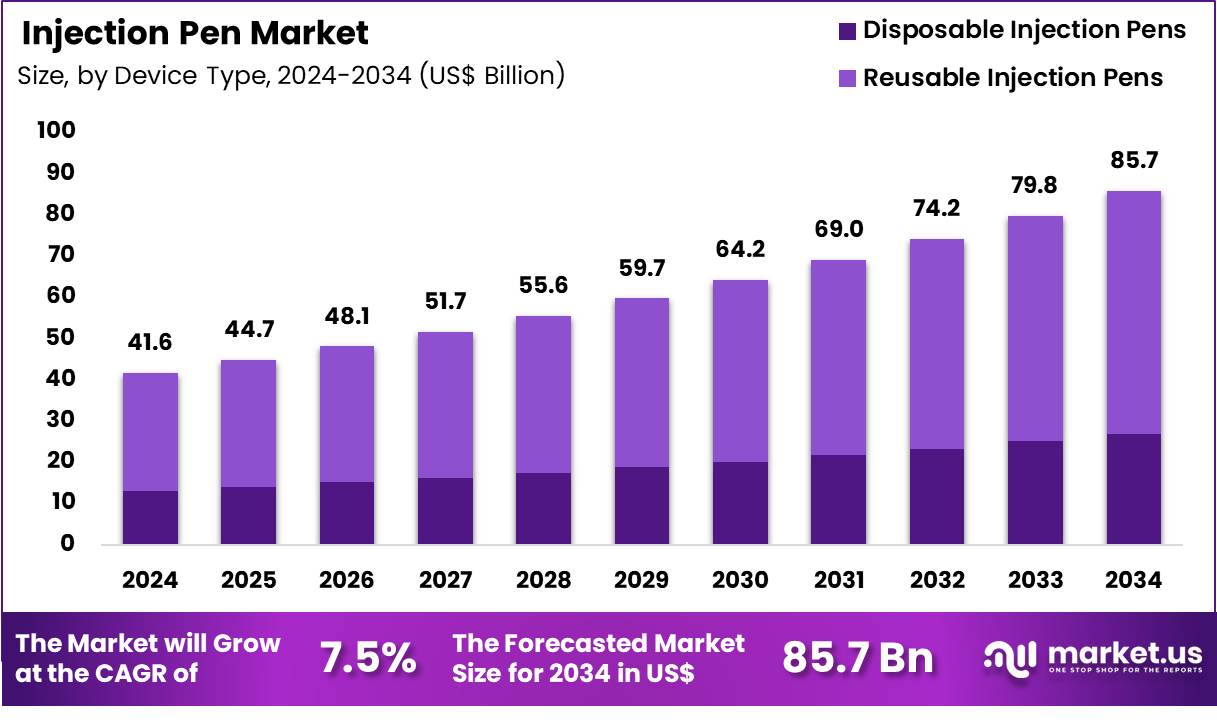
New York, NY – Sep 24, 2026 – The Global Injection Pen Market size is expected to be worth around US$ 85.7 Billion by 2034 from US$ 41.6 Billion in 2024, growing at a CAGR of 7.5% during the forecast period 2025 to 2034. In 2024, North America led the market, achieving over 43.1% share with a revenue of US$ 17.9 Billion.
Injection pens are compact drug-delivery devices designed to make subcutaneous injections easier, more convenient, and suitable for self-administration. They are widely used for insulin and are increasingly associated with injectable medicines for diabetes, obesity, and other chronic conditions. The U.S. CDC states that insulin pens can be more portable and easier to use than syringes, while pen needles are generally smaller and can be more comfortable.
The market is being supported by the growing use of self-administered medicines and the expansion of injectable therapies. In the United States, 26.5% of adults with diagnosed diabetes used GLP-1 injectables in 2024, according to the CDC National Center for Health Statistics. FDA-approved products such as insulin and GLP-1 medicines are available in single-patient-use pen formats, further supporting demand for convenient injection technologies.
From a market perspective, manufacturers are focusing on easier operation, dose accuracy, portability, patient safety, and connected or smart features. FDA records also show the presence of smart insulin pen technologies, indicating continued development beyond traditional injection devices.
Key Takeaways
- In 2024, the market generated US$ 41.6 billion in revenue and is projected to grow at a CAGR of 7.5%, reaching approximately US$ 85.7 billion by 2034.
- Based on device type, the market is segmented into disposable injection pens and reusable injection pens. Reusable injection pens dominated the market in 2024, accounting for a 68.6% market share.
- By application, the market is segmented into diabetes, growth hormone therapies, autoimmune diseases, fertility treatments, osteoporosis, anaphylaxis, obesity, and others. Among these, diabetes accounted for the largest share, at 46.9% in 2024.
- Based on age group, the market is categorized into pediatric, adult, and geriatric segments. The adult segment held the leading position in 2024, accounting for a 55.3% revenue share.
- By end user, the market is divided into hospitals, home use, and clinics. The hospitals segment dominated the market in 2024, representing a 43.5% revenue share.
- Regionally, North America dominated the global market in 2024, accounting for a 43.1% market share.
Key Market Segments
- Device Type Analysis: Reusable injection pens, accounting for 68.6%, are expected to maintain market leadership, supported by lower long-term costs, reduced medical waste, and growing sustainability awareness. Improvements in ergonomics, dose accuracy, cartridge compatibility, maintenance, and digital monitoring are further supporting their adoption across chronic disease treatments.
- Application Analysis: Diabetes, representing 46.9%, is expected to remain the leading application segment, driven by the increasing prevalence of type 1 and type 2 diabetes. Injection pens provide convenient dosing and support self-administration, while rising insulin therapy adoption and improved patient awareness continue to strengthen segment demand.
- Age Group Analysis: Adults, holding 55.3%, are expected to remain the dominant age group due to the high prevalence of chronic conditions requiring injectable therapies. Increasing diabetes, obesity, and autoimmune diseases, combined with demand for portable and convenient treatment options, continues to support injection pen adoption among adults.
- End-User Analysis: Hospitals, accounting for 43.5%, are expected to lead the end-user segment due to their role in diagnosis, treatment initiation, and patient education. Increasing use of injectable therapies, standardized treatment protocols, supervised administration, and bulk procurement are supporting sustained demand for injection pens across hospital settings.
Regional Analysis
North America
North America accounted for 43.1% of the global injection pen market in 2024, supported by increasing adoption of self-administered therapies, high healthcare spending, and growing demand for user-friendly drug delivery devices. Insulin pens are widely used for diabetes management, while autoinjectors support home-based treatment for autoimmune conditions and other chronic diseases.
The development of smart pens with dose tracking and mobile connectivity is further improving treatment monitoring. Growing demand for injectable therapies for obesity and other metabolic conditions is also supporting regional market expansion. According to the CDC, 40.3% of U.S. adults had obesity during August 2021–August 2023, highlighting the growing need for effective weight-management treatments.
Asia Pacific
Asia Pacific is expected to register the highest CAGR during the forecast period, driven by rising diabetes prevalence, improving healthcare infrastructure, increasing healthcare access, and expanding use of self-administered therapies. Growing investments in local manufacturing, digital healthcare, fertility treatments, and advanced injectable medicines are expected to strengthen regional demand for injection pens.
Emerging Trends
- Growth of self-administration – More injectable medicines are being designed for use outside hospitals, supporting demand for simple pen-based delivery systems.
- Expansion of GLP-1 therapies – Rising use of GLP-1 medicines for diabetes and certain weight-management indications is creating additional demand for convenient injectable delivery formats.
- Smart injection pens – Digital features such as dose recording, reminders, and app connectivity are emerging as manufacturers seek to improve treatment tracking and patient support. FDA records identify smart insulin pen systems as regulated medical devices.
- Prefilled and ready-to-use formats – Prefilled pens reduce preparation steps and can simplify administration, supporting their use in chronic disease treatment. FDA-approved insulin products include single-patient-use prefilled pens.
- Greater focus on safety – Single-patient use, fresh needles, dose accuracy, and prevention of medication-device sharing remain important areas of product development and healthcare practice.
Use Cases
- Diabetes management – Insulin pens are widely used to deliver basal and mealtime insulin for people with diabetes.
- GLP-1 treatment – Pen-based delivery is used for certain GLP-1 medicines prescribed for type 2 diabetes and, for some products, chronic weight management.
- Home-based treatment – Injection pens support self-administration, reducing the need for patients to visit healthcare facilities for every dose.
- Long-term chronic care – Pen devices are suitable for treatments requiring repeated injections, particularly where portability and ease of use are important.
- Connected medication management – Smart pens can combine injection delivery with digital tracking, helping patients and healthcare professionals monitor dosing information.
Frequently Asked Questions About Injection Pen
- Why are injection pens used instead of syringes?
Injection pens can provide greater portability and convenience than traditional syringes. The CDC notes that many people find insulin pens easier to use, while their smaller pen needles may provide greater comfort during injections. CDC - Are injection pens suitable for home use?
Many injection pens are specifically designed to support self-administration at home. However, patients should receive appropriate instructions from healthcare professionals regarding preparation, dosage, injection technique, storage, and safe disposal of used needles. - Are injection pens reusable?
Some injection pens are reusable and use replaceable medication cartridges, while others are prefilled and discarded after the medication is finished. The appropriate type depends on the specific medicine and manufacturer’s instructions. CDC - How often should a pen needle be replaced?
A new needle should generally be used for each injection when using an insulin pen. FDA and CDC guidance emphasizes safe needle practices, and insulin pens should not be shared even when the needle has been replaced. - What is driving the injection pen market?
Market growth is being supported by increasing demand for self-administered therapies, chronic disease treatment, injectable diabetes medicines, GLP-1 therapies, and convenient drug-delivery systems. Research also identifies increasing interest in self-injection within the expanding biopharmaceutical sector. PubMed - What challenges affect the injection pen market?
Key challenges include device cost, reimbursement limitations, patient training, correct injection technique, medication compatibility, disposal requirements, and safety concerns. The CDC also notes that insulin pens can cost more than syringes and may not always be covered by insurance. CDC - What is the future outlook for injection pens?
The market is expected to remain closely linked with growth in self-administered medicines, chronic disease treatment, biologics, and injectable diabetes and weight-management therapies. Greater attention is also being given to convenience, safety, digital connectivity, and patient-friendly device design. PubMed - What factors should manufacturers consider?
Manufacturers are expected to focus on ease of use, reliable dose delivery, patient safety, ergonomic design, portability, medication compatibility, and regulatory requirements. Digital features may also become increasingly relevant as healthcare systems seek better medication adherence and treatment monitoring.
Conclusion
The global injection pen market is expected to witness sustained growth, supported by the increasing adoption of self-administered therapies, rising prevalence of diabetes and obesity, and expanding use of injectable medicines. Reusable pens are expected to remain prominent, while advancements in smart, connected, and prefilled technologies are enhancing convenience, dose accuracy, safety, and treatment monitoring.
North America currently represents the leading regional market, whereas Asia Pacific is expected to record the fastest growth during the forecast period. Continued innovation in device design, growing healthcare access, and increasing demand for home-based chronic disease management are likely to create further opportunities for manufacturers and stakeholders across the injection pen market.
Discuss your needs with our analyst
Please share your requirements with more details so our analyst can check if they can solve your problem(s)




