


Overview
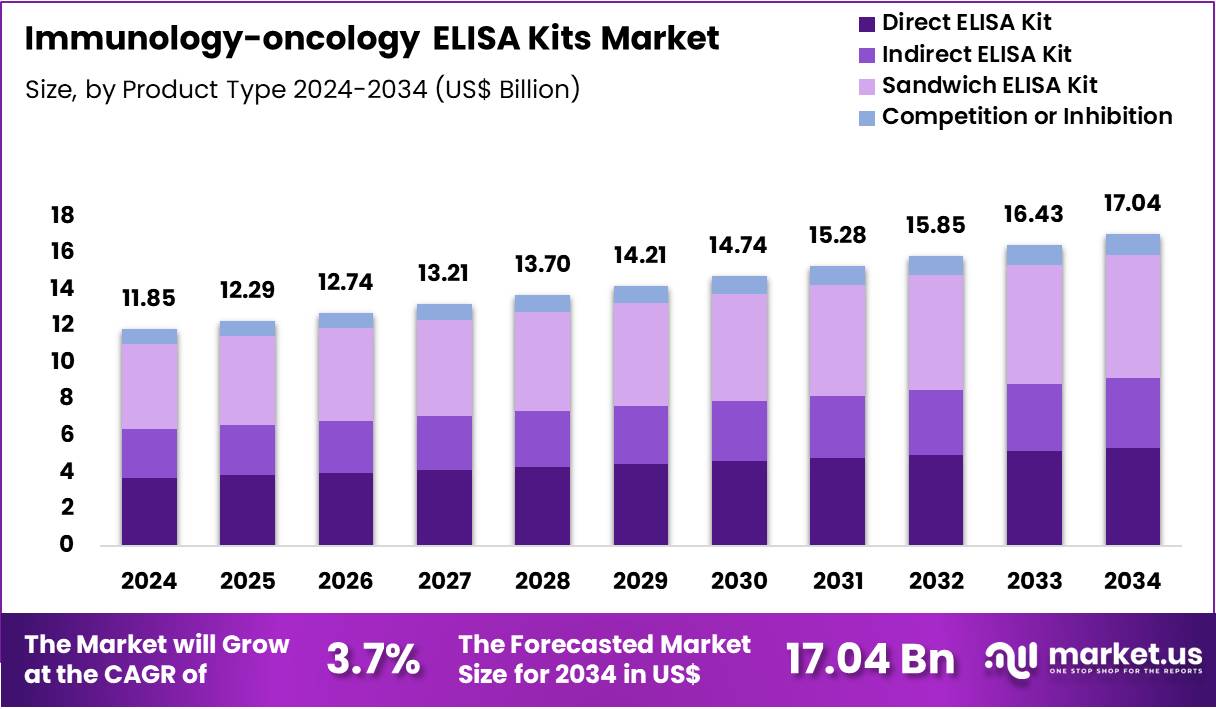
New York, NY – Aug 7, 2026 – Global Immunology-oncology ELISA Kits Market size is expected to be worth around US$ 17.04 Billion by 2034 from US$ 11.85 Billion in 2024, growing at a CAGR of 3.7% during the forecast period 2025 to 2034. In 2024, North America led the market, achieving over 41.7% share with a revenue of US$ 4.94 Billion.
The global Immunology-oncology ELISA Kits Market is witnessing significant growth due to increasing demand for biomarker-based cancer diagnosis, immune response monitoring, and advancements in precision oncology research.
ELISA kits are widely used for detecting cancer-related proteins, cytokines, immune checkpoint markers, and therapeutic response indicators, supporting applications in immunotherapy development and clinical research.
The market is driven by the rapid expansion of cancer immunology studies, rising adoption of targeted therapies, and growing investments in oncology biomarker discovery. According to global cancer statistics, approximately 20 million new cancer cases and 9.7 million cancer-related deaths were recorded in 2022, creating a strong need for advanced diagnostic and monitoring technologies.
The increasing use of immune checkpoint inhibitors, including therapies targeting PD-1, PD-L1, and CTLA-4 pathways, has further increased demand for reliable immunoassay solutions.
The Immunology-oncology ELISA Kits Market is also benefiting from advancements in multiplex immunoassays, automation, and high-sensitivity detection technologies. Research institutions, pharmaceutical companies, and diagnostic laboratories are increasingly adopting ELISA kits for clinical trials, drug development, and translational oncology research.
North America represents a leading region due to strong biotechnology infrastructure, high cancer research funding, and the presence of major life science companies. The United States invests more than US$7 billion annually in cancer research through the National Cancer Institute, supporting innovation in oncology diagnostics and immunotherapy.
With increasing focus on personalized medicine and immune-based cancer treatments, the Immunology-oncology ELISA Kits Market is expected to expand steadily through 2034, supported by technological innovation, rising cancer prevalence, and growing demand for accurate biomarker detection solutions.
Key Takeaways
- In 2024, the Immunology-oncology ELISA Kits Market generated a revenue of US$ 85 billion and is projected to grow at a CAGR of 3.7%, reaching US$ 17.04 billion by 2034.
- Based on Kit Type, the market is segmented into Direct ELISA Kit, Indirect ELISA Kit, Sandwich ELISA Kit, and Competition or Inhibition ELISA Kit. Among these, the Sandwich ELISA Kit segment dominated in 2024, accounting for a 39.6% market share.
- Based on Application, the market is categorized into Cancer Diagnosis, the pharmaceutical industry, Research, and Other Applications. The Cancer Diagnosis segment held the leading position in 2024, capturing a 51.2% market share.
- Based on End User, the market is segmented into Hospitals, Diagnostic Centers, Research Laboratories, and Others. The Hospitals segment emerged as the largest contributor in 2024, with a 42.1% market share.
- North America dominated the Immunology-oncology ELISA Kits Market in 2024, accounting for a significant 41.7% share of the global market.
Market Segmentation
Product Type Analysis
Direct ELISA Kits held an estimated 31.4% market share due to their rapid workflow and suitability for high-throughput antigen screening. These kits are widely used for detecting tumor-associated proteins, offering fewer processing steps, reduced variability, and improved consistency in diagnostic laboratory applications.
Indirect ELISA Kits are gaining demand due to their high sensitivity in detecting antibodies associated with tumor immunology. Research laboratories widely use these kits for immune profiling, cancer vaccine development, and autoantibody analysis, supported by enhanced signal amplification through secondary antibodies.
Application Analysis
Cancer Diagnosis dominated the market with a 51.2% share, driven by the growing use of ELISA kits for tumor marker detection, immune checkpoint evaluation, and treatment monitoring. Rising cancer prevalence and increasing adoption of biomarker-based diagnostics continue to support segment growth.
The Pharmaceutical Industry segment is expanding due to increasing immuno-oncology drug development and clinical research activities. ELISA kits are extensively used for cytokine analysis, pharmacokinetic studies, drug safety evaluation, and biomarker validation during therapeutic development processes.
End-User Analysis
Hospitals accounted for the leading 42.1% market share due to high oncology diagnostic volumes and increasing demand for immune biomarker testing. ELISA assays support tumor antigen detection, inflammatory marker analysis, and monitoring of patient responses to immunotherapy treatments.
Diagnostic Centers are witnessing steady growth due to the rising outsourcing of cancer biomarker testing and the increasing demand for accurate laboratory services. Their adoption of ELISA platforms is supported by cost-effectiveness, reliability, and compatibility with automated diagnostic workflows.
Research Laboratories contribute significantly through immuno-oncology studies, biomarker discovery, and translational medicine research. Universities and cancer institutes use ELISA kits for studying immune responses, therapeutic targets, and the development of next-generation cancer treatment strategies.
Statistical Information
- In 2025, multiplex immunoassay platforms used alongside ELISA workflows demonstrated the capability to measure more than 50 immune-related analytes simultaneously, supporting broader cancer immune profiling applications.
- A 2025 oncology biomarker validation study reported ELISA assay precision with intra-assay and inter-assay coefficient of variation values below 10%, indicating consistent laboratory performance for immune marker quantification.
- In 2025 clinical research applications, ELISA-based detection methods achieved analytical sensitivity improvements of approximately 2–10 fold compared with conventional colorimetric detection approaches through enhanced signal amplification technologies.
- 5A 2025 immuno-oncology research protocol reported ELISA assay turnaround times of approximately 2–5 hours for cytokine and immune biomarker analysis, supporting faster experimental decision-making.
- In 2025, high-sensitivity ELISA platforms used for cancer biomarker analysis reported detection limits reaching below 1 pg/mL for selected cytokines and immune checkpoint-related proteins.
- A 2026 immunoassay technology report indicated that automated ELISA processing systems can handle 96-well plate formats, allowing simultaneous analysis of up to 96 patient or research samples per assay run.
- A 2025 cancer immunotherapy biomarker study evaluated ELISA measurements across more than 100 biological samples to analyze immune response variations during treatment studies.
- In 2026, automated ELISA laboratory systems supported reduced manual handling steps by approximately 50% compared with traditional multi-step manual workflows, improving laboratory reproducibility and throughput.
Regional Analysis
North America dominates the Immunology-oncology ELISA Kits Market, accounting for a significant 41.7% share due to its advanced healthcare infrastructure, strong oncology research ecosystem, and widespread adoption of biomarker-based cancer therapies. The region benefits from extensive immunotherapy development activities, increasing clinical research programs, and the presence of leading biotechnology and pharmaceutical companies.
The United States records more than 2 million new cancer cases annually, according to the American Cancer Society, creating strong demand for tumor marker detection, cytokine analysis, and immune-response monitoring using ELISA technologies. Major cancer research institutions and academic centers continue to utilize ELISA platforms for translational research and therapeutic evaluation.
Asia Pacific is projected to witness the fastest growth due to rising cancer incidence, expanding biotechnology capabilities, and increasing investments in precision medicine. Countries including China, Japan, and South Korea are strengthening oncology research programs, increasing demand for advanced immunoassay solutions in clinical and research applications.
Business opportunities
The Immunology-oncology ELISA Kits Market presents significant business opportunities driven by the increasing adoption of biomarker-based cancer diagnostics, immunotherapy research, and precision oncology approaches. Companies can expand by developing advanced ELISA solutions for detecting immune checkpoint proteins, cytokines, tumor markers, and therapeutic response indicators.
The growing pipeline of cancer immunotherapies creates opportunities for ELISA kit manufacturers to collaborate with pharmaceutical and biotechnology companies for drug development and clinical trial applications.
Additional opportunities exist in the development of multiplex ELISA platforms, automated testing systems, and customized assay solutions that improve laboratory efficiency and support complex immune profiling studies. Emerging markets, particularly in Asia Pacific and other developing regions, offer growth potential due to rising cancer prevalence and increasing healthcare investments.
Strategic partnerships with research institutions, hospitals, and diagnostic laboratories can further strengthen market penetration. Furthermore, the integration of ELISA technologies with precision medicine and companion diagnostics provides opportunities for companies to deliver personalized cancer monitoring solutions and improve patient treatment outcomes.
Emerging Trends
- Increasing Focus on Immune Biomarker Detection: The demand for ELISA kits is increasing as researchers focus on immune biomarkers such as cytokines, tumor markers, and checkpoint proteins. The National Cancer Institute highlights that more than 2,000 cancer immunotherapy clinical trials are registered globally, supporting the need for accurate biomarker analysis tools.
- Growth of Multiplex Immunoassay Technologies: Multiplex ELISA solutions are gaining importance because they enable simultaneous analysis of multiple immune markers from limited samples. These advanced systems can evaluate dozens of biomarkers in one workflow, improving cancer immune profiling efficiency and supporting advanced oncology research applications.
- Rising Adoption in Precision Oncology Research: Precision oncology is driving demand for ELISA-based immune profiling technologies. The National Cancer Institute reported approximately 2.0 million new cancer cases in the United States in 2025, increasing research activities focused on personalized treatments and biomarker-guided therapy selection.
- Automation and Digital Laboratory Integration: Automated ELISA platforms are becoming increasingly popular in oncology laboratories due to faster processing and improved accuracy. Modern systems commonly support 96-well plate formats, allowing researchers to process multiple samples efficiently while reducing manual handling and workflow variations.
- Expansion of Immunotherapy Development Programs: Growing investment in immune-based cancer therapies is increasing demand for ELISA testing solutions. The FDA has approved more than 50 immune checkpoint inhibitor-related cancer indications, encouraging pharmaceutical companies to use biomarker assays for drug development and clinical evaluation.
Use Cases
- Monitoring Immune Checkpoint Therapy Response: ELISA kits are used to measure immune markers associated with PD-1, PD-L1, and CTLA-4 targeted therapies. These assays help researchers evaluate immune system changes, treatment effectiveness, and biomarker responses during clinical studies involving cancer immunotherapies.
- Cytokine Profiling in Cancer Research: ELISA-based cytokine testing helps researchers measure immune signaling molecules, including IL-6, IL-10, and TNF-α. These evaluations support studies on inflammation, tumor progression, and immune activation, providing valuable insights into cancer biology and therapeutic response mechanisms.
- Pharmaceutical Drug Development Applications: Pharmaceutical companies utilize immunology-oncology ELISA kits during preclinical and clinical research to evaluate drug performance, immune activation, and safety profiles. These assays support the development of antibody therapies, checkpoint inhibitors, and combination cancer treatment strategies.
- Companion Diagnostic Research Support: ELISA technologies assist in companion diagnostic development by identifying biomarkers linked with treatment outcomes. Researchers analyze patient samples to understand immune characteristics and establish connections between biomarker expression and response to specific oncology therapies.
- Academic and Translational Cancer Research: Universities and cancer research centers use ELISA kits to investigate tumor immune pathways, biomarker discovery, and new treatment targets. The National Institutes of Health supports thousands of cancer research projects annually, creating continuous demand for advanced laboratory testing methods.
Recent Development
- March 2026: Thermo Fisher Scientific completed its acquisition of Clario Holdings, Inc., further expanding its clinical research services and digital trial capabilities for biopharma and oncology research.
- March 2026: Thermo Fisher Scientific expanded its immunodiagnostics operations by opening a new distribution and labeling center in Uppsala, Sweden, enhancing global supply capabilities for diagnostic and life science products, including immunoassay solutions.
- June 2026: Bio-Techne Corporation entered into a definitive agreement to be acquired by MilliporeSigma (Merck KGaA, Darmstadt, Germany). The acquisition strengthens Merck’s life science portfolio, including antibodies, cytokines, proteins, and immunoassay technologies used in immunology and oncology research.
Frequently Asked Questions on Immunology-oncology ELISA Kits
- What factors are driving the Immunology-oncology ELISA Kits Market?
The market is driven by increasing cancer cases, growing adoption of immunotherapies, rising investment in oncology research, and expanding use of biomarker-based diagnostics. Technological advancements in ELISA platforms and increasing pharmaceutical research activities also contribute to market expansion. - Which kit type holds the largest share in the Immunology-oncology ELISA Kits Market?
Sandwich ELISA Kits hold the largest market share because they provide high sensitivity and specificity for detecting cancer biomarkers. These kits are widely used in oncology research, clinical diagnostics, and pharmaceutical studies requiring accurate quantification of immune-related proteins. - Why is cancer diagnosis a major application for Immunology-oncology ELISA Kits?
Cancer diagnosis is the leading application because ELISA kits help detect tumor markers, cytokines, and immune checkpoint proteins. These assays assist healthcare professionals in early disease detection, treatment monitoring, and evaluating patient responses to targeted cancer therapies. - Who are the major end users of Immunology-oncology ELISA Kits?
Hospitals, diagnostic centers, research laboratories, pharmaceutical companies, and biotechnology firms are the primary end users. They use ELISA kits for cancer biomarker testing, drug development, clinical trials, translational research, and monitoring responses to immunotherapy treatments. - Which region dominates the Immunology-oncology ELISA Kits Market?
North America leads the market due to advanced healthcare infrastructure, strong biotechnology industries, extensive oncology research, and high adoption of precision medicine. The presence of leading pharmaceutical companies and significant cancer research funding further supports regional market growth. - How are ELISA Kits used in immunotherapy research?
ELISA Kits are used to quantify cytokines, immune checkpoint proteins, and other biomarkers that indicate immune system activity. Researchers use these assays to evaluate treatment effectiveness, monitor immune responses, and support development of novel immunotherapy drugs. - What opportunities exist in the Immunology-oncology ELISA Kits Market?
Growing demand for personalized medicine, increasing immunotherapy development, expansion of biomarker discovery programs, and adoption of automated laboratory technologies create significant business opportunities. Emerging healthcare markets also offer strong potential for future product adoption and innovation. - What is the future outlook for the Immunology-oncology ELISA Kits Market?
The market is expected to grow steadily due to continuous advancements in cancer diagnostics, increasing investments in precision oncology, and expanding clinical research. Rising demand for accurate biomarker detection and companion diagnostics will continue to support long-term market development
Conclusion
The Immunology-oncology ELISA Kits Market is expected to experience steady growth as cancer immunotherapy, precision medicine, and biomarker-based diagnostics become increasingly important in healthcare and life science research. Rising investments in oncology drug development, expanding clinical trials, and continuous innovation in high-sensitivity ELISA technologies are supporting market expansion.
Increasing demand from hospitals, diagnostic laboratories, pharmaceutical companies, and research institutes is further strengthening adoption. North America remains the leading regional market due to its advanced healthcare infrastructure, while Asia-Pacific is emerging as the fastest-growing region with expanding biotechnology capabilities and government support for cancer research.
Continuous product innovation and strategic collaborations among leading companies are expected to enhance assay performance, improve laboratory efficiency, and create new opportunities throughout the forecast period.
Discuss your needs with our analyst
Please share your requirements with more details so our analyst can check if they can solve your problem(s)




