


Overview
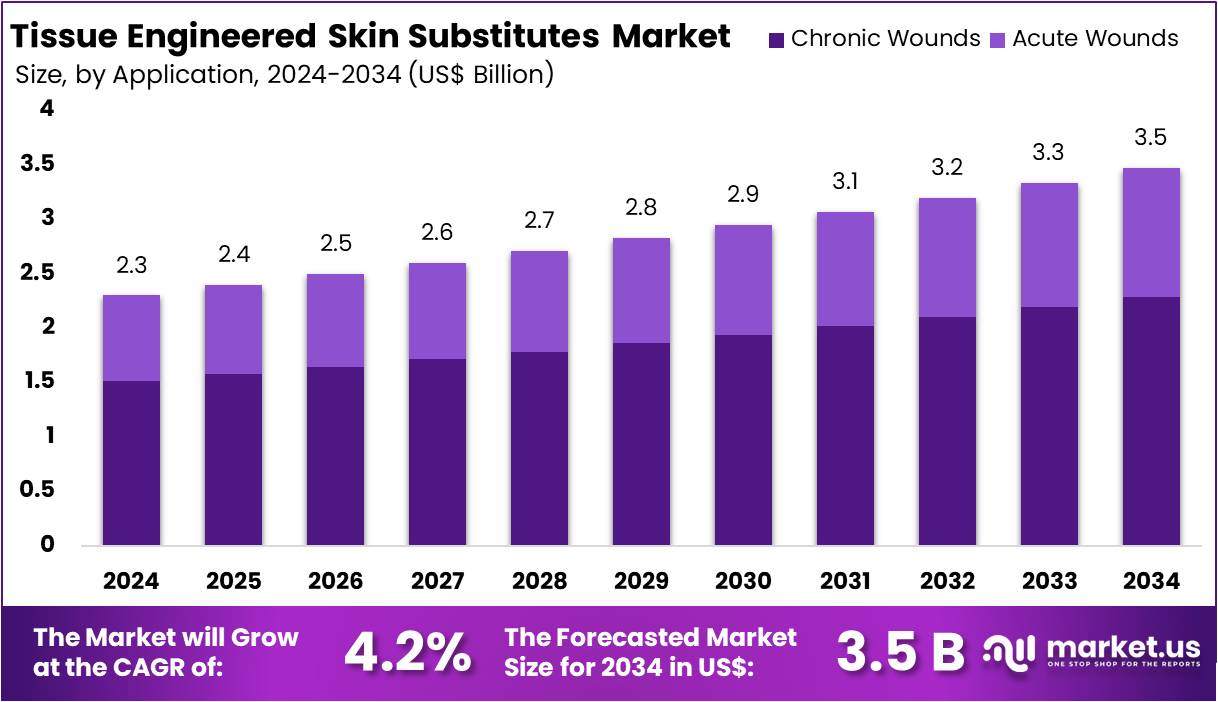
New York, NY – June 08, 2026 – The Global Tissue Engineered Skin Substitutes Market size is expected to be worth around US$ 3.5 Billion by 2034, from US$ 2.3 Billion in 2024, growing at a CAGR of 4.2% during the forecast period from 2025 to 2034.
Tissue engineered skin substitutes are advanced biomaterials developed to replace or restore the structure and function of damaged skin. These products combine biological materials, living cells, and engineered scaffolds to support wound healing, tissue regeneration, and skin repair. They are widely used in the treatment of chronic wounds, burns, diabetic foot ulcers, venous leg ulcers, and other complex skin injuries where conventional therapies may be insufficient.
The growing prevalence of chronic wounds, increasing incidence of burn injuries, and rising demand for regenerative medicine solutions are driving the adoption of tissue engineered skin substitutes worldwide. These products are designed to accelerate healing, reduce infection risks, minimize scarring, and improve patient outcomes. Technological advancements in cell culture techniques, biomaterials, and 3D bioprinting have further enhanced the effectiveness and availability of next-generation skin substitutes.
Healthcare providers are increasingly integrating tissue engineered skin substitutes into advanced wound management protocols due to their ability to promote tissue regeneration and reduce hospitalization time. In addition, ongoing research and development activities are expanding the range of applications for these products across reconstructive surgery and regenerative therapies.
As healthcare systems continue to focus on improving patient care and reducing treatment costs, tissue engineered skin substitutes are expected to play an increasingly important role in modern wound care, supporting innovation and growth within the global regenerative medicine landscape.
Key Takeaways
- The global Tissue Engineered Skin Substitutes market is anticipated to grow from US$ 2.3 billion in 2024 to approximately US$ 3.5 billion by 2034.
- The market is expected to register a CAGR of 4.2% between 2025 and 2034.
- In 2024, the Biologic Skin Substitutes segment held the largest share of the market, contributing more than 51.1% of total revenue.
- Chronic Wounds represented the leading application segment in 2024, accounting for over 65.8% of the global market share.
- Hospitals remained the dominant end-user category in 2024, capturing more than 53.4% of the overall market.
- North America led the global market in 2024, holding a share of over 36.5% and generating revenue of approximately US$ 839.5 million.
Regional Analysis
In 2024, North America accounted for more than 36.5% of the global Tissue Engineered Skin Substitutes market, generating approximately US$ 839.5 million in revenue. The region’s strong market position is supported by the high incidence of burn injuries, trauma cases, and chronic wounds, which continue to drive demand for advanced wound care solutions. The increasing need for effective skin regeneration therapies has encouraged the adoption of tissue engineered skin substitutes across hospitals and specialized treatment centers.
A well-established healthcare infrastructure further strengthens market growth. Healthcare providers across the United States and Canada have access to advanced regenerative medicine technologies and specialized wound care facilities, enabling the integration of innovative skin substitute products into clinical practice. In addition, substantial investments from both public and private sectors support ongoing research and development activities in regenerative medicine.
The region also benefits from a favorable regulatory environment, with approvals for new bioengineered skin products helping expand treatment options and improve patient access to advanced therapies. Continuous innovation, supported by collaborations among research institutions, biotechnology companies, and healthcare organizations, is accelerating product development.
Moreover, the growing elderly population and rising prevalence of diabetes-related wounds and pressure ulcers are contributing to market expansion. Combined with increasing healthcare expenditure and greater awareness of advanced wound management, these factors are expected to sustain North America’s leadership in the global market.
Emerging Trends
- Shift Toward Composite and Autologous Substitutes: Advanced tissue-engineered skin substitutes increasingly combine dermal fibroblasts and epidermal keratinocytes derived from the same patient. These autologous composite constructs improve skin regeneration, reduce immune rejection risks, and support long-term healing. Stem cells and gene-corrected cells are also being explored.
- Integration of Advanced Biomaterials and Scaffolds: Modern skin substitutes utilize biocompatible scaffolds such as collagen-glycosaminoglycan matrices and acellular dermal matrices. These structures provide mechanical support, enhance cell attachment and proliferation, maintain elasticity, and gradually degrade while facilitating effective tissue regeneration and wound repair.
- Development of Antimicrobial and Sensor-Embedded Constructs: Researchers are developing skin substitutes with integrated antimicrobial and biosensing capabilities. Novel biomaterials, including nanodiamond-silk membranes, can detect infection or inflammation, reduce bacterial growth, and promote wound healing, enabling more responsive and effective management of complex wounds.
- Use of Three-Dimensional (3D) Bioprinting for Shaped Grafts: Three-dimensional bioprinting technologies enable the creation of anatomically precise skin grafts tailored to complex body structures. These customized grafts improve integration, functionality, and cosmetic outcomes compared to conventional flat grafts, particularly in areas with irregular shapes.
- Defining Functional Wound Closure Beyond Visible Healing: Clinical researchers increasingly emphasize functional wound closure, which includes restoration of skin barrier integrity rather than surface healing alone. Assessing barrier function provides a more accurate indicator of long-term recovery and helps reduce wound recurrence rates.
Use Cases
- Treatment of Burn Injuries (Acute Wounds): Tissue-engineered skin substitutes are being evaluated for severe burn treatment, particularly in pediatric patients. Autologous skin constructs generated from small biopsies can cover extensive burn areas, accelerate healing, lower infection risks, minimize scarring, and improve overall clinical outcomes.
- Chronic Wounds Including Diabetic Foot Ulcers and Venous Leg Ulcers: Skin substitutes such as Dermagraft and Apligraf support healing in chronic wounds by promoting tissue regeneration and re-epithelialization. Acellular dermal matrices, placental membranes, and fish-skin grafts have demonstrated improved healing outcomes compared with conventional wound care approaches.
- Rare Genetic Skin Disorders (Epidermolysis Bullosa): Gene-corrected autologous tissue-engineered skin substitutes are being investigated for epidermolysis bullosa and other inherited skin disorders. These therapies aim to repair underlying genetic defects, provide durable wound closure, improve skin integrity, and reduce disease-related complications over time.
- War-Wound Management and Battlefield Medicine: Military healthcare programs are supporting the development of stem cell-enriched sprays and regenerative skin therapies for battlefield injuries. These technologies aim to enable rapid treatment, reduce donor-site requirements, minimize scarring, and improve recovery following burns or blast-related trauma.
Frequently Asked Questions on Tissue Engineered Skin Substitutes
- What are the primary applications of tissue engineered skin substitutes?
Tissue engineered skin substitutes are primarily used for treating chronic wounds, burn injuries, diabetic foot ulcers, venous leg ulcers, and surgical wounds. These products help accelerate healing, reduce infection risks, and improve overall clinical outcomes in patients with complex skin conditions. - What factors are driving the growth of the tissue engineered skin substitutes market?
Market growth is being driven by the increasing prevalence of chronic wounds, rising incidence of burn injuries, expanding elderly population, and growing adoption of regenerative medicine technologies. Continuous advancements in biomaterials and tissue engineering are further supporting market expansion. - Which product segment holds the largest share of the tissue engineered skin substitutes market?
Biologic skin substitutes account for the largest share of the market due to their ability to closely mimic natural skin structure and function. Their effectiveness in promoting tissue regeneration and wound closure has contributed to widespread clinical adoption. - Why are chronic wounds a major application area in this market?
Chronic wounds represent the leading application segment because they require long-term treatment and often heal slowly using conventional therapies. Tissue engineered skin substitutes offer enhanced healing capabilities, making them valuable for managing diabetic ulcers and pressure injuries. - Which end users contribute most to the tissue engineered skin substitutes market?
Hospitals are the leading end users of tissue engineered skin substitutes due to the high volume of wound care procedures performed in these settings. Advanced treatment infrastructure and access to specialized healthcare professionals further support product utilization. - Which region dominates the global tissue engineered skin substitutes market?
North America holds the largest share of the global market, supported by advanced healthcare infrastructure, strong research funding, favorable regulatory frameworks, and increasing demand for regenerative wound care therapies across hospitals and specialized treatment centers. - How do tissue engineered skin substitutes improve patient outcomes?
These products enhance wound healing by providing a supportive environment for cell growth and tissue regeneration. They help reduce healing time, minimize complications, lower infection risks, and improve the quality of life for patients with severe wounds. - What role does regenerative medicine play in the tissue engineered skin substitutes market?
Regenerative medicine serves as a key foundation for the market by enabling the development of advanced therapies that repair or replace damaged tissues. Innovations in cell-based treatments and biomaterials continue to improve the performance of skin substitute products. - What is the future outlook for the tissue engineered skin substitutes market?
The market is expected to witness steady growth over the coming years, supported by rising healthcare expenditure, technological advancements, increasing awareness of advanced wound care, and ongoing research efforts focused on developing next-generation skin regeneration solutions.
Conclusion
The global tissue engineered skin substitutes market is positioned for steady growth, driven by the increasing burden of chronic wounds, burn injuries, and the rising demand for regenerative medicine solutions. Continuous advancements in biologic skin substitutes, biomaterials, stem cell technologies, and 3D bioprinting are enhancing treatment effectiveness and expanding clinical applications.
The growing adoption of advanced wound care therapies across hospitals and specialized healthcare facilities is further supporting market development. With strong research investments, favorable regulatory support, and increasing focus on improving patient outcomes, tissue engineered skin substitutes are expected to remain a vital component of modern wound management and regenerative healthcare worldwide.
Discuss your needs with our analyst
Please share your requirements with more details so our analyst can check if they can solve your problem(s)




