


Overview
New York, NY – Aug 13, 2026 – The Global Women Digital Health Solutions Market Size is expected to be worth around US$ 10.1 billion by 2034 from US$ 3.1 billion in 2024, growing at a CAGR of 12.5% during the forecast period 2025 to 2034. North America held a dominant market position, capturing more than a 38.4% share and holding a US$ 1.2 billion market value for the year.
The Women’s Digital Health Solutions Market is expanding rapidly due to increasing awareness of women’s health needs, growing adoption of telemedicine, and rising demand for personalized healthcare services. Women require specialized care across menstruation, fertility, pregnancy, postpartum recovery, menopause, mental health, and chronic disease management, creating strong demand for digital health platforms.
According to the World Health Organization, women account for nearly 49.7% of the global population, while the National Center for Health Statistics (NCHS) reported in 2022 that women were more likely than men to use telemedicine services. Additionally, the Centers for Disease Control and Prevention (CDC) estimates that around 700 women die annually in the United States from pregnancy-related complications, many of which are preventable through timely healthcare interventions.
Technological innovation and strategic collaborations are further strengthening market growth. In September 2022, Thirty Madison merged with Nurx, creating a digital healthcare platform serving approximately 750,000 patients across reproductive health, dermatology, migraine, and primary care services. In November 2023, AstraZeneca launched Evinova to advance digital health technologies and improve clinical trial efficiency through data-driven solutions.
The WHO also reports that nearly 1 in 3 women globally have experienced physical and/or sexual violence, emphasizing the need for accessible digital mental health services. Furthermore, the GSMA estimates there are over 5.8 billion mobile subscribers worldwide, enabling broader access to mobile health applications, wearable devices, remote patient monitoring, and AI-powered digital therapeutics. These advancements are improving preventive care, patient engagement, and healthcare accessibility while supporting more personalized and data-driven women’s health solutions worldwide.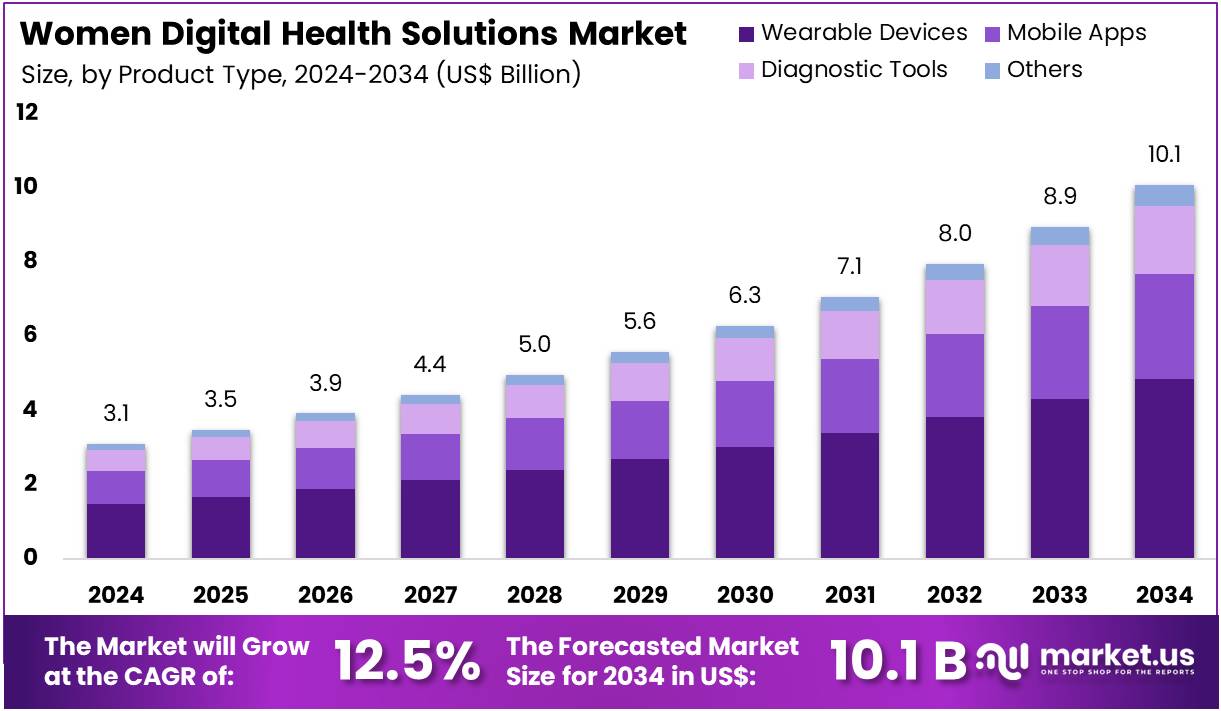
Key Takeaways
- The market was valued at US$ 3.1 billion in 2024 and is projected to reach US$ 10.1 billion by 2034, growing at a CAGR of 12.5% during the forecast period.
- By product type, the market is segmented into wearable devices, mobile apps, diagnostic tools, and others, with wearable devices dominating the segment by accounting for a 48.2% market share in 2024.
- Based on application, the market comprises reproductive health, pregnancy & nursing care, pelvic care, and general healthcare & wellness, with reproductive health holding the largest share of 43.2% in 2024.
- North America emerged as the leading regional market, capturing a 38.4% share of the global market in 2024.
Statistical Information
- Higher Telemedicine Adoption Among Women: Women are more likely than men to use telemedicine, demonstrating strong acceptance of digital healthcare services. According to the U.S. National Health Interview Survey, 42.0% of women used telemedicine in the previous 12 months compared with 31.7% of men in 2021. This trend supports the increasing adoption of women’s digital health platforms for virtual consultations, reproductive care, and chronic disease management.
- Maternal Health Creates Demand for Digital Monitoring: Maternal healthcare remains a major priority, increasing the need for remote pregnancy monitoring and digital maternal health solutions. According to the U.S. CDC, 817 maternal deaths occurred in the United States in 2022, with a maternal mortality rate of 22.3 deaths per 100,000 live births. Digital monitoring and telehealth can improve access to prenatal and postpartum care.
- Most Pregnancy-Related Deaths Are Preventable: Digital health technologies offer opportunities for earlier intervention and continuous monitoring during pregnancy. The CDC reports that more than 80% of pregnancy-related deaths were preventable based on Maternal Mortality Review Committee findings. Additionally, 53% of pregnancy-related deaths occurred between 7 days and 1 year after pregnancy, highlighting the importance of postpartum digital care.
- High Demand for Reproductive Health Services: Reproductive healthcare remains one of the largest use cases for women’s digital health applications. According to the U.S. National Center for Health Statistics, 54.3% of women aged 15–49 were using contraception during 2022–2023. Among users, 11.5% relied on female sterilization, 11.4% used oral contraceptive pills, and 10.5% used long-acting reversible contraceptives (LARCs).
- Digital Health Supports Women’s Preventive Care: Evidence shows telehealth can effectively deliver reproductive healthcare and support services. A U.S. government-supported systematic review analyzed 16 studies involving 10,731 participants and found telehealth produced outcomes comparable to in-person care for several reproductive health services, supporting broader adoption of women’s digital health platforms.
- Women Experience Higher Rates of Depression: Women are nearly 50% more likely than men to experience depression during their lifetime. The World Health Organization (WHO) estimates that approximately 280 million people globally live with depression, making digital mental health platforms increasingly important for women.
- Smartphones Expand Access to Digital Health: The GSMA reported that there were approximately 5.8 billion unique mobile subscribers worldwide in 2024, representing around 71% of the global population. Growing smartphone access supports wider adoption of women’s health apps, remote consultations, and digital monitoring.
- One in Three Women Experience Violence: According to the World Health Organization (WHO), about 1 in 3 women (around 30%) worldwide have experienced physical and/or sexual violence during their lifetime. Digital health platforms are increasingly being used to provide confidential counseling, mental health support, and crisis resources.
Regional Analysis
North America led the market by securing a market share of 38.4% in 2024.
North America accounted for the largest share of the women’s digital health solutions market in 2024, supported by widespread adoption of telehealth, digital health applications, and strong government initiatives promoting women’s healthcare. According to the U.S. Department of Health and Human Services (HHS), telehealth has become an integral part of healthcare delivery, improving access to maternal care, reproductive health, mental health, and chronic disease management.
The FDA continues to support innovation through regulatory pathways for software as a medical device (SaMD) and AI-enabled digital health technologies, encouraging the commercialization of women-focused digital solutions. The HHS Office on Women’s Health increased its budget from US$35.1 million in FY2022 to US$44.0 million in FY2024, strengthening programs focused on preventive healthcare, maternal health, and digital health innovation.
In addition, the CDC reports that more than 80% of pregnancy-related deaths are preventable, reinforcing the value of remote monitoring, virtual prenatal care, and postpartum digital support. High smartphone penetration, widespread electronic health record adoption, favorable reimbursement policies, and continuous investments from healthcare technology companies continue to position North America as the leading regional market for women’s digital health solutions.
Emerging Trends
- AI-Powered Personalized Healthcare Solutions: Artificial intelligence is increasingly used in women’s digital health platforms for fertility prediction, menstrual tracking, pregnancy risk assessment, and personalized treatment recommendations. The FDA recognizes AI-based digital health technologies as important tools for improving diagnosis, monitoring, and healthcare decision-making.
- Growth of Remote Maternal Health Monitoring: Remote patient monitoring is expanding in pregnancy and postpartum care by enabling continuous tracking of vital signs, glucose levels, and pregnancy symptoms. The CDC reports that more than 80% of pregnancy-related deaths are preventable, increasing demand for early detection and digital monitoring solutions.
- Expansion of Wearable Health Technologies: Wearable devices such as smartwatches, rings, and fertility trackers are gaining popularity for monitoring menstrual cycles, ovulation, sleep, stress, and overall wellness. The FDA identifies wearable sensors and connected devices as key components of digital healthcare innovation.
- Increasing Adoption of Digital Fertility and Reproductive Health Apps: Women are increasingly using mobile applications for contraception management, fertility planning, cycle tracking, and reproductive education. CDC reproductive health programs highlight the importance of improving access to evidence-based reproductive healthcare services.
- Rise of Digital Mental Health Platforms for Women: Digital counseling, therapy applications, and behavioral health platforms are expanding to address anxiety, depression, postpartum mental health, and stress management. WHO reports that around 280 million people globally live with depression, with women experiencing higher rates of depressive disorders.
- Integration of Health Data Through Connected Platforms: Healthcare providers are increasingly combining data from electronic health records, mobile applications, and wearable devices to deliver personalized care. WHO promotes digital health strategies focused on interoperability, data exchange, and improved healthcare delivery.
Use Cases
- Fertility Tracking and Family Planning: Digital fertility platforms help women monitor menstrual cycles, ovulation patterns, and reproductive health indicators. These solutions use algorithms and wearable data to predict fertile windows and support conception planning. They also provide access to virtual consultations with fertility specialists and reproductive healthcare providers.
- Pregnancy and Prenatal Care Monitoring: Digital health applications support pregnant women through remote monitoring of blood pressure, glucose levels, weight, and pregnancy symptoms. These tools help healthcare providers identify early warning signs and improve prenatal care management. The CDC highlights that timely monitoring can help prevent pregnancy-related complications.
- Postpartum Recovery and Maternal Support: Digital platforms provide postpartum care through virtual consultations, recovery tracking, mental health assessments, breastfeeding guidance, and medication reminders. These solutions address critical postpartum needs, as CDC data shows that more than 80% of pregnancy-related deaths are preventable through improved healthcare access and intervention.
- Menstrual Health Management: Mobile applications help women track menstrual cycles, predict periods, identify irregular patterns, and understand hormonal changes. These tools support early detection of conditions such as polycystic ovary syndrome (PCOS), endometriosis, and abnormal menstrual symptoms by encouraging timely medical consultation.
- Menopause Symptom Management: Digital health solutions assist women experiencing menopause by tracking symptoms such as hot flashes, sleep disruption, mood changes, and hormonal fluctuations. Virtual care platforms connect users with healthcare professionals for personalized guidance, lifestyle recommendations, and treatment options.
Frequently Asked Questions on Women Digital Health Solutions
- What is driving the growth of the Women’s Digital Health Solutions Market?
The market is driven by increasing awareness of women’s healthcare needs, rising telemedicine adoption, growing smartphone usage, demand for personalized care, and advancements in artificial intelligence, wearable technologies, and digital platforms that improve healthcare accessibility. - What are the major applications of Women’s Digital Health Solutions?
Major applications include reproductive health, fertility management, pregnancy and postpartum care, menstrual tracking, menopause support, pelvic health management, mental wellness, chronic disease monitoring, and preventive healthcare services focused on improving women’s health outcomes. - How are wearable devices used in women’s digital healthcare?
Wearable devices monitor health parameters such as menstrual cycles, fertility indicators, heart rate, sleep patterns, stress levels, and physical activity. These devices provide real-time health information, enabling personalized recommendations and supporting early detection of potential health issues. - How does telehealth benefit women’s healthcare?
Telehealth provides convenient access to healthcare professionals through virtual consultations for gynecology, fertility, pregnancy care, mental health, and chronic disease management. It helps reduce healthcare barriers related to distance, time constraints, and limited availability of specialists. - What role does artificial intelligence play in women’s digital health solutions?
AI analyzes healthcare data from mobile applications, wearable devices, and medical records to deliver personalized insights. It supports fertility prediction, symptom analysis, risk assessment, treatment recommendations, and improved decision-making for women’s healthcare providers. - Why is reproductive health a key segment in the Women’s Digital Health Solutions Market?
Reproductive health is a major segment due to increasing demand for fertility tracking, contraception management, pregnancy planning, menstrual monitoring, and hormonal health support. Digital platforms provide personalized tools and easier access to reproductive healthcare information and specialists. - How do digital solutions support pregnancy and maternal care?
Digital health platforms help monitor pregnancy progress through remote tracking of blood pressure, glucose levels, weight, and symptoms. These solutions enable early risk identification, improve prenatal communication, and support better maternal and infant healthcare outcomes. - What challenges affect the Women’s Digital Health Solutions Market?
Major challenges include concerns regarding patient data privacy, cybersecurity risks, regulatory requirements, limited digital healthcare awareness, and unequal access to technology. Improving security standards and digital accessibility is important for wider market adoption. - What is the future outlook for Women’s Digital Health Solutions?
The future of women’s digital health will be shaped by AI, wearable technologies, remote monitoring, and personalized healthcare platforms. These innovations are expected to improve early diagnosis, preventive care, patient engagement, and access to women-centered healthcare services globally.
Conclusion
The Women’s Digital Health Solutions Market is evolving rapidly due to increasing awareness of women-specific healthcare needs, rising telehealth adoption, and advancements in AI, wearable devices, and remote monitoring technologies. Digital platforms are transforming reproductive health, pregnancy care, menopause management, mental wellness, and chronic disease monitoring by providing personalized and accessible healthcare solutions.
Supportive government initiatives, growing smartphone adoption, and improved digital infrastructure are further accelerating market expansion. As healthcare systems continue shifting toward patient-centered and data-driven models, women’s digital health solutions are expected to play a crucial role in improving preventive care, early diagnosis, and overall health outcomes worldwide.
Discuss your needs with our analyst
Please share your requirements with more details so our analyst can check if they can solve your problem(s)




