


Overview
New York, NY – Aug 13, 2026 – The Global Airway Management Devices Market size is expected to reach around US$ 4.6 Billion by 2034, up from US$ 2.4 Billion in 2024, growing at a CAGR of 6.7% during the forecast period from 2025 to 2034. North America held a dominant market position, capturing more than a 37.6% share and reaching a market value of US$ 0.9 billion.
The global airway management devices market is witnessing steady growth due to the rising burden of respiratory diseases, increasing surgical procedures, emergency care requirements, and advancements in airway technologies. These devices, including endotracheal tubes, laryngeal mask airways, tracheostomy tubes, video laryngoscopes, and resuscitation equipment, are critical for maintaining patient ventilation during anesthesia, intensive care, and emergency interventions.
The growing prevalence of respiratory disorders is a major demand driver. According to the World Health Organization (WHO), chronic obstructive pulmonary disease (COPD) caused approximately 3.5 million deaths in 2021, while asthma affected around 262 million people in 2019. A 2024 global study estimated 213.4 million COPD cases in 2021, resulting in 3.72 million deaths and 79.78 million DALYs, highlighting the increasing need for effective airway support solutions.
Environmental and infectious disease factors are further supporting market expansion. WHO estimates that air pollution contributes to nearly 7 million deaths annually, increasing respiratory complications and hospital admissions. Additionally, seasonal outbreaks of influenza, respiratory syncytial virus (RSV), and other respiratory infections continue to increase demand for airway equipment in hospitals and emergency settings.
The market is also benefiting from rising surgical volumes and healthcare infrastructure improvements. The global unmet need for surgery exceeds 160 million procedures annually, creating continuous demand for airway devices in operating rooms. Technological advancements, including video laryngoscopes, single-use airway devices, and improved infection-control solutions, are enhancing clinical safety and supporting adoption across hospitals, ambulatory surgical centers, and emergency care facilities.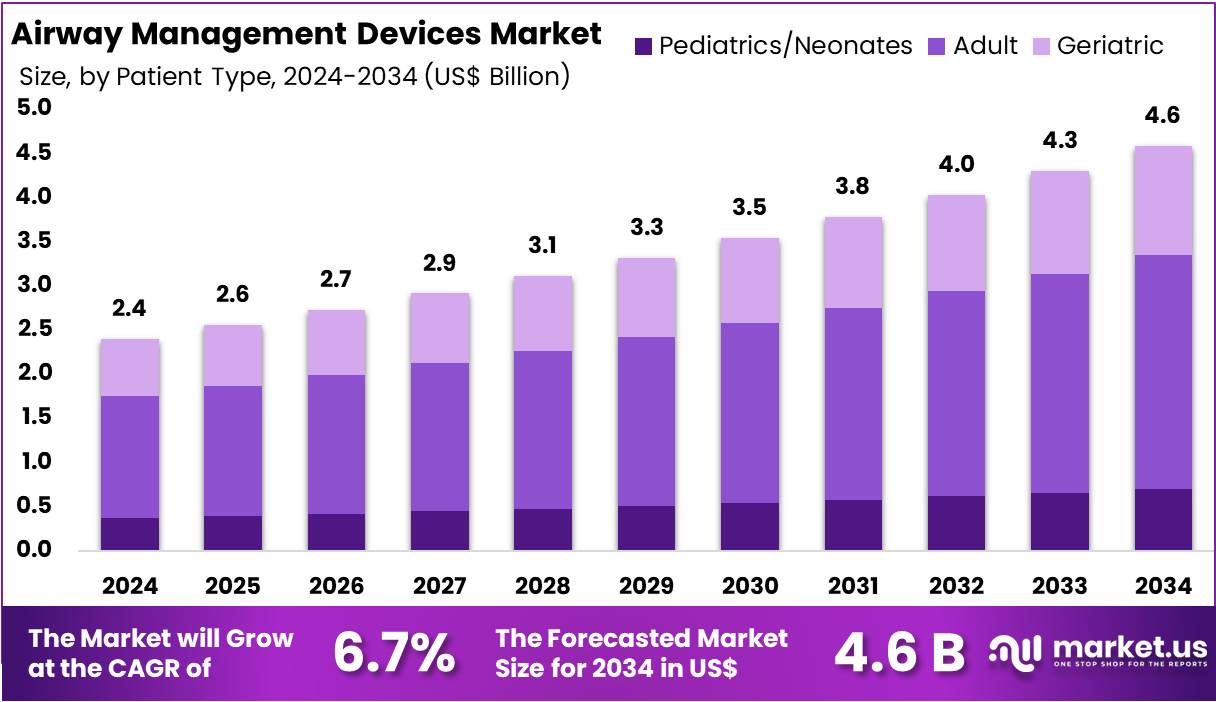
Key Takeaways
- The global airway management devices market is expected to expand from US$ 2.4 billion in 2024 to US$ 4.6 billion by 2034.
- The supraglottic devices segment led the product category in 2024, accounting for over 35.2% of the global airway management devices market.
- Among patient types, the adult segment held the largest market share in 2024, contributing more than 57.6% of the global market.
- By application, the anaesthesia segment dominated in 2024, representing over 51.0% of total market revenue.
- In the end-user category, anaesthesia accounted for the largest share in 2024, capturing more than 50.6% of the global airway management devices market.
- North America remained the leading regional market in 2024, holding 37.6% of the global market and reaching a value of approximately US$ 0.9 billion.
Statistical Information
- Rising Global COPD Burden is Increasing Demand for Airway Management Devices: Chronic obstructive pulmonary disease (COPD) remains one of the world’s leading causes of death, creating sustained demand for endotracheal tubes, laryngeal masks, ventilators, and other airway management devices. According to the World Health Organization (WHO), COPD caused approximately 3.4 million deaths globally in 2023, making it the third leading cause of death worldwide. WHO also reports that nearly 90% of COPD deaths among people under 70 years occur in low- and middle-income countries.
- Growing Asthma Population Expands Airway Device Utilization: Asthma continues to increase demand for airway support during emergency treatment and anesthesia. According to WHO, 363 million people worldwide were living with asthma in 2023, while the disease caused approximately 442,000 deaths. Inhaled therapies, emergency airway management, and oxygen support remain essential components of treatment.
- Medical Oxygen Demand Supports Airway Management Equipment Procurement: The expansion of oxygen infrastructure is directly supporting procurement of airway management devices. WHO’s Global Forum on Medical Devices reported that approximately 374 million people worldwide require medical oxygen, with an estimated 4.6 billion cubic meters of medical oxygen needed annually, including demand for acute medical and surgical care as well as COPD management.
- U.S. COPD Statistics Reflect High Healthcare Utilization: According to the U.S. Centers for Disease Control and Prevention (CDC), 4.2% of U.S. adults had been diagnosed with COPD, emphysema, or chronic bronchitis in 2024. The CDC also reported approximately 854,000 emergency department visits with COPD as the primary diagnosis, highlighting continued demand for emergency airway equipment.
- Asthma Emergency Care Continues to Drive Airway Device Usage: CDC data indicate that 8.6% of U.S. adults and 6.5% of children currently had asthma in 2024. The agency also recorded approximately 1.4 million emergency department visits for asthma, demonstrating continued utilization of airway management and respiratory support devices.
- Smoking Remains the Leading Risk Factor for COPD: According to the Global Burden of Disease (GBD) 2021 study published by BMC Medicine, smoking accounted for 34.8% of global COPD disability-adjusted life years (DALYs). Ambient particulate matter contributed 22.2%, while household air pollution contributed 19.5%, highlighting continued respiratory disease burden.
- Aging Population Will Increase Surgical and Critical Care Demand: According to the United Nations, the global population aged 65 years and older is projected to increase from 857 million in 2025 to approximately 1.6 billion by 2050. Older adults experience higher rates of surgery, respiratory disease, and difficult airway management, increasing long-term demand for airway devices.
- Difficult Airway Occurs in a Significant Share of Surgical Patients: According to the American Society of Anesthesiologists (ASA) Difficult Airway Guidelines, difficult tracheal intubation occurs in approximately 1–10% of patients, while failed intubation is estimated at 0.05–0.35% of routine surgical cases. This supports continued demand for advanced airway devices and video laryngoscopes.
Regional Analysis
North America led the regional market in 2024, representing a 37.6% share
North America dominated the airway management devices market due to its advanced healthcare infrastructure, high surgical volumes, and significant burden of respiratory diseases. According to the U.S. Centers for Disease Control and Prevention (CDC), chronic lower respiratory disease remained among the leading causes of death in the United States, while millions of adults continue to live with chronic obstructive pulmonary disease (COPD), increasing demand for airway management during emergency and critical care.
The region also performs millions of inpatient and outpatient surgical procedures annually, supporting consistent use of endotracheal tubes, laryngeal mask airways, and video laryngoscopes. Extensive intensive care unit (ICU) capacity and well-established emergency medical services (EMS) further strengthen demand for advanced airway devices. High healthcare spending enables hospitals to adopt innovative technologies and replace older equipment regularly. In addition, the U.S. Food and Drug Administration (FDA) continues to clear new airway management products through established regulatory pathways, accelerating innovation and supporting widespread adoption across hospitals, ambulatory surgical centers, and emergency care providers.
Emerging Trends
- Growing Adoption of Video Laryngoscopy: Hospitals are increasingly replacing conventional laryngoscopes with video laryngoscopes because they improve airway visualization and first-pass intubation success. In 2025, the FDA recognized ISO 7376-2, a dedicated international standard for video laryngoscopes, reflecting rapid technological advancement and wider clinical adoption.
- Expansion of Global Oxygen Infrastructure: Healthcare systems are investing in integrated oxygen delivery and airway management systems. WHO identifies oxygen as an essential medicine with no substitute for surgery, trauma, pneumonia, and critical illness. WHO and UNICEF continue supporting oxygen system expansion through standardized procurement guidance and national oxygen scale-up programs.
- Rising Preference for Disposable Airway Devices: Healthcare providers are increasingly adopting single-use airway products to reduce cross-contamination and simplify infection prevention. FDA and healthcare organizations continue emphasizing device safety, while hospitals invest in disposable laryngoscope blades, endotracheal tubes, and supraglottic airways for improved patient protection.
- Stronger Regulatory Focus on Device Quality: Regulatory agencies continue strengthening airway device standards. In 2026, the FDA updated recognized standards for laryngoscopes, including new specifications for video laryngoscopes, supporting manufacturers in developing safer, higher-performance airway management technologies for hospitals and emergency care providers.
- Increasing Investment in Critical Care Equipment: WHO estimates there are about 2 million different medical device types across more than 7,000 generic device groups, with respiratory and airway technologies remaining essential for emergency preparedness. Hospitals continue expanding ICU equipment inventories following global investments in respiratory care infrastructure.
Use Cases
- Airway Support During Surgical Procedures: Airway management devices are routinely used during general anesthesia to maintain patient ventilation throughout surgery. WHO states oxygen is essential for every surgical setting, making endotracheal tubes, laryngeal masks, and ventilation equipment fundamental components of operating rooms worldwide.
- Emergency Treatment for Severe Respiratory Failure: Patients experiencing severe respiratory distress from pneumonia, trauma, COPD, or other emergencies often require rapid airway stabilization. FDA lists mechanical ventilators and respiratory support devices among the primary technologies used to assist breathing in hospital emergency departments and ICUs.
- Critical Care and Intensive Care Units: ICU patients frequently require prolonged mechanical ventilation supported by airway devices. WHO identifies oxygen therapy and respiratory support as lifesaving interventions for critically ill patients, encouraging hospitals to maintain advanced airway equipment for continuous patient care.
- Prehospital Emergency Medical Services (EMS): Emergency responders use bag-valve masks, supraglottic airway devices, and video laryngoscopes to stabilize patients before hospital arrival. These technologies improve airway access during trauma, cardiac arrest, and respiratory emergencies, expanding airway device utilization beyond hospital environments.
- Management of Sleep-Related Breathing Disorders: Airway management technologies are increasingly used for obstructive sleep apnea treatment. According to the FDA, Continuous Positive Airway Pressure (CPAP) and BiPAP systems help keep airways open during sleep, supporting millions of patients with chronic breathing disorders at home.
Frequently Asked Questions on Airway Management Devices
- What factors are driving the growth of airway management devices?
Rising cases of COPD, asthma, trauma, and respiratory infections, along with increasing surgical procedures, aging populations, and expanding critical care infrastructure, are driving demand. Technological innovations and infection-control measures also support market growth. - How do respiratory diseases affect demand for airway management devices?
Respiratory conditions such as COPD, asthma, pneumonia, and acute respiratory distress syndrome often require airway support, oxygen therapy, or mechanical ventilation. The growing burden of these diseases continues to increase the use of airway management devices globally. - What is the future outlook for the airway management devices market?
The market is expected to grow steadily due to increasing respiratory disease prevalence, rising surgical volumes, expanding emergency care services, and continuous technological advancements. Demand is also supported by healthcare infrastructure development and an aging global population. - Which product segment leads the airway management devices market?
Supraglottic airway devices hold a leading market share because they are easy to use, offer rapid airway access, and reduce complications. Their widespread adoption in anesthesia and emergency medicine continues to strengthen their market position. - Which region dominates the airway management devices market?
North America leads the market due to advanced healthcare infrastructure, high surgical procedure volumes, strong healthcare spending, extensive ICU capacity, and rapid adoption of innovative airway management technologies approved by regulatory agencies. - What opportunities exist in the airway management devices market?
Significant opportunities include increasing adoption of disposable airway devices, expansion of emergency medical services, growing investment in ICU infrastructure, wider use of video-assisted airway technologies, and improved access to healthcare in emerging economies.
Conclusion
The airway management devices market is poised for steady growth, driven by the rising prevalence of respiratory diseases, increasing surgical procedures, and expanding emergency and critical care services worldwide. Continuous advancements in video laryngoscopy, disposable airway products, and infection-control technologies are improving patient safety and clinical outcomes.
Strong healthcare investments, growing ICU capacity, and supportive regulatory frameworks are further accelerating product adoption across hospitals and ambulatory surgical centers. As healthcare systems continue to strengthen emergency preparedness and respiratory care capabilities, demand for reliable airway management devices is expected to remain robust, creating long-term opportunities for manufacturers and healthcare providers globally.
Discuss your needs with our analyst
Please share your requirements with more details so our analyst can check if they can solve your problem(s)




