


Overview
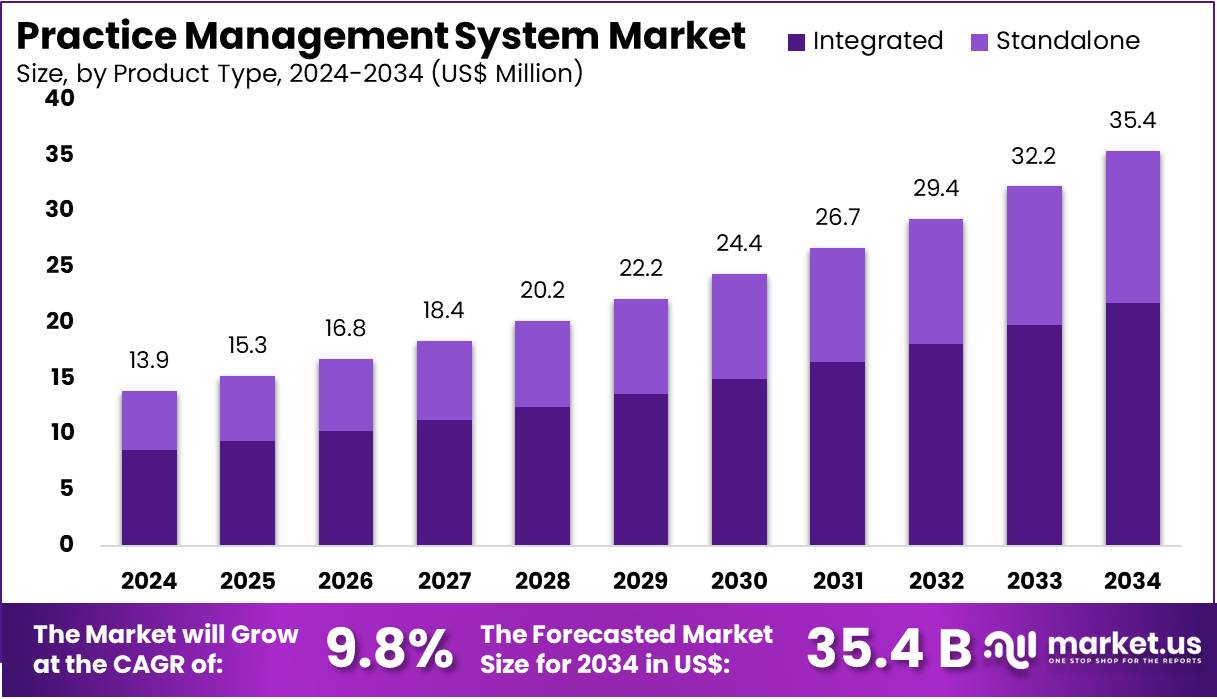
New York, NY – May 08, 2026 –The Practice Management System Market size is expected to be worth around US$ 35.4 Billion by 2034 from US$ 13.9 Billion in 2024, growing at a CAGR of 9.8% during the forecast period 2025 to 2034.
A Practice Management System (PMS) is an integrated software solution designed to streamline administrative, financial, and operational functions within healthcare practices and clinics. The system enables healthcare providers to manage patient scheduling, billing, electronic medical records, claims processing, and workflow automation through a centralized digital platform.
Increasing adoption of digital healthcare technologies and the growing need for operational efficiency are supporting the demand for practice management systems across hospitals, physician offices, and specialty clinics.
The market is witnessing steady growth due to the rising volume of patient data, increasing emphasis on reducing administrative burden, and growing regulatory requirements related to healthcare documentation and reimbursement processes.
Cloud-based deployment models are gaining significant traction owing to their scalability, remote accessibility, lower infrastructure costs, and improved data security capabilities. In addition, integration with telehealth services and electronic health record systems is enhancing the overall efficiency of healthcare delivery.
North America currently represents a major market for practice management systems, supported by advanced healthcare IT infrastructure and high adoption of digital health solutions. Meanwhile, Asia-Pacific is expected to register notable growth due to expanding healthcare infrastructure, increasing healthcare expenditures, and rapid digital transformation initiatives.
Key industry participants are focusing on product innovation, interoperability, and AI-enabled workflow optimization to strengthen their market presence and improve patient care outcomes.
Key Takeaways
- The global practice management system market was valued at US$ 13.9 billion in 2024 and is projected to reach US$ 35.4 billion by 2034, expanding at a CAGR of 9.8% during the forecast period.
- Based on product type, the market is categorized into integrated and standalone systems. The integrated segment dominated the market in 2024, accounting for a revenue share of 61.5%.
- By component, the market is segmented into software and services, with the software segment holding a leading market share of 72.8% in 2024.
- In terms of delivery mode, the market is divided into web-based, cloud-based, and on-premise solutions. Among these, the web-based segment emerged as the leading category, capturing 56.7% of the total market revenue.
- Based on end user, the market is segmented into physician back office, pharmacies, diagnostic laboratories, and others. The physician back office segment led the market with a revenue share of 53.9%.
- North America dominated the global practice management system market in 2024, securing a market share of 44.3%.
Regional Analysis
North America dominated the practice management system market in 2024, accounting for the largest revenue share of 44.3%. The regional market growth is primarily driven by the increasing adoption of electronic health records (EHR) and integrated healthcare technologies that improve administrative efficiency and patient management.
The growing elderly population and rising prevalence of chronic diseases have significantly increased healthcare service demand, creating a greater need for advanced practice management solutions. In addition, supportive government initiatives, including Medicaid and Medicare EHR incentive programs, have accelerated the adoption of digital healthcare systems across hospitals and clinics. Technological advancements and the integration of telehealth services have further strengthened market expansion in the region.
Asia Pacific is expected to register the fastest CAGR during the forecast period owing to rapid healthcare infrastructure development and increasing healthcare digitization across emerging economies such as China and India. The rising aging population and growing burden of chronic diseases are expected to increase the demand for efficient healthcare management systems.
Furthermore, improving economic conditions, expanding middle-class population, and supportive government initiatives aimed at enhancing healthcare accessibility are contributing to market growth. Increasing awareness regarding the importance of efficient healthcare operations and quality patient care is also expected to support the adoption of practice management systems across the region.
Emerging Trends
- Shift to Cloud-Based Platforms: Healthcare providers are adopting cloud-based PMS solutions for secure remote access, automatic updates, real-time synchronization, lower infrastructure costs, and easy scalability, helping clinics improve efficiency and support long-term operational growth.
- Rise of Artificial Intelligence and Automation: AI-powered PMS platforms automate scheduling, billing, claims management, and documentation, reducing errors and administrative workload while improving workflow speed, operational efficiency, and allowing healthcare staff to focus more on patient care.
- Focus on Data Privacy and Cybersecurity: Modern PMS platforms prioritize cybersecurity through encryption, access controls, audit tracking, and blockchain integration, helping healthcare providers protect patient information, prevent cyber threats, and comply with healthcare privacy regulations.
- Specialty-Specific Customization: Practice management systems are increasingly customized for specialties like dermatology, ophthalmology, and physical therapy, offering tailored workflows, billing codes, and templates that improve efficiency, accuracy, and practice-specific operational management.
Use Cases
- Appointment Scheduling: Practice Management Systems simplify appointment scheduling through online booking, automated reminders, real-time calendar updates, and provider management tools, reducing missed appointments while improving operational efficiency and patient satisfaction.
- Performance Tracking and Reporting: PMS dashboards help clinics monitor appointments, billing performance, and staff productivity, enabling data-driven decisions, identifying workflow gaps, improving operational efficiency, and supporting long-term business and patient care improvements.
- Enhanced Security and Compliance: Practice Management Systems strengthen data security using encryption, access restrictions, audit logs, and regular updates, helping clinics prevent data breaches, maintain regulatory compliance, and enhance patient trust and confidentiality.
- Smarter Documentation with AI Scribes: AI scribes in PMS platforms automatically generate patient notes during consultations, reducing documentation time, improving record accuracy, minimizing administrative burden, and allowing healthcare professionals to focus more on patient interactions.
Frequently Asked Questions on Practice Management System
- Why is a Practice Management System important for healthcare providers?
A Practice Management System helps healthcare providers reduce manual administrative tasks, improve appointment coordination, and enhance billing accuracy. The system supports operational efficiency, minimizes errors, strengthens patient engagement, and enables medical professionals to focus more effectively on delivering quality healthcare services. - What are the key features of a Practice Management System?
Key features of a Practice Management System include appointment scheduling, electronic billing, patient registration, claims management, reporting tools, insurance verification, and revenue cycle management. Advanced systems also integrate telehealth, analytics, and automated reminders to improve administrative and clinical operations. - How does a Practice Management System improve operational efficiency?
A Practice Management System automates repetitive administrative functions such as scheduling, invoicing, claims processing, and patient communication. Automation reduces paperwork, decreases processing time, minimizes human errors, and improves coordination between departments, resulting in enhanced workflow efficiency across healthcare organizations. - How does cloud-based deployment benefit Practice Management Systems?
Cloud-based Practice Management Systems provide remote accessibility, lower infrastructure costs, enhanced data security, and simplified software updates. These systems allow healthcare providers to access patient and operational information from multiple locations while supporting scalability and reducing information technology maintenance requirements. - How do Practice Management Systems ensure data security?
Practice Management Systems ensure data security through encryption technologies, secure cloud storage, user authentication protocols, and regular software updates. Compliance with healthcare regulations and implementation of cybersecurity measures help protect sensitive patient information from unauthorized access and data breaches. - What is the difference between EHR and Practice Management Systems?
Electronic Health Record systems primarily focus on clinical patient data management, while Practice Management Systems concentrate on administrative and financial operations. Many healthcare organizations integrate both systems to improve workflow coordination, patient care delivery, and operational efficiency across facilities. - How is telehealth influencing the Practice Management System market?
Telehealth integration is significantly influencing the Practice Management System market by increasing demand for remote patient management capabilities. Healthcare providers are adopting integrated platforms that support virtual consultations, digital scheduling, billing management, and secure communication between physicians and patients. - How do Practice Management Systems support regulatory compliance?
Practice Management Systems support regulatory compliance by maintaining accurate patient records, automating documentation processes, and ensuring secure data management practices. The systems help healthcare organizations comply with healthcare regulations, billing standards, and patient privacy requirements across different regions and markets.
Conclusion
The Practice Management System market is experiencing significant growth due to the increasing adoption of digital healthcare technologies and the rising need for operational efficiency across healthcare facilities.
Cloud-based platforms, AI-powered automation, telehealth integration, and enhanced cybersecurity features are transforming administrative and patient management processes. Growing healthcare digitization, regulatory compliance requirements, and demand for streamlined workflows are further supporting market expansion globally.
North America continues to lead the market, while Asia-Pacific is expected to witness strong growth opportunities. Continuous technological advancements and specialty-specific customization are expected to improve healthcare delivery, operational performance, and patient care outcomes throughout the forecast period.
Discuss your needs with our analyst
Please share your requirements with more details so our analyst can check if they can solve your problem(s)




