


Overview
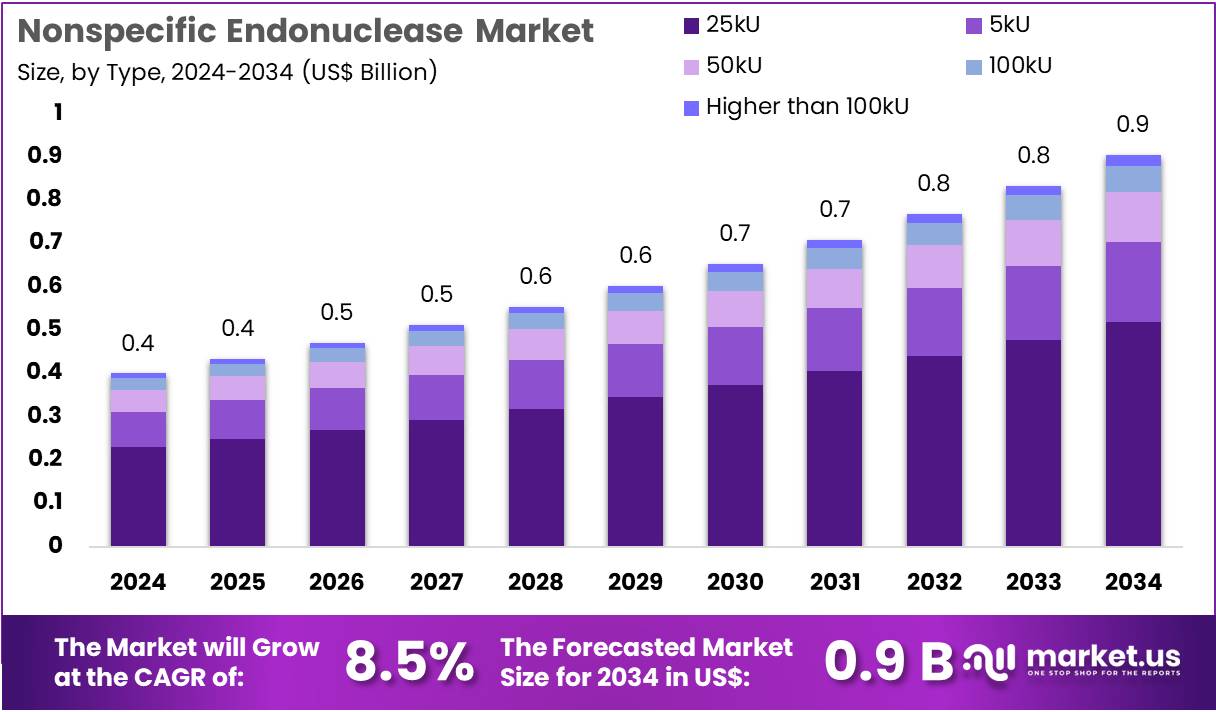
New York, NY – June 03, 2026 –The Nonspecific Endonuclease Market Size is expected to be worth around US$ 0.9 Billion by 2034 from US$ 0.4 Billion in 2024, growing at a CAGR of 8.5% during the forecast period 2025 to 2034. North America held a dominant market position, capturing more than a 39.1% share and holds US$ 0.2 Billion market value for the year.
Nonspecific Endonuclease is an enzyme that cleaves nucleic acids, including both DNA and RNA, without requiring a specific nucleotide sequence for recognition. This broad-spectrum activity makes it a valuable tool across biotechnology, pharmaceutical manufacturing, molecular biology, and life science research applications. The enzyme functions by hydrolyzing phosphodiester bonds within nucleic acid strands, resulting in the efficient degradation of genetic material into smaller oligonucleotides and nucleotides.
Nonspecific Endonucleases are widely utilized during bioprocessing and recombinant protein production to reduce viscosity caused by released cellular DNA and RNA following cell lysis. Their use helps improve downstream purification efficiency, enhance product recovery, and support regulatory compliance by minimizing residual host-cell nucleic acid contamination in biologics and vaccine manufacturing processes.
Growing demand for biopharmaceuticals, gene therapies, cell-based therapies, and advanced research tools has contributed to increasing adoption of Nonspecific Endonucleases globally. The enzyme is also employed in laboratory workflows involving nucleic acid removal, sample preparation, protein purification, and diagnostic assay development.
Technological advancements in enzyme engineering and production methods continue to improve enzyme stability, activity, and process compatibility. As the biotechnology and pharmaceutical sectors expand, Nonspecific Endonucleases are expected to remain essential processing aids, supporting efficient manufacturing operations and high-quality product development across a broad range of life science applications.
Key Takeaways
- The global nonspecific endonuclease market was valued at US$ 0.4 billion in 2024 and is projected to reach US$ 0.9 billion by 2033, expanding at a CAGR of 8.5% during the forecast period.
- Based on type, the market is segmented into 5kU, 25kU, 50kU, 100kU, and above 100kU. Among these, the 25kU segment dominated the market in 2024, accounting for 57.3% of the total revenue share.
- By application, the market is categorized into biological laboratories, university research rooms, and others. The biological laboratories segment emerged as the leading application area, capturing 62.5% of the market share in 2024.
- North America held the largest regional share of the nonspecific endonuclease market in 2024, representing 39.1% of the global market revenue.
Regional Analysis
North America accounted for the largest share of the nonspecific endonuclease market in 2024, driven by strong investments in biotechnology, pharmaceutical research, and life sciences innovation. The region benefits from a well-established research infrastructure, substantial government funding, and high levels of private sector participation.
Continuous support for genomics and molecular biology research has increased the demand for enzymes used in DNA and RNA processing. In addition, significant venture capital investments in the life sciences sector and innovation-focused programs in both the United States and Canada have strengthened the adoption of advanced research reagents, including nonspecific endonucleases.
Asia Pacific is projected to register the fastest growth rate during the forecast period. The region is witnessing rapid expansion in biotechnology research, biopharmaceutical manufacturing, and academic research activities. Governments across China, Japan, South Korea, and India are increasing investments in research and development to support scientific advancement and innovation.
The growing number of biotechnology startups, expanding contract manufacturing capabilities, and favorable government initiatives aimed at accelerating biotechnology research are expected to drive market growth. Furthermore, increasing efforts to develop bio-based economies and strengthen domestic biopharmaceutical production are creating substantial demand for molecular biology reagents, positioning Asia Pacific as a key growth hub for the nonspecific endonuclease market.
Emerging Trends
- Growing use to remove DNA contamination: Biotech and pharma labs increasingly use nonspecific endonucleases to remove leftover DNA from vaccines, viral vectors, and protein drugs, helping them meet strict impurity limits below about 10 nanograms of residual DNA per dose in many guidelines.
- Support for new gene and cell therapies: Nonspecific endonucleases are more often used to clean up nucleic acid impurities in viral vectors and cell therapies, as over 1,000 gene therapy trials have been registered globally, with many using DNA-based delivery systems that must be purified carefully.
- Better understanding of how they cut DNA: Structural biology studies from research groups supported by the U.S. National Institutes of Health show how nonspecific endonucleases prefer DNA regions that bend easily, helping explain why they cut some sites faster, and this guides design of safer, more controlled enzyme use.
- Broader role in cell DNA repair and cell death: Government-backed studies in model organisms show nonspecific endonucleases help recycle DNA building blocks, repair damaged DNA, and fragment DNA during programmed cell death, processes that together affect billions of cells daily in a human body.
- Wider detection in plants and microbes: Academic and public-funded surveys have identified more than 30 sugar nonspecific endonucleases in bacteria, fungi, and plants such as tea and barley, showing these enzymes are common in nature and opening new possibilities for using them in agriculture and food biotechnology.
Use Cases
- Cleaning DNA and RNA contamination in labs: Nonspecific endonucleases such as Benzonase or DNase I are routinely used to digest all forms of DNA and RNA into tiny fragments under 10 base pairs, making laboratory samples cleaner for tests like PCR, sequencing, and protein analysis.
- Supporting DNA repair and mutation studies: Researchers use these enzymes to study how cells repair DNA by creating controlled DNA breaks and observing repair pathways, which helps to understand diseases linked to DNA repair defects that affect at least hundreds of thousands of patients worldwide.
- Helping map DNA structure and mutations: Because nonspecific endonucleases recognize different DNA shapes, scientists use them as analytical tools to map unusual DNA structures and mutation sites, and more than 30 distinct enzymes have been isolated for such structural and mutation-mapping experiments.
- Breaking DNA during programmed cell death: Studies supported by public health agencies show these enzymes contribute to DNA fragmentation in apoptosis, where a single human cell can cut its genome, about 6 billion base pairs, into many small pieces as part of normal tissue turnover and immune defense.
- Participating in gene silencing and mRNA control: Nonspecific endonucleases help degrade messenger RNA during gene silencing and control of gene activity, and this regulation can affect expression of thousands of genes in a cell, influencing processes such as development, immunity, and response to stress.
Frequently Asked Questions on Nonspecific Endonuclease
- How does a Nonspecific Endonuclease work?
Nonspecific endonucleases function by cleaving phosphodiester bonds within nucleic acid molecules. This process breaks long DNA and RNA strands into smaller fragments, reducing sample viscosity and facilitating easier handling, purification, and analysis in research and industrial applications. - What are the major applications of Nonspecific Endonucleases?
These enzymes are commonly used in biological laboratories, biopharmaceutical manufacturing, vaccine production, protein purification, diagnostic testing, and academic research. Their ability to efficiently remove nucleic acid contaminants makes them valuable across a broad range of life science processes. - What factors are driving the growth of the Nonspecific Endonuclease Market?
Market growth is being supported by increasing investments in biotechnology, rising biopharmaceutical production, expanding genomics research, and growing demand for advanced molecular biology tools. The development of cell and gene therapies is also contributing to greater enzyme utilization. - Which type segment dominates the Nonspecific Endonuclease Market?
The 25kU segment holds the leading position in the market due to its balance of performance, efficiency, and cost-effectiveness. Its widespread adoption in laboratory research and bioprocessing applications has contributed significantly to its dominant market share. - Which application segment accounts for the largest market share?
Biological laboratories represent the largest application segment in the nonspecific endonuclease market. High utilization in nucleic acid removal, sample preparation, and molecular biology experiments has strengthened demand from research institutions and commercial laboratories worldwide. - Which region leads the Nonspecific Endonuclease Market?
North America leads the global market due to its advanced biotechnology infrastructure, strong research funding, and high concentration of pharmaceutical and life science companies. Continuous innovation and substantial investment in genomics research further support regional market dominance. - What is the future outlook for the Nonspecific Endonuclease Market?
The market is expected to experience steady growth over the coming years, supported by advances in biotechnology, increasing demand for biologics, and expanding research activities. Continuous innovation in enzyme engineering is likely to enhance performance and broaden application opportunities.
Conclusion
The nonspecific endonuclease market is poised for sustained growth, driven by expanding applications in biotechnology, biopharmaceutical manufacturing, genomics research, and advanced therapeutic development. These enzymes play a critical role in nucleic acid removal, process optimization, and product quality enhancement across research and commercial settings.
Increasing adoption in gene therapies, cell therapies, vaccine production, and protein purification is expected to support long-term market expansion. North America currently leads the market due to its strong research ecosystem, while Asia Pacific is emerging as the fastest-growing region. Continued advancements in enzyme engineering and rising global investments in life sciences will further strengthen market opportunities through 2033.
Discuss your needs with our analyst
Please share your requirements with more details so our analyst can check if they can solve your problem(s)




