


Overview
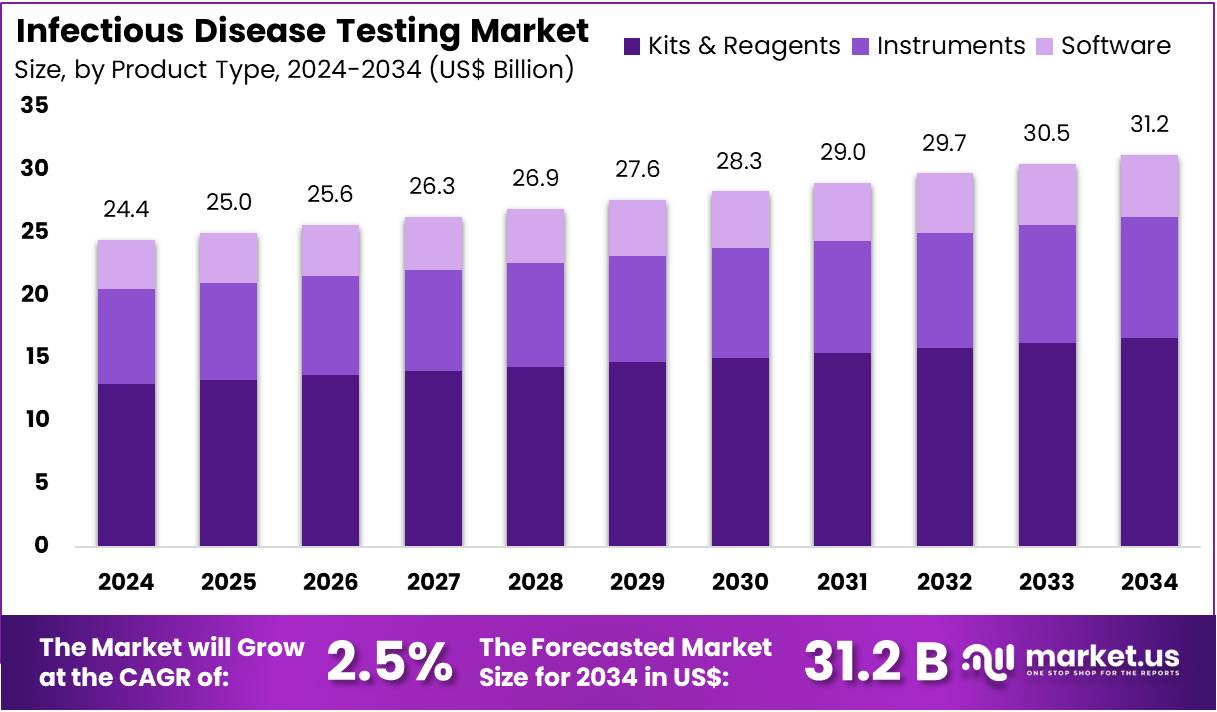
New York, NY – May 07, 2026 – The Infectious Disease Testing Market Size is expected to be worth around US$ 31.2 billion by 2034 from US$ 24.4 billion in 2024, growing at a CAGR of 2.5% during the forecast period 2025 to 2034. North America held a dominant market position, capturing more than a 38.5% share and holds US$ 9.4 Billion market value for the year.
The global infectious disease testing market is witnessing steady growth due to the rising prevalence of viral, bacterial, and fungal infections across both developed and emerging economies. Infectious disease testing refers to diagnostic procedures used to detect pathogens such as bacteria, viruses, parasites, and fungi in the human body. These tests play a critical role in disease prevention, early diagnosis, treatment selection, and outbreak control.
Growth in the market is being supported by the increasing burden of diseases such as influenza, tuberculosis, hepatitis, HIV/AIDS, COVID-19, and sexually transmitted infections. In addition, the expansion of molecular diagnostics, rapid antigen tests, and point-of-care testing technologies has significantly improved testing accuracy and turnaround time. Governments and healthcare organizations are also increasing investments in laboratory infrastructure and disease surveillance systems, further contributing to market expansion.
Hospitals, diagnostic laboratories, blood banks, and research institutes represent the major end users of infectious disease testing solutions. North America holds a significant market share due to advanced healthcare infrastructure and high adoption of diagnostic technologies, while Asia-Pacific is expected to witness strong growth driven by improving healthcare access and rising awareness regarding early disease detection.
Key market participants are focusing on product innovation, automation, and strategic collaborations to strengthen their market presence and meet the growing global demand for accurate and rapid infectious disease diagnostics.
Key Takeaways
- The global infectious disease testing market generated revenue of US$ 24.4 billion in 2024 and is projected to reach US$ 31.2 billion by 2034, expanding at a CAGR of 2.5% during the forecast period.
- Based on product type, the market is segmented into kits & reagents, instruments, and software & services. Among these, the kits & reagents segment dominated the market in 2024, accounting for a revenue share of 55.5%.
- By technology, the market is categorized into molecular diagnostics, immunodiagnostics, clinical microbiology, and biosensor-based solutions. Molecular diagnostics emerged as the leading technology segment, holding 42.3% of the market share in 2024.
- In terms of application, the market includes infectious diseases, nephrology, diabetes, cardiology, cancer/oncology, autoimmune diseases, and others. The infectious diseases segment held the largest revenue share of 48.5% in 2024.
- Based on sample type, the market is divided into blood, urine, sputum, saliva, and others. The blood segment led the market with a revenue share of 46.2%.
- By disease type, the market comprises respiratory infections, vector-borne diseases, sexually transmitted infections (STIs), hospital-acquired infections (HAIs), gastrointestinal infections, and others. Respiratory infections accounted for the highest market share of 34.0% in 2024.
- In terms of end users, the market is segmented into diagnostic laboratories, hospitals & clinics, research institutes, homecare settings, and others. Diagnostic laboratories dominated the segment with a 42.0% revenue share.
- North America remained the leading regional market, capturing 38.5% of the global market share in 2024.
Regional Analysis
North America accounted for the largest share of the infectious disease testing market in 2024, driven by the rising incidence of infectious diseases and strong adoption of advanced diagnostic technologies.
Increasing cases of respiratory infections, sexually transmitted diseases, and tuberculosis significantly boosted the demand for diagnostic testing across hospitals, laboratories, and outpatient care settings.
According to the Centers for Disease Control and Prevention (CDC), tuberculosis cases in the US increased by 16% in 2023 compared to the previous year. Technological advancements in molecular diagnostics and point-of-care testing further enhanced the speed, efficiency, and accuracy of disease detection.
In addition, higher healthcare spending and supportive government initiatives focused on disease surveillance and infection control contributed to regional market growth.
Emerging Trends
- Smarter and Faster Home Tests: Advanced home testing kits now detect multiple infections, including flu, COVID-19, and inflammation-related conditions. These rapid tests provide accurate results within minutes, improving early diagnosis, convenience, and disease management without requiring laboratory visits.
- Wastewater Testing for Early Detection: Wastewater testing is increasingly used to identify infectious diseases before symptoms appear in communities. This cost-effective surveillance method helps governments and health agencies monitor outbreaks early and respond quickly to prevent widespread transmission.
- Paper-Based and Portable Diagnostics: Paper-based diagnostic tools are transforming healthcare by offering low-cost, portable, and rapid infection detection. These easy-to-use tests are highly valuable in rural and underserved regions where laboratory infrastructure and healthcare access remain limited.
- Point-of-Care Molecular Testing: Portable molecular diagnostic devices now deliver laboratory-quality results directly at clinics, hospitals, and emergency settings. These systems improve treatment decisions by enabling rapid and accurate detection of diseases such as COVID-19, HIV, and tuberculosis.
Use Cases
- Home Testing for Personal Safety: Home testing kits allow individuals to quickly check for infections before travel, work, or hospital visits. These tests reduce unnecessary healthcare visits, support early detection, and help minimize the spread of contagious diseases.
- Wastewater Testing for Public Health: Public health authorities use wastewater surveillance to monitor infectious diseases across communities, schools, and airports. This approach provides early outbreak warnings, improves disease tracking, and supports faster public health response strategies.
- AI in Infection Monitoring: Artificial intelligence technologies are improving infection monitoring by analyzing patient data and identifying health risks early. AI-driven systems help healthcare providers make faster decisions, enhance patient care, and improve disease management outcomes.
- Sharing Test Data Across Systems: Integrated healthcare data-sharing systems improve collaboration between hospitals, laboratories, and public health agencies. Shared testing data supports faster outbreak tracking, better treatment coordination, and stronger responses during global infectious disease emergencies.
Frequently Asked Questions on Infectious Disease Testing
- What factors are driving the growth of the infectious disease testing market?
The market is primarily driven by the increasing prevalence of infectious diseases, rising awareness regarding early diagnosis, and growing adoption of advanced diagnostic technologies. Expanding healthcare infrastructure, government disease surveillance programs, and demand for rapid and accurate testing solutions also support market growth. - Which technologies are widely used in infectious disease testing?
Common technologies used in infectious disease testing include molecular diagnostics, immunodiagnostics, clinical microbiology, and biosensor-based testing. Among these, molecular diagnostics are widely preferred due to their high sensitivity, rapid turnaround time, and ability to detect infections at an early stage. - Which sample types are commonly used in infectious disease testing?
Blood, urine, sputum, saliva, and tissue samples are commonly used for infectious disease testing. Blood samples account for a significant share due to their effectiveness in detecting a wide range of infections, including viral, bacterial, and blood-borne diseases. - Which region dominates the infectious disease testing market?
North America holds the leading share in the infectious disease testing market due to advanced healthcare infrastructure, strong adoption of innovative diagnostic technologies, and increasing cases of infectious diseases. Government support for disease monitoring and high healthcare expenditure also contribute to regional dominance. - Why is Asia Pacific expected to witness significant market growth?
Asia Pacific is projected to experience strong market growth due to rising healthcare investments, increasing awareness regarding disease prevention, and growing prevalence of infectious diseases. Expanding healthcare facilities and improving access to advanced diagnostic technologies are further supporting regional market expansion.
Conclusion
The global infectious disease testing market is expected to witness steady expansion due to the increasing burden of infectious diseases and the growing need for rapid, accurate, and accessible diagnostic solutions.
Technological advancements in molecular diagnostics, point-of-care testing, AI-based monitoring, and portable diagnostic tools are transforming disease detection and management worldwide. Strong government initiatives, rising healthcare investments, and expanding laboratory infrastructure are further supporting market growth.
While North America continues to dominate the market due to advanced healthcare systems, Asia Pacific is anticipated to emerge as the fastest-growing region driven by improving healthcare access and increasing awareness regarding early disease diagnosis and prevention.
Discuss your needs with our analyst
Please share your requirements with more details so our analyst can check if they can solve your problem(s)




