


Overview
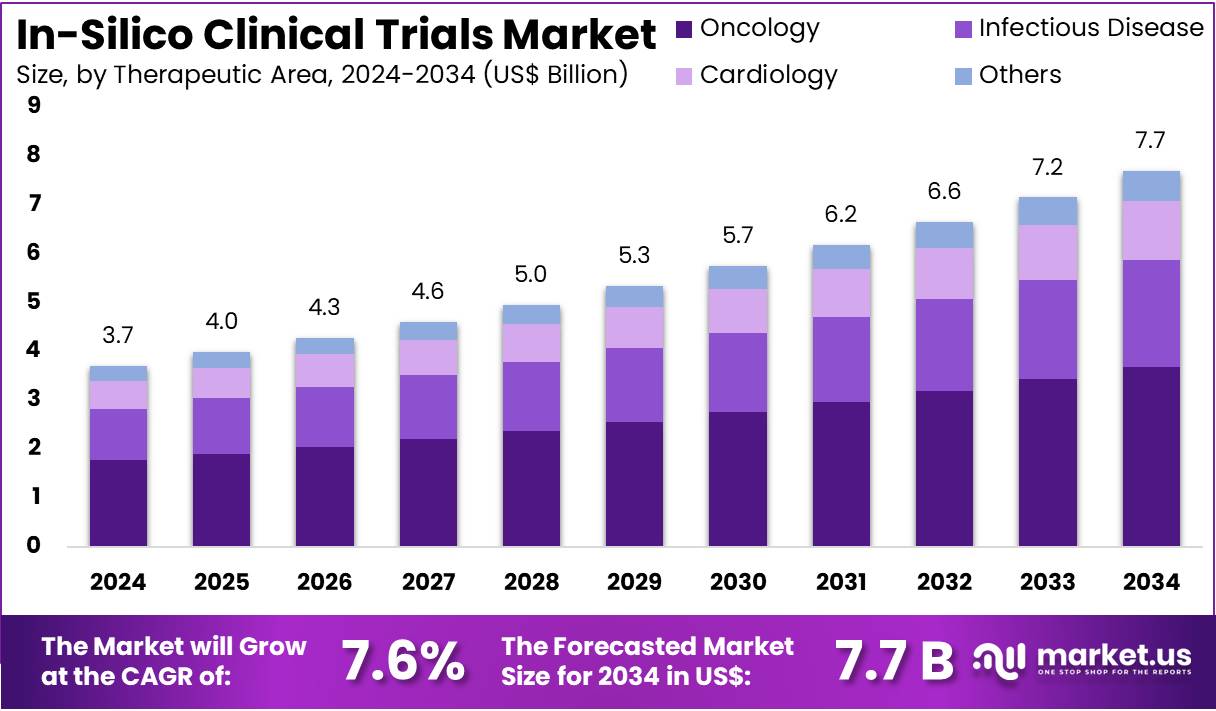
New York, NY – June 04, 2026 – The In-Silico Clinical Trials Market size is expected to be worth around US$ 7.7 billion by 2034 from US$ 3.7 billion in 2024, growing at a CAGR of 7.6% during the forecast period 2025 to 2034.
In-silico clinical trials are emerging as a transformative approach in pharmaceutical and medical device development. These trials use advanced computer modeling, simulation technologies, artificial intelligence (AI), and virtual patient populations to predict the safety, efficacy, and performance of drugs, therapies, and medical devices before or alongside traditional human clinical studies.
By creating digital representations of biological systems and patient characteristics, researchers can evaluate treatment outcomes across diverse patient groups, disease conditions, and treatment scenarios. This approach helps identify potential risks, optimize study designs, and improve decision-making during the development process.
The adoption of in-silico clinical trials is being driven by the growing need to reduce development timelines, lower research costs, and improve clinical trial success rates. Traditional clinical trials are often expensive, time-consuming, and resource-intensive. In contrast, virtual simulations can rapidly generate insights, enabling researchers to refine therapies and prioritize the most promising candidates for further testing.
Regulatory agencies and healthcare stakeholders are increasingly recognizing the value of computational modeling as a complementary tool to conventional clinical research. Applications are expanding across therapeutic areas, including cardiovascular diseases, oncology, neurology, and rare diseases.
As digital health technologies continue to advance, in-silico clinical trials are expected to play a critical role in accelerating innovation, supporting precision medicine, and enhancing the efficiency of healthcare research and development worldwide.
Key Takeaways
- The global in-silico clinical trials market was valued at US$ 3.7 billion in 2024 and is projected to reach US$ 7.7 billion by 2033, expanding at a CAGR of 7.6% during the forecast period.
- Based on industry segments, the market is categorized into medical devices and pharmaceuticals. The medical devices segment accounted for the largest share of 61.4% in 2024.
- By therapeutic area, the market is segmented into oncology, infectious diseases, cardiology, and others. Among these, the oncology segment dominated the market, capturing 47.9% of the total revenue share in 2024.
- According to phase, the market is divided into Phase I, Phase II, Phase III, and Phase IV. The Phase II segment emerged as the leading category, holding a revenue share of 38.9% in 2024.
- North America maintained its position as the leading regional market, accounting for 44.7% of the global in-silico clinical trials market share in 2024.
Regional Analysis
North America Leads the In-Silico Clinical Trials Market
North America accounted for the largest share of the in-silico clinical trials market in 2024, driven by strong regulatory support, advanced healthcare infrastructure, and increasing adoption of computational modeling technologies. Regulatory authorities have encouraged the integration of modeling and simulation tools into drug development processes, creating a favorable environment for the use of virtual clinical trials.
In addition, substantial investments in biomedical research and digital health innovation have strengthened the region’s leadership position. Growing collaboration between pharmaceutical companies, research institutions, and technology providers has further accelerated the adoption of in-silico approaches, supporting faster and more efficient clinical development.
Asia Pacific Expected to Register the Fastest Growth
The Asia Pacific market is projected to witness the highest growth rate during the forecast period, supported by expanding pharmaceutical and biotechnology industries and increasing investments in advanced research technologies. Countries such as China, Japan, and India are enhancing their capabilities in computational science and digital healthcare, creating new opportunities for the adoption of in-silico methodologies.
Regulatory agencies across the region are also showing increasing interest in incorporating computational modeling into drug evaluation processes. Furthermore, rising government funding for research and development, coupled with improvements in scientific computing infrastructure, is expected to drive the widespread use of virtual clinical trial technologies across the region.
Emerging Trends
- AI and Machine Learning Integration: Artificial intelligence and machine learning are enhancing the accuracy of in-silico clinical trials by enabling advanced patient simulations and predictive analytics. These technologies help researchers forecast treatment responses, optimize drug development processes, reduce testing costs, and support the advancement of personalized medicine.
- Growing Regulatory Support: Regulatory agencies are increasingly recognizing the value of computational modeling in healthcare research. The acceptance of simulation-generated data in regulatory submissions is encouraging broader adoption of in-silico trials, helping organizations accelerate product development, improve decision-making, and streamline approval processes.
- Expanding Use Beyond Pharmaceuticals: The application of in-silico clinical trials is expanding beyond pharmaceuticals into medical device development. Manufacturers increasingly use simulations to evaluate device performance, safety, and durability, reducing development risks and supporting product optimization before conducting costly physical or human-based studies.
- Rise of Personalized Virtual Patients: The development of personalized virtual patient models is gaining momentum across healthcare research. These digital representations replicate specific patient characteristics and disease conditions, allowing researchers to evaluate treatment effectiveness, predict adverse events, and develop more targeted therapeutic solutions efficiently.
- Cost Efficiency Drives Adoption: Rising research and development expenses are encouraging healthcare organizations to adopt in-silico clinical trials. Virtual simulations reduce reliance on expensive laboratory, animal, and early-stage human testing, enabling companies to lower costs, shorten development timelines, and improve overall operational efficiency.
Use Cases
- Drug Development: Pharmaceutical companies use in-silico clinical trials to evaluate drug candidates before initiating traditional studies. Simulations help predict safety and efficacy outcomes, identify promising compounds, reduce failure rates, and accelerate the development of innovative therapies while minimizing research expenditures.
- Medical Device Testing: Medical device manufacturers leverage in-silico simulations to assess product functionality and safety under various conditions. These virtual evaluations help identify design issues, improve performance, support regulatory submissions, and reduce dependence on extensive physical testing throughout the development process.
- Reducing the Need for Animal Testing: In-silico clinical trials provide an ethical alternative to certain animal studies by simulating biological responses through advanced computational models. This approach reduces animal usage, accelerates preclinical research activities, and generates valuable safety and efficacy insights before human testing begins.
- Patient Risk Assessment: Healthcare providers and researchers use in-silico simulations to assess treatment-related risks for individual patients. By predicting potential outcomes and adverse reactions, these tools support personalized treatment planning, improve patient safety, and enhance clinical decision-making for complex medical conditions.
- Optimizing Clinical Trial Design: Researchers utilize in-silico clinical trials to evaluate different study designs before launching traditional trials. Virtual testing helps determine optimal patient populations, dosing strategies, and timelines, increasing trial efficiency, reducing costs, and improving the likelihood of successful outcomes.
- Studying Rare Diseases: In-silico clinical trials play a vital role in rare disease research where patient populations are limited. Computational models generate meaningful insights into treatment effectiveness, support drug development efforts, reduce research challenges, and accelerate access to innovative therapies for underserved patients.
Frequently Asked Questions on In-Silico Clinical Trials Market
- How do in-silico clinical trials work?
In-silico clinical trials utilize computational models that replicate human biological systems and disease conditions. Researchers run simulations on virtual patient groups to predict treatment responses, assess risks, and optimize study designs before conducting or alongside conventional clinical trials. - What are the key benefits of in-silico clinical trials?
The primary benefits include reduced development costs, shorter research timelines, improved patient safety, and enhanced decision-making. These trials help identify potential issues early in the development process, increasing the efficiency and success rate of drug and medical device development. - Which industries use in-silico clinical trials?
In-silico clinical trials are widely used by pharmaceutical companies, medical device manufacturers, biotechnology firms, research institutions, and regulatory organizations. They support product development, safety assessments, treatment optimization, and regulatory submissions across multiple healthcare sectors. - What technologies support in-silico clinical trials?
Advanced technologies such as artificial intelligence, machine learning, computational biology, cloud computing, digital twins, and predictive analytics play a vital role in in-silico clinical trials. These technologies enable accurate simulations and large-scale analysis of complex biological data. - What is driving the growth of the in-silico clinical trials market?
Market growth is being driven by rising drug development costs, increasing demand for efficient clinical research, advancements in artificial intelligence, and growing acceptance of computational modeling by regulatory agencies. These factors are encouraging wider adoption of virtual trial methodologies globally. - Which segment holds the largest share of the in-silico clinical trials market?
The medical devices segment holds the largest market share due to the increasing use of simulation technologies for device testing, design validation, and performance evaluation. These solutions help manufacturers reduce development risks and accelerate regulatory approval processes. - Why is oncology a major application area in the market?
Oncology represents a significant application area because cancer treatment development requires extensive testing and personalized approaches. In-silico models help researchers simulate disease progression and treatment outcomes, enabling more efficient evaluation of new cancer therapies and clinical strategies. - Which region leads the global in-silico clinical trials market?
North America leads the global market due to strong regulatory support, advanced healthcare infrastructure, significant research funding, and the presence of leading pharmaceutical and technology companies. These factors have accelerated the adoption of computational modeling and virtual trial technologies.
Conclusion
The in-silico clinical trials market is gaining significant momentum as healthcare and life sciences organizations seek faster, cost-effective, and more efficient alternatives to traditional clinical research. Advances in artificial intelligence, machine learning, computational modeling, and digital health technologies are enhancing the accuracy and reliability of virtual simulations.
Strong regulatory support, growing adoption across pharmaceutical and medical device industries, and increasing demand for personalized medicine are further driving market expansion. With North America leading adoption and Asia Pacific emerging as a high-growth region, in-silico clinical trials are expected to play a pivotal role in accelerating innovation and improving healthcare outcomes globally.
Discuss your needs with our analyst
Please share your requirements with more details so our analyst can check if they can solve your problem(s)




