


Overview
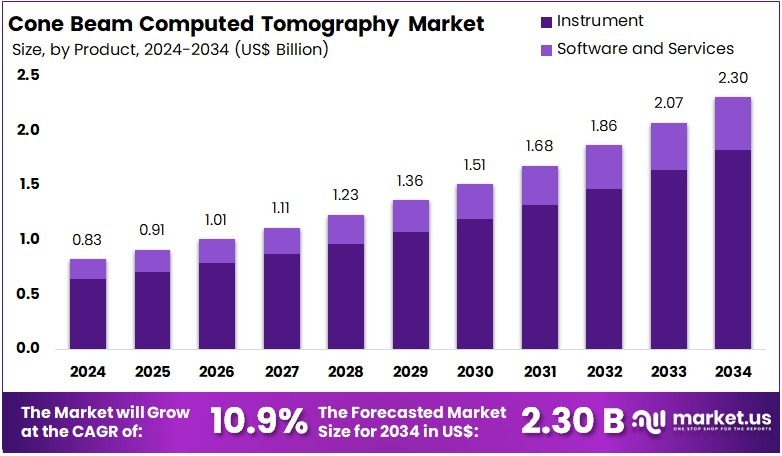
New York, NY – May 05, 2026 – The Global Cone Beam Computed Tomography Market size is expected to be worth around US$ 2,302.15 million by 2034 from US$ 825.39 million in 2024, growing at a CAGR of 10.9% during the forecast period 2025 to 2034.
Cone Beam Computed Tomography (CBCT) is an advanced imaging technology widely used in dental and maxillofacial diagnostics. A three-dimensional (3D) imaging method is provided by CBCT, enabling detailed visualization of bone structures, teeth, nerve pathways, and soft tissues within a single scan. Compared to conventional two-dimensional radiography, improved diagnostic accuracy is achieved, supporting precise treatment planning and clinical decision-making.
A cone-shaped X-ray beam is utilized in CBCT systems, capturing multiple images from different angles during a single rotation around the patient. These images are reconstructed into a 3D dataset using specialized software. As a result, high-resolution images are generated with relatively lower radiation exposure when compared to traditional computed tomography systems.
CBCT technology has been extensively adopted in applications such as dental implant planning, orthodontic assessment, endodontic evaluation, and temporomandibular joint analysis. The ability to detect complex anatomical structures and pathologies has significantly enhanced patient outcomes and procedural efficiency.
The growing demand for minimally invasive procedures and accurate diagnostics has contributed to the increasing adoption of CBCT systems globally. Continuous technological advancements, including improved image quality and reduced scan time, are further supporting market growth. Overall, CBCT is being recognized as a critical tool in modern dental imaging, offering reliable, efficient, and patient-centered diagnostic solutions.
Key Takeaways
- In 2024, the Cone Beam Computed Tomography (CBCT) market generated revenue of US$ 39 million and is projected to grow at a CAGR of 10.9%, reaching US$ 2,302.15 million by 2034.
- By product type, the market is categorized into instruments and software & services. The instrument segment accounted for the largest share, contributing 77.8% of total market revenue in 2024.
- Based on application, the market is segmented into dental imaging, breast imaging, orthopedic imaging, ENT imaging, cardiovascular imaging, and others. Among these, dental imaging emerged as the leading segment, capturing 67.2% of the market share in 2024.
- In terms of end-users, the market is divided into hospitals, dental clinics, orthopedic centers, and ambulatory surgical centers. Dental clinics held the dominant position, representing 46.4% of the total market share in 2024.
- Regionally, North America accounted for the highest revenue contribution, securing a market share of 41.7% in 2024.
Regional Analysis
North America has retained a dominant position in the Cone Beam Computed Tomography (CBCT) market, accounting for 41.7% of total revenue in 2024. This leadership is supported by well-established healthcare infrastructure and strong adoption of advanced imaging technologies across medical and dental applications.
The United States and Canada have demonstrated significant uptake of CBCT systems, driven by continuous investments in healthcare innovation and clinical advancements. The increasing aging population and rising demand for complex dental procedures, including implants and orthodontics, have further accelerated the need for precise 3D imaging solutions.
CBCT systems, offering high-resolution imaging with comparatively lower radiation exposure, have been widely integrated into dental clinics, hospitals, and specialty centers. Public health data indicates a substantial burden of untreated dental conditions, reinforcing the demand for advanced diagnostic tools.
The Asia Pacific region is anticipated to register the fastest growth during the forecast period. Expanding applications beyond dental imaging are contributing to increased adoption. CBCT is being utilized in ENT for sinus and nasal assessments, as well as in orthopedics for detailed evaluation of fractures and joint disorders. Additionally, its role in oncology for tumor localization and radiation therapy planning is gaining recognition, supporting broader regional healthcare advancements.
Emerging Trends
- Better Image Quality with Less Radiation: Advanced CBCT systems deliver higher-resolution images with reduced radiation exposure. Enhanced sensors and optimized protocols improve diagnostic accuracy, enabling earlier detection, precise treatment planning, and improved patient safety standards.
- Integration with AI and Advanced Software: Modern CBCT integrates AI and machine learning for improved image interpretation. Advanced reconstruction reduces noise and artifacts, enabling faster, more accurate diagnoses and supporting clinicians in data-driven, precision-based treatment decisions.
- Expanding Beyond Dentistry: CBCT adoption is expanding into ENT and orthopedics. High-precision 3D imaging supports sinus evaluation, ear diagnostics, fracture assessment, and joint analysis, increasing its value across multiple medical specialties requiring detailed anatomical visualization.
- Portable and Point-of-Care CBCT Systems: Portable CBCT devices enable on-site imaging in clinics and emergency settings. Improved accessibility reduces patient wait times, supports rapid diagnosis in trauma cases, and enhances operational efficiency within decentralized healthcare delivery environments.
- Rising CBCT Adoption in Asia-Pacific: Asia-Pacific CBCT adoption is projected to grow above 20% over five years. Growth is driven by rising healthcare investments, infrastructure development, and increasing awareness of early diagnosis and advanced imaging benefits.
Use Cases
- Dental Implant Planning: CBCT supports 55.9% of implant procedures by enabling 3D evaluation of bone density, structure, and volume. It improves implant placement accuracy, reduces surgical risks, and enhances long-term clinical outcomes.
- Endodontic Assessment: Accounting for 12.9% usage, CBCT enables detailed visualization of root canal anatomy. It detects fractures, hidden canals, and infections, improving diagnostic precision and increasing the success rate of root canal treatments.
- Evaluation of Impacted Teeth: Used in 12.6% of cases, CBCT provides precise 3D positioning of impacted teeth. It supports surgical planning, reduces nerve damage risks, and improves outcomes in extractions and orthodontic repositioning procedures.
- Assessment of Pathological Lesions: CBCT, representing 10.5% usage, enables detailed evaluation of cysts and tumors. It supports accurate diagnosis, surgical planning, and biopsy guidance by clearly defining lesion size, structure, and interaction with tissues.
- Temporomandibular Joint (TMJ) Analysis: CBCT accounts for 7.5% of TMJ diagnostics, providing detailed joint imaging. It supports detection of arthritis, degeneration, and displacement, enabling accurate diagnosis and development of targeted, patient-specific treatment plans.
- Orthodontic Planning: CBCT enhances orthodontic planning by providing 3D visualization of teeth and craniofacial structures. It supports airway analysis, bone assessment, and precise treatment design, improving outcomes for braces and aligner therapies.
- Interventional Radiology Procedures: CBCT supports image-guided interventions such as chemoembolization and embolization procedures. Real-time imaging improves targeting accuracy, enhances procedural safety, and enables effective monitoring of treatment outcomes in minimally invasive therapies.
Frequently Asked Questions on Cone Beam Computed Tomography
- How does CBCT differ from conventional CT scanning?
CBCT differs from conventional CT scanning in terms of beam geometry, scan time, and radiation dose. It provides targeted imaging with faster acquisition and lower exposure levels, making it particularly suitable for dental, orthodontic, and ENT applications requiring detailed anatomical assessment. - What are the primary applications of CBCT in healthcare?
CBCT is widely used in dental implant planning, orthodontics, endodontics, and oral surgery. It is also increasingly adopted in ENT diagnostics and maxillofacial imaging, where precise visualization of bone structures and spatial relationships is essential for clinical decision-making. - What factors are driving the growth of the CBCT market?
Market growth is being driven by increasing demand for advanced dental imaging, rising prevalence of dental disorders, and technological advancements in imaging systems. Additionally, growing awareness among healthcare professionals regarding accurate diagnostics is contributing significantly to market expansion. - Which regions dominate the CBCT market globally?
North America and Europe are leading the CBCT market due to well-established healthcare infrastructure and high adoption of advanced technologies. Meanwhile, Asia-Pacific is emerging as a high-growth region, supported by increasing healthcare investments and expanding dental care services. - Who are the key end-users in the CBCT market?
The primary end-users include dental clinics, hospitals, and diagnostic imaging centers. Dental clinics represent the largest segment due to the widespread use of CBCT in routine dental procedures, particularly for implantology and orthodontic treatment planning. - What technological trends are shaping the CBCT market?
Technological advancements such as integration with digital workflows, artificial intelligence-based image analysis, and portable CBCT systems are shaping the market. These innovations are improving diagnostic accuracy, workflow efficiency, and accessibility across diverse healthcare settings.
Conclusion
The Cone Beam Computed Tomography (CBCT) market is experiencing steady growth, driven by increasing demand for high-precision imaging and minimally invasive diagnostics. Technological advancements, including AI integration, improved image quality, and portable systems, are enhancing clinical efficiency and patient outcomes.
Strong adoption across dental applications, along with expanding use in ENT, orthopedics, and interventional radiology, is broadening its market scope. North America continues to lead, while Asia-Pacific shows significant growth potential due to rising healthcare investments.
Overall, CBCT is positioned as a critical imaging solution, supporting accurate diagnosis, optimized treatment planning, and improved healthcare delivery globally.
Discuss your needs with our analyst
Please share your requirements with more details so our analyst can check if they can solve your problem(s)




