


Overview
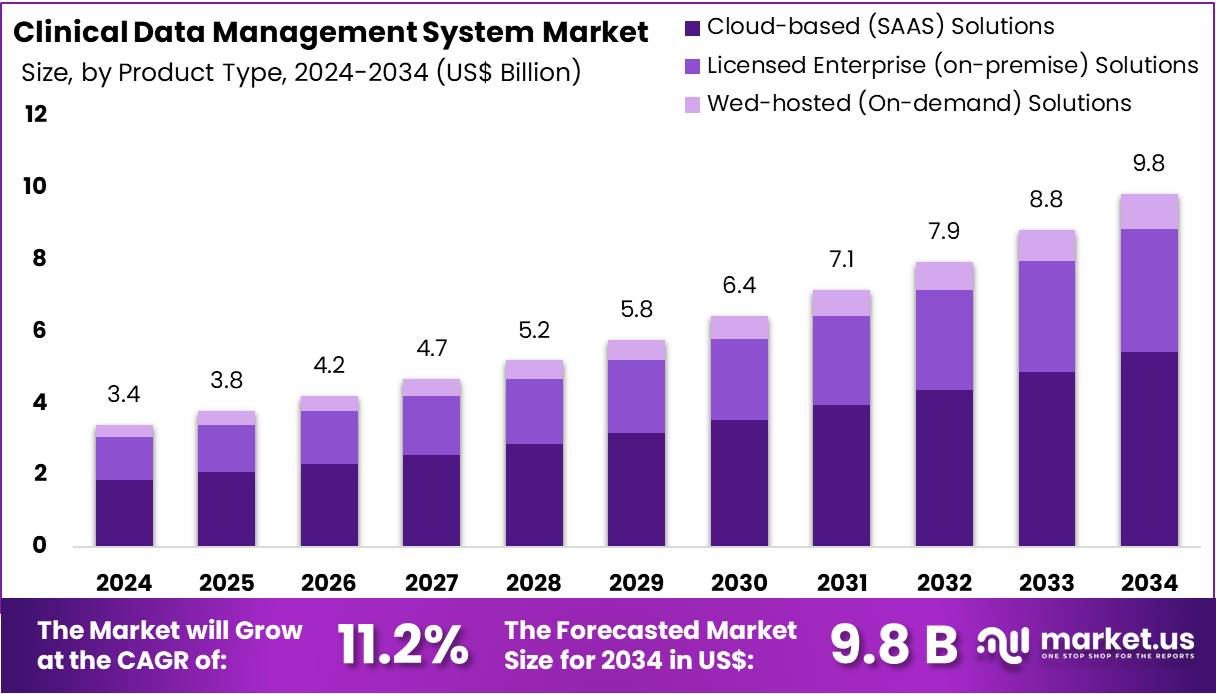
New York, NY – June 10, 2026 – The Global Clinical Data Management System Market size is expected to be worth around US$ 9.8 Billion by 2034, from US$ 3.4 Billion in 2024, growing at a CAGR of 11.2% during the forecast period from 2025 to 2034.
A Clinical Data Management System (CDMS) is a specialized software solution designed to support the collection, validation, storage, and management of clinical trial data in a structured and compliant manner. The system plays a critical role in ensuring data accuracy, integrity, and regulatory compliance throughout the clinical research lifecycle.
The growth of CDMS adoption can be attributed to the increasing complexity of clinical trials, rising volumes of patient data, and stringent regulatory requirements imposed by global health authorities. The system enables centralized data handling, reducing manual errors and improving operational efficiency across research sites.
Key functionalities of a CDMS include electronic data capture, real-time data validation, query management, audit trails, and secure data storage. These capabilities ensure that clinical data is consistently standardized and readily available for analysis and regulatory submission.
The integration of advanced technologies such as cloud computing, artificial intelligence, and machine learning has further enhanced the performance of CDMS platforms. These innovations have enabled predictive data validation, faster discrepancy resolution, and improved decision-making in clinical research processes.
The demand for CDMS solutions is expected to witness steady expansion due to the increasing focus on decentralized clinical trials and the growing emphasis on data-driven drug development. Pharmaceutical companies, contract research organizations, and academic research institutions are increasingly investing in these systems to streamline trial operations.
Overall, CDMS solutions are positioned as a fundamental component of modern clinical research infrastructure, supporting improved data quality, regulatory compliance, and accelerated clinical trial outcomes.
Key Takeaways
- The global Clinical Data Management System market was valued at USD 3.4 billion in 2024 and is projected to reach USD 9.8 billion by 2034, expanding at a CAGR of 11.2%.
- In 2024, the Cloud-based (SaaS) solutions segment dominated the global market, accounting for 55.2% of the total revenue share.
- The Pharma and Biotech Companies segment led the global market in 2024, contributing 44.0% of the overall revenue share.
- North America held the leading position in the global market in 2024, representing more than 48.2% of the total revenue share.
Regional Analysis
North America leads the Clinical Trial Management System (CTMS) market due to the presence of highly advanced research institutions, universities, and leading pharmaceutical and medical device companies. These organizations actively conduct a large number of clinical trials and increasingly rely on CTMS solutions to enhance trial planning, streamline monitoring processes, and ensure compliance with stringent regulatory standards. The region also benefits from a well-established and robust healthcare infrastructure, which provides strong operational support for conducting complex and large-scale clinical studies.
Supportive government initiatives further strengthen the market landscape. In January 2023, the Canadian government introduced multiple healthcare-focused programs, including national training platforms, a clinical trial consortium, and several research initiatives aimed at improving public health outcomes. Approximately USD 60.0 million was allocated to support 22 clinical trial-related projects, with a strong focus on studies aligned with Canada’s Biomanufacturing and Life Sciences Strategy (BLSS). These initiatives highlight a clear emphasis on strengthening domestic clinical research capabilities and accelerating innovation within the life sciences sector.
Such sustained investments, combined with increasing adoption of digital clinical trial technologies, continue to drive demand for CTMS solutions across the region. The strong ecosystem of research funding, technological advancement, and regulatory support ensures that North America maintains its dominant position in the global CTMS market.
Emerging Trends
- Standardized Data Submission Through CDISC Dataset-JSON: In April 2025, the U.S. FDA proposed the adoption of CDISC Dataset-JSON v1.1 as a standardized format for electronic clinical study data submissions to regulatory agencies. This transition is expected to reduce dependence on legacy SAS XPT files, improve data exchange efficiency, and simplify submission workflows for sponsors and regulators.
- Growing Adoption of HL7 FHIR for Real-World Data Integration: The increasing use of HL7 FHIR standards is transforming the integration of real-world clinical data into research systems. By improving interoperability between electronic health records (EHRs) and Clinical Data Management Systems (CDMS), FHIR helps streamline data sharing, reduce data mapping complexities, and support more efficient utilization of real-world evidence.
- Expansion of API-Enabled Clinical Data Connectivity: The launch of the ClinicalTrials.gov FHIR API has accelerated programmatic access to clinical trial information. This development enables CDMS platforms to automatically retrieve and integrate trial registration and results data, enhancing data accessibility, supporting advanced analytics, and improving operational efficiency across research organizations.
Use Cases
- Structured Regulatory Data Submission: Clinical trial sponsors increasingly utilize standardized electronic data formats to support regulatory submissions. The adoption of modern data exchange standards enhances data consistency, facilitates regulatory review processes, and improves the overall efficiency of submitting clinical study datasets to health authorities.
- Automated Clinical Trial Data Integration: Biotechnology companies, pharmaceutical organizations, and academic institutions are leveraging API-based solutions to automatically synchronize trial information from external databases. This approach reduces manual data entry requirements, improves data accuracy, and enables real-time access to updated clinical trial information.
- Remote Collection of Patient-Generated Health Data: Clinical researchers are increasingly incorporating wearable devices and mobile health applications into study protocols to capture patient-generated data remotely. This approach enhances data completeness, improves participant engagement, enables continuous monitoring, and supports decentralized clinical trial models by providing timely and reliable real-world data.
Frequently Asked Questions on Clinical Data Management System
- Why is a Clinical Data Management System important in clinical trials?
A CDMS plays a critical role in maintaining high-quality clinical data by minimizing manual errors, enabling real-time validation, and supporting regulatory requirements. Accurate and reliable data generated through the system helps accelerate drug development and approval processes. - What are the key features of a Clinical Data Management System?
Key features of a CDMS include electronic data capture, data validation, query management, audit trails, reporting tools, and secure database management. These capabilities improve operational efficiency while ensuring the integrity and traceability of clinical trial information. - Who uses Clinical Data Management Systems?
Clinical Data Management Systems are widely used by pharmaceutical companies, biotechnology firms, contract research organizations (CROs), medical device manufacturers, and academic research institutions. These organizations rely on CDMS platforms to efficiently manage and monitor clinical trial data. - How does cloud-based CDMS benefit clinical research organizations?
Cloud-based CDMS solutions provide scalability, remote accessibility, reduced infrastructure costs, and faster implementation. They enable real-time collaboration among stakeholders across multiple locations, improving data visibility and supporting efficient management of decentralized clinical trials. - Which deployment model dominates the Clinical Data Management System market?
Cloud-based Software-as-a-Service (SaaS) solutions dominate the market due to their flexibility, cost efficiency, and ease of deployment. These platforms support real-time data access and collaboration, making them increasingly preferred by clinical research organizations worldwide. - Which end-user segment holds the largest market share?
Pharmaceutical and biotechnology companies represent the largest end-user segment in the Clinical Data Management System market. Their extensive involvement in drug development and clinical research activities generates significant demand for advanced data management and compliance solutions. - Which region leads the Clinical Data Management System market?
North America holds the leading position in the global Clinical Data Management System market. The region benefits from strong clinical research infrastructure, substantial healthcare investments, advanced technology adoption, and supportive government initiatives promoting clinical trial innovation and efficiency. - How is artificial intelligence influencing the Clinical Data Management System market?
Artificial intelligence is enhancing CDMS capabilities by automating data validation, identifying anomalies, and improving data quality management. These technologies help reduce manual workload, accelerate trial timelines, and support more efficient clinical research operations.
Conclusion
The Clinical Data Management System (CDMS) market is experiencing strong growth, driven by increasing clinical trial complexity, rising data volumes, and the growing need for regulatory compliance. The adoption of cloud-based platforms, artificial intelligence, HL7 FHIR standards, and standardized data submission formats is transforming clinical data management processes.
Pharmaceutical and biotechnology companies remain the largest users of CDMS solutions, while North America continues to lead the market due to its advanced research ecosystem and supportive government initiatives. As decentralized trials and real-world data integration gain momentum, CDMS platforms will play an increasingly vital role in improving data quality, operational efficiency, and clinical research outcomes.
Discuss your needs with our analyst
Please share your requirements with more details so our analyst can check if they can solve your problem(s)




