


Overview
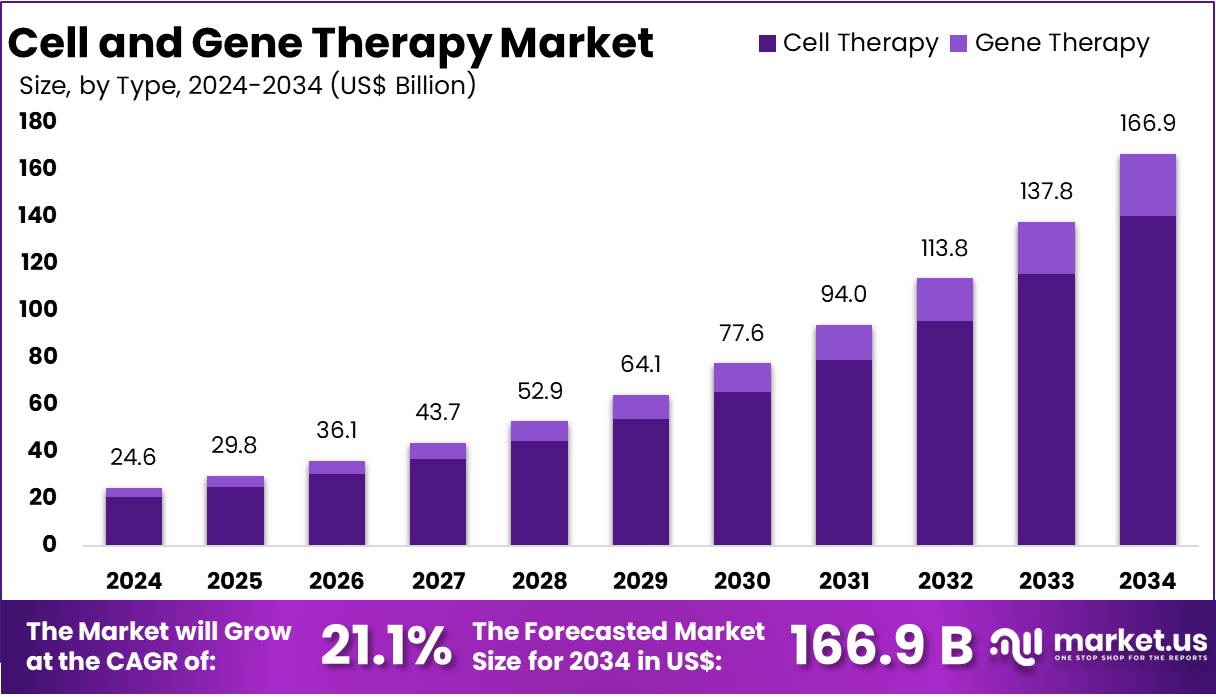
New York, NY – July 15, 2026 – The Cell and Gene Therapy Market Size is forecasted to be valued at US$ 166.9 Billion by 2034 from US$ 24.6 Billion in 2024, growing at a CAGR of 21.1% during the forecast period 2025 to 2034. North America held a dominant market position, capturing more than a 47.8% share and holds US$ 11.8 Billion market value for the year.
Cell and gene therapy is an advanced area of regenerative medicine that focuses on treating or potentially curing diseases by modifying or replacing damaged cells and genes. Cell therapy involves the transplantation of healthy or engineered cells to restore normal function, repair damaged tissues, or strengthen the body’s immune response. Gene therapy, on the other hand, introduces, removes, or modifies genetic material within a patient’s cells to address the underlying cause of inherited and acquired diseases.
These therapies have demonstrated significant potential in the treatment of cancer, rare genetic disorders, autoimmune diseases, cardiovascular conditions, and neurological disorders. Recent advancements in gene-editing technologies, including CRISPR-based approaches, viral vectors, and stem cell research, have accelerated the development of innovative therapeutic solutions. Additionally, increasing investments in biotechnology research, expanding clinical trials, and supportive regulatory initiatives are contributing to the rapid advancement of the cell and gene therapy landscape.
Despite challenges related to manufacturing complexity, high treatment costs, and regulatory requirements, continuous technological innovations and growing healthcare investments are expected to improve accessibility and commercial adoption. As precision medicine continues to evolve, cell and gene therapy is emerging as a transformative healthcare approach that offers the potential for long-term disease management and, in some cases, curative outcomes, creating new opportunities for patients, healthcare providers, and the global biopharmaceutical industry.
Key Takeaways
- The global cell and gene therapy market was valued at US$ 24.6 billion in 2024 and is projected to reach US$ 166.9 billion by 2034, expanding at a CAGR of 21.1% during the forecast period.
- By therapy type, the Cell Therapy segment accounted for the largest market share of 84.1% in 2024.
- Based on indication, the Infectious Diseases segment held a significant revenue share of 27.2% in 2024.
- By delivery method, the In Vivo segment emerged as the leading category, capturing 78.0% of the market revenue in 2024.
- Among end users, Hospitals represented the largest revenue-generating segment, accounting for 35.7% of the global market in 2024.
- North America dominated the global cell and gene therapy market, securing the highest regional market share of 47.8% in 2024.
Regional Analysis
North America Leads the Cell and Gene Therapy Market, While Asia Pacific Emerges as the Fastest-Growing Region
North America accounted for the largest share of the global cell and gene therapy market in 2024, supported by advanced healthcare infrastructure, strong biotechnology capabilities, favorable regulatory policies, and substantial research investments. The United States remains a key innovation hub, with accelerated regulatory pathways, a high concentration of biotechnology companies, and growing adoption of advanced therapies for cancer and rare genetic disorders. Continuous investments in clinical research and specialized treatment facilities further strengthen the region’s market leadership.
Asia Pacific is projected to register the fastest growth during the forecast period, driven by expanding healthcare infrastructure, increasing government support, and rising biotechnology investments across China, Japan, and South Korea. The region is witnessing rapid progress in gene editing, CAR-T cell therapy, and personalized medicine, alongside a growing number of clinical trials and regulatory approvals. Continuous innovation, expanding manufacturing capabilities, and favorable policy initiatives are expected to position Asia Pacific as a major growth engine for the global cell and gene therapy market.
Cell and Gene Therapy Statistics
- During the first quarter of 2024, regulatory authorities in the United States, China, and Canada approved two gene therapies and one cell therapy, reflecting continued regulatory progress in the sector.
- More than 4,000 gene, cell, and RNA therapies are currently under development worldwide, highlighting a strong global innovation pipeline.
- The number of therapies entering Phase I clinical trials increased by 11% in Q1 2024, demonstrating continued expansion of early-stage clinical research.
- Deal-making activity across the cell and gene therapy industry rose by 34% during the first quarter of 2024, indicating increased strategic investment and partnership activity.
- Cell and gene therapy startups secured approximately US$240.1 million in funding during Q1 2024, despite a decline in the overall number of financing transactions.
- By the end of Q1 2024, 32 gene therapies had received global regulatory approval, including two new approvals during the quarter. In addition, 20 RNA therapies and 68 non-genetically modified cell therapies had been approved worldwide.
- Approximately 97% of CAR-T cell therapies in development are focused on treating various forms of cancer, emphasizing the technology’s dominant role in oncology.
- Gene therapies account for 2,093 candidates, representing 52% of the global development pipeline, with more than half targeting oncology indications.
- Around 885 non-genetically modified cell therapies are under development, accounting for 22% of the overall therapeutic pipeline.
- In vivo delivery technologies were utilized in 42% of gene therapies under development during Q1 2024, reflecting growing adoption of advanced delivery platforms.
- Approximately 80% of RNA therapies in development are being designed for non-oncology diseases, demonstrating expanding applications beyond cancer treatment.
- Total financing raised by companies operating in the cell and gene therapy industry increased by 34% quarter-over-quarter during Q1 2024.
- Although startup transactions declined by 33%, the sector still completed 125 financing deals during the first quarter of 2024.
- Among gene therapy clinical trials initiated in Q1 2024, 43% focused on non-oncology indications, while 57% of all newly initiated trials targeted diseases outside oncology.
- The number of therapies progressing to the pre-registration stage declined by 11%, indicating continued challenges in advancing products toward commercialization.
- The largest transaction during Q1 2024 was Novo Nordisk’s acquisition of Cardior Pharmaceuticals, valued at up to €1 billion.
Funding and Clinical Development Statistics
- Nearly 100 funding transactions, representing approximately US$ 3.4 billion in total deal value, were completed during 2023.
- Annual funding deals peaked at 127 transactions in 2021, declined by 24% in 2022, and remained relatively stable at 96 deals in 2023.
- Later-stage venture capital investments increased during 2023, while funding activity across all investment stages remained above levels recorded five years earlier.
- Between 2019 and 2023, 3,285 clinical trials were initiated globally, including 631 new trials in 2023.
- Industry-sponsored studies accounted for 64% of clinical trial initiations in 2023, while non-industry organizations contributed the remaining 36%.
Global Spending Statistics
- Worldwide spending on cell and gene therapies reached US$ 5.9 billion in 2023, reflecting 38% annual growth.
- The market has achieved an average annual spending growth rate of approximately 65% over the past five years.
- The United States accounted for 62% of global spending, while the remaining 38% originated from international markets, reflecting stronger adoption and utilization in the U.S.
Additional Cell and Gene Therapy Statistics
- Global investment in cell and gene therapy research reached approximately US$ 2.3 billion during 2023, reflecting continued public and private sector support.
- More than 2,900 clinical trials involving cell and gene therapies were active worldwide by mid-2024.
- The current development landscape includes approximately 170 gene therapies and 362 cell therapies under active development across multiple therapeutic areas.
- The U.S. FDA has approved 25 cell and gene therapies, including seven new approvals during 2023.
- Leading biotechnology companies invested more than US$ 500 million over the past year to expand manufacturing infrastructure for advanced therapies.
- More than 60% of ongoing research programs focus on oncology and rare genetic diseases.
- Cell and gene therapies demonstrate an estimated 14% success rate from Phase I clinical trials through FDA approval, exceeding the average success rate across the broader pharmaceutical industry.
- More than 5,000 peer-reviewed scientific publications related to cell and gene therapy were published during 2023.
- Venture capital investment in cell and gene therapy startups increased by 30% year-over-year, reaching approximately US$ 1.8 billion in 2023.
- More than 120 strategic partnerships between biotechnology companies and academic institutions were established during 2024 to accelerate research and development.
- Regulatory agencies in over 20 countries introduced updated frameworks to streamline approval pathways for cell and gene therapies.
- Approximately 35,000 patients worldwide received commercially available cell and gene therapies during 2023, nearly doubling patient access compared with the previous year.
- Manufacturing innovations have reduced production timelines for personalized cell therapies from approximately four weeks to seven days.
- Cost-reduction initiatives have lowered the average price of gene therapies by approximately 25% over the past three years.
- More than 50 specialized educational programs dedicated to cell and gene therapy were introduced globally during the past year.
- The number of intellectual property licenses related to cell and gene therapy increased by 40% year-over-year, reflecting expanding commercialization opportunities.
- Public acceptance continues to strengthen, with more than 70% of respondents in 2024 surveys expressing positive attitudes toward cell and gene therapies.
Emerging Trends
- Enhanced Regulatory Scrutiny and Safety Protocols: Regulatory agencies such as the FDA and EMA are strengthening safety oversight for cell and gene therapies, particularly CAR-T treatments, by increasing monitoring of long-term risks, including secondary cancers, resulting in stricter approval requirements and greater emphasis on patient safety.
- Breakthroughs in Gene Editing Technologies: Advances in CRISPR-based gene editing are enabling the approval of therapies for inherited disorders such as sickle cell disease and beta thalassemia, demonstrating the technology’s potential to precisely correct disease-causing mutations and improve long-term treatment outcomes.
- Manufacturing Process Innovations: Manufacturers are increasingly developing allogeneic, off-the-shelf cell therapies that simplify production, reduce manufacturing timelines, improve scalability, lower costs, and expand patient access compared with traditional personalized autologous cell therapy manufacturing approaches.
- Increased Investment in Research and Development: Rising investments in research and development continue to accelerate innovation across the cell and gene therapy industry, supporting a growing pipeline of cell, gene, and nucleic acid therapies targeting diverse diseases and expanding future commercialization opportunities.
- Adoption of Outcome-Based Pricing Models: Healthcare providers, payers, and manufacturers are increasingly adopting outcome-based reimbursement models that link therapy payments to clinical performance, improving affordability, reducing financial risk, and supporting broader patient access to high-cost advanced therapies.
Use Cases
- Oncology Advancements: Cell and gene therapies, particularly CAR-T cell therapies, are transforming cancer treatment by delivering personalized and targeted therapies for blood cancers while expanding into solid tumors, improving treatment effectiveness, minimizing adverse effects, and enhancing long-term patient survival outcomes.
- Treatment of Rare Genetic Disorders: Gene therapies are providing disease-modifying and potentially curative treatments for rare inherited disorders, including Duchenne muscular dystrophy and spinal muscular atrophy, by correcting underlying genetic abnormalities rather than simply managing symptoms through conventional therapies.
- Expanding into Neurodegenerative and Cardiovascular Diseases: Cell and gene therapies are increasingly being evaluated for neurodegenerative and cardiovascular diseases, offering innovative therapeutic strategies that address underlying disease mechanisms and create new treatment possibilities for conditions with limited existing options.
- Applications in Immunological and Inflammatory Diseases: Researchers are expanding the application of cell and gene therapies for autoimmune and inflammatory disorders by developing treatments that precisely regulate immune responses, improve therapeutic effectiveness, reduce adverse effects, and provide longer-lasting disease control.
Frequently Asked Questions on Cell and Gene Therapy
- What is the difference between cell therapy and gene therapy?
Cell therapy involves introducing healthy or modified living cells into a patient’s body to restore normal function, while gene therapy focuses on adding, replacing, or editing genetic material within cells. Both approaches can be used independently or together to improve treatment outcomes for complex diseases. - What is CAR-T cell therapy?
herapy is a specialized form of cell therapy in which a patient’s T cells are genetically modified to recognize and destroy cancer cells. After laboratory modification and expansion, these engineered immune cells are reinfused into the patient to provide targeted cancer treatment. - Are cell and gene therapies safe?
Cell and gene therapies undergo extensive clinical testing and regulatory evaluation before approval to ensure safety and effectiveness. Although they provide significant therapeutic benefits, potential risks such as immune reactions, infections, or unintended genetic changes require careful monitoring and long-term patient follow-up. - Why are cell and gene therapies expensive?
Cell and gene therapies involve highly specialized manufacturing, personalized treatment processes, advanced laboratory technologies, and strict quality control requirements. High research and development investments, regulatory compliance, and individualized production contribute significantly to their overall treatment costs. - What factors are driving the Cell and Gene Therapy Market?
The market is primarily driven by increasing prevalence of genetic disorders, rising cancer incidence, growing investment in biotechnology research, expanding clinical trials, regulatory support for advanced therapies, and continuous technological innovations in gene editing, viral vectors, and cell manufacturing processes. - What are the major applications of the Cell and Gene Therapy Market?
Major applications include oncology, rare genetic diseases, cardiovascular disorders, neurological diseases, autoimmune conditions, ophthalmology, and regenerative medicine. Oncology remains the leading application segment due to growing adoption of CAR-T therapies and expanding cancer-focused clinical research worldwide. - Which region dominates the Cell and Gene Therapy Market?
North America dominates the cell and gene therapy market because of strong healthcare infrastructure, substantial research investments, supportive regulatory frameworks, and the presence of leading biotechnology companies. Europe maintains significant market share, while Asia-Pacific demonstrates the fastest projected growth rate. - What is the outlook for the Cell and Gene Therapy Market?
The cell and gene therapy market is expected to witness sustained growth due to increasing product approvals, expanding clinical pipelines, continuous technological advancements, and rising healthcare investments. Growing awareness of personalized medicine and supportive regulatory initiatives are expected to further strengthen long-term market expansion.
Conclusion
The global cell and gene therapy market is positioned for strong long-term growth, supported by rapid advances in gene editing, cell engineering, and precision medicine. Rising regulatory approvals, expanding clinical trial activity, and increasing investments from biotechnology companies and governments continue to strengthen the industry’s development pipeline.
North America remains the leading market, while Asia Pacific is expected to experience the fastest expansion due to improving healthcare infrastructure and innovation. Although manufacturing complexity, high treatment costs, and regulatory challenges remain, ongoing technological advancements and scalable production methods are expected to improve accessibility, accelerate commercialization, and establish cell and gene therapies as transformative treatment options.
Discuss your needs with our analyst
Please share your requirements with more details so our analyst can check if they can solve your problem(s)




