


Overview
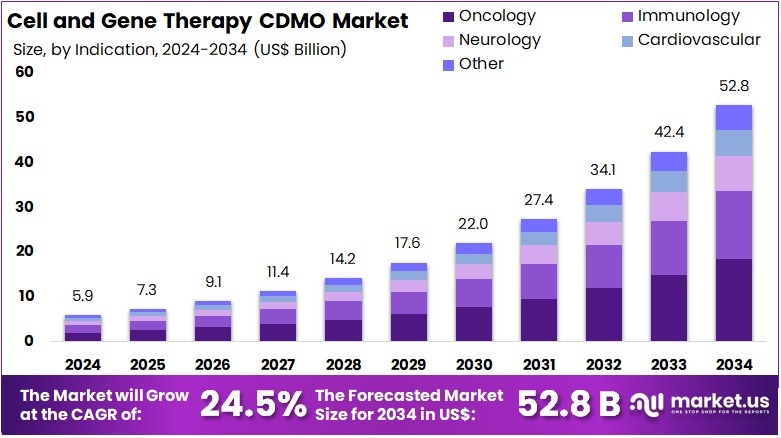
New York, NY – June 04, 2026 – The Global Cell and Gene Therapy CDMO Market Size is expected to be worth around US$ 52.8 Billion by 2034, from US$ 5.9 Billion in 2024, growing at a CAGR of 24.5% during the forecast period from 2025 to 2034. North America held a dominant market position, capturing more than a 43.2% share and holds US$ 2.5 Billion market value for the year.
Cell and Gene Therapy Contract Development and Manufacturing Organizations (CDMOs) play a critical role in advancing the commercialization of innovative therapies designed to treat complex and rare diseases. These specialized organizations provide end-to-end services, including process development, analytical testing, clinical and commercial manufacturing, regulatory support, and supply chain management for cell and gene therapy products.
The growing demand for personalized medicine, increasing investments in biotechnology, and a robust pipeline of cell and gene therapy candidates have significantly accelerated the need for specialized manufacturing capabilities. CDMOs enable biotechnology and pharmaceutical companies to streamline development timelines, reduce capital expenditures, and access advanced technologies and expertise required for the production of highly complex therapies.
Cell therapy manufacturing involves the processing, expansion, and preservation of living cells, while gene therapy manufacturing focuses on the delivery of genetic material using viral and non-viral vectors. Due to stringent quality requirements and regulatory standards, specialized infrastructure and technical expertise are essential throughout the development and manufacturing process.
The global Cell and Gene Therapy CDMO market continues to expand as regulatory approvals increase and clinical trial activity rises worldwide. Technological advancements in automation, bioprocessing, and manufacturing scalability are further supporting market growth. As the industry evolves, CDMOs are expected to remain strategic partners, helping developers bring life-changing therapies to patients more efficiently and cost-effectively.
Key Takeaways
- The global Cell and Gene Therapy CDMO market is projected to increase from US$ 5.9 billion in 2024 to US$ 52.8 billion by 2034.
- The market is anticipated to register a CAGR of 24.5% during the forecast period from 2025 to 2034.
- Cell Therapy dominated the product segment in 2024, capturing a market share of more than 45.8%.
- Oncology remained the largest application area, accounting for over 45.8% of the overall market revenue in 2024.
- North America held the leading position in 2024, representing more than 43.2% of the global market and generating approximately US$ 2.5 billion in revenue.
Regional Analysis
North America dominated the Cell and Gene Therapy CDMO market in 2024, accounting for more than 43.2% of the global market and generating approximately US$ 2.5 billion in revenue. The region’s leadership is supported by a well-established biopharmaceutical industry, advanced manufacturing infrastructure, and a highly skilled workforce. Strong regulatory frameworks and streamlined approval pathways for advanced therapies have further enhanced its position as a preferred destination for cell and gene therapy manufacturing services.
The United States remains the primary growth driver within the region. Favorable regulatory support, increasing investments in rare disease research, and substantial funding for advanced therapeutics have accelerated market expansion. Biopharmaceutical companies increasingly rely on CDMOs to manage complex manufacturing processes, scale production efficiently, and ensure regulatory compliance, contributing to rising outsourcing demand.
Collaboration between academic institutions, research centers, and CDMOs continues to strengthen the regional ecosystem. These partnerships facilitate innovation, accelerate clinical development, and support GMP-compliant manufacturing of emerging therapies. In response to growing demand, many CDMOs have expanded production capacity and invested in advanced technologies.
Canada is also contributing significantly to regional growth through supportive government initiatives, research funding, and tax incentives for life sciences innovation. The emergence of new biotechnology companies and increasing contract manufacturing activities have further reinforced North America’s leading position in the global market.
Emerging Trends
- Rising Demand for End-to-End Manufacturing Services: Biotech companies increasingly prefer CDMOs that provide complete services from research through commercial manufacturing. This integrated approach simplifies project management, reduces costs, minimizes technology transfer risks, prevents delays, and accelerates product launches, making development more efficient for complex therapies.
- Growing Investment in Viral Vector Manufacturing: The increasing adoption of gene therapies is driving substantial investments in viral vector manufacturing. CDMOs are expanding facilities, implementing advanced bioprocessing technologies, and strengthening technical expertise to meet rising clinical and commercial demand while ensuring a reliable supply chain.
- Shift Toward Modular and Flexible Facilities: CDMOs are adopting modular and flexible manufacturing facilities to improve responsiveness and efficiency. These systems allow rapid adaptation to different therapy types, support personalized medicine production, enable easier scaling, and provide cost-effective solutions for evolving biotechnology requirements.
- Surge in Partnerships and Mergers: Strategic partnerships, mergers, and acquisitions are becoming increasingly common within the CDMO sector. These collaborations expand service portfolios, strengthen technological capabilities, enhance global reach, facilitate knowledge sharing, and improve the ability to address complex manufacturing and regulatory challenges.
- Embracing Automation and Digital Tools: Automation, artificial intelligence, and digital technologies are transforming CDMO operations. These tools improve process control, reduce human error, enhance manufacturing consistency, enable real-time monitoring, support data-driven decision-making, and increase overall production efficiency for advanced therapies.
- Stronger Focus on Regulatory Compliance: CDMOs are strengthening regulatory and quality management capabilities to meet strict global standards. Investments in workforce training, digital documentation systems, compliance programs, and quality assurance processes help clients avoid delays while maintaining product safety and regulatory readiness.
- Expansion into Emerging Regions: CDMOs are expanding operations into emerging markets such as Asia-Pacific and Latin America. This strategy provides access to growing patient populations, skilled talent, and cost-effective manufacturing capabilities while helping biotechnology companies overcome regional regulatory and logistical challenges.
Use Cases
- Manufacturing Personalized Cancer Treatments: CDMOs support the production of personalized cancer therapies such as CAR-T treatments by managing cell collection, modification, processing, and quality control. Their expertise ensures timely manufacturing, regulatory compliance, and reliable delivery, helping patients gain faster access to advanced therapies.
- Production of Gene Therapies for Rare Diseases: CDMOs assist in developing and manufacturing gene therapies for rare genetic disorders. They produce viral vectors, maintain regulatory compliance, and ensure product quality, enabling biotechnology companies to focus on innovation while accelerating treatment availability for underserved patient populations.
- Scaling Up Clinical Trial Materials: CDMOs manufacture clinical trial materials that meet stringent safety and quality requirements. Their expertise in small-batch production, GMP compliance, documentation, and process flexibility enables biotechnology companies to support clinical studies efficiently and reduce development timelines.
- Cryopreservation and Logistics Support: CDMOs provide cryopreservation services and cold-chain logistics for sensitive cell therapies. Advanced storage technologies, temperature-controlled transportation, and continuous monitoring ensure product integrity, reduce transportation risks, and enable safe delivery of therapies from manufacturing facilities to treatment centers.
- Process Development and Optimization: CDMOs improve manufacturing processes by refining production workflows, increasing efficiency, and reducing costs. Through process optimization, scalability assessments, and regulatory alignment, they help biotechnology companies achieve reliable, high-quality production while accelerating the path toward commercialization.
- Quality Testing and Regulatory Support: CDMOs conduct comprehensive quality testing to verify product purity, potency, and safety. They also provide regulatory support through documentation, audit preparation, and compliance management, helping biotechnology companies navigate approval processes and maintain consistent manufacturing standards.
- Technology Transfer from Lab to Commercial Scale: CDMOs facilitate technology transfer by converting laboratory processes into scalable commercial manufacturing operations. They document procedures, validate production methods, manage risks, and ensure consistent quality, enabling biotechnology companies to expand production efficiently and launch therapies successfully.
Frequently Asked Questions on Cell and Gene Therapy CDMO
- Why are CDMOs important in the cell and gene therapy industry?
CDMOs play a critical role by offering advanced manufacturing infrastructure, technical expertise, and regulatory support that many therapy developers lack internally. Their services reduce development timelines, lower capital investment requirements, and enable companies to focus on research, clinical development, and product commercialization. - What services are typically offered by Cell and Gene Therapy CDMOs?
Cell and gene therapy CDMOs provide a wide range of services including process development, analytical testing, vector manufacturing, cell processing, fill-finish operations, quality control, and regulatory support. These integrated services help ensure efficient development and manufacturing across the entire product lifecycle. - Which types of therapies are commonly manufactured by Cell and Gene Therapy CDMOs?
CDMOs commonly manufacture therapies such as CAR-T cell therapies, stem cell therapies, gene-modified cell therapies, viral vector-based treatments, and gene replacement therapies. The growing diversity of therapeutic approaches has increased demand for specialized manufacturing expertise and production platforms. - How does outsourcing benefit cell and gene therapy developers?
Outsourcing to CDMOs allows therapy developers to access specialized facilities, experienced personnel, and advanced technologies without significant capital expenditures. This approach improves operational efficiency, reduces manufacturing risks, and supports faster progression from clinical development to commercial production. - Which regions are leading the Cell and Gene Therapy CDMO Market?
North America currently leads the market due to strong biotechnology investments, advanced healthcare infrastructure, and a high concentration of therapy developers. Europe also represents a significant market, while Asia-Pacific is experiencing rapid growth driven by expanding biopharmaceutical capabilities and supportive government initiatives. - What role do viral vectors play in the Cell and Gene Therapy CDMO Market?
Viral vectors serve as critical delivery systems for many gene therapies by enabling the transfer of genetic material into target cells. The increasing demand for viral vector production has created substantial opportunities for CDMOs specializing in vector development, manufacturing, and quality testing services. - What trends are shaping the future of the Cell and Gene Therapy CDMO Market?
Key market trends include the adoption of automation technologies, expansion of manufacturing capacities, increasing strategic partnerships, and growing use of advanced gene-editing platforms. These developments are enhancing production efficiency and supporting the commercialization of innovative therapies worldwide. - What is the future outlook for the Cell and Gene Therapy CDMO Market?
The market is expected to witness strong growth over the coming years, supported by a robust clinical pipeline, increasing therapy approvals, and rising outsourcing activities. Continued technological innovation and investments in manufacturing infrastructure are anticipated to create significant long-term opportunities for CDMOs.
Conclusion
The Cell and Gene Therapy CDMO market is positioned for substantial growth, driven by increasing demand for advanced therapies, expanding clinical pipelines, and rising outsourcing activities across the biotechnology and pharmaceutical sectors. CDMOs have become essential partners by providing specialized manufacturing expertise, regulatory support, and scalable production capabilities that accelerate therapy development and commercialization.
Technological advancements, growing investments in viral vector manufacturing, and the adoption of automation are further strengthening market expansion. As personalized medicine and gene-based treatments gain wider acceptance, CDMOs are expected to play an increasingly strategic role in delivering innovative, safe, and cost-effective therapies to patients worldwide.
Discuss your needs with our analyst
Please share your requirements with more details so our analyst can check if they can solve your problem(s)




