


Overview
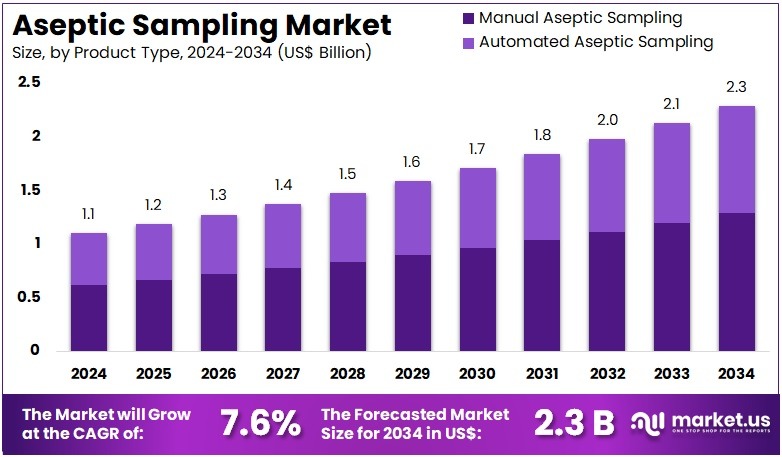
New York, NY – June 03, 2026 –The Aseptic Sampling Market Size is expected to be worth around US$ 2.3 billion by 2034 from US$ 1.1 billion in 2024, growing at a CAGR of 7.6% during the forecast period 2025 to 2034. North America held a dominant market position, capturing more than a 38.4% share and holds US$ 0.4 Billion market value for the year.
Aseptic sampling is a critical process used across pharmaceutical, biotechnology, food, beverage, and healthcare industries to obtain representative samples from sterile environments without introducing contamination. The technique plays an essential role in quality control, process monitoring, product validation, and regulatory compliance, helping manufacturers maintain product integrity and ensure consumer safety.
The growing emphasis on sterile manufacturing practices and stringent regulatory requirements has increased the adoption of advanced aseptic sampling solutions worldwide. These systems are designed to enable safe and reliable sample collection from bioreactors, fermentation vessels, storage tanks, and processing lines while minimizing the risk of microbial ingress. Modern aseptic sampling technologies support both manual and automated operations, improving operational efficiency and reducing human intervention.
In the pharmaceutical and biopharmaceutical sectors, aseptic sampling is widely utilized during drug development, vaccine production, and biologics manufacturing to monitor critical process parameters and ensure product quality throughout production cycles. Similarly, the food and beverage industry relies on aseptic sampling to verify product safety and maintain compliance with hygiene standards.
Technological advancements, including single-use sampling systems and automated sampling devices, are further enhancing process reliability and reducing contamination risks. As industries continue to prioritize product safety, operational efficiency, and regulatory adherence, aseptic sampling remains a fundamental component of sterile manufacturing processes, supporting consistent product quality and strengthening confidence across global supply chains.
Key Takeaways
- The global aseptic sampling market was valued at US$ 1.1 billion in 2024 and is projected to reach US$ 2.3 billion by 2034, expanding at a CAGR of 7.6% during the forecast period.
- Based on product type, the market is categorized into manual aseptic sampling and automated aseptic sampling. Manual aseptic sampling dominated the market in 2024, accounting for a 56.3% revenue share.
- By technology, the market is segmented into off-line sampling technique, in-line sampling technique, and on-line sampling technique. The in-line sampling technique segment held the largest market share of 51.4% in 2024.
- In terms of application, the market is divided into upstream processing and downstream processing. The downstream processing segment emerged as the leading category, capturing 58.5% of the total market revenue in 2024.
- Based on end user, the market is segmented into pharmaceutical & biotechnology companies, CMOs & CROs, and others. Pharmaceutical & biotechnology companies represented the largest segment, contributing 60.2% of the market revenue in 2024.
- North America remained the leading regional market, accounting for a 38.4% share of the global aseptic sampling market in 2024.
Regional Analysis
North America accounted for the largest share of the aseptic sampling market in 2024, driven by stringent regulatory requirements governing sterile pharmaceutical manufacturing. Regulatory agencies across the region continue to strengthen standards related to product sterility, contamination control, and quality assurance, encouraging the adoption of advanced aseptic sampling technologies.
The strong presence of pharmaceutical and biotechnology manufacturers, coupled with ongoing investments in biologics and sterile drug production, further supports market growth. Additionally, the increasing focus on compliance with current good manufacturing practices and enhanced environmental monitoring requirements has accelerated the implementation of reliable sterile sampling systems throughout the region.
Asia Pacific is anticipated to register the fastest growth rate during the forecast period. The expansion of pharmaceutical manufacturing capabilities, rising investments in biotechnology, and increasing production of vaccines and sterile drugs are creating substantial demand for aseptic sampling solutions. Governments and regulatory authorities across countries such as China and India are continuously strengthening pharmaceutical quality standards and aligning local regulations with international guidelines.
These developments are increasing the need for effective contamination control and process monitoring throughout manufacturing operations. Furthermore, the growing presence of contract manufacturing organizations, expanding healthcare infrastructure, and rising focus on product quality and safety are expected to drive the adoption of advanced aseptic sampling technologies across the Asia Pacific region.
Emerging Trends
- Shift Toward Single-Use Sampling Devices: Manufacturers are increasingly adopting single-use aseptic sampling devices to minimize contamination risks. These disposable systems eliminate cleaning requirements, reduce downtime, support faster production changes, improve compliance with GMP standards, and enhance operational efficiency in pharmaceutical and biotechnology manufacturing environments.
- Growing Use of Automation: Automation is gaining importance in aseptic sampling systems by reducing human intervention and sampling errors. Automated solutions provide consistent results, improve process control, enhance contamination prevention, lower labor requirements, and support efficient large-scale pharmaceutical and biotechnology production operations.
- Stricter Regulatory Focus on Sterility: Regulatory agencies are enforcing stricter sterility and GMP requirements for pharmaceutical manufacturing. This has increased demand for advanced aseptic sampling technologies that improve contamination control, ensure product quality, maintain regulatory compliance, and support safe production of sterile products.
- Integration with Digital Monitoring Systems: Modern aseptic sampling systems increasingly incorporate digital monitoring capabilities. These technologies enable real-time tracking of sampling activities, improve traceability, support audit documentation, accelerate quality analysis, enhance process visibility, and align manufacturing operations with Industry 4.0 objectives.
- Rising Demand from Biologics and Cell Therapy Industries: The expansion of biologics and cell therapy production is increasing demand for highly sterile sampling solutions. Manufacturers require precise, contamination-free systems that operate within cleanrooms, meet regulatory standards, and ensure product integrity throughout sensitive production processes.
- Sustainability and Eco-Friendly Design: Environmental sustainability is influencing aseptic sampling device development. Manufacturers are exploring recyclable materials, waste reduction strategies, and energy-efficient production methods. These initiatives help lower environmental impact while maintaining sterility requirements and supporting sustainability goals across pharmaceutical operations.
- Customized Sampling Solutions: Demand for customized aseptic sampling systems is growing as production processes become more specialized. Modular and tailored solutions improve compatibility with unique equipment configurations, enhance sampling accuracy, simplify operations, reduce errors, and support complex manufacturing requirements effectively.
Use Cases
- Pharmaceutical Manufacturing: Aseptic sampling is widely used in pharmaceutical production to collect sterile samples during manufacturing. It helps detect contamination, verify product quality, maintain regulatory compliance, prevent batch losses, reduce recall risks, and ensure the safety and effectiveness of final products.
- Biotechnology Labs: Biotechnology laboratories use aseptic sampling to monitor cell cultures and microbial growth processes. Sterile sample collection prevents contamination, supports accurate process monitoring, improves production efficiency, reduces batch failure risks, and ensures reliable development of biological products.
- Food and Beverage Industry: Aseptic sampling supports food and beverage quality control by enabling sterile testing during production. It helps identify microbial contamination, maintain hygiene standards, comply with food safety regulations, protect product quality, and strengthen consumer confidence in finished products.
- Water and Environmental Testing: Aseptic sampling is essential for monitoring purified water systems in laboratories and pharmaceutical facilities. It enables accurate microbial testing, supports GMP compliance, maintains water quality standards, prevents contamination issues, and ensures safe operation of critical production processes.
- Fermentation Monitoring: Industries using fermentation processes rely on aseptic sampling to monitor microbial activity, pH, and other critical parameters. Sterile sampling preserves batch integrity, improves process control, ensures consistent product quality, reduces waste, and supports efficient fermentation operations.
- Cleanroom and Sterile Facility Monitoring: Aseptic sampling is used in cleanrooms to evaluate air, surfaces, and equipment for contamination. Regular monitoring helps maintain sterile conditions, detect contamination early, support regulatory compliance, protect sensitive manufacturing operations, and ensure high-quality production outcomes.
- Research and Development (R&D): Research and development teams use aseptic sampling to evaluate compounds, monitor reactions, and assess product stability under sterile conditions. This approach ensures data accuracy, protects experimental integrity, minimizes contamination risks, and supports innovation in advanced therapeutic development.
Frequently Asked Questions on Aseptic Sampling
- Why is aseptic sampling important in pharmaceutical manufacturing?
Aseptic sampling helps ensure that products remain sterile throughout production and testing processes. It minimizes contamination risks, supports regulatory compliance, and provides accurate quality control data, which is essential for maintaining product safety, efficacy, and consistency. - What industries commonly use aseptic sampling systems?
Aseptic sampling systems are extensively used in pharmaceutical manufacturing, biotechnology production, food and beverage processing, chemical manufacturing, and research laboratories. These industries rely on contamination-free sample collection to meet quality standards and regulatory requirements. - How does aseptic sampling support regulatory compliance?
Aseptic sampling supports compliance with regulations established by health authorities by ensuring sample integrity and traceability. Proper sampling procedures help manufacturers meet quality assurance requirements, maintain documentation standards, and demonstrate adherence to Good Manufacturing Practices (GMP). - What are the benefits of single-use aseptic sampling systems?
Single-use aseptic sampling systems reduce cleaning and sterilization requirements, minimize cross-contamination risks, and improve operational efficiency. They also support flexible manufacturing environments and help lower maintenance costs associated with reusable sampling equipment. - How is aseptic sampling used in biopharmaceutical production?
In biopharmaceutical production, aseptic sampling enables the collection of process samples from bioreactors, fermentation systems, and storage vessels. The collected samples are analyzed to monitor product quality, process performance, and microbial contamination throughout manufacturing operations. - How is aseptic sampling expected to evolve in the future?
Future developments in aseptic sampling are expected to focus on automation, digital monitoring, single-use technologies, and integrated process analytical solutions. These advancements will help improve operational efficiency, regulatory compliance, and contamination control across industries. - Which region leads the global aseptic sampling market?
North America holds a significant market share due to its strong pharmaceutical and biotechnology sectors, advanced manufacturing infrastructure, and stringent regulatory framework. Europe also represents a major market, while Asia-Pacific is experiencing rapid growth and investment. - What role do single-use technologies play in market growth?
Single-use technologies are transforming the aseptic sampling market by improving flexibility, reducing operational complexity, and minimizing contamination risks. Their widespread adoption in biopharmaceutical manufacturing is creating substantial opportunities for equipment manufacturers and solution providers.
Conclusion
The aseptic sampling market is experiencing steady growth, supported by increasing regulatory requirements, expanding pharmaceutical and biotechnology production, and rising emphasis on contamination control. The adoption of advanced technologies, including single-use systems, automation, and digital monitoring solutions, is enhancing sampling accuracy, operational efficiency, and product safety.
Growing demand from biologics, cell therapy, and sterile manufacturing applications continues to create significant opportunities for market participants. While North America remains the leading market, Asia Pacific is emerging as a high-growth region due to expanding manufacturing capabilities and regulatory advancements. Overall, aseptic sampling remains essential for ensuring product quality, compliance, and manufacturing reliability.
Discuss your needs with our analyst
Please share your requirements with more details so our analyst can check if they can solve your problem(s)




